
To qualify for a Certificate of Good Standing and order through Form My Company, your UK company must maintain up-to-date Companies House filings, submit annual confirmation statements, pay statutory fee liabilities, and retain active director appointments.
How Does a Certificate of Good Standing Verify Corporate Legitimacy?
A Certificate of Good Standing proves that a registered UK limited company maintains active legal status, compliant corporate records, and continuous registration with Companies House while satisfying statutory filing duties under the Companies Act 2006.
Companies House issues official documentation to confirm that a corporate entity operates without pending strike-off actions. Financial institutions request this document before opening business bank accounts. Foreign governments require authentication when UK companies establish overseas branches. Corporate buyers evaluate official registry records during commercial acquisition negotiations.
Regulatory frameworks require transparent reporting from all active business entities. Registrars review annual confirmation statements, statutory financial accounts, and registered office addresses before issuing verification documents. Entities failing to satisfy reporting standards lose official compliance status immediately. Maintaining accurate public registers prevents legal complications and protects commercial operations.
Companies House verifies internal filings against statutory compliance metrics. Verification checks confirm active director appointments and legal shareholder records. Registered corporate entities must clear all outstanding public filings to obtain official certification. Third-party vendors rely on these verified registry records to confirm legitimate corporate identity during international transactions.
Establishing verified regulatory compliance allows companies to pursue global expansion opportunities. Lenders examine public registry status to assess corporate creditworthiness and legal liability risks. Submitting mandatory filings on time ensures smooth verification processing. You can order a Certificate of Good Standing to secure official proof of your company’s active status.
What Compliance Requirements Allow a UK Company to Achieve Good Standing Status?
A UK company achieves Good Standing status by submitting annual confirmation statements on time, filing statutory financial accounts, maintaining at least one natural person director, and operating an active registered office address within its jurisdiction.
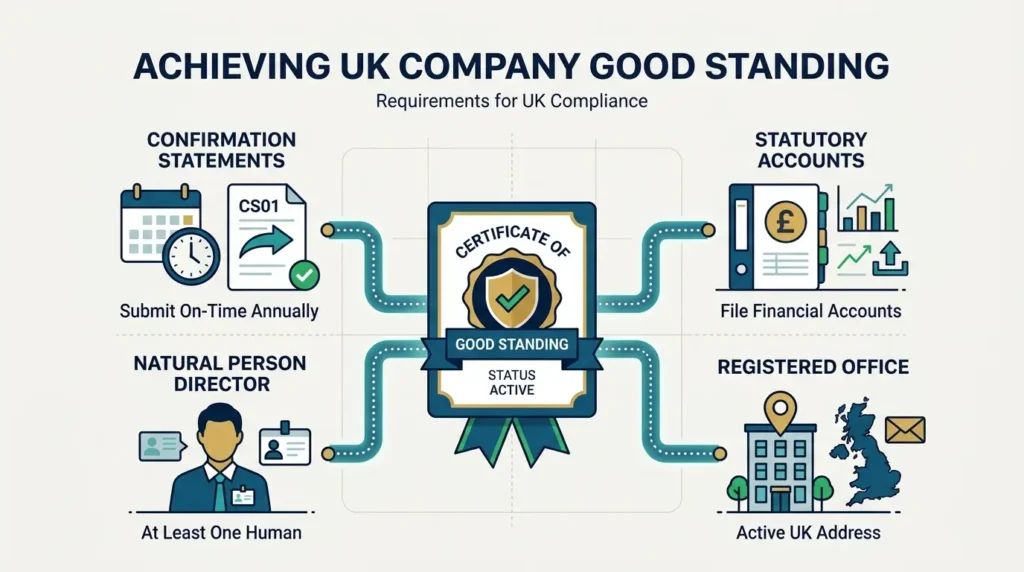
Companies House enforces strict filing schedules for all incorporated business entities. Directors submit confirmation statements every 12 months to verify corporate structure details. Financial accounts must reflect accurate balance sheets, profit metrics, and director reports. Missing filing deadlines triggers automatic financial penalties and jeopardises official corporate status.
UK corporate governance rules demand accurate director and shareholder disclosures. Every company must retain at least one individual director who is 16 years of age or older. Companies House records must reflect current residential addresses and service locations for all officers. Any unrecorded management change creates immediate compliance discrepancies on public registers.
Companies must maintain a physical registered office address within their incorporation jurisdiction. Official government bodies send statutory correspondence and legal notices to this designated location. PO Box addresses without physical verification fail statutory compliance checks. Operating a verified registered office preserves administrative alignment with Companies House standards.
Understanding mandatory corporate obligations ensures uninterrupted commercial operations across UK jurisdictions. Corporate entities must systematically clear administrative hurdles before requesting official registry documents. Directors can review how to get your company compliant enough to qualify for Good Standing to resolve statutory record discrepancies before submitting formal applications.
What Corporate Filings Must Be Submitted to Avoid Registry Penalties?
Companies must submit annual accounts, confirmation statements, Persons with Significant Control registers, and notification of officer changes to avoid Companies House penalties and administrative dissolved status.
Annual accounts present a formal summary of corporate financial activities during each accounting period. Micro-entities, small businesses, and large corporations submit tailored balance sheets matching specific UK accounting standards. Late account submissions trigger immediate financial fines starting at £150 for private companies. Continued non-compliance leads to compulsory strike-off proceedings by the registrar.
The Confirmation Statement form CS01 updates statutory records regarding company ownership and capital structure. Directors verify share capital allocations, shareholder names, and primary business activity codes. Submitting false information or ignoring annual filing deadlines constitutes a criminal offence under UK company law. Active management preserves clean corporate records through routine annual updates.
Maintaining accurate Persons with Significant Control registers remains a strict legal mandate. Companies identify individuals holding over 25% of voting rights or share ownership. Registrars require immediate updates when corporate beneficial ownership structures undergo changes. Transparent ownership records protect corporate entities from regulatory scrutiny and anti-money laundering investigations.
Updating Companies House records prevents administrative delays when requesting official registry documentation. Corporate officers file statutory forms within 14 days of management restructuring. Timely notifications protect public registers from outdated operational details. Clean filings build institutional credibility across banking, legal, and commercial sectors.
How Does Form My Company Help Qualify and Order Your Document?
Form My Company checks public registry filings, resolves corporate record discrepancies, reviews administrative standing, and submits official registry orders directly to Companies House for fast document delivery.
Navigating registry requirements requires precise administrative checks and regulatory alignment. Compliance experts audit public records to identify overdue confirmation statements or missing financial accounts. Resolving filing gaps prior to document submission prevents order rejections by Companies House. Form My Company streamlines corporate verification processes for active UK entities.
Official verification applications require exact alignment with statutory registry data. Errors in company names, registration numbers, or officer details delay document issuance. Form My Company cross-references internal corporate data against live Companies House registers. Precise submission management guarantees rapid verification without unnecessary administrative friction.
Corporate entities frequently require legal authentication for international commercial activities. Foreign authorities demand Hague Apostille certification or consular legalisation alongside standard registry documents. Form My Company manages secondary legalisation workflows for cross-border commercial expansions. Integrated ordering systems handle document retrieval, legal authentication, and international delivery.
Securing official proof of compliance allows business owners to execute time-sensitive transactions. Professional filing agents reduce processing delays through direct electronic communication channels with Companies House. Business owners can get help qualifying for Good Standing and order from Form My Company to obtain official corporate documentation quickly and efficiently.
What Issues Cause a Company to Lose Good Standing Status?
A company loses Good Standing status by missing account filing deadlines, failing to submit confirmation statements, operating without active directors, or facing legal compulsory strike-off action from Companies House.
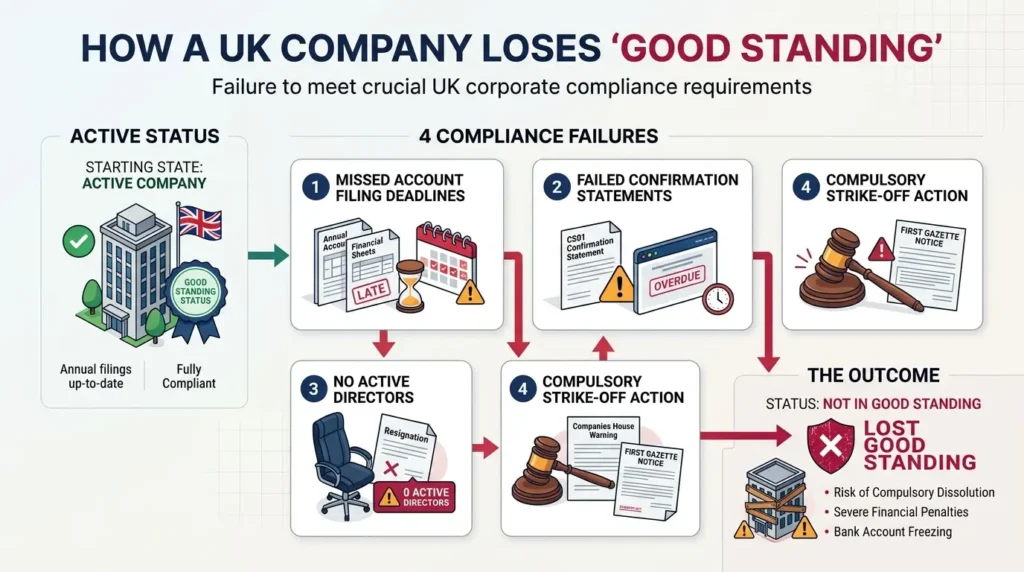
Failing to submit mandatory financial statements breaks statutory compliance obligations under UK law. Companies House flags accounts as overdue immediately after the nine-month filing deadline passes. Registrars freeze official certification services for non-compliant business entities. Unresolved financial reporting failures trigger administrative strike-off notices published in the London Gazette.
Operating without eligible active corporate officers invalidates statutory legal standing. UK legislation mandates at least one natural person acting as a registered director. Resignations that leave a company without active individual leadership create immediate regulatory non-compliance. Companies House suspends official document services until valid director appointments are registered on public records.
Failing to maintain a valid registered office address causes critical communication failures with government agencies. Statutory notices returned undelivered prompt legal investigations into corporate operational viability. Registrars initiate compulsory dissolution when companies fail to maintain verified physical contact addresses. Restoring valid address details is mandatory before re-establishing legal standing.
Resolving public filing defaults requires immediate administrative intervention and statutory fee payments. Directors must submit all outstanding financial accounts and corporate updates simultaneously. Clearing administrative flags restores normal operational status on official registries. Professional support helps businesses fix compliance breaches before severe legal consequences occur.
How Long Does It Take to Receive an Official Certificate?
Standard electronic processing takes three to five working days, while expedited same-day registry services issue official digitally signed certificates within 24 hours of application approval.
Processing timelines depend on chosen registry service levels and current administrative workloads. Standard electronic submissions undergo routine verification by Companies House officers within 72 hours. Digital certificates arrive via secure email immediately upon official approval. Physical paper copies require additional postal delivery time depending on destination locations.
Expedited processing channels accelerate document issuance for urgent commercial requirements. Emergency legal requests, banking applications, and contract deadlines require rapid document turnaround times. Same-day registry services prioritize application review before daily administrative cutoff hours. Submitting error-free data ensures immediate processing without manual review delays.
International delivery timelines vary based on required legalisation services and courier options. Adding Hague Apostille certification extends standard processing timelines by three to five additional business days. Consular legalisation workflows require separate submissions to foreign embassy offices. Selecting integrated processing services streamlines multi-stage document authentication pipelines.
Planning regulatory document orders prevents delays in executing critical business operations. Understanding official registry processing windows allows corporate officers to align documentation requests with external deal deadlines. Modern digital workflows provide real-time tracking from initial application submission to final document delivery.
Explore More Certificate of Good Standing Guide,
Request a Certificate of Good Standing After Compliance Check With Form My Company
Get Your Filings Sorted and Certificate Issued by Form My Company
Frequently Asked Questions
What is a UK Certificate of Good Standing?
A UK Certificate of Good Standing is an official Companies House document that confirms a limited company is active, compliant, and up to date with all statutory filings. It verifies that no action is currently being taken to strike off or dissolve the corporate entity. Businesses can request this document through Form My Company to prove corporate legitimacy to banks, investors, and foreign registries.
How do you get a Certificate of Good Standing for a UK company?
To obtain a Certificate of Good Standing, a UK company must have submitted all required confirmation statements, annual financial accounts, and officer records to Companies House. Form My Company assists business owners by reviewing company compliance records and submitting formal requests directly to the registry on their behalf. Once approved, the official document is issued electronically or sent via postal delivery.
Why do banks require a Certificate of Good Standing?
Financial institutions require a Certificate of Good Standing to verify that a business entity legally exists and maintains active regulatory compliance before opening corporate bank accounts or issuing credit lines. This document proves that the legal entity has satisfied statutory obligations under the Companies Act and is not undergoing compulsory liquidation. Providing a verified certificate from Form My Company reduces compliance risk during banking onboarding.
How long does it take to receive a Certificate of Good Standing?
Standard Companies House processing for a Certificate of Good Standing typically takes three to five working days, while expedited same-day services issue digital documents within 24 hours. Ordering through Form My Company allows business owners to track their registry requests and choose priority submission options to meet tight commercial deadlines. Processing times may vary if additional Hague Apostille or legalisation services are required for overseas use.
What causes a business to lose Good Standing status?
A company loses Good Standing status by failing to submit annual confirmation statements, missing financial account filing deadlines, or operating without an active individual director on record. Registrars flag non-compliant entities, which halts official document issuance and can lead to compulsory strike-off proceedings. Resolving outstanding filing defaults through Form My Company restores proper corporate status on public registers.