
You request a Certificate of Good Standing from Companies House through Form My Company by completing a compliance review, verifying accurate annual filings, paying the standard processing fee, and selecting official physical or digital document delivery to confirm active business standing.
Why Is a Compliance Check Necessary Before Ordering Your Certificate?
A compliance check verifies that your UK company maintains up-to-date annual filings, active director details, and correct registered office information before Companies House issues official documentation.
Companies House refuses to issue official documentation when a legal entity maintains overdue filings. Official corporate registries require full regulatory alignment before verifying active legal status. A pre-order review identifies missing confirmation statements, outstanding financial accounts, or administrative defaults. Resolving these issues prior to application prevents immediate rejections, non-refundable administrative fees, and unnecessary processing delays.
UK corporate law requires private limited companies to maintain accurate public registers at all times. A thorough pre-application assessment reviews your filing history across multiple compliance parameters. This review checks confirmation statement submission dates, annual account filing statuses, and active director service addresses. Verifying these records ensures your company status remains fully active without pending strike-off notices.
Failing to complete a preliminary audit creates operational bottlenecks for commercial expansion. Financial institutions, foreign authorities, and corporate partners require certified documentation that reflects flawless compliance records. Conducting a compliance check guarantees that your application processes smoothly without administrative flags from Companies House examiners.
What Issues Can Prevent Companies House From Issuing the Document?
Companies House blocks document issuance when businesses fail to submit confirmation statements, owe late filing penalties, or face active strike-off proceedings.
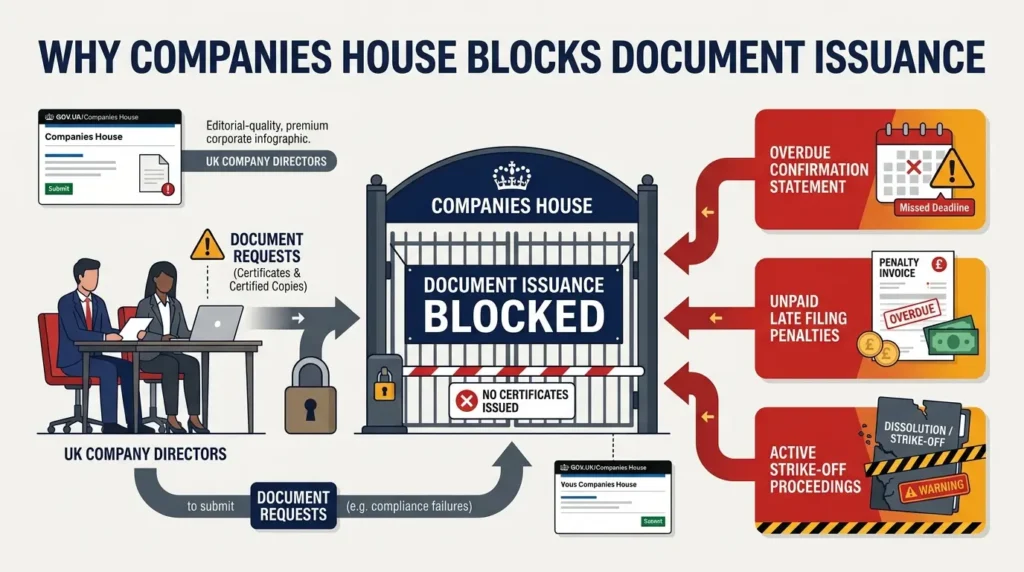
Corporate registries enforce strict legal boundaries before issuing official legal statements. Specific statutory defaults automatically halt the processing of official documentation. Understanding these administrative blockers enables corporate officers to rectify public records before submitting formal requests to Companies House.
File missing annual confirmation statements to restore filing compliance.
Pay outstanding financial account late filing penalties to clear administrative holds.
Update changed registered office address details with form AD01.
Register accurate persons with significant control (PSC) notifications promptly.
Withdraw voluntary or compulsory strike-off notices before requesting documentation.
Resolving statutory defaults requires formal submissions directly to the official registrar. Once Companies House processes the corrective filings, your company status returns to good administrative standing. Maintaining zero default flags on the public register allows immediate, unhindered access to official corporate certifications.
How Does a Confirmation Statement Impact Your Good Standing Status?
A confirmation statement validates current company details annually, and missing its strict deadline instantly invalidates your company’s eligibility for official certification.
Every UK private limited company must deliver a confirmation statement at least once every 12 months. This filing confirms that your public register details remain precise and accurate. When an officer misses this regulatory deadline, Companies House marks the company status as non-compliant. To understand how statutory filings affect eligibility, review how confirmation statements affect your certificate of good standing.
Late confirmation statements signal potential corporate abandonment to statutory authorities. Continued non-compliance triggers compulsory strike-off procedures under the Companies Act 2006. During active strike-off actions, Companies House freezes all requests for official legal documentation. Submitting missing confirmation statements immediately halts dissolution procedures and restores regulatory eligibility.
Maintaining exact filing schedules ensures continuous legal standing throughout the operational calendar. Corporate officers must audit share capital allocations, shareholder records, and principal business activities annually. Accurate confirmation statement filings allow seamless access to certified corporate documents whenever international expansion or banking requirements arise.
How Do UK Compliance Standards Compare With Overseas Corporate Requirements?
UK compliance standards require strict annual registry updates at Companies House, whereas foreign jurisdictions often demand notarized, apostilled, or periodic tax clearance certificates.
International business operations require a clear understanding of cross-border compliance variations. Corporate entities operating across international boundaries encounter contrasting regulatory frameworks. Evaluating requirements involves comparing what counts as good standing at Companies House vs overseas to satisfy local corporate authorities.
UK legislation focuses heavily on timely public register maintenance, verified officer information, and transparent filing histories. Overseas registries frequently combine corporate registry filings with strict local tax compliance certifications. Certain jurisdictions mandate quarterly filings, local agent representation, and certified physical seals for legal validity. Overseas banks and foreign governments often demand an Hague Apostille attached to your official UK certificate before accepting cross-border documentation.
Navigating these international differences requires precise administrative execution. When establishing foreign branches or opening overseas bank accounts, entities must align UK registry filings with host country legal expectations. Securing an official UK certificate post-compliance check provides the baseline proof of legal existence required by foreign statutory bodies.
How Do You Request a Certificate of Good Standing Through Form My Company?
You order the certificate by selecting the service online, submitting company details for a compliance audit, and approving the final verified application for rapid processing.
Form My Company simplifies official document retrieval by performing critical pre-application checks before submission. Corporate officers begin by submitting their company registration number through our secure portal. Our automated system assesses your current status on the official public register to detect filing discrepancies immediately.
Once our initial review confirms full statutory compliance, Form My Company submits the formal application to Companies House. If our system uncovers overdue statements or missing officer information, our corporate specialists guide you through corrective filings. Resolving these issues before formal submission eliminates registry rejections and expedites total processing turnaround times.
After Companies House issues the certified document, Form My Company provides immediate digital copies and dispatches physical certificates via secure courier. Business owners save valuable administrative time while avoiding common registry submission errors. You can efficiently request a Certificate of Good Standing after compliance check with Form My Company to meet urgent commercial deadlines.
What Key Information Appears on an Official Certificate?
An official certificate details the company name, incorporation date, active legal status, director names, and continuous compliance confirmation from Companies House.
An official certificate serves as legal proof that a business entity exists continuously under statutory regulations. Specific details printed on the document validate corporate identity for third-party institutions. Understanding these specific entries helps corporate officers verify document completeness prior to international legal submissions.
Display exact registered company name and official registration number.
Verify legal incorporation date under the relevant Companies Act legislation.
State explicit confirmation of continuous legal existence and active status.
List current appointed company directors and formal secretary details.
Confirm that no current dissolution or strike-off proceedings exist.
Financial institutions, investors, and legal advisors evaluate these explicit details during formal due diligence procedures. Having complete, unblemished officer listings and filing confirmations validates your legal infrastructure. An accurate certificate reinforces commercial credibility during major corporate transactions, financing rounds, and cross-border partnerships.
How Does Having Good Standing Benefit Your Business Growth?
Maintaining good standing accelerates corporate bank account approvals, simplifies international trade licensing, and builds immediate trust with commercial partners.
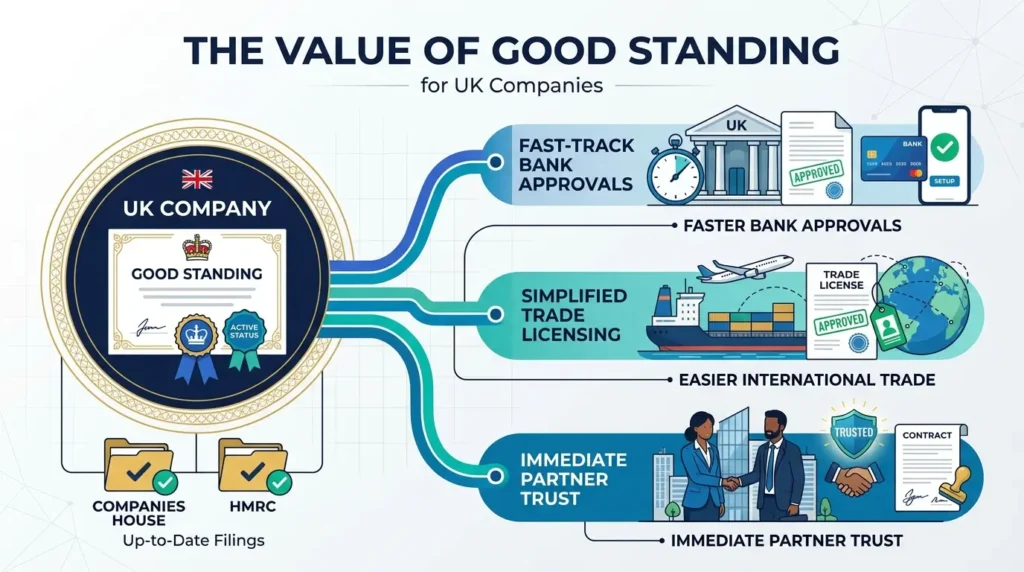
Legal compliance directly impacts commercial scalability and corporate growth velocity. Financial institutions refuse merchant services, business loans, and commercial accounts to non-compliant corporate entities. A verified certificate provides immediate, unchallengeable proof of operational legitimacy to risk-averse institutional underwriters.
International expansion relies on swift legal authentication across foreign jurisdictions. Foreign regulatory bodies mandate certified proof of active legal status before granting operating licenses or trading permits. Presenting an official UK certificate proves that your business meets rigorous statutory standards within its primary incorporation jurisdiction.
Maintaining seamless compliance protects your corporate brand equity and valuation. Venture capital firms, institutional lenders, and acquisition partners conduct extensive regulatory audits before committing funds. A clean administrative track record demonstrates professional governance, reduces transaction friction, and secures vital commercial contracts without legal delays.
What Steps Keep Your Business Continuously Compliant Year-Round?
Continuous year-round compliance requires setting automated filing reminders, maintaining accurate statutory registers, and auditing director information regularly.
Proactive corporate management prevents sudden loss of legal standing. Waiting for annual filing deadlines creates unnecessary operational risks and potential registry penalties. Establishing systematic governance routines ensures your company maintains clean public records permanently.
Schedule automated calendar alerts 30 days before annual confirmation statement deadlines.
Review director residential address records quarterly to ensure privacy compliance.
Audit person with significant control (PSC) details whenever shareholding structures change.
Submit annual financial accounts well in advance of legal statutory cutoffs.
Update registered office changes immediately using standard statutory notifications.
Implementing structured administrative workflows protects corporate entities from unexpected non-compliance penalties. Consistent oversight ensures that your business remains eligible for official documentation at any moment. Maintaining permanent regulatory readiness allows your executive team to capitalize on immediate commercial opportunities without administrative barriers.
A Certificate of Good Standing serves as indispensable proof of legal compliance, operational stability, and corporate legitimacy. Securing this document requires flawless alignment with Companies House filing obligations, including prompt confirmation statements and updated register details. Conducting a thorough pre-application compliance check prevents administrative rejections and guarantees fast document delivery. Form My Company streamlines this entire process by auditing your public records, resolving compliance gaps, and filing directly with Companies House to deliver fully verified corporate certificates efficiently.
Explore More Certificate of Good Standing Guide,
Check Your Eligibility and Order a Certificate of Good Standing With Form My Company
Get Your Filings Sorted and Certificate Issued by Form My Company
Frequently Asked Questions
How long does it take to get a Certificate of Good Standing in the UK?
Standard processing by Companies House typically takes four to five working days, while an express sameday service is available for urgent orders. When ordering through Form My Company, digital copies are dispatched immediately upon issuance, with physical certificates sent via secure courier or international post.
What is required to obtain a Certificate of Good Standing for a UK business?
A UK limited company must be fully compliant with Companies House, meaning all annual confirmation statements and accounts must be up to date. Form My Company reviews your public register status before submitting the request to ensure your legal entity meets all statutory requirements for document approval.
Does a Certificate of Good Standing expire?
While a Certificate of Good Standing does not have a formal statutory expiration date, most foreign authorities, banks, and lenders require a document issued within the last three to six months. Requesting an updated certificate through Form My Company ensures your business documentation satisfies current due diligence standards.
Can a non-UK resident request a Certificate of Good Standing for a UK company?
Yes, any authorized officer, shareholder, or representative can request a Certificate of Good Standing for an active UK company regardless of their physical location. Form My Company facilitates international requests by offering electronic PDF delivery alongside apostille and international courier options for overseas legal use.
What is the difference between a Certificate of Incorporation and a Certificate of Good Standing?
A Certificate of Incorporation proves that a company was legally created on a specific date, whereas a Certificate of Good Standing confirms that the business currently exists and remains compliant with filing obligations. Ordering a Certificate of Good Standing through Form My Company provides official verification of active legal standing for third-party institutions.