
To maintain Good Standing status, UK companies must submit annual Confirmation Statements, file up-to-date statutory accounts with Companies House, maintain registered office details, keep Persons with Significant Control registers accurate, and settle all statutory tax obligations with HM Revenue and Customs.
What Is a Certificate of Good Standing for UK Companies?
A Certificate of Good Standing is an official Companies House document that verifies a registered business entity continuously fulfills statutory filing duties, maintains active corporate status, and operates without pending dissolution proceedings or administrative strike-off actions.
Companies House issues this official document to confirm continuous regulatory compliance. Corporate entities present this document to financial institutions, overseas authorities, legal partners, and commercial lenders. Financial institutions request proof of active registration before opening business bank accounts. Overseas governments demand official verification when UK companies register foreign branches. Lenders verify active corporate status to assess borrowing legitimacy.
The Registrar of Companies issues the official state document only when corporate records remain completely current. Companies House verifies that mandatory filings arrive on time. The government register confirms no administrative strike-off proceedings exist. The document features an official verification code to allow instant online authentication.
Entities seeking foreign expansion must validate corporate standing through official channels. Obtaining a Certificate of Good Standing provides verified proof of legal compliance for foreign government authorities and international commercial partners. Official validation protects international trade operations from regulatory interruptions.
Which Statutory Filings Determine Corporate Compliance Standing?
Companies House evaluates corporate standing based on timely submissions of Confirmation Statements, full statutory financial accounts, accurate director appointments, updated registered office addresses, and verified Persons with Significant Control registers.
The annual Confirmation Statement replaces the former annual return under the Companies Act 2006. Directors submit form CS01 every 12 months to verify corporate structural data. Submission deadlines expire exactly 14 days after the review period ends. The filing confirms active director details, shareholder allocations, statement of capital, and principal business activities.
Statutory accounts represent the second major filing requirement for limited companies. Private limited companies file annual financial statements within 9 months of their financial year-end date. Public limited companies complete filings within 6 months of financial year-end. Small businesses present micro-entity accounts containing simplified balance sheets and profit calculations. Medium and large corporate entities submit full audited financial statements.
Failure to submit mandatory financial filings triggers immediate statutory penalties. Late filing penalties range from £150 to £1,500 depending on delay duration. Companies House doubles financial penalties when businesses file late in two consecutive financial years. Persistent default leads to compulsory strike-off proceedings under Section 1000 of the Companies Act 2006.
How Do Persons with Significant Control (PSC) Registers Impact Compliance Status?
Maintaining accurate Persons with Significant Control registers impacts compliance status because Companies House automatically rejects Good Standing requests from entities with undisclosed beneficial owners, outdated shareholder structures, or unverified director identities.
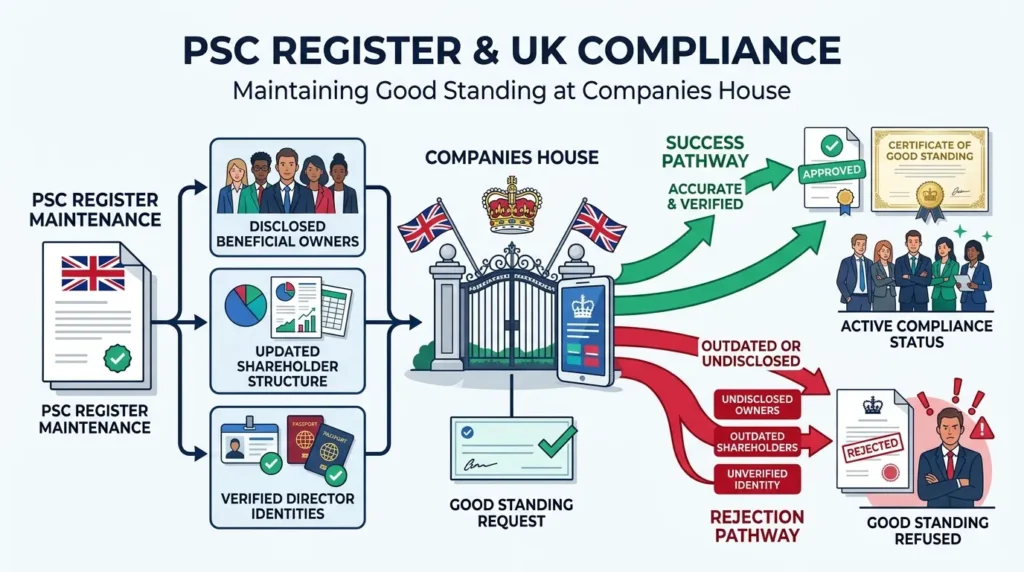
The Small Business, Enterprise and Employment Act 2015 introduced mandatory beneficial ownership reporting. UK companies identify individuals holding significant corporate influence. Significant control applies to individuals owning more than 25% of company shares. Significant control applies to individuals holding more than 25% of voting rights. Significant control applies to individuals possessing rights to appoint or remove majority board members.
Companies register beneficial ownership changes on official statutory books within 14 days. Corporate entities notify Companies House within 14 days after updating internal registers. The Economic Crime and Corporate Transparency Act 2023 introduced identity verification mandates for all active directors and Persons with Significant Control. Authorized corporate service providers authenticate director identity credentials through official government verification channels.
Failure to maintain transparent beneficial ownership records constitutes a criminal offense. Directors face personal fines when corporate registers omit required beneficial ownership details. Registrar officials withhold legal standing documentation until entities correct inaccurate corporate ownership registers.
What Financial Obligations Must Entities Settle with HMRC?
Entities must settle Corporation Tax payments, Value Added Tax liabilities, Pay As You Earn withholdings, and National Insurance contributions with HM Revenue and Customs to maintain complete corporate tax compliance.
Tax compliance directly affects corporate standing and commercial operations. UK businesses pay Corporation Tax at rates ranging between 19% and 25% based on taxable profits. Companies pay estimated tax liabilities 9 months and 1 day after the financial accounting period ends. Corporate entities submit formal Company Tax Returns (form CT600) within 12 months of accounting period completion.
Value Added Tax obligations apply to entities reaching annual taxable turnover thresholds of £90,000. Registered entities file quarterly VAT returns through Making Tax Digital software. Employers process payroll taxes using Pay As You Earn systems. Companies remit tax withholdings and National Insurance contributions monthly to tax authorities.
Tax non-compliance triggers formal enforcement actions from tax authorities. HM Revenue and Customs issues tax determinations when entities fail to file required tax returns. Tax authorities apply statutory interest charges on outstanding corporate tax debts. Unresolved tax liabilities jeopardize corporate legitimacy and prevent business expansion into foreign markets.
How Does a Registered Office Address Affect Legal Good Standing?
A valid physical registered office address in the UK preserves legal standing by ensuring effective service of legal notices, statutory correspondence, and official government communications from Companies House and HMRC.
Companies House mandates that every corporate entity maintains an active physical address within its jurisdiction. English and Welsh companies retain registered offices in England or Wales. Scottish companies maintain registered office addresses in Scotland. Northern Irish entities maintain addresses in Northern Ireland. PO Box addresses remain prohibited unless accompanied by full physical street details.
The registered office serves as the official destination for legal notices and statutory notifications. Process servers deliver court documents directly to registered addresses. Companies House delivers statutory filing warnings and compliance notifications to registered offices. Returning official mail as undeliverable prompts immediate government investigations into active trading status.
When corporate entities change physical office locations, directors file form AD01 within 14 days. Failure to update physical address details prevents successful delivery of regulatory notices. Registrar officials initiate administrative strike-off procedures when official communications bounce back consistently.
What Triggers the Loss of Good Standing Status for Limited Companies?
Companies lose Good Standing status by missing statutory filing deadlines, failing to pay annual registration fees, operating without active directors, allowing corporate address invalidation, or accumulating unpaid statutory tax liabilities.
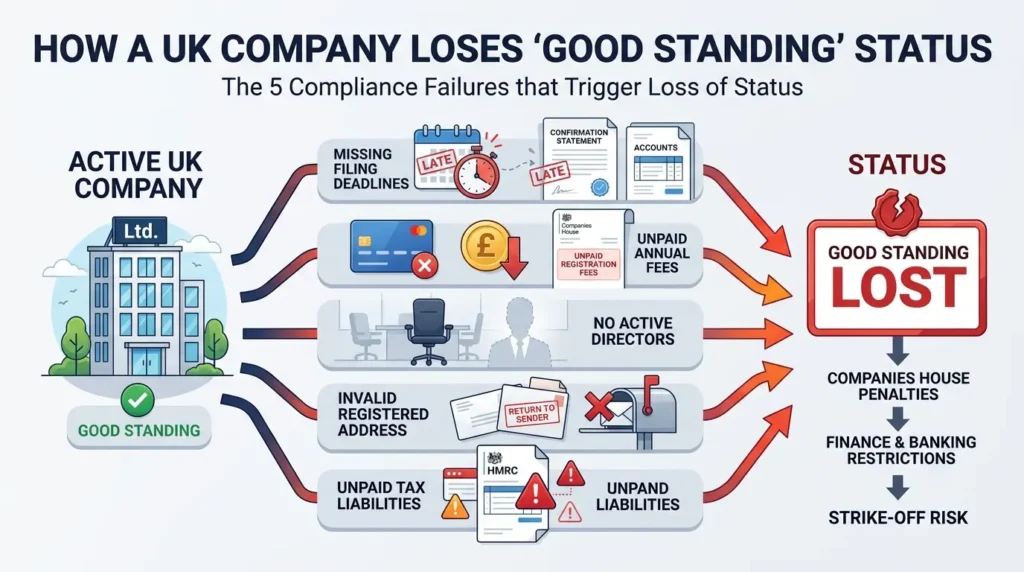
Missing annual Confirmation Statement deadlines represents the primary cause of default. Overdue statutory accounts trigger immediate non-compliance warnings on public registers. Public registers display clear default notices when filings pass mandatory due dates. Third-party risk scoring systems monitor public records to downgrade corporate credit ratings.
Operating without the minimum required board members invalidates corporate standing. Private limited companies require at least one natural person as an active director. Public limited companies require at least two directors and one qualified company secretary. Disqualified directors must resign immediately to avoid compromising corporate legitimacy.
Unresolved non-compliance leads directly to compulsory strike-off notices. The Registrar publishes official strike-off warnings in the London Gazette, Edinburgh Gazette, or Belfast Gazette. Entities receive 2 months to rectify default conditions before final dissolution occurs. Dissolved companies forfeit corporate assets directly to the Crown under bona vacantia rules.
Understanding operational compliance steps prevents default risks. Reviewing an operational guide on how to get your company compliant enough to qualify for Good Standing helps directors restore accurate filing structures before submitting formal state applications.
How Do Businesses Apply to Restore Compliance and Standing?
Businesses restore compliance standing by submitting overdue statutory returns, paying outstanding filing penalties, updating officer details, rectifying register discrepancies, and requesting official review from Companies House.
Restoration processes begin with a comprehensive corporate record audit. Directors review public register entries to identify missing statutory filings. Companies prepare past-due financial accounts using qualified accountants. Corporate officers complete late Confirmation Statements to update ownership data.
Paying accumulated statutory fines represents a mandatory step in restoration efforts. Entities settle late filing penalties directly with Companies House before applying for standing certificates. Business owners clear outstanding tax liabilities with HMRC to remove regulatory restrictions. Updating register details corrects historic discrepancies across government databases.
Professional incorporation agents simplify statutory restoration workflows for business owners. Experienced compliance specialists handle filing submissions, rectify structural defaults, and secure official documentation efficiently. Directors can get help qualifying for Good Standing and order from Form My Company to expedite regulatory reviews and obtain verified corporate documentation.
Form My Company assists UK limited companies with statutory filing obligations, corporate register updates, and compliance documentation. Professional assistance ensures corporate entities meet all government requirements for continuous Good Standing status.
Explore More Certificate of Good Standing Guide,
Why Can Overdue Filings Stop You Getting a Certificate of Good Standing?
What Makes a UK Company Eligible for a Certificate of Good Standing?
Frequently Asked Questions
What is a UK Certificate of Good Standing?
A UK Certificate of Good Standing, officially known as a Continuous Existence Certificate, is an official document issued by Companies House verifying that a limited company is fully registered and compliant. It proves that a business has filed all mandatory annual returns and financial statements without facing dissolution or administrative strike-off proceedings. Companies can request official documentation directly through Form My Company to prove their active corporate status to banks, overseas governments, and commercial partners.
Why do companies need a Certificate of Good Standing?
Businesses typically require a Certificate of Good Standing when opening overseas bank accounts, setting up foreign branches, or securing international business contracts. Lenders and regulatory authorities inspect this state document to confirm an entity’s legal legitimacy and up-to-date compliance record. Form My Company assists UK corporate entities in obtaining a Certificate of Good Standing to fulfill compliance requirements for international growth and financial verification.
How do you qualify for a Certificate of Good Standing in the UK?
To qualify for a Certificate of Good Standing, a UK company must have submitted its latest Confirmation Statement (form CS01) and up-to-date statutory accounts to Companies House. Additionally, the company must maintain a valid registered office address within its jurisdiction and have at least one active natural person appointed as a director. When corporate records are fully compliant, Form My Company can process the application and secure the official certificate from the Registrar of Companies.
How long does it take to get a Certificate of Good Standing?
Standard processing for a Certificate of Good Standing by Companies House usually takes around four to five working days, while an expedited sameday service is available for urgent commercial needs. Once issued, the document remains valid as proof of corporate compliance as long as the underlying filing records remain current, though most foreign institutions require a certificate dated within three months. Form My Company offers streamlined ordering options to ensure prompt delivery of verified corporate documents.
Does a Certificate of Good Standing include director and shareholder details?
Yes, a Certificate of Good Standing can specify director names, company secretary details, registered office addresses, and shareholder information upon request, provided these details are up to date on the public register. Including these specific management and ownership details helps satisfy enhanced due diligence checks for offshore banks and foreign authorities. Through Form My Company, corporate clients can tailor their Certificate of Good Standing order to include necessary statutory disclosures.