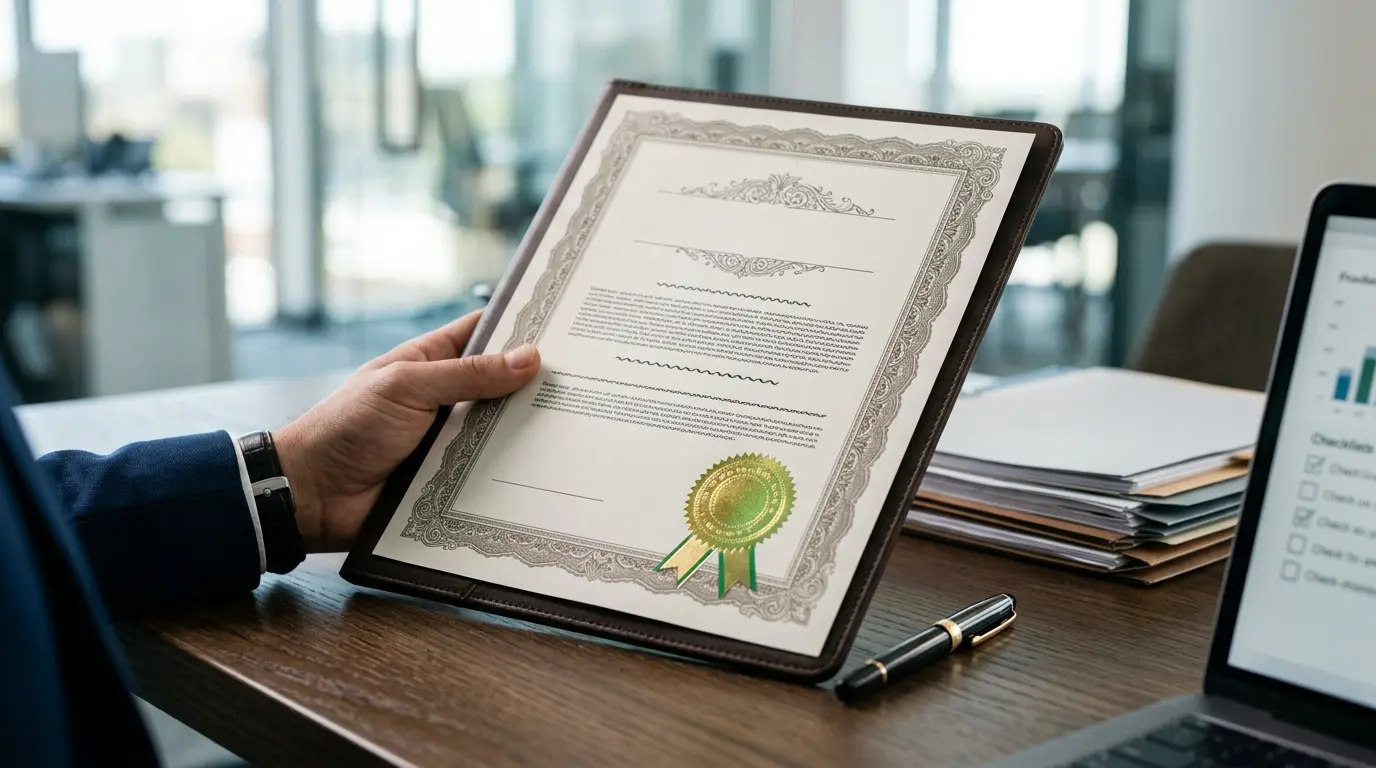
Companies secure Good Standing by filing annual confirmation statements, submitting audited accounts, settling tax liabilities, and maintaining updated Companies House registers. Meeting these statutory obligations ensures Companies House issues a Certificate of Good Standing without administrative delays.
What Statutory Filings Does Companies House Require for Good Standing?
Companies House requires UK businesses to file annual confirmation statements, submit annual accounts, and maintain accurate registers of directors and Persons with Significant Control. Completing these statutory filings on time maintains official compliance and preserves active legal status.
Companies House monitors statutory filing compliance for every registered UK business. A company must file its annual confirmation statement within 14 days of the review period ending. Directors must record all changes to company structure, registered office address, and shareholding details promptly.
Businesses must submit annual accounts within nine months of their financial year-end. Missing filing deadlines triggers immediate late filing penalties and marks the corporate record as non-compliant. Companies House refuses certificate issuance when records show overdue filings or pending enforcement actions.
Maintaining internal statutory registers is a mandatory corporate requirement under the Companies Act 2006. Directors must update four core registers: register of members, register of directors, register of secretaries, and register of Persons with Significant Control (PSC). Discrepancies between internal registers and public records prevent official verification.
Maintaining complete compliance records allows business owners to request an official Certificate of Good Standing to prove legal standing to international banks and trading partners. Accurate records ensure Companies House validates corporate standing instantly.
How Do Tax Obligations Impact Corporate Good Standing Status?
Tax obligations impact corporate standing when businesses fail to submit Corporation Tax returns, settle VAT liabilities, or pay PAYE deductions to HMRC. Meeting tax deadlines prevents enforcement actions that compromise corporate legal status.
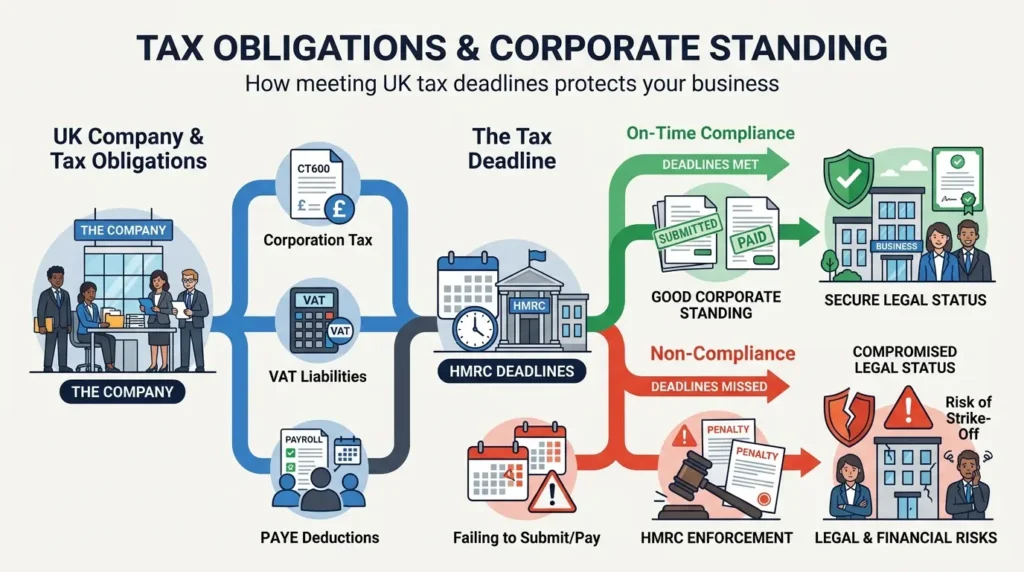
HM Revenue and Customs (HMRC) enforces strict compliance schedules for corporate tax liabilities. UK businesses must submit Corporation Tax returns (CT600) within 12 months of the accounting period end. Companies must pay estimated Corporation Tax liabilities within nine months and one day post-period end.
Unpaid tax liabilities trigger formal debt collection procedures and statutory demand notices. HMRC shares enforcement notices with regulatory bodies during legal proceedings or insolvency filings. Tax defaults lead to court judgments that strip a business of its active operating status.
Value Added Tax (VAT) registered entities must submit quarterly VAT returns through Making Tax Digital software. Pay As You Earn (PAYE) deductions require real-time submission during every payroll cycle. Meeting tax obligations consistently ensures continuous compliance across all government departments.
Companies seeking to verify statutory alignment across filing dates can review what compliance requirements must be met for good standing status to evaluate corporate readiness. Clear tax records facilitate smooth corporate expansion.
Which Internal Governance Protocols Keep a Business Compliant?
Internal governance protocols maintain compliance through regular board meetings, updated articles of association, proper share allotment documentation, and statutory register maintenance. Documenting executive decisions prevents internal governance disputes and regulatory non-compliance.
Corporate governance requires formal documentation of all executive decisions and share capital adjustments. Directors must hold annual general meetings and record official minutes for board resolutions. Board records validate operational legitimacy during official audits and legal evaluations.
Articles of Association dictate internal management rules and voting procedures. Companies must file amended articles with Companies House within 15 days of passing a special resolution. Failing to file updated governance documents invalidates internal structural changes.
Share capital changes demand precise regulatory documentation and board approval. Directors must file Form SH01 within one month of issuing new equity shares. Proper allotment documentation ensures accurate shareholding records on public registries.
Maintaining robust governance structures protects corporate identity and operational licenses. Clear internal policies simplify external legal audits conducted by financial institutions, investors, and state regulators.
How Do You Audit Your Business File Before Applying for Certification?
Auditing a business file requires cross-referencing Companies House records, reviewing HMRC tax accounts, verifying PSC entries, and checking officer details. Fixing record discrepancies prior to application prevents certificate rejection.
A thorough pre-application audit begins on the official Companies House service register. Directors must inspect public filing histories to verify that all confirmation statements and annual accounts show as fully processed. Unprocessed documents or administrative rejections require immediate rectification.
Verifying director and secretary details prevents operational delays during official background checks. Officers must update changes in residential addresses, service addresses, and nationality listings using formal notification forms. Address mismatches delay official state certifications.
Auditing the Person with Significant Control (PSC) register ensures accurate transparency compliance. UK law mandates that entities identify individuals controlling over 25% of voting rights or shares. Incorrect PSC notifications trigger statutory warnings from regulatory officers.
Checking filing history details ensures a company meets eligibility criteria before ordering documents. Officers can get help qualifying for good standing and order from Form My Company to secure official state documentation efficiently. Pre-audit procedures guarantee rapid document turnaround times.
What Steps Resolve Compliance Lapses and Restore Good Standing?
Resolving compliance lapses involves filing overdue confirmation statements, submitting late financial accounts, paying HMRC penalties, and updating public registers. Completing these actions clears default flags on Companies House records.
Fixing administrative defaults starts with identifying missing statutory submissions. Directors must prepare and submit late confirmation statements using electronic filing portals immediately. Rapid filing stops automatic striking-off procedures initiated by the registrar.
Overdue financial statements require immediate accountant preparation and submission. Companies House imposes automatic civil penalties on late accounts ranging from £150 to £1,500 based on delay duration. Paying outstanding penalties removes administrative holds on corporate records.
Restoring corporate standing requires clearing all active legal defaults with government agencies. Companies subject to compulsory strike-off notices must file Form DCA or submit full compliance filings alongside a formal objection letter. Removing strike-off actions restores active legal status.
Professional corporate service providers assist businesses in rectifying historical filing errors quickly. Form My Company reviews corporate history records to submit accurate filings directly to Companies House registers. Corrective actions restore full legal standing.
How Does a Certificate of Good Standing Support Business Growth?
A Certificate of Good Standing supports growth by validating corporate legitimacy for international bank accounts, cross-border contracts, trade licenses, and institutional investors. Official state certification proves active legal status during expansion.
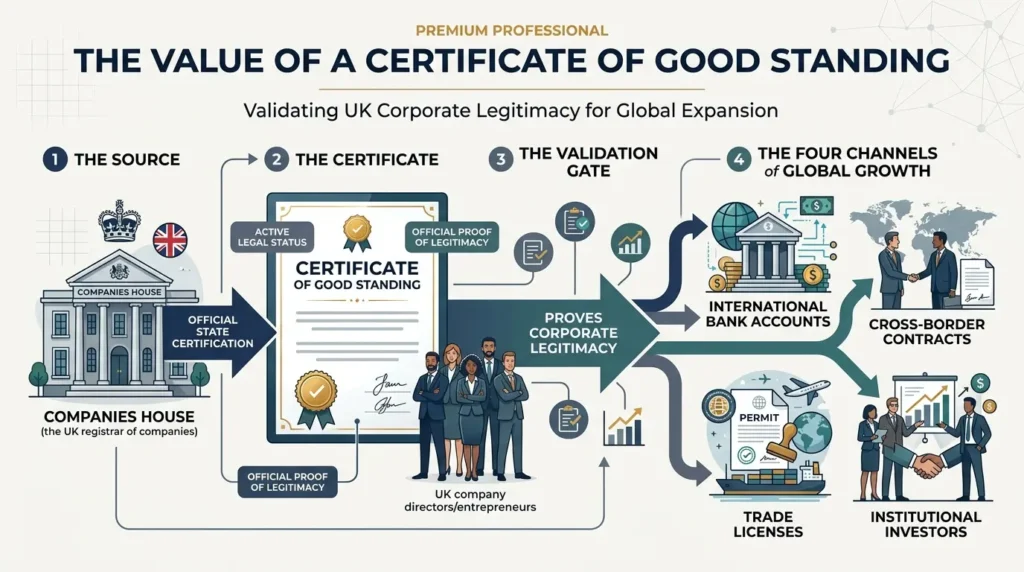
International banking institutions require proof of legal existence before opening corporate accounts. Banks accept official state certificates to satisfy Know Your Customer (KYC) and Anti-Money Laundering (AML) legal regulations. Certified legal standing accelerates account opening procedures globally.
Overseas trade authorities demand legal verification before issuing foreign operating licenses. Expanding UK firms must present state-certified corporate documentation during branch registration processes. Certified legal status establishes immediate credibility in foreign commercial jurisdictions.
Commercial lenders and venture capital firms evaluate compliance records during funding due diligence. Lenders review official standing documentation to confirm the target entity faces no active strike-off proceedings or legal defaults. Clean compliance records improve financing approval odds.
Form My Company coordinates directly with Companies House to issue official certificates for expanding commercial enterprises. Official documentation unlocks international commercial opportunities and protects corporate reputations.
Explore More Certificate of Good Standing Guide,
Comparing What Counts as Good Standing at Companies House vs Overseas
How to Check Whether Your Company Qualifies for a Certificate of Good Standing
Frequently Asked Questions
What is a Certificate of Good Standing in the UK?
A Certificate of Good Standing is an official document issued by Companies House that confirms a UK company is properly registered, up to date with its statutory filings, and actively operating. Businesses often obtain this document through Form My Company to prove their legal status to foreign authorities, investors, and financial institutions. It verifies that the business faces no pending dissolution or compulsory strike-off actions.
How do I get a Certificate of Good Standing for my UK company?
To get a Certificate of Good Standing, a company must ensure all annual confirmation statements, annual accounts, and director details are fully updated with Companies House. You can order an official Certificate of Good Standing directly through Form My Company, where compliance experts inspect your filing history to ensure rapid processing. Once verified, Companies House issues the physical or digital certificate for official commercial use.
How long is a Certificate of Good Standing valid?
A Certificate of Good Standing does not have a strict legal expiration date, but most UK banks, lenders, and foreign registries require one issued within the last 3 to 6 months. Because corporate filing statuses change, requesting a freshly dated document via Form My Company ensures international entities accept the verification. Outdated certificates are frequently rejected during corporate bank account applications and legal due diligence.
Why do banks require a Certificate of Good Standing?
Financial institutions require a Certificate of Good Standing to satisfy Anti-Money Laundering (AML) and Know Your Customer (KYC) regulatory compliance checks. The document serves as state-verified evidence that the business entity exists legally and maintains clean corporate compliance records. Services provided by Form My Company facilitate fast delivery of this document to prevent delays when opening corporate bank accounts or applying for commercial credit.
Can a company with overdue filings get a Certificate of Good Standing?
No, Companies House will not issue a Certificate of Good Standing if a business has overdue annual accounts or late confirmation statements. All statutory filing defaults must be resolved and processed on the public registry before the document can be ordered through Form My Company. Clearing outstanding compliance issues restores active status and allows official state certification.