
Good standing for a UK company means it is up to date with filing annual accounts and confirmation statements while remaining active on the Companies House register. Overseas registers often require additional tax clearance, physical office proofs, and local director attestations.
Companies operating internationally must maintain regulatory compliance across multiple legal jurisdictions. The definition of good standing varies significantly depending on whether a business registers in the UK or overseas. A clear understanding of these compliance differences helps corporate leaders mitigate legal risks, protect commercial contracts, and preserve business continuity.
What Constitutes Good Standing Under UK Corporate Law?
Under UK corporate law, good standing requires a company to maintain an active status on the register, file all required confirmation statements on time, submit annual accounts regularly, and pay all statutory fee obligations to Companies House.
Companies House measures good standing through strict adherence to statutory filing schedules. A UK company loses its good standing status as soon as it misses an annual filing deadline. Directors must file confirmation statements annually to verify shareholder details, registered office addresses, and officer appointments. Failure to submit these records prompts automated regulatory enforcement from Companies House.
Financial transparency serves as another vital pillar of UK corporate compliance. Every registered entity must file annual accounts that reflect its true financial position. Companies House issues public warnings and late filing penalties when accounts become overdue. Persistent non-compliance triggers compulsory strike-off proceedings, which liquidates corporate standing completely.
Legal active status forms the final requirement for UK good standing. A company cannot be in liquidation, administration, or subject to strike-off notices. When an entity meets all filing schedules, Companies House issues official documentation confirming its active status. Businesses can obtain an official Certificate of Good Standing to prove their continuous regulatory adherence to financial institutions and foreign authorities.
How Do Overseas Registries Define Corporate Good Standing?
Overseas registries define corporate good standing by evaluating local tax compliance certificates, resident director requirements, physical substance proof, periodic license renewals, and official registered agent attestations alongside standard registry filings.
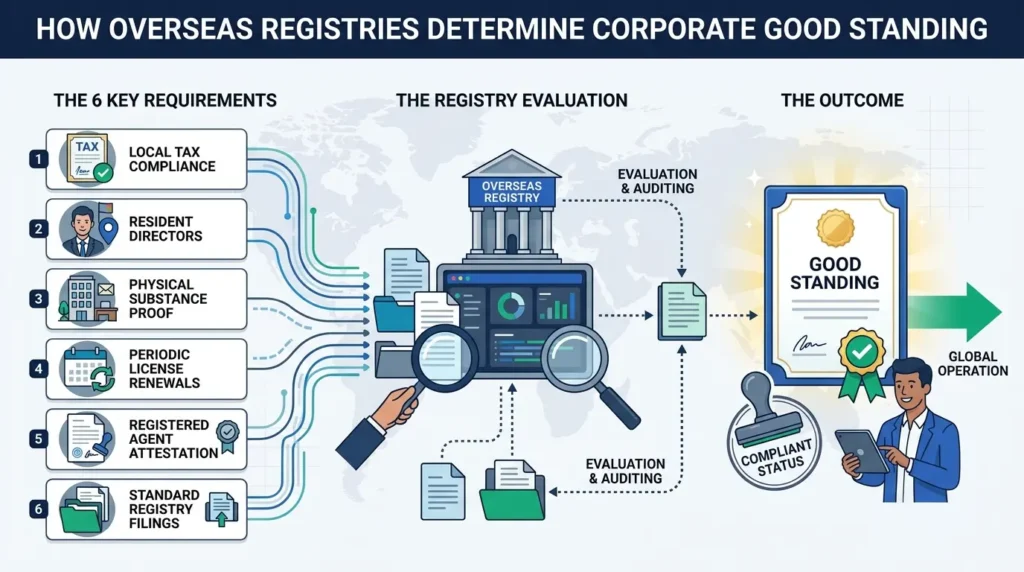
International business registries enforce criteria that extend beyond basic administrative record filings. Many offshore and foreign jurisdictions prioritize financial tax clearance over simple statutory filings. Regulators in countries such as the United Arab Emirates, Singapore, and various US states evaluate whether a company holds active tax clearance before issuing compliance verification.
Local physical presence requirements influence overseas good standing assessments. Foreign jurisdictions frequently mandate local resident directors and verified physical office leases. Authorities in jurisdictions like the Cayman Islands or British Virgin Islands conduct annual audits to verify economic substance compliance. Failing an economic substance test revokes good standing immediately.
Foreign registries rely heavily on registered agents to maintain statutory compliance. Registered agents submit annual compliance declarations and collect statutory license fees on behalf of foreign business entities. Overseas corporate registers suspend company operations when registered agent fees or local annual franchise taxes remain unpaid.
What Are the Key Differences Between UK and Foreign Compliance Records?
UK compliance focuses primarily on public register transparency and timely statutory filings, whereas foreign compliance records emphasize local tax standing, physical operational substance, resident officer verification, and active commercial licensing.
| Compliance Factor | UK Companies House Standards | Overseas Registry Standards |
| Primary Focus | Timely public register updates | Tax status and local operational presence |
| Officer Mandates | Directors of any nationality | Resident director or agent required |
| Substance Proof | Registered office address only | Physical lease and staff validation |
| Renewal Mechanics | Annual accounts & confirmation statements | Franchise taxes and commercial licenses |
Filing mechanisms differ significantly between UK authorities and foreign registers. Companies House maintains a centralized, fully digital public database. Anyone can inspect UK corporate filings online within seconds. Overseas registries often maintain private corporate records that require notarized requests or official power-of-attorney documents to access.
Financial reporting structures present distinct compliance challenges across borders. The UK applies standardized financial reporting frameworks like FRS 102 for company accounts. Overseas jurisdictions may require audited accounts submitted to local tax authorities rather than public corporate registries. Some foreign regions demand annual franchise tax payments based on authorized share capital rather than flat administrative filing fees.
Director verification standards create another layer of operational divergence. UK regulators verify director identities through standardized identity checks and public register disclosures. Overseas registers often require local resident managers to sign annual compliance affidavits. Non-resident directors face heightened scrutiny when attempting to secure foreign certificates of compliance without local agent backing.
Why Does Cross-Border Compliance Impact International Business Growth?
Cross-border compliance impacts growth because global banks, commercial partners, foreign registries, and institutional investors mandate verified proof of good standing before opening accounts, approving mergers, or signing cross-border contracts.
International banks perform thorough due diligence before opening corporate accounts or extending credit lines. Financial institutions reject applications from companies that show overdue filings or regulatory flags on any national register. Maintaining good standing across all operational jurisdictions accelerates cross-border banking approvals and prevents unexpected account freezes.
Cross-border trade agreements depend on validated corporate status. Foreign governments require imported business services to present apostilled corporate compliance certificates before approving local trading licenses. Companies can review the impact of confirmation statements on corporate standing to understand how domestic filing accuracy directly supports foreign market expansion.
Mergers and acquisitions demand pristine compliance histories across all target jurisdictions. Buyers conduct extensive corporate searches to detect hidden tax liabilities or regulatory default notices. Unresolved compliance issues in foreign registers delay corporate valuations and increase transaction costs significantly. Proactive register maintenance preserves corporate valuation during international investment rounds.
How Can Companies Maintain Seamless Compliance Across Jurisdictions?
Companies maintain multi-jurisdictional compliance by automating statutory filing calendars, partnering with professional corporate service providers, auditing local register entries regularly, and synchronizing global corporate record management.
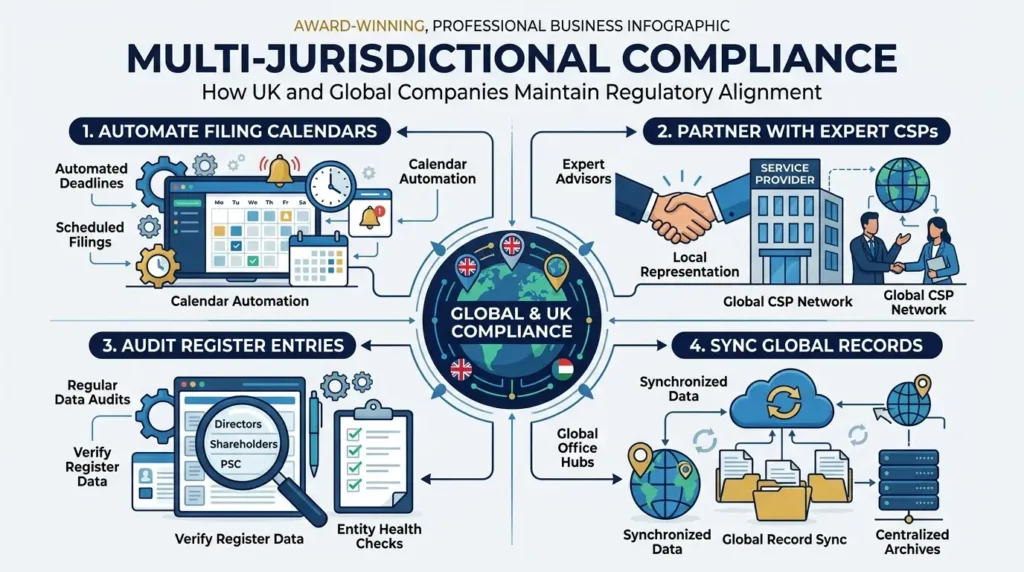
Tracking multi-jurisdictional filing deadlines requires centralized compliance management. Missing a statutory deadline in a foreign country leads to severe penalty fees and sudden loss of legal standing. Operations teams must establish automated compliance tracking systems that monitor submission dates for confirmation statements, tax returns, and registry renewals across every active jurisdiction.
Engaging dedicated corporate service experts eliminates local compliance blind spots. Managing overseas compliance requires deep familiarity with foreign company law, local tax codes, and language requirements. Professional corporate service teams manage local filing submissions, maintain registered office services, and interface directly with international registries on your behalf.
Conducting regular internal compliance audits prevents registry discrepancies before they trigger enforcement action. Business managers should perform quarterly reviews of officer details, registered address records, and financial filing statuses on all domestic and international registers. Organizations should complete a thorough compliance verification with Form My Company to resolve corporate record errors and secure official status documentation efficiently.
Explore More Certificate of Good Standing Guide,
How to Fix Overdue Filings Before Requesting a Certificate of Good Standing
How to Check Whether Your Company Qualifies for a Certificate of Good Standing
Frequently Asked Questions
How do I get a Certificate of Good Standing from Companies House?
To obtain a Certificate of Good Standing from Companies House, a company must be up to date with its annual accounts, confirmation statements, and statutory filings. Business owners can order an official certificate through Form My Company‘s Certificate of Good Standing service to verify their active corporate status and legal compliance.
What is included in a Companies House Certificate of Good Standing?
A Certificate of Good Standing issued by Companies House confirms a company’s active legal status, registered office address, and statutory filing compliance. Depending on requirements, it can also detail director names, secretary information, shareholder structures, and company objects for official verification.
Why do banks require a Certificate of Good Standing?
Financial institutions require a Certificate of Good Standing during corporate account openings or due diligence reviews to confirm a business is legally active and compliant with registry filings. Requesting this official document through Form My Company proves that the entity is not subject to liquidation, strike-off, or administration proceedings.
How long is a Certificate of Good Standing valid for?
While a Certificate of Good Standing does not have an official expiration date printed by Companies House, most international registries, lenders, and foreign authorities accept it for 30 to 90 days from the date of issue. Obtaining an updated certificate ensures foreign regulators receive current proof of ongoing legal compliance.
Can an overseas company request a UK Certificate of Good Standing?
A UK-registered subsidiary or branch operating overseas can request a Certificate of Good Standing to satisfy foreign corporate registries and legal compliance checks. Through Form My Company, businesses can secure an official Companies House certificate tailored to foreign legal requirements, including options for apostille or legalisation services.