
Companies House refuses to issue a Certificate of Good Standing when a company fails to maintain up-to-date statutory filings, lacks an active registered director, owes penalty fees, or faces pending strike-off proceedings that violate standard corporate compliance standards.
What Statutory Filing Defaults Lead to Refusal?
Companies House automatically blocks certificate issuance when a UK entity misses statutory deadlines for annual accounts or confirmation statements, causing an immediate compliance breach within the central registry system.
Companies House enforces strict statutory reporting schedules for every active UK business entity. A private limited company must submit statutory accounts within nine months after its financial year ends. Directors must also file a confirmation statement at least once every 12 months. When a business misses these deadlines, the registry system flags the corporate profile as non-compliant.
The electronic register automatically halts administrative service requests for overdue accounts. Non-compliance signals potential financial distress or operational abandonment to external creditors and regulators. The registrar enforces these statutory filing timelines to guarantee public registry transparency across the United Kingdom business sector. Resolving statutory filing defaults requires submitting missing financial statements and paying all associated late filing penalties.
Updating corporate records on the central portal clears technical compliance flags promptly. Once the registrar processes overdue financial filings, the company recovers its eligible administrative standing.
How Does Director Information Non-Compliance Affect Application Eligibility?
Incomplete director details, unverified identities, or a total lack of natural person directors prevent Companies House from validating legal governance, triggering an immediate rejection of the request.
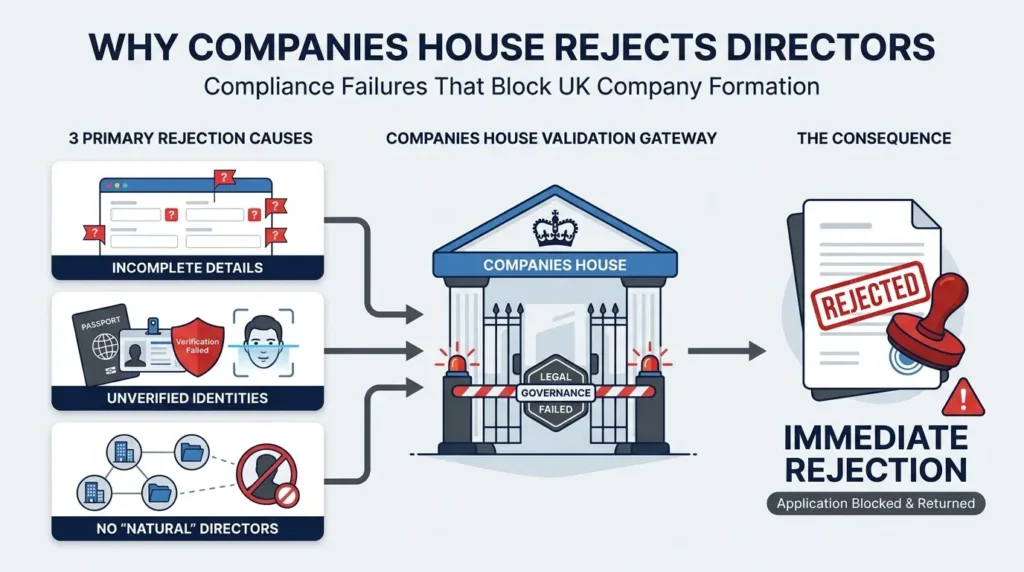
UK corporate law requires every private limited company to maintain at least one appointed director who is a natural person aged 16 or older. Appointing corporate entities as sole directors violates legal governance frameworks established under the Companies Act 2006. Furthermore, corporate officers must supply accurate residential addresses, service addresses, and official identity verification details.
Registrar updates mandate strict compliance with director disclosure standards. If an officer resigned without submitting Form AP01 or Form TM01, the registry record remains inaccurate. Companies House rejects requests from entities displaying invalid director structures or unverified officer profiles. Correcting officer records requires filing updated information directly to the official UK registry.
Businesses encountering complex officer filings can review what to do if Companies House won’t confirm your good standing status to evaluate corrective administrative steps. Ensuring every director record aligns with official requirements clears statutory impediments to certificate issuance.
Why Do Pending Strike-Off Proceedings Block Certificate Issuance?
Companies House prohibits certificate issuance for entities undergoing compulsory strike-off proceedings, as active dissolution flags indicate the impending removal of the company from the official register.
Compulsory strike-off occurs when the registrar believes a business no longer operates. Failure to respond to official warning notices triggers a formal Gazette notice publication. Once the registrar publishes a First Gazette Notice, the entity enters compulsory dissolution proceedings.
The registry cannot certify good standing for a business undergoing active strike-off. The system blocks requests until directors submit formal objection filings and resolve outstanding regulatory breaches. Halting dissolution requires submitting Form DS01 objections, settling late fees, and providing missing statutory returns. Resolving compulsory strike-off flags restores normal registry operations.
How Do Unpaid Late Filing Penalties Impact Certificate Approval?
Outstanding civil monetary penalties incurred from overdue financial statements automatically freeze administrative services, preventing Companies House from approving formal standing applications.
Companies House levies automatic financial penalties when entities submit annual accounts past statutory deadlines. Penalty amounts escalate based on the length of the delay. A delay under one month incurs a £150 fine, while delays exceeding six months result in a £1,500 penalty for private limited companies.
Unpaid civil penalties trigger automated collection procedures within the government department. The registrar refuses official certifications until the company settles outstanding debts. Paying civil monetary obligations clears registry account holds instantly.
What Persons with Significant Control (PSC) Errors Cause Direct Rejections?
Unreported changes to beneficial ownership, missing PSC registers, or unverified controller disclosures directly breach statutory transparency laws, resulting in immediate application rejection.
UK corporate regulations mandate accurate public reporting regarding entity ownership structures. Companies must report individuals who hold more than 25% of voting rights or share capital. Failure to update the central PSC register when ownership changes occur constitutes an offense under UK law.
The registrar checks PSC filings during certificate processing routines. Missing notifications, unverified residential addresses, or ambiguous control structures cause systematic rejections. Updating individual controller records via official portal submissions restores statutory compliance.
How Does an Invalid Registered Office Address Prevent Certification?
Companies House rejects applications if the registered office address is flagged as invalid, unauthorized, or failing to meet statutory location standards within the UK jurisdiction.
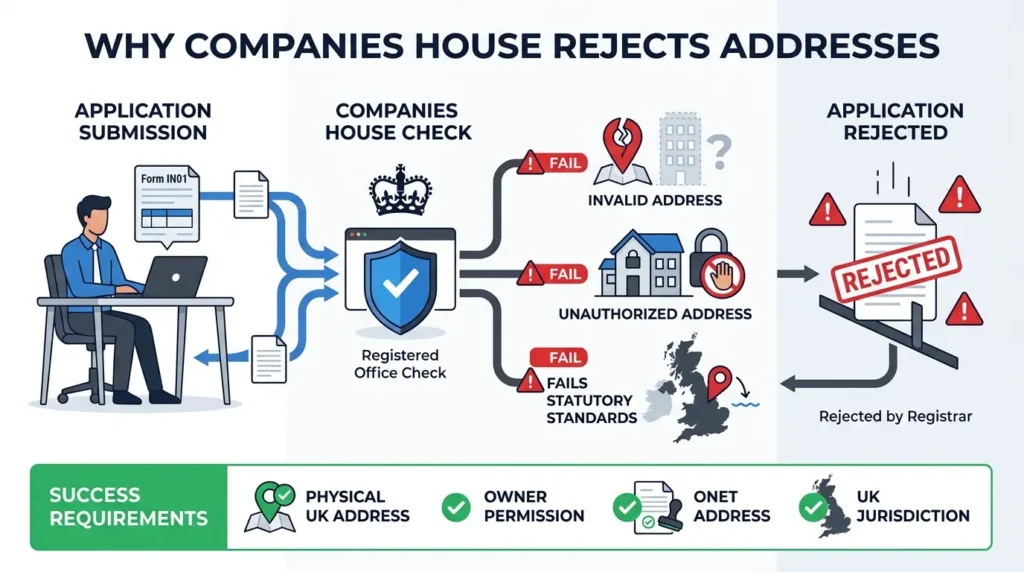
Every UK entity must maintain a physical registered office address within its incorporation region. The address must process official postal communications from government bodies effectively. Using an unauthorized address or an invalid PO Box causes official mail delivery failures.
When official communications return undelivered, Companies House flags the address as invalid. The registrar requires directors to submit Form AD01 to register a legitimate physical address. Rectifying registered location details allows normal administrative services to resume.
Why Does Restoring Good Standing Require Professional Corporate Services?
Rectifying complex filing defaults, resolving registry disputes, and navigating compliance frameworks demand precise corporate governance execution to secure administrative approval.
Resolving multi-layered registry defaults involves submitting amended accounting disclosures, paying statutory fines, and updating officer databases simultaneously. Errors in corrective documentation prolong administrative holds and delay international trade agreements. Professional corporate secretarial teams manage these administrative corrections systematically.
Utilizing dedicated Certificate of Good Standing services accelerates compliance rectification across all official departments. Professional administrators audit public registry files, identify underlying refusal causes, and submit corrective paperwork to Companies House efficiently.
Entities requiring rapid resolution can secure your good standing certificate the right way with Form My Company to avoid technical rejections and ensure full statutory compliance.
Companies House maintains strict regulatory standards before issuing official status documentation. Understanding specific compliance failures enables directors to fix underlying errors proactively.
Form My Company assists UK entities with registry audits, statutory filings, and official status reinstatements. Our corporate compliance services resolve filing backlogs, update director details, and secure official documentation directly from Companies House.
Explore More Certificate of Good Standing Guide,
What Compliance Requirements Must Be Met for Good Standing Status?
Why Can Overdue Filings Stop You Getting a Certificate of Good Standing?
Frequently Asked Questions
What is a UK Certificate of Good Standing?
A UK Certificate of Good Standing, officially known as a Certificate of Official Confirmation, is an official document issued by Companies House verifying that a company is continuously registered and fully compliant with statutory filing requirements. It confirms that the entity has submitted all required annual returns and maintains at least one active director. Corporate administrative providers like Form My Company assist UK businesses in obtaining this certified document for international banking, cross-border expansion, and legal transactions.
How do I get a Certificate of Good Standing from Companies House?
You can order a Certificate of Good Standing directly from Companies House or through a professional corporate service provider like Form My Company. The application requires providing your registered UK company name and registration number to verify that all statutory accounts and confirmation statements are up to date. Once compliance is confirmed, the registrar issues the document electronically or as an official printed certificate with an apostille if required for overseas use.
How long does it take to get a Certificate of Good Standing?
Standard processing by Companies House typically takes four to five working days, while an expedited express service can deliver the certificate within 24 hours. When using Form My Company to request a Certificate of Good Standing, processing timelines depend on whether your company records require immediate compliance updates or legal apostille certification. Electing for digital PDF delivery speeds up receipt compared to standard postal dispatch.
How long is a Certificate of Good Standing valid for?
While a Certificate of Good Standing does not contain a formal expiration date, most overseas registries, financial institutions, and legal bodies require the document to be issued within the last two to three months. Because company status and statutory compliance can change rapidly, third parties demand recently dated documentation to verify active standing. Form My Company recommends ordering a fresh certificate immediately prior to submitting international business applications.
Can a company get a Certificate of Good Standing if it has overdue filings?
No, Companies House will automatically refuse to issue a Certificate of Good Standing if a business has overdue annual accounts, missing confirmation statements, or unpaid late filing penalties. The company must first resolve all compliance defaults and update its official register entries. Services like Form My Company help businesses audit their statutory filings and submit necessary corrective paperwork to restore eligible standing before requesting the certificate.