
If Companies House refuses to confirm your good standing status, you must immediately resolve outstanding filing defaults, submit overdue confirmation statements or annual accounts, pay accrued penalties, and reapply for verification.
Why Does Companies House Refuse Good Standing Status?
Companies House refuses good standing status when a UK company breaches legal filing deadlines, fails to maintain required officer details, owes statutory late filing penalties, or faces active strike-off proceedings initiated by the registrar.
Companies House maintains the official public register of UK corporate entities. It enforces strict compliance parameters under the Companies Act 2006. A company achieves good standing status only when its public records remain completely up to date. The register must reflect full regulatory compliance.
The registrar checks statutory filing histories before issuing verification documentation. If an entity misses the deadline for its annual confirmation statement, Companies House halts good standing certification. Late submission of annual accounts triggers an automatic block on status confirmation. The register requires continuous maintenance to reflect accurate operational parameters.
Corporate entities must maintain at least one active, natural person as a director. If a company fails to register required officer details, the registrar marks the profile non-compliant. Failure to maintain a valid registered office address within the appropriate UK jurisdiction also triggers a refusal.
Active strike-off proceedings present the most severe barrier to good standing confirmation. If Companies House publishes a First Gazette notice to dissolve a business, the company loses eligible status immediately. You must resolve all outstanding statutory defaults before requesting status confirmation again.
How Do You Identify the Specific Reasons for Refusal?
You identify specific refusal reasons by reviewing the company register profile on Companies House Service, examining recent statutory notices, checking overdue filing dates, and contacting the registrar directly.
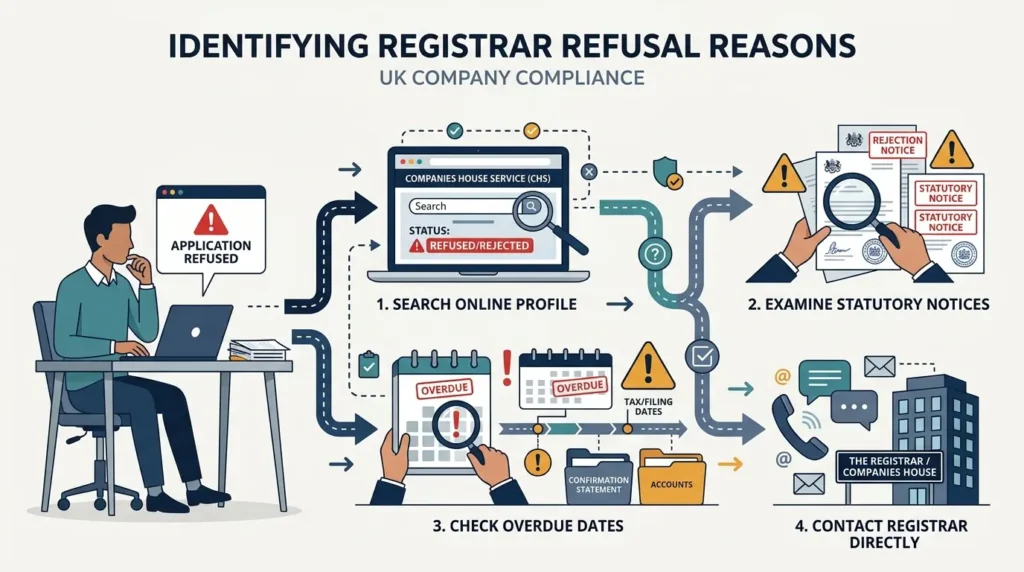
Identifying the root cause of verification refusal requires a systematic audit of the public register. The Companies House Service portal provides real-time visibility into filing histories and corporate compliance statuses. Accessing the portal reveals overdue documents instantly.
Review the corporate overview page to identify missing compliance milestones. Check the confirmation statement due date against current calendar records. Check the annual accounts target date to confirm whether statutory timeframes have expired. A single missed date prevents status verification.
Inspect the filing history tab for official rejection notices or administrative warnings. The registrar issues formal warnings when compliance obligations lapse. If a First Gazette notice appears in the filing history, compulsory strike-off action has already commenced.
Evaluate officer registers to ensure all active appointment records contain complete information. Verify that Persons with Significant Control (PSC) registers reflect current ownership structures. If online portal records show ambiguous errors, request administrative clarification directly from Companies House support teams.
What Steps Resolve Overdue Filings and Annual Accounts?
To resolve overdue filings, compile complete statutory accounts, draft the current confirmation statement, submit missing documents online, and verify receipt with Companies House.
Resolving compliance defaults requires immediate administrative action. You must prioritize preparing overdue accounts and statements. Delaying submissions increases administrative penalties and prolongs status suspension.
To restore compliance, complete these sequential tasks:
Prepare missing annual accounts according to UK Financial Reporting Standards
Complete the current confirmation statement using accurate shareholder data
File overdue documentation electronically using Companies House WebFiling
Pay outstanding administrative late filing fees through official payment portals
Verify successful filing acceptance via electronic confirmation receipts
Electronic submission speeds up document processing significantly compared to paper filings. WebFiling portals process standard confirmation statements within 24 hours. Electronic accounts processing usually finishes within two working days.
Ensure all financial data aligns perfectly with statutory requirements before submission. Incorrect figures or missing director signatures result in document rejection. Rejections reset processing timelines and delay status restoration. Once the registrar accepts all pending filings, the corporate profile returns to compliant status.
How Do You Cancel an Active Strike-Off Action?
You cancel an active strike-off action by filing form DS02, submitting all overdue statutory returns, paying outstanding penalties, and requesting explicit suspension from the registrar.
When Companies House initiates compulsory strike-off action, it publishes a notice in the Gazette. This publication starts a two-month countdown toward complete company dissolution. You must stop this process before the registrar issues confirmation documentation.
Submit all overdue financial accounts and confirmation statements immediately to demonstrate active trading. Filing required documents shows the registrar that the entity remains commercially active. Include formal written requests asking Companies House to suspend dissolution activity.
If third parties object to strike-off, Companies House halts the dissolution temporarily. However, directors must resolve underlying compliance issues to remove the strike-off flag permanently. Paying accrued late penalties removes administrative blocks.
Once the registrar processes overdue filings, it removes the Gazette notice. The official register status shifts back from active strike-off to normal operation. Only after this status update takes effect can you request formal status verification.
How Long Does It Take to Restore Good Standing Status?
Restoring good standing status takes between 24 hours and five working days, depending on filing submission methods, document processing speed, and penalty clearance.
Processing timelines vary based on the nature of compliance defaults and chosen filing methods. Electronic filings update public records faster than postal submissions. Understanding these timeframes helps manage commercial expectations.
Direct electronic submission of confirmation statements updates public records within 24 hours. Submit financial accounts online to achieve approval within three working days. Paper submissions take up to ten working days to process.
If strike-off notices require cancellation, administrative reviews add up to five working days. The registrar must verify full compliance before removing dissolution flags. Penalty payments process within 24 hours when completed online.
After public records update, requesting status confirmation takes additional time. Standard digital issuance takes two to three working days. Express processing options deliver verified documentation within 24 hours.
When Should You Seek Professional Administrative Help?
You should seek professional help when facing complex filing backlogs, active strike-off notices, missing historical data, or urgent international commercial deadlines.
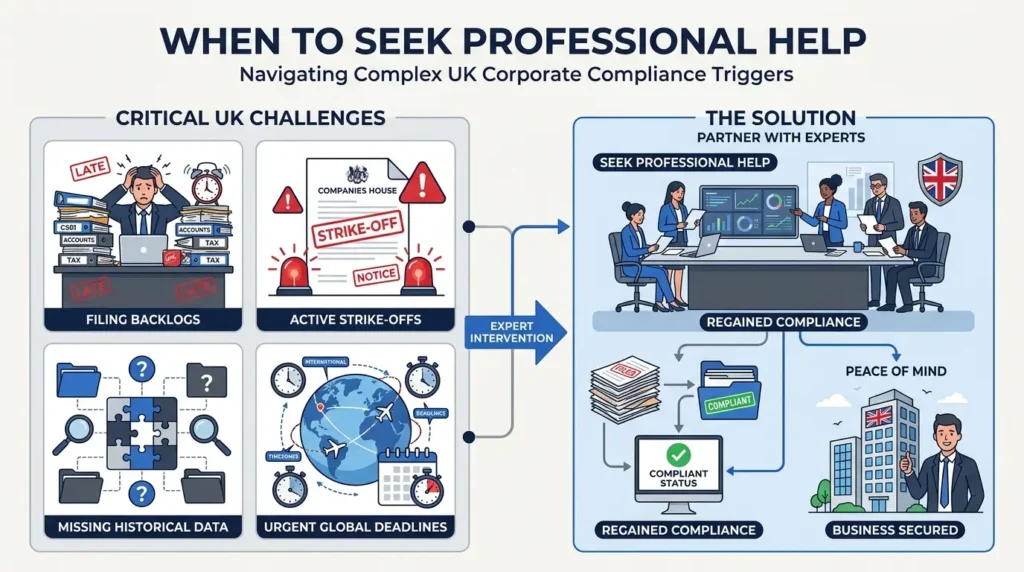
Managing statutory compliance recovery requires precise knowledge of UK corporate law. Mistakes during filing submission cause immediate rejections, wasting critical time. Professional corporate service providers streamline the compliance restoration process.
Complex accounts backlogs often require specialized corporate assistance. Professional service providers audit corporate records to identify missing compliance elements. They prepare accurate statements that pass Companies House validation checks without delay.
If third parties require urgent proof of good standing, professional support prevents unnecessary delays. Understanding why Companies House might refuse to issue a Certificate of Good Standing helps businesses avoid common compliance traps and handle statutory defaults effectively. Experts interact directly with registrar officials to expedite processing.
Delegating compliance recovery ensures accurate documentation handling. Professional assistance allows business owners to focus on operational management while specialists fix register defaults. Rapid resolution protects commercial relationships and preserves corporate credibility.
How Do You Apply for Official Status Verification After Resolving Defaults?
You apply for official status verification by requesting document issuance online, selecting required delivery speeds, and paying the official administrative fees.
Once public records confirm full compliance, you can request formal status documentation. Ensure the register updates completely before submitting new applications. Pre-emptive requests result in immediate rejection if updates remain pending.
Select the appropriate issuance channel based on operational urgency. Companies House provides standard and expedited document delivery services. Standard requests process within normal working timeframes, while express options provide fast-turnaround verification.
Cross-check all information on the application against public register details. Discrepancies between application entries and registered details cause processing delays. Ensure director names, registered addresses, and company numbers match official database entries exactly.
Keep electronic copies of official status documentation for corporate record management. Financial institutions, international partners, and legal advisers frequently require updated status proof. Maintaining digital copies simplifies future verification requests.
What Steps Prevent Future Loss of Good Standing?
You prevent future loss of good standing by setting automated compliance alerts, maintaining accurate statutory registers, filing returns early, and engaging corporate secretarial support.
Maintaining continuous compliance requires proactive administrative management. Establishing formal compliance protocols prevents accidental deadline breaches and expensive late filing penalties.
Implement these continuous compliance practices:
Set automated calendar alerts 30 days before statutory submission deadlines
File annual confirmation statements during the initial opening window
Review Person with Significant Control records whenever ownership changes occur
Update registered office details immediately following corporate moves
Maintain dedicated corporate secretarial oversight for statutory filings
Filing statutory returns well ahead of final deadlines provides safety buffers. Early submission allows time to correct unexpected portal errors or processing rejections. Never wait until deadline dates to submit essential corporate documentation.
Engage professional corporate secretarial services to manage ongoing compliance obligations. External specialists monitor filing calendars, draft accurate returns, and submit documents promptly. Continuous monitoring guarantees public register accuracy throughout the operational year.
Restoring Compliance Efficiently
Maintaining good standing status remains essential for seamless corporate operations in the UK. When filing defaults occur, prompt corrective action restores register compliance and protects commercial standing. Identifying root causes, submitting accurate filings, and clearing outstanding fees ensures swift status recovery.
Form My Company assists businesses in navigating complex corporate filings and register restoration. You can secure your Good Standing Certificate the right way with Form My Company to ensure full regulatory compliance. Professional support simplifies statutory management and keeps your business compliant with UK legal standards.
Explore More Certificate of Good Standing Guide,
How to Get Your Company Compliant Enough to Qualify for Good Standing
How to Fix Overdue Filings Before Requesting a Certificate of Good Standing
Frequently Asked Questions
How do I get a Certificate of Good Standing in the UK?
To obtain a Certificate of Good Standing for a UK company, you must submit an official request to Companies House or use an authorized company formation agent like Form My Company. The company must be fully compliant, with up-to-date annual accounts and confirmation statements, to qualify for document issuance. Form My Company manages the verification process and delivers official hard copies or digital certificates directly from the registrar.
What is a Certificate of Good Standing used for?
A Certificate of Good Standing proves that a UK company is validly incorporated and fully compliant with statutory filing requirements under the Companies Act 2006. Overseas banks, international vendors, state authorities, and prospective investors frequently request this document during due diligence or account opening procedures. Businesses frequently use the Certificate of Good Standing service from Form My Company to verify operational legitimacy for international trade and corporate expansion.
How long does it take to get a Certificate of Good Standing from Companies House?
Standard processing by Companies House typically takes four to five working days, while express processing options deliver the document within 24 hours. Form My Company offers expedited Certificate of Good Standing services to ensure urgent legal and banking deadlines are met without delay. Delivery times may vary depending on whether physical postal dispatch or certified digital delivery is selected.
Why would Companies House refuse to issue a Certificate of Good Standing?
Companies House will refuse to issue a Certificate of Good Standing if the company has overdue annual accounts, missing confirmation statements, or unpaid late filing penalties. Refusal also occurs if the company lacks a valid registered office address or is undergoing active strike-off proceedings. Form My Company assists business owners in identifying and resolving public register defaults so eligibility for the certificate can be restored quickly.
Does a Certificate of Good Standing expire?
While a Certificate of Good Standing does not have a statutory expiration date, most financial institutions, registries, and legal bodies require the document to be issued within the last three to six months. Because public register compliance statuses change regularly, foreign authorities require recent verification to confirm active standing. Ordering a refreshed Certificate of Good Standing through Form My Company guarantees that all official company details reflect real-time registry compliance.