
A UK Certificate of Good Standing is obtained by submitting an official application to Companies House, provided your company is up to date with all confirmation statements, annual accounts, director filings, and statutory compliance obligations.
What Is a UK Certificate of Good Standing?
A Certificate of Good Standing is an official state document issued by Companies House confirming that a private limited company exists continuously, complies with statutory reporting deadlines, and legally operates under UK corporate law.
Companies House acts as the primary executive register for corporate bodies in the United Kingdom. When commercial partners require verification of legal existence, Companies House validates company records against the Companies Act 2006. The official certificate proves that your corporate structure remains legally active, updated, and compliant.
Overseas financial institutions, foreign tax authorities, and international vendors demand this statutory document during mandatory due diligence checks. Lenders inspect legal standing to ensure the borrowing entity maintains clean filings before granting credit facilities. Obtaining this official proof prevents contract delays and protects international business transactions.
Entities operating in foreign jurisdictions must frequently legalise their official corporate documentation through an Hague Apostille certification. You can order a Certificate of Good Standing online to accelerate international business expansion and satisfy foreign registry compliance demands.
Why Do Companies House Reject Good Standing Applications?
Companies House rejects good standing applications when a registered company fails to file annual accounts, misses confirmation statement deadlines, lacks required officers, or breaches statutory disclosure regulations under UK company law.
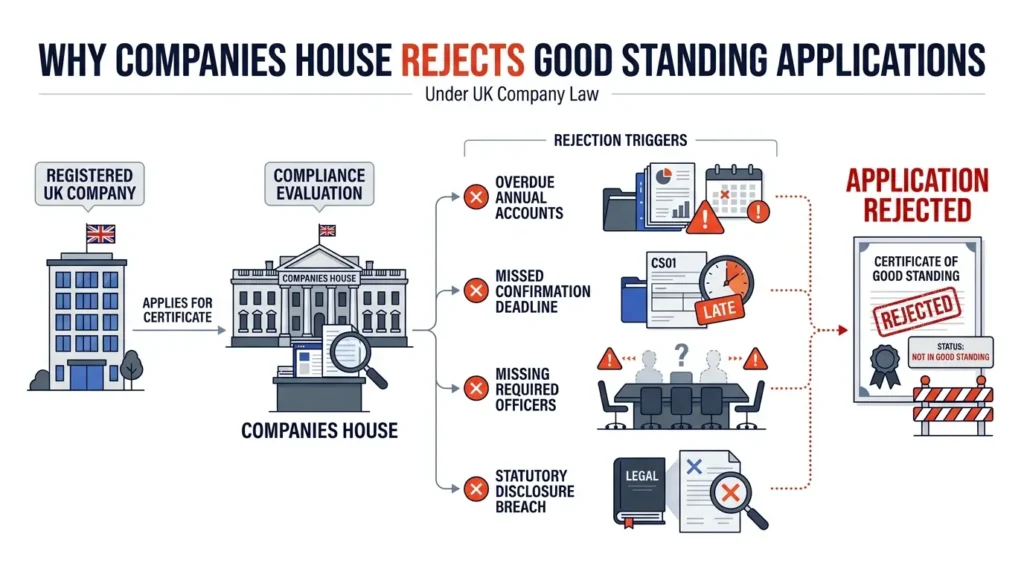
Compliance failures trigger automatic holds on legal certificate requests. If a company fails to submit financial statements before statutory deadlines, Companies House marks the register non-compliant. Registry officials will not authenticate corporate standing until you resolve every outstanding filing delinquency.
Structural deficiencies also prevent certificate issuance. UK business law mandates that every private limited company maintains at least one natural person as a director. If a firm operates with only corporate directors or fails to register an active official address, registry officers reject official requests.
Firms experiencing administrative holdbacks must address statutory delinquencies immediately. If administrative errors cause registry delays, review our guide on what to do if Companies House won’t confirm your good standing status to identify corrective administrative procedures.
What Information Appears on an Official Certificate?
An official certificate details the company name, incorporation date, registration number, active director names, secretary details, registered office address, and a formal statutory statement verifying compliance status.
The registry generates custom certificates incorporating specific operational parameters required by requesting overseas institutions. Standard filings display basic corporate identity, while expanded certificates list share capital structures, shareholder names, and specific director birth dates.
International counterparties require specific information fields to complete anti-money laundering protocols. When a foreign bank conducts corporate onboarding, compliance officers compare registry statements against corporate constitutional documents. Including accurate officer information prevents banking application rejections.
Official documents carry formal physical or cryptographic authentication marks applied by official registrar officers. Overseas registries verify these security features during legalisation processes. Form My Company prepares compliant registry filings to ensure accurate corporate detail representation on official records.
Why Might Companies House Refuse to Issue a Certificate?
Companies House refuses certificate requests when corporate entities face compulsory strike-off proceedings, operate under liquidation orders, breach mandatory officer regulations, or maintain overdue statutory annual filings.
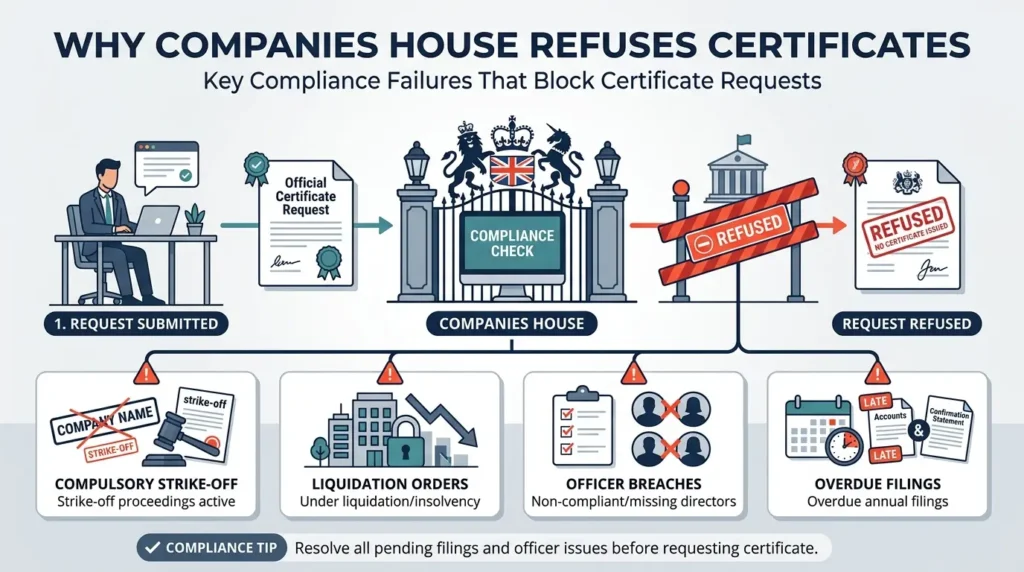
Compulsory strike-off action initiated by the registrar halts all standard administrative requests immediately. When officers identify prolonged non-filing of annual returns, statutory notice sequences commence under Section 1000 of the Companies Act 2006. Active strike-off flags invalidate good standing status instantly.
Insolvency proceedings, court orders, and administrative receiverships permanently block official standing confirmations. If formal winding-up petitions exist on official record, Companies House refuses to issue status verifications. Interested parties can analyze why Companies House might refuse to issue a Certificate of Good Standing to evaluate corporate risk factors before applying.
Corporate structure non-compliance creates subtle operational barriers. If person with significant control disclosure filings remain unverified or outdated, registry systems block document generation. Filing updated corporate registers restores compliance standing required for certificate generation.
How Does Form My Company Simplify the Application Process?
Form My Company simplifies certificate processing by auditing official company records, rectifying filing deficiencies, submitting express applications to Companies House, and managing Hague Apostille legalisation services.
Navigating registry requirements demands thorough pre-application data verification. Form My Company conducts comprehensive corporate record audits before submitting official requests. This systematic check eliminates application rejections caused by hidden filing omissions or administrative errors.
Professional corporate services eliminate standard administrative friction for fast-growing businesses. Form My Company communicates directly with Companies House officials to bypass processing bottlenecks. Experienced account coordinators handle document dispatch, international courier routing, and official seal authentications.
Securing valid legal credentials requires precision timing when closing critical international deals. Utilizing expert company formation and management specialists guarantees fast document delivery without compliance failures.
A Certificate of Good Standing validates legal authority, protects banking operations, and enables cross-border expansion for UK registered businesses. Obtaining this document requires clear corporate registers, timely statutory filings, and precise registry administrative execution. Maintaining active compliance across all reporting categories ensures seamless document processing when international partners request verification. Form My Company delivers complete corporate filing services, application management, and official legalisation solutions to ensure your firm maintains flawless registry standing.
Explore More Certificate of Good Standing Guide,
Get Help Qualifying for Good Standing and Order From Form My Company
Get Your Filings Sorted and Certificate Issued by Form My Company
Frequently Asked Questions
How do I get a Certificate of Good Standing in the UK?
To obtain a Certificate of Good Standing in the UK, your business must be actively registered with Companies House and fully compliant with all annual filing duties, including confirmation statements and accounts. You can order the official document directly through Form My Company, where compliance experts audit your registry records to ensure error-free submission and rapid issuance.
How long does it take to issue a Certificate of Good Standing?
Standard processing by Companies House generally takes 3 to 5 working days, while same-day express options are available for urgent corporate requests. When applying through Form My Company, application details are pre-validated against official UK company registers to prevent administrative delays and expedite dispatch.
What is included on a UK Certificate of Good Standing?
An official Certificate of Good Standing confirms a company’s continuous legal existence, active registration status, and compliance with statutory filing requirements under the Companies Act 2006. Depending on your regulatory needs, Form My Company can request expanded details on the document, including registered office address, director names, company secretary information, and issued share capital.
Why would Companies House refuse a Certificate of Good Standing?
Companies House refuses certificate applications if an entity has overdue confirmation statements, late annual financial accounts, or lacks an active natural director. Working with Form My Company helps identify and resolve statutory filing delinquencies prior to submission, ensuring your application meets all regulatory criteria.
Is a Certificate of Good Standing required for opening an overseas business bank account?
Yes, foreign financial institutions, tax registries, and international partners frequently require a Certificate of Good Standing to fulfill anti-money laundering (AML) and corporate due diligence protocols. Form My Company assists UK businesses by providing official legal certificates alongside optional Hague Apostille certification for seamless international document recognition.