
Could the right SIC code depend more on what your company actually does than on what it’s called? When several descriptions seem to fit, it’s easy to pick a close match and still miss the right one. SIC codes classify a company’s business activity, and the code you report needs to match the UK list used for Companies House filings.
The official lists can feel dense, particularly when similar activities have different descriptions. It’s also easy to find a US classification by mistake. For UK filings, Companies House uses a condensed version of UK SIC 2007. Although UK SIC 2026 has been published, it isn’t yet in use for Companies House filings.
This guide explains what a SIC code records and where it appears, then takes you through finding the closest match for your company’s actual activities. You’ll also learn what to do if those activities change and how to avoid common filing mistakes. Start by describing what your business does, then match that work to the correct UK code.
Key Takeaways
- A SIC code describes your company’s economic activity; it isn’t your company registration number.
- Use the Companies House filing list, as a code from another database may not be accepted.
- Choose descriptions that reflect work your company actually carries out, not just its brand or future plans.
- To find suitable SIC codes, describe your activities, search the official list and compare the wording before filing.
- Review your recorded activity when your operations materially change, and consider whether an update is appropriate.
What SIC codes mean for your UK company’s nature of business
The UK system forms part of the UK Standard Industrial Classification of Economic Activities. The Office for National Statistics (ONS) maintains the wider classification, while Companies House provides a condensed list for company filings. This gives the nature-of-business entry a shared reference point rather than relying only on a company’s own wording.
What does a SIC code tell Companies House?
UK SIC codes and US SIC codes are not interchangeable
The same abbreviation appears in different national systems, which can make search results confusing. A result from the US Securities and Exchange Commission (SEC) relates to US company filings. It may explain how a SIC code identifies a type of business in that context, but it doesn’t establish which code is appropriate for a UK Companies House submission.
For a UK filing, use the Companies House condensed list, based on the broader ONS classification. Don’t assume that a code from a US database or another organisation’s directory will be accepted in the UK. Match the company’s activity to the UK descriptions and use the filing list as your reference. This keeps the classification aligned with the system your company reports through.
How UK SIC codes are organised and which official list to use
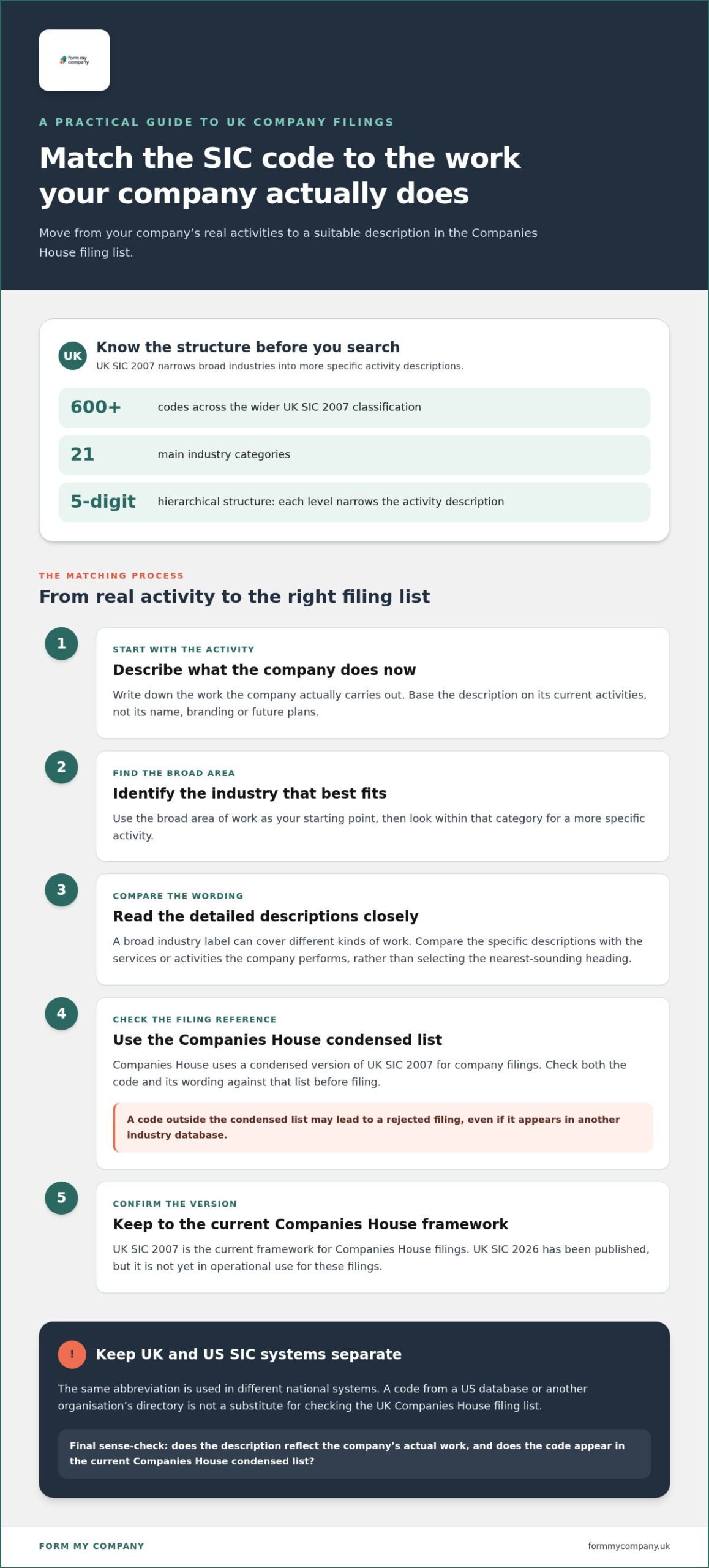
For a UK company filing, use the current Companies House condensed SIC list because it contains the codes accepted for reporting a company’s nature of business. The list is condensed from the wider ONS classification. GOV.UK guidance warns that a code outside the condensed list may lead to a rejected filing, even if it appears in another industry database.
Why Companies House uses a condensed SIC list
Search results can also mix UK and US classifications. A SIC entry on the US Securities and Exchange Commission (SEC) site belongs to the US filing context; it isn’t the list for a UK company submission. The shared abbreviation doesn’t make the systems interchangeable. For Companies House filings, follow the UK condensed list and current filing instructions.
How to read a SIC code description
Use this quick approach to narrow your search:
- Identify the broad industry that best fits the company’s current activity.
- Compare the specific descriptions within that category with the work the company performs.
- Check the code and wording against the latest Companies House condensed list before filing.
Descriptions and classification versions matter. The current filing framework is UK SIC 2007. UK SIC 2026 was published in April 2026, but it isn’t yet in operational use for Companies House filings, so businesses don’t need to switch to it for this purpose. Avoid relying on an old downloaded table or an unfamiliar database. Return to the official list when preparing a submission.
Once you’ve identified the appropriate activity and are preparing your company’s registration details, Form My Company’s Digital Package company formation option can help you bring those details together as part of setting up your company.
How to choose SIC codes when your company has several activities
Match the code to what the company actually does
When one company has more than one business activity
For each activity, ask:
- Is the company doing this work now?
- Is it a meaningful part of the business, rather than a speculative plan?
Keep these notes with your registration details so your choices are grounded in how the business operates. Founders preparing incorporation information can also explore Form My Company’s Digital Package for company formation as they organise their registration details.
How to find and enter the right SIC code for a UK filing
A practical search process for the Companies House list
Where SIC codes appear in company filings
The relevant filing depends on whether you’re forming a company or updating information for an existing one. When setting up a company, provide its nature of business as part of the incorporation process. For an existing company, a SIC code is recorded in the confirmation statement, the filing used to confirm company information held by Companies House. Selecting a code doesn’t complete the rest of the submission.
Companies House can change its online forms and filing instructions. Check the current guidance and fields before submitting, rather than assuming a previous screen or process is still the same. Keep the activity description and selected code to hand, then enter the details in the relevant filing and review them alongside the other information before submission.
If you’re updating an existing company’s recorded activity, Form My Company’s confirmation statement filing service covers the filing for that update. Founders preparing incorporation details can also start their company formation with Form My Company.
Keep your company’s SIC codes accurate as its activities evolve
When to review a company’s SIC code
How company formation support can simplify the next step
Take the next step towards setting up your company
Explore Form My Company’s company formation packages and take the next step towards setting up your UK company.
Frequently Asked Questions
What does SIC stand for in a UK company filing?
How do I find my company’s SIC code?
Can a UK company have more than one SIC code?
What happens if I choose the wrong SIC code?
Do SIC codes affect a company’s tax bill?
A SIC code doesn’t, by itself, set a company’s tax bill. Tax is worked out using the company’s actual circumstances and applicable tax rules, not just the label on its Companies House record. However, HMRC may consider activity information when assessing matters such as a research and development tax relief claim. Keep the code consistent with the company’s real work, and report the relevant facts accurately in tax filings.
Are UK SIC codes the same as US SIC codes?
No. UK and US SIC systems serve different national filing contexts, so a code found in a US database may not be valid for a UK company filing. For Companies House submissions, use its condensed UK list, based on the UK classification maintained by the Office for National Statistics. Don’t rely on a code just because its wording looks familiar in a US search result; check the UK code and description directly.
Can I change my company’s SIC code after registration?
Yes. An existing company updates its SIC code through its confirmation statement, Form CS01, rather than a separate SIC-code form. You can submit the confirmation statement early if you need to update the recorded activity before its usual review point. Before filing, check the latest Companies House instructions and select a code from the current condensed list that reflects the company’s activities.