
Landlords request company articles of association to verify corporate legal structure, confirm director signing authority, and assess financial borrowing powers. This compliance check mitigates risk by ensuring your legal entity validly exists and can enter binding commercial lease agreements in the UK.
What Information Do Landlords Extract From Company Articles?
Landlords review company articles to confirm corporate governance structures, verify authorized signatories, validate legal powers, and evaluate internal restrictions. This examination guarantees the business operates legally under Companies House registration frameworks while confirming directors hold official power to execute lease commitments.
Commercial property owners conduct rigorous due diligence before executing lease agreements. They examine legal incorporation records to assess tenant liability and financial stability. Company articles of association serve as the primary constitutional framework for registered entities in the UK.
Landlords cross-reference these constitutional documents against official records at Companies House. They inspect specific clauses regarding director authority and corporate representation. This legal verification ensures the entity operates within legal parameters.
Property managers analyze internal rules governing legal representation and contract execution. They confirm that signatories possess proper board authorization. This audit prevents future disputes regarding unauthorized contractual commitments.
Landlords inspect clauses that limit business operational scopes or liability. They verify whether the company holds specific restrictions regarding commercial premises. Understanding these parameters ensures the business operates inside approved statutory boundaries.
Why Is Signatory Authority Critical in Commercial Property Leases?
Landlords verify signatory authority to prevent legal disputes over unauthorized contract execution and void leases. Checking constitutional delegation limits ensures that designated directors possess legal power to execute binding commercial tenancy obligations on behalf of the registered business entity.
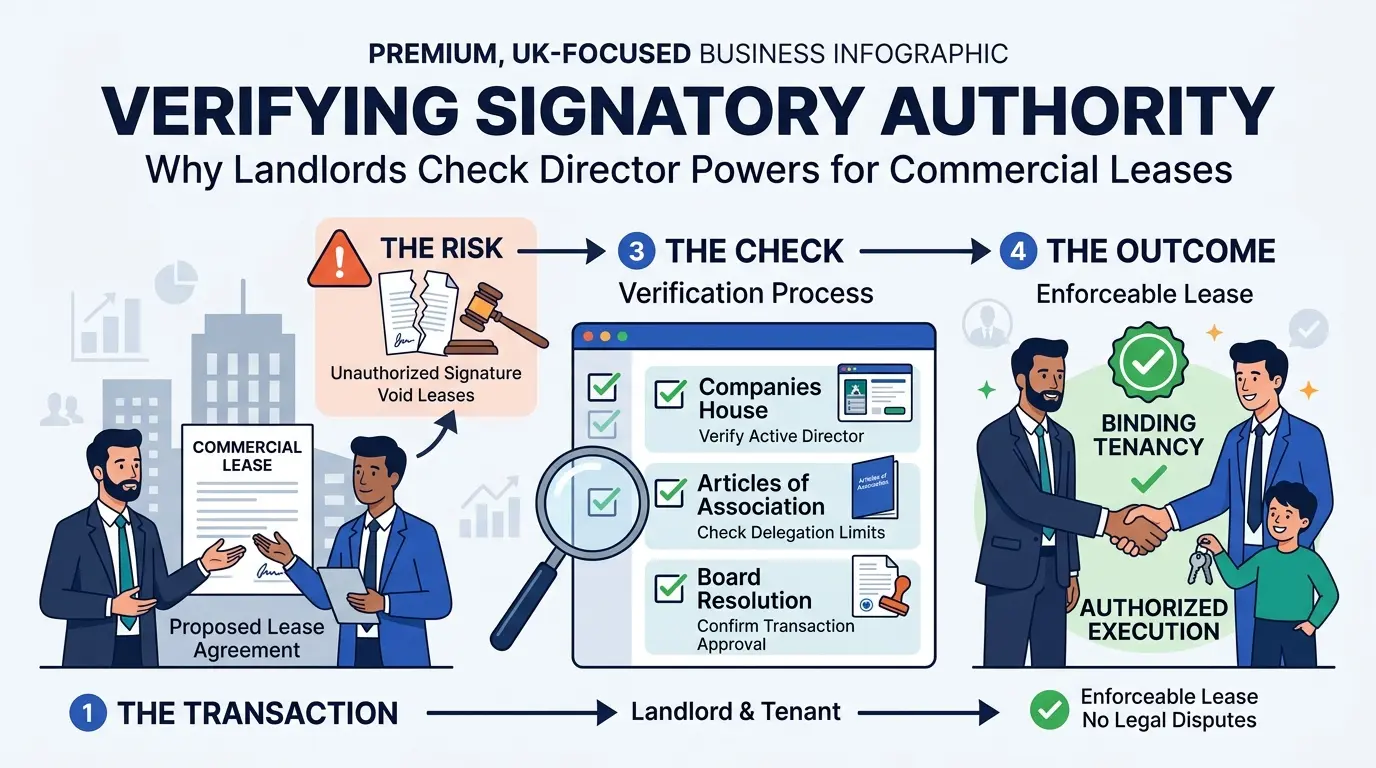
Commercial property leases represent long-term legal and financial commitments. Landlords must ensure that signatories possess actual statutory authority to bind the corporate tenant. Without proper authorization, a commercial lease agreement becomes unenforceable in UK courts.
Company articles dictate exact board procedures for delegating signing power. Landlords examine whether single directors can bind the business independently. They check whether joint signatures or board resolutions are mandatory for real estate contracts.
Verifying signatory authority protects property owners against corporate unauthorized representations. If an unauthorized employee signs a lease, the entity can challenge agreement validity. Proper review of constitutional documents eliminates this risk entirely before tenancy execution.
Property managers cross-reference designated signatories against official corporate filings. They match director identities listed in articles with current Companies House filings. This multi-layered validation safeguards both landlord investments and tenant liability frameworks.
How Do Landlords Assess Borrowing Powers and Guarantees?
Landlords evaluate constitutional borrowing powers to confirm the corporate entity can incur long-term financial liabilities, rent obligations, and lease indemnities. This legal review confirms the corporate board does not exceed internal financial limits when executing binding tenancy contracts.
Financial obligations in commercial leases extend beyond monthly rent payments. Leases include repair covenants, service charges, and long-term financial guarantees. Landlords inspect company articles to verify internal financial authorization thresholds.
Standard articles of association usually grant broad financial authority to corporate boards. Custom constitutional documents often place financial ceilings on director commitments. Landlords verify whether lease obligations breach these specific internal governance caps.
When lease agreements require corporate guarantees or indemnities, legal verification becomes vital. Landlords review constitutional clauses to confirm the business can legally guarantee third-party liabilities. Uncapped guarantee powers ensure parent companies or affiliates can legally back lease commitments.
Proper assessment prevents tenant default based on ultra vires legal defenses. Ultra vires actions occur when directors enter agreements exceeding constitutional authority. Confirming financial limits guarantees full enforceability of all financial lease clauses throughout the tenancy term.
Which Risks Do Property Owners Avoid Through Document Verification?
Landlords review company articles to eliminate legal risks involving corporate fraud, improper execution, operational breaches, and tenancy invalidity. Document checks confirm corporate legitimacy, statutory authority, and business continuity before committing commercial real estate assets to long-term commercial leases.
Commercial property transactions carry significant financial exposure for property owners. Landlords mitigate lease default risks by conducting comprehensive corporate identity verification. Verifying constitutional documents ensures the tenant operates as a legitimate legal entity.
Document checks prevent corporate impersonation and fraudulent tenancy applications. Property owners verify that the applicant entity exists on the official public register. They validate corporate history to establish genuine operational background.
Landlords prevent legal challenge risks regarding lease validity and contract terms. If a tenant enters liquidation, insolvency practitioners audit initial lease execution procedures. Fully verified legal execution prevents tenancy setting-aside during future insolvency proceedings.
Verifying internal rules prevents operational breaches within shared commercial properties. Landlords check whether internal corporate objects conflict with building use classes. Proactive document analysis ensures smooth tenancy management and strict regulatory compliance.
Businesses can acquire tailored supplementary company documents to satisfy stringent commercial landlord verification requirements efficiently.
How Does Model Articles Governance Differ From Custom Articles?
Model articles provide standard default corporate governance frameworks under the Companies Act 2006, whereas custom articles contain tailored clauses restricting director powers. Landlords review custom clauses carefully to identify operational restrictions that could jeopardize commercial lease execution.
The UK Companies Act 2006 supplies default rules called Model Articles to standard private limited companies. Model articles grant directors general management authority to execute ordinary business contracts. Landlords process standard model articles quickly due to predictable legal terms.
Custom articles introduce specific restrictions on director execution authority and financial limits. Companies implement custom provisions to manage shareholder rights or investor conditions. Landlords must identify all non-standard clauses before approving commercial tenancy applications.
Custom clauses often require specific shareholder consent for major commercial transactions. If lease values exceed stated thresholds, directors need explicit shareholder approval. Landlords demand official shareholder resolutions when custom articles limit standard board powers.
Understanding these governance distinctions prevents transaction delays during lease negotiations. Tenants with custom governance structures must present complete documentation early. Clear legal documentation streamlines the tenant vetting procedure for commercial real estate agents.
Tenants preparing for commercial negotiations should learn how to prepare your memorandum and articles for a commercial lease to ensure complete statutory compliance.
What Happens If Your Company Articles Are Outdated or Missing?
Missing or outdated company articles cause lease approval delays, mandatory legal amendments, or complete commercial application rejection. Landlords suspend lease proceedings until corporate entities present officially certified constitutional documents that comply with current UK statutory frameworks.
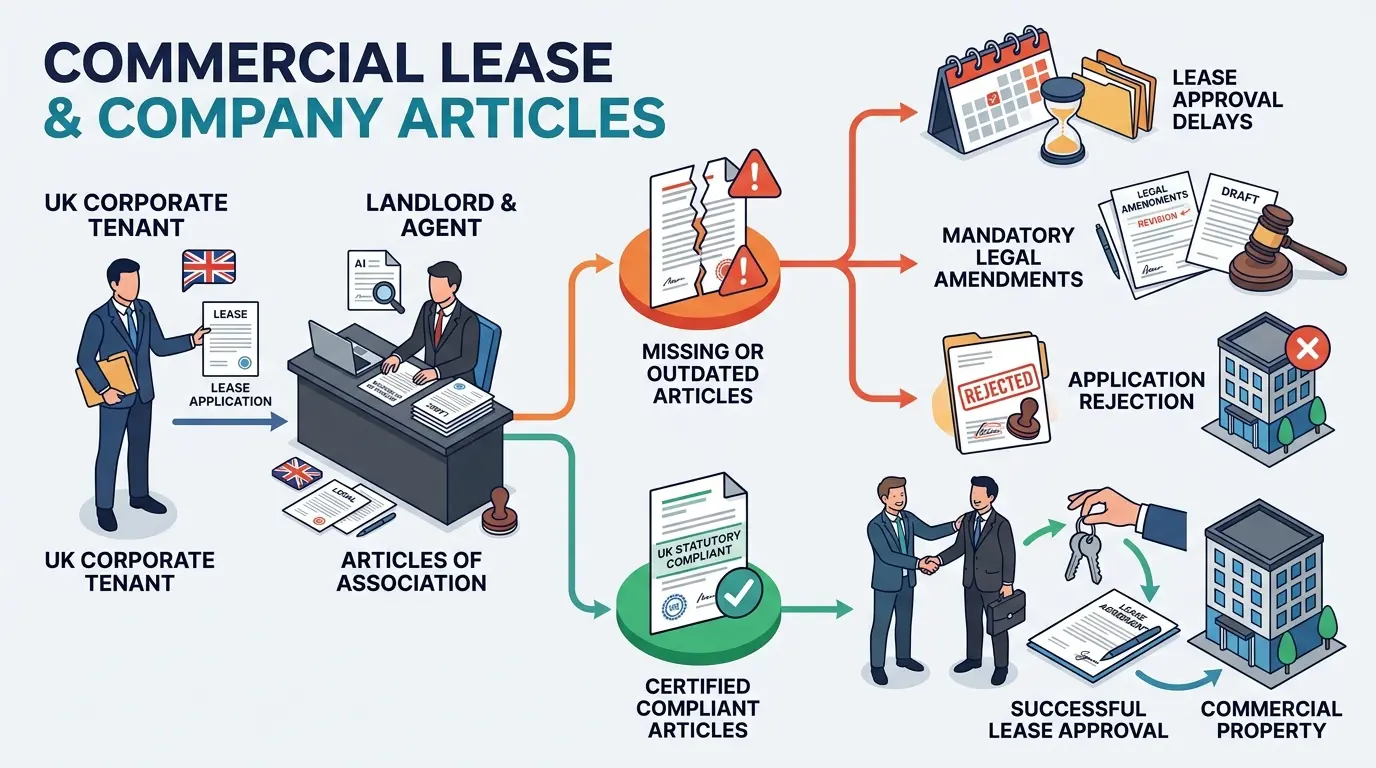
Incomplete governance records present significant legal red flags to commercial landlords. Property owners pause lease negotiations when applicants fail to produce certified constitutional documents. Delaying document delivery can result in losing desirable commercial property locations.
Legacy companies registered under older legislation often maintain outdated constitutional clauses. Articles drafted under the Companies Act 1985 may contain obsolete objects clauses. Modern property transactions require updated constitutional documentation aligning with current legal frameworks.
When original records are lost, companies must obtain official duplicate filings. Landlords require official Companies House copies or certified solicitor duplicates. Unofficial drafts or incomplete templates do not meet legal lease vetting requirements.
If articles contain restrictive clauses blocking lease execution, companies must pass special resolutions. Updating internal articles requires a 75% shareholder approval vote followed by official Companies House registration. Completing these corporate updates promptly ensures lease negotiations proceed without disruption.
To prevent negotiation delays, businesses can order bound company articles for your lease with Form My Company to present professionally certified compliance documentation to landlords immediately.
How Can Businesses Prepare Governance Documents for Lease Approval?
Businesses prepare governance documents by retrieving certified Companies House filings, reviewing internal signing powers, and passing necessary board resolutions. Preparing constitutional paperwork beforehand accelerates commercial property application reviews and ensures seamless legal lease execution.
Proactive document preparation accelerates the commercial tenancy application process. Corporate tenants must audit internal governance files before submitting formal lease applications. Having verified legal documentation available builds confidence with commercial property managers.
Companies must compile a complete corporate compliance file for landlord review. This package contains articles of association, certificate of incorporation, and memorandum of association. Including current officer lists and registered office details ensures complete administrative transparency.
Directors should review signing provisions within their current constitutional documents. If multiple signatures are required, board members must coordinate availability for document signing. Preparing formal board resolutions authorizing designated directors streamlines contract execution.
Form My Company assists growing businesses by delivering legally verified corporate documentation packages. Providing clear constitutional records demonstrates financial maturity and operational stability to commercial property owners.
Landlords demand company articles to verify corporate existence, director authority, and financial execution limits before issuing commercial leases. Thorough document review eliminates legal risk, prevents unauthorized execution, and ensures tenancy enforceability under UK law. Ensuring your constitutional documents are fully updated, certified, and aligned with Companies House records guarantees a smooth lease approval process. Form My Company delivers accurate corporate documentation services to help businesses navigate commercial lease requirements efficiently.
Explore More Supplementary Company Documents Guide,
What Do the Memorandum and Articles Say About Your Company’s Powers?
Why Might Companies House Refuse to Issue a Certificate of Good Standing?
Frequently Asked Questions
What are supplementary company documents and why are they needed?
Supplementary company documents are official legal and constitutional records—such as updated Articles of Association, Share Certificates, or Certificates of Good Standing—that complement standard corporate registration filings. Financial institutions, legal entities, and commercial landlords require these certified records to verify corporate governance, legal ownership, and operational status. Form My Company provides official supplementary company documents to ensure registered businesses meet formal UK legal compliance and verification requirements.
How do I get certified copies of company constitutional documents?
You can request certified copies of constitutional filings directly from Companies House or through a qualified corporate service provider. Form My Company supplies officially certified supplementary company documents formatted specifically to satisfy bank, investor, and landlord due diligence checks. These records confirm current corporate governance structures and document official director authority under UK law.
Why do banks and landlords ask for additional company filings?
Banks and commercial landlords review supplementary company documents to evaluate financial limits, operational powers, and legal signatory authority before approving accounts or real estate leases. This thorough compliance verification ensures that corporate directors possess the legal capacity to enter binding agreements on behalf of the registered business. Utilizing verified supplementary company documents from Form My Company eliminates legal risks associated with unauthorized contract execution.
Can a company update its Articles of Association after incorporation?
Yes, a UK private limited company can amend or update its Articles of Association post-incorporation by passing a special resolution requiring a 75% shareholder vote. Once approved, the updated constitutional documents must be officially submitted to Companies House within 15 days to maintain legal validity. Form My Company assists businesses in procuring updated supplementary company documents to reflect current legal, financial, and governance structures.
What is included in a complete supplementary corporate documentation package?
A complete supplementary corporate documentation package typically includes certified Articles of Association, the Memorandum of Association, official shareholder registers, and proof of good standing. These documents establish transparent corporate lineage, directorship rights, and official business address verification for legal transactions. Obtaining a comprehensive suite of supplementary company documents through Form My Company ensures full regulatory compliance during commercial negotiations.