
A virtual office can give your business a professional address and selected administrative support without requiring you to work from a dedicated office. The services included depend on the arrangement, so it’s worth separating your address, post, calls and meeting needs before choosing.
If you’re unsure what the term includes, or how it differs from a business address or registered office, you’re not alone. These services can serve different purposes, so focus on what your business needs rather than relying on the label alone.
This guide explains common virtual office services and how to assess your address, mail, call and meeting requirements separately. You’ll also learn what to consider when choosing an arrangement, including the distinct role of a registered office address. Form My Company provides virtual office services, a separate Registered Office Address Service and meeting room hire, so you can consider support that fits your needs.
Key Takeaways
- A virtual office can provide remote business support without requiring a dedicated workspace.
- Separate the purpose of your address from mail handling, call answering and meeting room needs.
- Compare services by what they cover, rather than relying on the virtual office label alone.
- Before choosing services, document where you plan to use the address and who will manage correspondence.
- Form My Company offers virtual office and business address services, with meeting room hire for in-person discussions.
What is a virtual office, and what problem does it solve?
You can run a business without working from commercial premises every day, but you may still need a way to handle business correspondence or present a dedicated business address. A virtual office brings selected remote business support together without necessarily providing a permanent desk or workspace.
A virtual office is a set of business support services that gives a company an address and other practical options without leasing a conventional office for everyday use. The exact mix varies. An address is one service; receiving or managing post, answering calls and using a meeting room are separate needs that may be offered alongside it. The virtual office Wikipedia overview also describes the range of services associated with the concept.
For founders, an address can help keep business correspondence separate from a home address. Other support may suit particular tasks: mail handling can help manage incoming post, call answering can support telephone enquiries, and meeting room access can provide a place to meet when required. Don’t assume that one service automatically includes the others. Form My Company provides business address services as well as virtual office services, so consider the purpose of each separately.
The distinction matters for official use, too. A business-facing address and a registered office address are not automatically interchangeable. Whether an address is suitable for a statutory purpose depends on the address itself and the requirements that apply to your company or organisation. Resolve this before using an address on formal records or correspondence.
Who might benefit from a virtual office?
A virtual office may suit a founder who works from home or remotely but wants business correspondence handled separately, or who needs selected administrative support without taking on daily premises. A growing business may also value occasional in-person meeting space whilst its team continues to work remotely. Choose according to the tasks you need to support, not simply the size or stage of the business.
Different business structures can have different address requirements, so don’t assume the same option will work for every organisation. First identify where the address will appear and what role it needs to serve.
What a virtual office does not automatically provide
The label alone doesn’t tell you what is included. Access to an address does not necessarily mean post is handled, calls are answered, or meeting rooms are available. Nor should you assume there’s a staffed workplace or permanent desk. Those are distinct from having an address for business use.
Before choosing, list the tasks you need covered. Separate everyday correspondence from calls, meetings and any formal address purpose. Then assess each service against its intended use and the applicable requirements. This helps you choose practical support without taking on services that don’t match how your business operates.
Which virtual office services do businesses actually use?
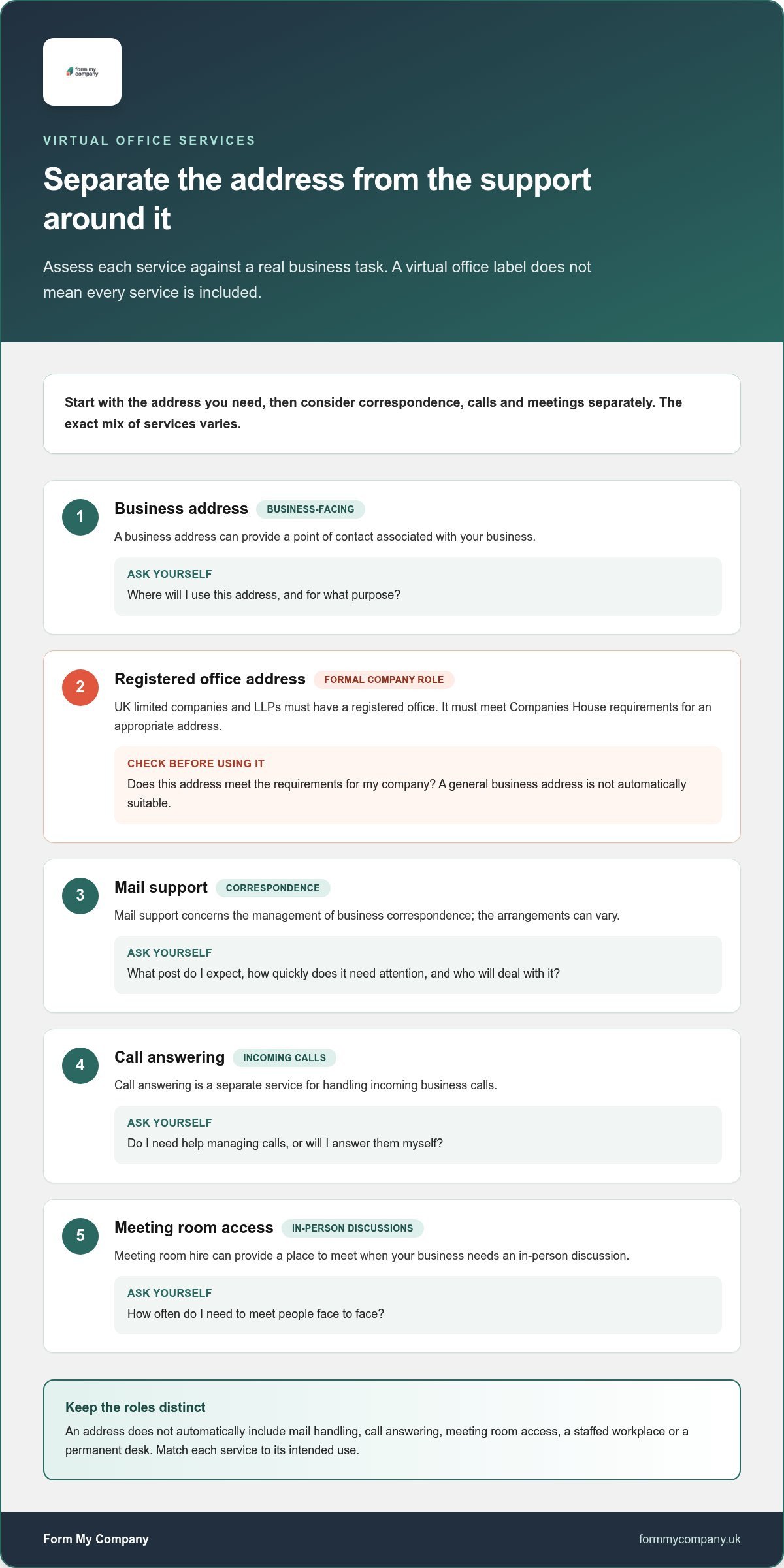
A virtual office is a service category, not one universally fixed package. One business may need an address for its public-facing details; another may need support with correspondence, incoming calls or occasional in-person meetings. Treat each element as a separate choice, then select only what supports a real business task.
Use this comparison to identify what you need before considering how services are grouped or named.
| Service | Typical purpose | Question to answer |
|---|---|---|
| Business address | Present a business-facing address for relevant business use. | Where will I use it, and for what purpose? |
| Registered office address | Provide a company’s formal registered address. | Does this address meet the requirements for my company? |
| Mail support | Help manage business correspondence. | What post do I expect, and who needs to deal with it? |
| Call answering | Support the handling of incoming business calls. | Do I need help managing calls, or will I answer them myself? |
| Meeting room access | Provide a place for in-person discussions when needed. | How often do I need to meet people face to face? |
Business address and registered office: understand the distinction
A business address can give customers, suppliers or other contacts a point of contact associated with your business. Its suitability depends on how you intend to use it. A registered office has a distinct formal role: UK limited companies and LLPs must have one, and it must meet Companies House requirements for an appropriate address. Don’t assume every business address is suitable for this purpose.
Form My Company provides a separate Registered Office Address Service. If you’re considering an address for company records, distinguish that formal need from a general business-facing address and consider the requirements that apply to your company.
Mail, calls and meeting rooms: match services to tasks
Mail support concerns the management of business correspondence, but the exact arrangements can vary. Think about the type and volume of post you expect, how quickly it needs attention and who in your business will take responsibility for it. This helps you define the practical service you need without assuming every address service handles mail in the same way.
How should you compare virtual office options for your business?
Compare the service against the work it needs to do, not the label on a package. A virtual office doesn’t automatically mean a registered office, a staffed workplace or a permanent desk. Address use, correspondence, calls, meetings and administration are separate considerations, even when services are presented together.
Use this framework to separate essential support from occasional-use options:
| Need | What to assess | Must-have or occasional-use? |
|---|---|---|
| Address purpose | Will it appear on business materials, handle correspondence or serve a formal company purpose? | Usually a must-have if required for your chosen use. |
| How often do you expect business post, and who will manage it? | Must-have if regular correspondence needs attention. | |
| Calls | Do you receive frequent business calls that need support, or can your team handle them? | Choose according to call volume and responsibility. |
| Meeting access | Do you need a room regularly, or only for occasional face-to-face discussions? | Often occasional-use if most work is remote. |
| Administration | Which address-related and communication tasks need organising? | Prioritise specific gaps rather than a broad label. |
Which address purpose matters most to your business?
Write down every place you expect to use an address, such as for business correspondence, public-facing details or formal company records. These purposes aren’t interchangeable. A general business address may suit one use but not another, and a registered office has a formal role for a company. Its suitability depends on the intended use and applicable requirements, including Companies House rules. Identify the purpose first, then assess the address against it. Don’t assume that an address is suitable for every use.
How much communication and meeting support do you need?
Meetings follow a different pattern. A business that meets clients in person often may need regular room access; one that mainly works remotely may only need a room occasionally. Form My Company offers meeting room hire as a separate service, so consider it on its own merits rather than assuming it comes with an address.
Use a simple rule: mark recurring operational requirements as must-haves, then keep occasional needs separate. Compare what each service covers, who manages the task and how often you’ll use it. That makes it easier to choose practical support without adding services that don’t solve a current business need. Explore Form My Company’s business support as you decide which services fit.
How do you prepare to use a virtual office?
Make the decision in a clear order: define what the address is for, identify the support your business needs, check the requirements that apply, then select services. This preparation helps you plan how the arrangement will work in practice, including where the address will appear and who will deal with correspondence.
- Define the address purpose. List each intended use, such as business correspondence, public-facing business details or formal company records. Record exactly where the address may appear, rather than treating every use as the same requirement.
- List the support you need. Note the post you expect, who will manage it, whether incoming calls need support and how often you may need a meeting room. Separate ongoing tasks from occasional ones.
- Check applicable requirements. Address rules can differ according to the purpose. Statutory company requirements and tax-related requirements may not be identical, so consult current official guidance for each intended use before relying on an address.
- Select services to match. Choose the address and any additional support that meets a defined need. Don’t assume a standard package is necessary, or that every service category will be useful to your business.
Set out your address and administration requirements
Keep a short written record of where the address will be used and what each use is for. For example, distinguish a correspondence address from an address intended for formal company records. Then name the person responsible for receiving, reviewing and acting on official communications. Clear ownership matters: a message only helps if someone knows it has arrived and is responsible for the next step.
If you’re assessing an address for business-facing use, Form My Company provides a business address service. Consider its purpose separately from a registered office address, and use the relevant current requirements to assess any proposed formal use.
Choose only the support your working pattern needs
Match services to the way your business operates. If business post needs active management, include mail support in your requirements. If calls regularly interrupt work or need someone responsible for handling enquiries, consider call answering. If you meet clients in person only from time to time, meeting room hire may address that occasional need without making it part of your everyday setup.
Mark each item as regular, occasional or unnecessary for now. Regular needs may justify ongoing support; an occasional meeting can be planned separately. The right combination depends on your business’s address purpose, working pattern and administration, not on assumptions about what a virtual office package should contain.
Once your checklist is ready, explore Form My Company’s virtual office services and choose support that fits the requirements you’ve identified.
How can Form My Company support your virtual office needs?
Form My Company provides virtual office and business address services as part of its wider UK company formation and administration offering. These address services can support different needs: a virtual office arrangement may help with remote business operations, whilst a business address serves a purpose you identify for your business. Neither label means an address automatically suits every formal use.
Meeting room hire is also available as a separate service. Consider it if you need a place for an in-person discussion. Keeping the choice distinct makes it easier to build support around the way your business works, rather than assuming every service belongs in one package.
Connect your address decision with company formation
Address planning is one practical part of establishing or administering a UK company. As you organise the company’s details, decide where the address will be used and distinguish general business correspondence from any formal registered office purpose. Applicable requirements depend on the intended use and company circumstances, so don’t assume one arrangement is suitable for every company structure or official purpose.
Form My Company also provides a separate Registered Office Address Service. Treat this as distinct from its virtual office and business address services, and consider the relevant requirements for the specific purpose you have in mind. Keeping the address decision clear at the outset can help you organise where communications should go and who in the business is responsible for them.
Take the next step with a clear service requirement
Start with the address purpose. Then decide whether your working pattern calls for help with correspondence, incoming calls or occasional meetings. For example, a business that manages its own calls may not need call answering, whilst one that meets people face to face only occasionally can consider room hire separately. Your requirements, not assumptions about a standard package, should guide the combination you choose.
Once you’ve identified the purpose of the address and any additional support you need, explore Form My Company’s virtual office services. The service page is a practical next step for reviewing this option in the context of your requirements.
You don’t need a long brief to get started. A concise list of intended address uses, communication needs and meeting requirements gives you a clearer basis for choosing relevant support. Explore your virtual office options and take the next step with your priorities in hand.
Choose a setup that can grow with your needs
Your next step doesn’t need to settle every future requirement. Start with the purpose you need to address now, then keep occasional or future needs separate. That gives you a clear basis for choosing support without adding services simply because they’re grouped together.
Before you decide, write down where you intend to use the address and who will manage related communications. Keep formal company use distinct from general business correspondence, and consider whether call answering or meeting room hire addresses a practical need in your working pattern. This short plan can make it easier to assess a virtual office arrangement on its merits.
Form My Company offers virtual office services and a separate Registered Office Address Service. Meeting room hire is also available as a related business service. Explore the options and decide which ones fit your requirements.
Explore virtual office services and take your next step with confidence. A clear list of priorities is enough to get started.
Frequently Asked Questions
What is a virtual office in the UK?
In the UK, a virtual office is a way to access selected business support without basing your day-to-day work in a leased office. Depending on the arrangement, this may include an address, correspondence support, calls or meeting space. For example, a consultant working entirely online might want a business-facing address but have no need for a regular desk. Look at the specific services provided, not just the name.
Can a virtual office address be used as a registered office?
It can be used for a limited company if the address meets Companies House requirements for a registered office. It must be an appropriate address where documents can be delivered and signed for, and it must be in the UK jurisdiction where the company is registered. A PO Box alone isn’t sufficient. Before using an address for this formal purpose, check that it meets the current requirements and that official post will be dealt with.
Is a virtual office suitable for a limited company?
Yes, it can suit a limited company, provided the arrangement supports the company’s actual needs and any address used for formal purposes meets applicable requirements. For instance, a director who works from home may want to keep business contact details separate from their home life. They should still plan how company communications will reach the right person and be acted on, rather than assuming an address alone manages company administration.
What is the difference between a virtual office and a business address?
A business address describes an address used for a business purpose; a virtual office may refer to a broader arrangement of remote business support. The terms don’t guarantee the same services. For example, a business may need an address for correspondence but handle all post and calls itself. A separate address used for formal company records has its own requirements, so identify the purpose before deciding what service fits.
Can I use a virtual office if I work from home?
Yes. Working from home doesn’t prevent you from using separate business support. A home-based designer, for example, could keep working from a spare room while using a business address for relevant business contact purposes. Before choosing, consider where that address will appear and how you’ll handle correspondence sent there. If you plan to use it for a formal purpose, check the applicable rules rather than relying on the service label.
Does a virtual office include mail handling and call answering?
Not necessarily. Services vary, so an address arrangement shouldn’t be taken to mean that post is managed or incoming calls are answered. Think about your actual workflow: if invoices or official letters arrive at an address, decide who will monitor and act on them. If calls need separate support, treat call answering as its own requirement. Clear expectations help prevent important messages from being overlooked.
How do I choose a virtual office service for my business?
Start with a short written brief: state the address purpose, the communications you expect and who will manage them. Then separate essential ongoing support from services you’d use only occasionally, such as meeting space. Compare the service descriptions against each task, and check current requirements for any formal address use. This makes the decision more specific than choosing by package name and helps keep your arrangement aligned with how the business operates.