
To update your Articles of Association, pass a special resolution requiring a 75% shareholder majority vote. You must submit the updated articles, special resolution, and Form CC04 to Companies House within 15 days of approval.
Why Must UK Companies Update Their Articles of Association?
UK companies update their Articles of Association to align corporate governance with statutory requirements, accommodate ownership changes, and integrate modern operational policies. Failure to amend outdated governance rules restricts commercial agility, delays investment rounds, and creates regulatory non-compliance.
Articles of Association serve as the constitutional foundation for every UK private limited company. The Companies Act 2006 establishes the statutory framework governing these internal regulations. Many businesses operate on outdated Model Articles that do not support complex share structures or modern governance needs. Updating these constitutional documents ensures your business retains operational flexibility while remaining legally compliant.
When share classes expand, existing provisions often fail to govern dividend rights or voting power accurately. Amending your constitutional framework establishes clear shareholder agreements, prevents internal disputes, and streamlines decision-making processes. Investors frequently require tailored constitutional clauses before capital injection, such as drag-along rights, tag-along rights, or specific director appointment powers.
Outdated governance structures expose directors to personal liability and regulatory enforcement. For instance, understanding what happens when your articles of association are out of date helps board members identify legal vulnerabilities before disputes arise. Regular constitutional reviews align corporate governance with active commercial strategies, enabling seamless expansion and risk mitigation.
What Board Actions Are Required Before Updating Articles?
Board members must convene an official meeting, review proposed constitutional changes, draft the new Articles of Association, and formally propose a special resolution to shareholders. These preliminary actions ensure procedural validity and prevent legal challenges from minority shareholders.
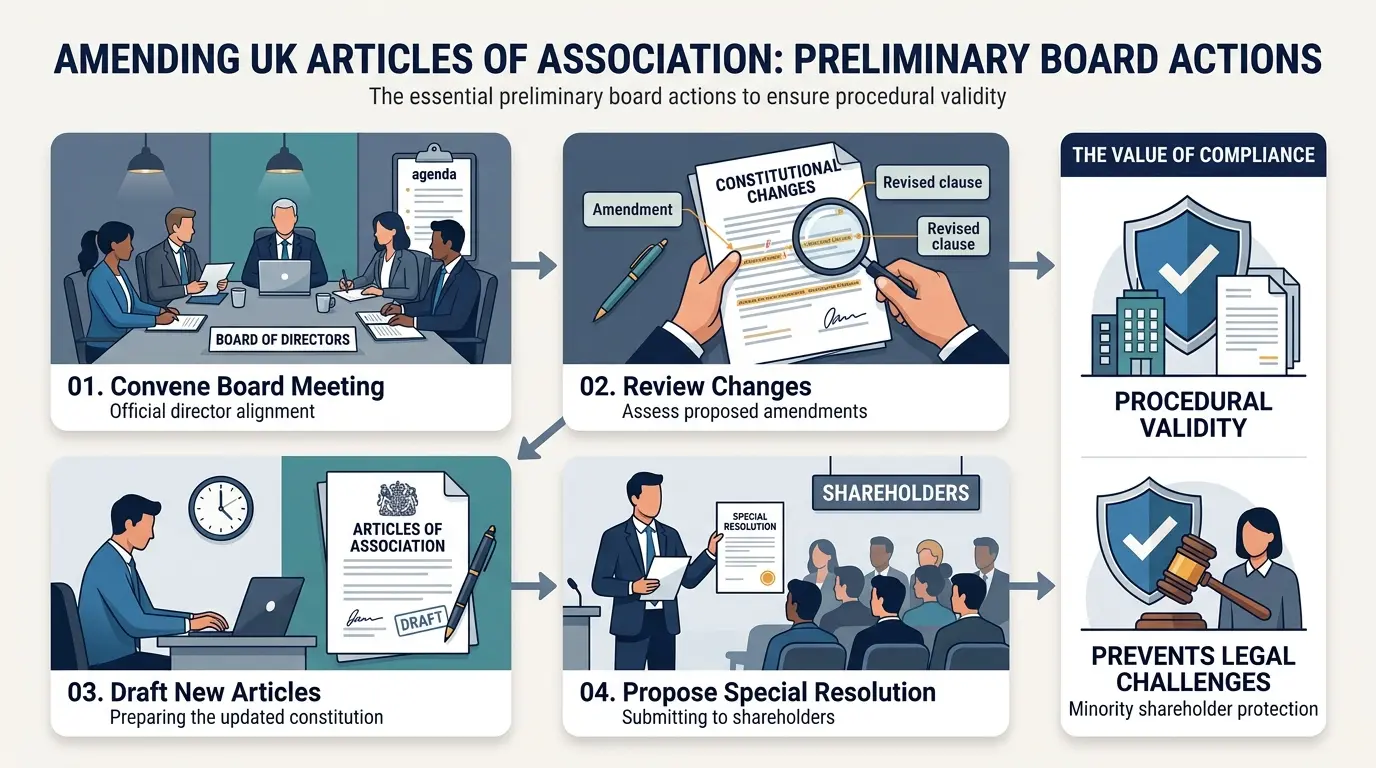
Updating constitutional documents requires strict adherence to corporate protocol. Directors must review current governance provisions to identify conflicting clauses, obsolete provisions, and missing statutory powers. Drafting proposed amendments demands precise legal language to guarantee enforceability under current UK corporate law.
The board of directors must hold a formal board meeting to approve the proposed draft. During this meeting, directors vote to approve the text and schedule a general meeting for shareholder approval. Directors may also obtain shareholder consent using the written resolution procedure if the company constitution permits written voting.
Accurate board minutes must record the rationale for amending the constitution, the specific clauses changed, and the authorization to notify shareholders. Failing to document board approvals invalidates subsequent shareholder resolutions and creates regulatory non-compliance during official audits. Proper meeting documentation provides a clear audit trail for legal authorities, tax advisors, and prospective investors.
How Do Shareholders Approve Amending Articles of Association?
Shareholders approve amendments to the Articles of Association by passing a special resolution, which requires a minimum 75% majority vote. Shareholders cast votes either at a formally convened general meeting or through a legally binding written resolution.
Section 21 of the Companies Act 2006 mandates that any constitutional alteration requires a special resolution. A standard ordinary resolution requiring a simple majority is insufficient for constitutional changes. Shareholders holding at least 75% of the total voting rights must vote in favor of the resolution to make the amendments legally binding.
When convening a general meeting, directors must issue a formal notice at least 14 clear days in advance. The notice must contain the exact text of the proposed special resolution and the full text of the proposed new articles. Alternatively, private limited companies can pass written resolutions, provided the requisite 75% voting threshold is achieved within 28 days of circulation.
Accurate vote counting requires verifying shareholder eligibility, voting power, and proxy designations. After achieving the 75% threshold, the company secretary or designated director must sign and date the resolution. Once approved, the amended articles instantly bind the company, its directors, and all shareholders.
Which Forms Must You File With Companies House?
Companies must file Form CC04 alongside a signed copy of the special resolution and the full text of the newly adopted Articles of Association. All documents must reach Companies House within 15 days of the shareholder resolution date.
Filing constitutional updates requires submitting three primary documents to the official registry. The first document is the complete copy of the special resolution authorising the constitutional change. The second document is the complete copy of the amended Articles of Association, containing all revised clauses and formatting.
The third submission requirement is Form CC04, titled Statement of Company’s Objects, if the company alters its main business scope alongside the articles. If the amendments do not alter business objects, submitting the special resolution and the new articles satisfies statutory filing rules. Filings must occur within 15 calendar days of the resolution passing.
Late submissions attract administrative penalties, public registry queries, and potential legal invalidation of governance decisions. Submitting documentation electronically via Companies House online portals accelerates processing times, ensuring the public register reflects current governance structures immediately. Ensure every page displays correct corporate details, including the registered company name and company number.
How Do You Prepare the Amended Articles Document for Submission?
To prepare amended articles for submission, compile the full updated document text, execute signature blocks, reformat numbering sequentially, and save the file in print-ready PDF format. Companies House rejects partial clause updates and incomplete document submissions.
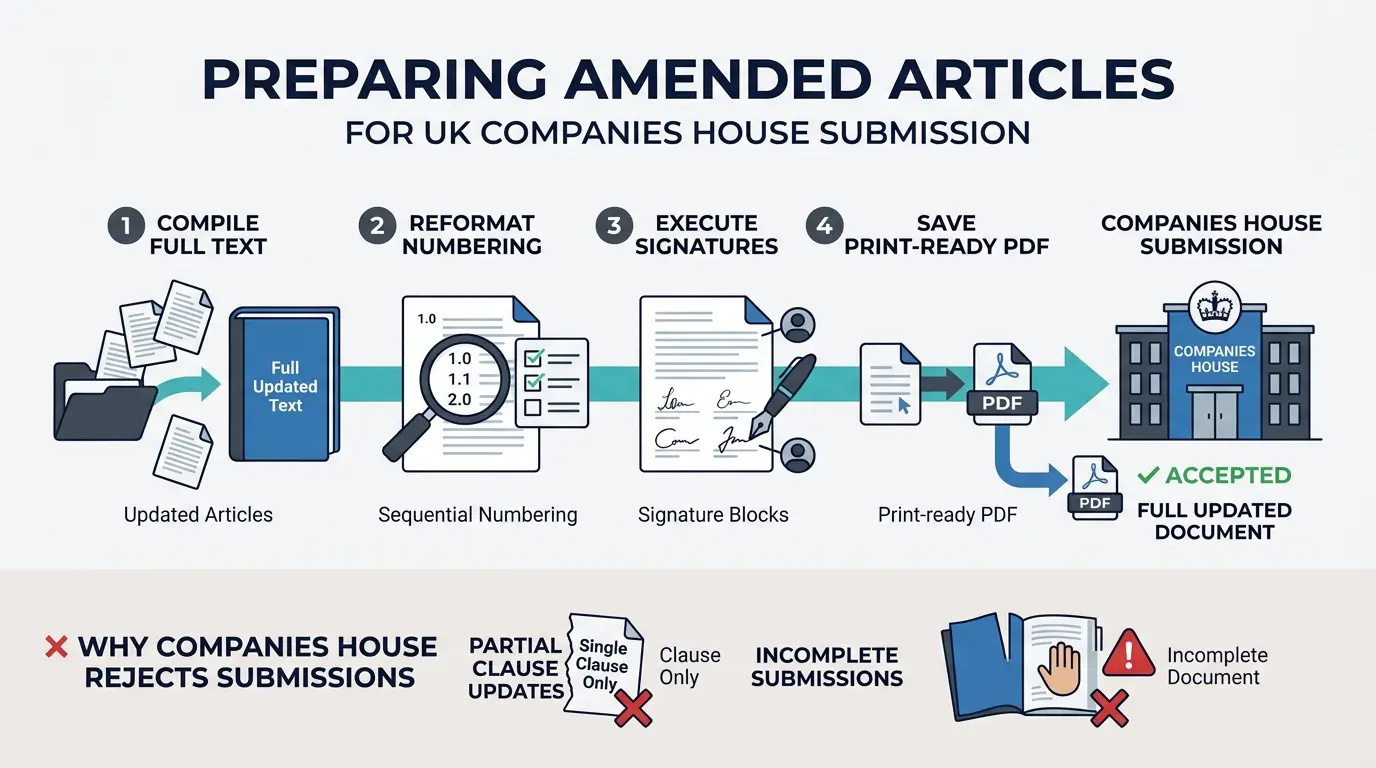
Companies House accepts only complete, fully written constitutional documents. Submitting isolated amendments or single-page alterations causes immediate rejection by registry staff. The submission must represent the complete, stand-alone constitution that replaces all prior versions in their entirety.
The revised document must maintain clear, logical formatting. Numbering schemes must remain sequential across all sections, sub-sections, and definitions. Cross-references between clauses must be checked to eliminate references to revoked clauses. Ensure that corporate details on the title page match current Companies House register entries exactly.
Digital copies submitted electronically must meet specific technical parameters, including crisp typography and unencrypted PDF formatting. Board members can manage administrative burden by utilizing tailored solutions to order supplementary company documents that satisfy all statutory Companies House formatting standards. Clean document presentation ensures rapid registry approval and public record accuracy.
What Are the Penalties for Failing to File Updated Articles?
Failing to file updated Articles of Association within 15 days constitutes a criminal offense under Section 26 of the Companies Act 2006. The company and every defaulting officer face financial fines, legal unenforceability, and corporate registry sanctions.
Timely registration of constitutional updates is a legal obligation under UK corporate law. If a company passes a special resolution but fails to submit updated articles within 15 days, the company and its officers incur statutory liability. Initial court fines can reach level 3 on the standard scale, along with daily default fines for continued non-compliance.
Beyond financial penalties, failure to file creates significant legal uncertainty for corporate transactions. Unfiled articles cannot be enforced against third parties who rely on the public Companies House register. Third parties, including commercial banks and financial lenders, treat unregistered constitutional changes as legally void until registered.
Delayed filings jeopardize ongoing business operations, commercial acquisitions, and equity financing. Investors conducting legal due diligence will identify gaps between internal shareholder agreements and public filings. Resolving registry discrepancies requires retrospective filings, board ratifications, and unnecessary administrative costs.
How Does Updating Articles Affect Existing Shareholder Agreements?
Updating the Articles of Association requires aligning constitutional clauses with existing shareholder agreements to eliminate legal contradictions. In the event of a conflict between public articles and private agreements, public articles generally govern third-party interactions.
Shareholder agreements operate as private contracts between equity holders, whereas Articles of Association form a public constitutional document. When updating constitutional rules, companies must reconcile both documents to maintain operational consistency. Conflicting provisions create operational paralysis, voting deadlocks, and costly shareholder litigation.
Key provisions requiring alignment include pre-emption rights, share transfer restrictions, dividend distribution rules, and board representation thresholds. For instance, if a private agreement grants specific veto rights but the public articles omit them, directors face conflicting obligations. Updating the public constitution establishes statutory enforceability for key commercial terms.
When revising governance frameworks, directors must evaluate whether private contracts require formal amendment alongside public filings. Aligning public articles with private investor terms protects business founders, secures minority shareholder rights, and provides clarity for corporate governance operations.
How Long Does Companies House Take to Process Updated Articles?
Companies House processes electronic filings within 24 to 48 hours, whereas paper submissions take 10 to 15 working days. Once processed, the updated Articles of Association become part of the official public record.
Processing times depend heavily on the submission method chosen by company officers. WebFiling and electronic portal submissions process rapidly because automated validation checks verify corporate information instantly. Electronic submissions receive immediate digital receipts, confirming successful delivery to registry systems.
Paper applications submitted via postal mail experience longer processing queues. Manual data entry, physical verification, and mail delivery introduce significant delays. If paper filings contain typographical errors or incomplete details, Companies House returns the entire submission, restarting the statutory 15-day timeline.
Businesses requiring urgent corporate updates should prioritize digital filing workflows. Rapid registration ensures that external entities, such as commercial banks, trade registries, and institutional investors, can verify updated constitutional frameworks without delay.
How Can Businesses Maintain Ongoing Constitutional Compliance?
Businesses maintain constitutional compliance by conducting annual governance reviews, monitoring statutory legal updates, tracking shareholder changes, and updating corporate records promptly. Routine compliance prevents regulatory breaches and supports long-term commercial growth.
Maintaining compliant governance documents is an ongoing operational commitment. As UK corporate laws evolve, statutory Model Articles require customization to preserve commercial relevance. Regular reviews ensure company constitutions accommodate changing tax legislation, director appointments, and operational strategies.
Corporate secretaries and directors must establish robust internal auditing schedules. Whenever company ownership structures change or new funding rounds occur, officers should evaluate whether existing articles support new share classes. Documenting every governance decision preserves statutory compliance and simplifies statutory annual filings.
Professional business service providers streamline corporate management by handling complex filings, drafting resolutions, and managing official submissions. Companies looking to simplify governance tasks can refresh bound memorandum & articles with Form My Company to guarantee accuracy, regulatory compliance, and rapid processing.
Updating Articles of Association requires strict adherence to legal procedures, including passing a special shareholder resolution by a 75% majority vote and submitting required documentation within 15 days. Filing Form CC04 alongside the new articles ensures compliance with the Companies Act 2006 and avoids statutory fines. Maintaining clear, updated public records protects corporate governance, secures shareholder rights, and facilitates seamless commercial transactions. Form My Company assists UK businesses by providing professional document drafting, constitutional reviews, and statutory Companies House filing services to ensure corporate compliance.
Explore More Supplementary Company Documents Guide,
How to Store Bound Articles Alongside Your Statutory Registers
How to Prepare Your Memorandum and Articles for a Commercial Lease
Frequently Asked Questions
What Are Supplementary Company Documents in the UK?
Supplementary company documents are official filings, certificates, and resolutions that supplement core incorporation papers to reflect ongoing governance updates. Businesses utilize the Supplementary Company Documents service from Form My Company to obtain verified record packs, updated Articles, and legal resolution filings required by Companies House.
Why Do UK Businesses Need Supplementary Company Documents?
UK limited companies need supplementary documents to establish legal compliance during corporate audits, bank account applications, funding rounds, and international expansion. Utilizing Supplementary Company Documents through Form My Company provides verified proof of current ownership structures, active filing status, and official director details to third-party stakeholders.
What Is Included in Form My Company’s Supplementary Company Documents Service?
Form My Company’s Supplementary Company Documents service provides professionally drafted special resolutions, certified company registers, updated constitutions, and official Certificates of Good Standing. This service ensures all corporate governance modifications meet statutory Companies House standards and strict legal formatting guidelines.
How Do You File Supplementary Company Documents With Companies House?
Companies file supplementary documents by submitting updated constitutional texts, official board resolutions, or designated statutory notices directly to Companies House within mandatory filing deadlines. Form My Company manages this process by preparing compliant document packages and submitting accurate records directly to the official registrar.
How Quickly Can You Obtain Certified Supplementary Documents?
Digital supplementary document filings and official electronic extracts are typically processed by Companies House within 24 to 48 hours. Selecting the Supplementary Company Documents package from Form My Company ensures rapid turnarounds for solicitor-certified hard copies and official document packs.