
Share transfer rules in Articles of Association define the constitutional procedures, director powers, and statutory restrictions governing the transfer of ownership in a UK limited company. They regulate director approval rights, pre-emption mechanisms, legal execution, and mandatory registration requirements.
Why Do Articles of Association Regulate Share Transfers?
Articles of Association regulate share transfers to maintain company ownership structure, protect shareholder value, and enforce legal compliance under the Companies Act 2006. These provisions establish clear transfer protocols, prevent unauthorized share movements, and safeguard proprietary business interests.
UK company law establishes the Articles of Association as a legally binding constitutional contract. Section 33 of the Companies Act 2006 binds the company and its members to all internal regulations. Share transfer rules prevent unknown third parties from buying equity without existing member consent. They establish clear operational standards for legal ownership changes within private limited structures.
Private companies rely on transfer rules to maintain financial stability and strategic focus. Unrestricted share transfers expose corporate structures to hostile entry or competitor involvement. The articles define clear parameters for share valuations, member notifications, and board approvals. These rules ensure every equity change aligns with established business objectives.
Directors hold a fiduciary duty to enforce constitutional provisions during equity movements. The articles outline exact administrative steps for reviewing transfer instruments and recording member names. Proper regulation minimizes internal shareholder disputes and provides legal certainty during corporate restructuring. Statutory frameworks ensure transparent record-keeping across all private limited entities.
What Powers Do Directors Have to Refuse Share Transfers?
Directors hold the constitutional authority to refuse share transfer registrations when the Articles of Association grant explicit discretionary powers. Refusals require formal board resolution, valid contractual reasons, and written notification to the transferee within two months.
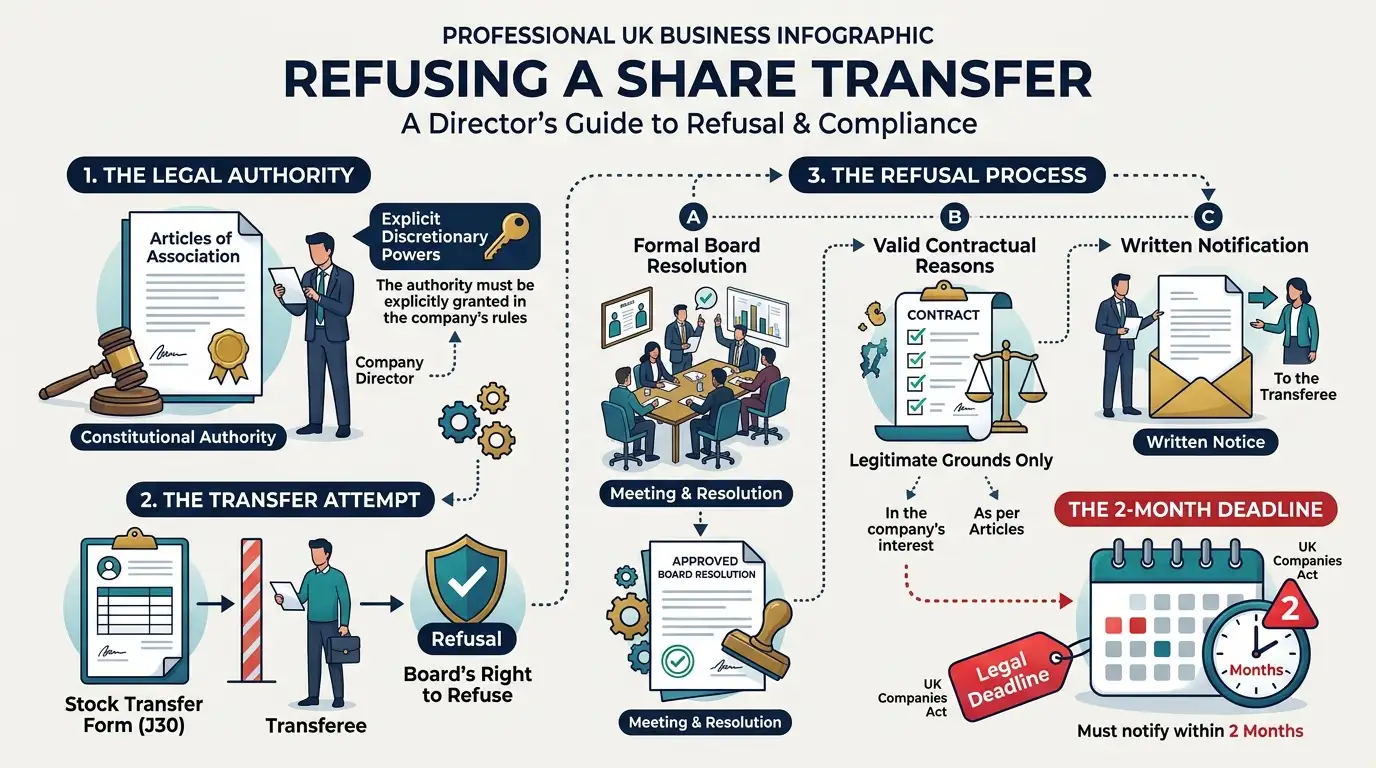
Model Articles for private limited companies grant directors absolute discretion to refuse share transfers. Directors exercise this power under Article 26 to protect company stability. The board must hold a formal meeting to evaluate every submitted transfer instrument. They must vote on the transfer request in good faith.
The Companies Act 2006 imposes strict statutory timelines on transfer refusals. Section 771 mandates that directors notify the transferee of a refusal within two months. The notice must contain specific reasons for withholding registration approval. Failure to provide reasons constitutes an offense by the company and its officers.
Refusal grounds must align with constitutional authority and fiduciary responsibilities. Valid refusal grounds include unpaid call payments, bad faith transactions, or competitor acquisition attempts. Directors cannot refuse transfers arbitrarily or for personal benefit. Courts invalidate transfer refusals executed outside constitutional boundaries or legal fiduciary duties.
How Do Pre-emption Rights Affect Private Share Transfers?
Pre-emption rights force selling shareholders to offer their equity to existing members before transferring shares to external buyers. These rights establish mandatory offer pricing, precise notification periods, and proportional allocation formulas based on existing holdings.
Pre-emption rights preserve existing shareholder equity percentages during ownership changes. When a member decides to sell equity, the articles trigger a right of first refusal. Existing shareholders receive written notice detailing the proposed transfer volume and valuation. Members maintain the right to purchase shares proportionally to their current holdings.
The constitutional provisions establish fixed timelines for exercising pre-emption options. Transfer notices specify a precise window, typically between 14 and 30 days, for member responses. If existing shareholders decline the purchase offer, the seller gains authorization for external transfers. The external transfer price cannot fall below the price offered to internal members.
Pre-emption clauses define clear valuation mechanisms to resolve price disagreements. Articles specify valuation methods through independent auditor assessments, fair market value calculations, or agreed formula pricing. Clear valuation rules eliminate transfer deadlocks and protect minority shareholders from equity dilution. Proper execution maintains corporate valuation standards during internal ownership transitions.
What Documents Are Required to Complete a Share Transfer?
Completing a share transfer requires a executed Stock Transfer Form J30, board approval minutes, stamped transfer documents, and updated internal statutory registers. Companies must issue new physical or digital share certificates within two months of registration.
The legal transfer process begins with the execution of a Stock Transfer Form J30. The transferor and transferee complete the form with full legal names, addresses, and consideration amounts. Transfers exceeding £1,000 require formal submission to HM Revenue and Customs for Stamp Duty payment. HMRC stamps the transfer form upon receiving the mandatory 0.5% duty payment.
Directors review the stamped J30 form alongside the primary constitutional files. When managing complex corporate restructuring, companies utilize specialized Supplementary Company Documents to ensure constitutional alignment and maintain regulatory compliance. Board members verify that the transaction complies with all pre-emption rights and constitutional restrictions. Upon verification, the board passes a formal resolution approving the registration of the new shareholder.
Administrative completion requires immediate updates to company registers. The board records the transferee details in the Register of Members under Section 113 rules. Legal ownership transfers officially when the company writes the new member into the statutory register. The business cancels old share certificates and issues updated documentation within two months.
What Restrictions Can Articles Impose on Share Valuation?
Articles of Association impose valuation restrictions by defining mandatory appraisal formulas, appointing independent chartered accountants, and excluding speculative market pricing. These restrictions prevent inflated offer prices and establish fair market valuations for internal share sales.
Constitutional valuation provisions control how members price equity during forced or voluntary transfers. Unrestricted pricing allows departing shareholders to demand unviable purchase rates from existing members. Articles eliminate speculative pricing by locking in precise financial appraisal rules. These formulas often link share value to asset backing, net earnings, or EBITDA multiples.
Independent valuation mechanisms resolve disputes between buyers and sellers. Articles designate qualified third-party auditors to determine fair value when parties disagree. The independent auditor acts as an expert rather than an arbitrator. The auditor evaluates balance sheets, revenue streams, and cash flows using statutory accounting standards.
Valuation restrictions apply directly during compulsory transfer events. Standard articles enforce mandatory transfer clauses when employees leave, members die, or insolvency occurs. Bad leaver provisions set share values at nominal par value rather than fair market value. Good leaver provisions allow departing members to receive full calculated market pricing.
How Do Drag-Along and Tag-Along Rules Function?
Drag-along rules compel minority shareholders to join a majority-approved company sale, while tag-along rules guarantee minority members the right to join equity sales under identical price conditions.
Drag-along clauses protect majority shareholders during complete corporate acquisitions. When majority holders secure an acquisition offer, drag-along provisions trigger automatically. Minority members must sell their equity to the acquiring entity under identical commercial terms. These provisions prevent minority investors from blocking institutional buyouts or corporate sales.
Tag-along provisions protect minority investors from being left behind during partial ownership changes. When a majority shareholder sells controlling interest, tag-along rights activate instantly. The seller must ensure the buyer extends the exact purchase offer to minority shareholders. Minority members retain the choice to sell their proportional stakes under the negotiated deal terms.
Articles define precise percentage thresholds for activating drag-along and tag-along mechanisms. Standard thresholds require agreement from holders of 50% to 75% of voting equity. Clear execution terms mandate notice timelines, payment processing schedules, and documentation requirements. Proper constitutional structuring ensures equitable treatment across all shareholder tiers during major exits.
What Happens When a Share Transfer Violates the Articles?
A share transfer that violates the Articles of Association is legally void, unenforceable, and fails to transfer beneficial or legal ownership. The company must refuse statutory register updates, and affected shareholders can pursue High Court rectification orders.
Transfers executed outside constitutional rules lack legal authority under UK corporate law. If directors register a non-compliant transfer, the entry in the Register of Members remains invalid. The seller continues to hold legal ownership, voting rights, and dividend entitlements. The intended buyer acquires no recognized legal interest in company equity.
Injured shareholders possess clear legal remedies under Section 125 of the Companies Act 2006. Members file court applications for register rectification to remove unauthorized entry records. High Court judges issue orders striking invalid shareholders from statutory company books. Courts can also assess compensation claims against directors who approve non-compliant equity transfers.
Companies mitigate legal exposure by reviewing constitutional transfer terms before executing sales. To avoid compliance failures during transaction planning, review how to use your articles when selling or transferring shares to verify procedural requirements. Correcting invalid transfers requires reversing payments, canceling invalid documentation, and reissuing share certificates. Strict adherence to constitutional rules prevents costly legal battles between shareholders and directors.
How Do Mandatory Transmission Rules Operate Upon Death or Bankruptcy?
Mandatory transmission rules transfer share ownership automatically to personal representatives or bankruptcy trustees by operation of law. Beneficiaries must elect between registering as legal members or transferring shares to third parties under existing article restrictions.
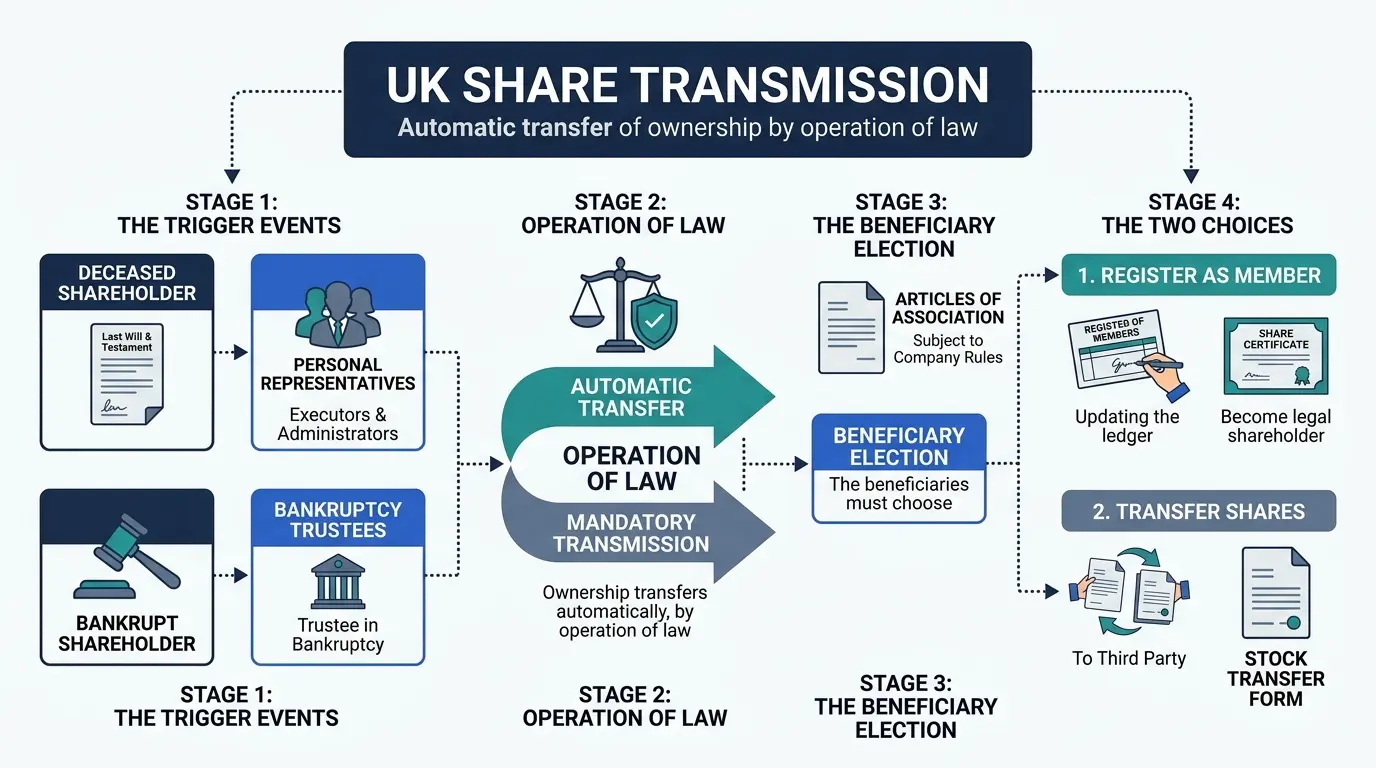
Transmission differs fundamentally from standard share transfers under UK company law. Transmission occurs automatically upon life events without requiring a Stock Transfer Form. Personal representatives submit grant of probate documents or death certificates to prove legal entitlement. Bankruptcy trustees present official bankruptcy orders to establish control over bankrupt member assets.
Personal representatives gain beneficial interest in equity immediately upon member death. Beneficial interest entitles representatives to receive dividend payments and corporate distributions. Representatives do not automatically gain voting rights or meeting attendance privileges. Voting rights activate only when representatives register as official members in statutory books.
The articles dictate how representatives convert beneficial ownership into legal membership. Representatives choose to register directly or transfer equity to named estate beneficiaries. Third-party beneficiaries remain subject to all pre-emption and director refusal rules in the articles. Articles prevent estate disputes from disrupting normal corporate governance operations.
Ensuring Flawless Share Transfers with Form My Company
Executing constitutional share transfers requires precise compliance with statutory frameworks and internal company rules. Incomplete documentation, missed board resolutions, or incorrect register entries invalidate equity transactions and create severe legal liabilities. Form My Company delivers comprehensive corporate compliance solutions to streamline ownership changes, update statutory records, and ensure complete constitutional alignment for UK limited businesses.
Form My Company simplifies corporate documentation workflows for businesses undergoing structural transitions. Get bound articles for share transfers from Form My Company to maintain physical corporate records and present legal documentation to shareholders, banks, and regulatory bodies.
Explore More Supplementary Company Documents Guide,
What Do Investors Look for in Your Articles of Association?
Do Co-Founders Each Need a Copy of the Articles of Association?
Frequently Asked Questions
What are supplementary company documents for a UK business?
Supplementary company documents are official legal and constitutional records—such as updated Articles of Association, share certificates, board resolutions, and statutory registers—that supplement a business’s core incorporation filings. Companies use these documents to maintain legal compliance under the Companies Act 2006 during corporate changes or share transfers. Businesses can order tailored Supplementary Company Documents through Form My Company to ensure statutory records remain accurate and up to date.
Why does a business need updated supplementary company documents?
Updated company documentation is required when altering corporate structures, issuing new shares, adding directors, or opening business bank accounts. Lenders, investors, and regulatory bodies demand current constitutional papers to verify director authority and shareholding structures. Ordering official Supplementary Company Documents from Form My Company ensures all corporate amendments meet legal compliance standards without administrative delay.
How do custom Articles of Association differ from Model Articles?
Model Articles provide standard, default rules for operating a UK limited company, whereas custom Articles of Association include specific provisions like share transfer restrictions, pre-emption rights, and drag-along clauses. Customizing these constitutional documents allows business owners to tailor internal governance to their operational needs and investor agreements. Form My Company provides tailored Supplementary Company Documents to align company articles with specific business governance requirements.
Can supplementary company documents be issued in physical bound formats?
Yes, companies can obtain both digital files and hard-copy bound constitutional documents for physical corporate records and formal verification. Physical bound copies are frequently requested by financial institutions, solicitors, and overseas regulators during due diligence processes. Form My Company supplies professionally printed and bound Supplementary Company Documents suitable for official corporate record-keeping.
How quickly can a company obtain updated supplementary documents?
Digital versions of corporate documents can be prepared and issued within 24 to 48 hours after confirmation of the corporate changes, with hard-copy bound versions dispatched shortly after. Fast turnaround prevents delays during time-sensitive commercial transactions, equity sales, or banking applications. Form My Company offers expedited service options for Supplementary Company Documents to ensure fast, compliant delivery.