
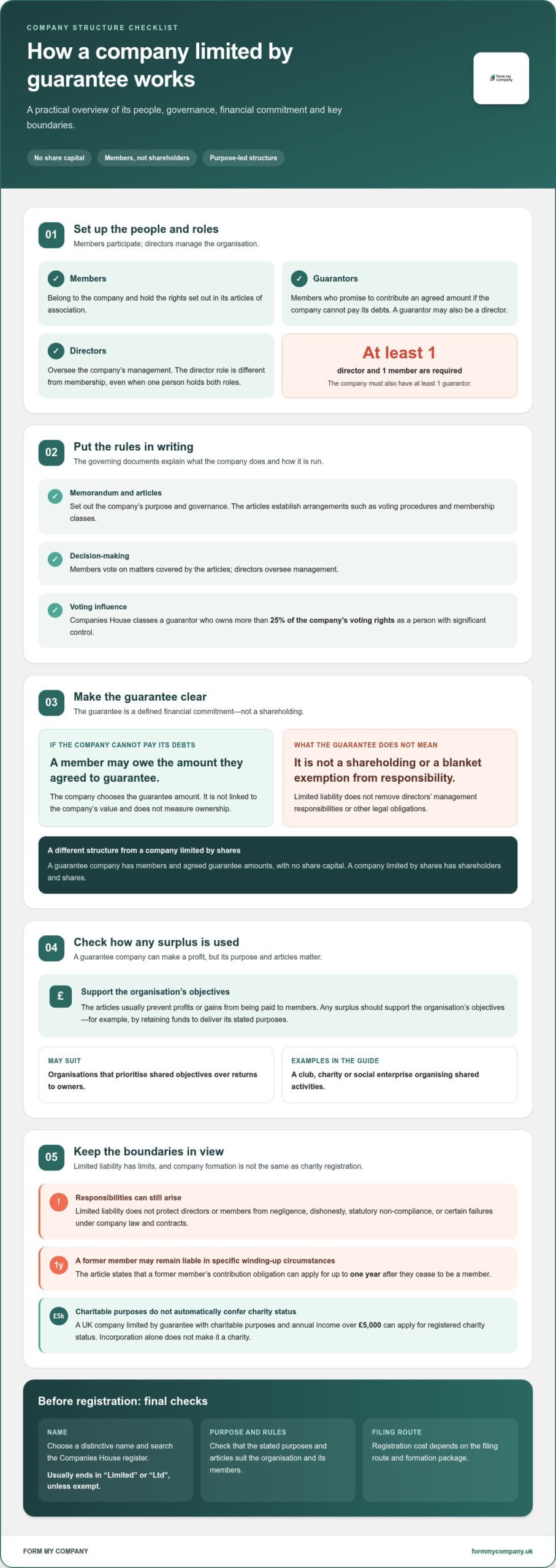
The defining feature isn’t shares: it’s the amount members agree to contribute if the company can’t pay its debts. Company limited by guarantee registration in the UK requires at least one guarantor, according to Companies House, and the company must have at least one director and one member. It has no share capital, so its structure centres on members, guarantors and the company’s governing documents.
Choosing company limited by guarantee registration can feel complex at first, especially when you need to understand what members may owe and how decisions will be made. This guide explains how a guarantee company works, how it differs from a company limited by shares, and what information and documents registration requires. You’ll also learn how guarantee amounts affect members’ potential liability, what the articles of association do, and which details are needed about directors and guarantors. With these essentials clear, you can assess whether the structure suits your organisation and prepare for registration.
Key Takeaways
- Understand how members, guarantors and directors fit together, and how the articles of association shape company governance.
- Set a guarantee amount that reflects what members agree to contribute if the company cannot pay its debts.
- Distinguish members’ limited liability from responsibilities that may still arise through management or legal obligations.
- Prepare the company’s governing documents and the required details for directors, guarantors and the registered office.
- Consider whether the company’s non-profit structure suits your organisation before you begin registration.
What is a Limited by Guarantee Company?
A company limited by guarantee is a separate legal entity with members instead of shareholders. It has no share capital, and its memorandum and articles set out its purpose and governance.
Guarantors, directors and members
Guarantors are members who promise to contribute an agreed amount if the company cannot pay its debts. A guarantor may also be a director, but the roles differ: members participate in the company, while directors manage it. This distinction matters when deciding who will join, make decisions and take responsibility for running the organisation. A guarantee company must have at least one director and one member.
Membership and governance
Membership determines who belongs to the company and holds the rights set out in its articles of association. The articles establish governance arrangements, including voting procedures and membership classes. Members vote on matters covered by the articles, while directors oversee the company’s management. This structure clarifies how decisions are made and who can make them. A company limited by shares has shareholders and shares instead of guarantors and guaranteed amounts.
Members’ financial liability
A member’s liability is generally limited to the guarantee amount they agreed to contribute. The amount is payable if the company cannot meet its debts; it is not a shareholding or a measure of ownership value. Members should understand this financial commitment before joining. The company chooses its guarantee amount, which is not linked to the company’s value. Limited liability does not remove directors’ responsibilities for managing the organisation.
A guarantee company can make a profit, but its articles usually prevent profits or gains from being paid to members. Any surplus should support the organisation’s objectives rather than be distributed to guarantors. For example, the organisation may retain funds to deliver its stated purposes. This structure can suit organisations that prioritise shared objectives over returns to owners.
Choose a distinctive name and search the Companies House register before applying. A UK guarantee company’s name must end in “Limited” or “Ltd”, unless it is exempt. Consider whether the name reflects the organisation’s purpose and will remain suitable as its work develops.
The registration cost depends on the filing route and formation package. Form My Company offers a Limited by Guarantee Package to help with company formation. The company’s stated purposes and articles also help you assess whether its governance suits the people who will become members.
Companies House classes a guarantor who owns more than 25% of a company’s voting rights as a person with significant control. This statement matters when identifying who holds substantial voting influence. Members should understand their voting rights alongside their guarantee, since the two describe different aspects of their position in the company.
What does ‘limited liability’ mean for a member?
Limited liability caps a member’s financial commitment at the guarantee amount they agreed to contribute. It does not make the company’s debts disappear. Instead, it separates the company’s obligations from members’ personal finances, subject to their agreed guarantee and other legal responsibilities. This structure can suit a club, charity or social enterprise that needs a corporate entity to organise shared activities, employ staff or enter contracts.
For example, a community club could use a company limited by guarantee to manage membership, venue costs and activities. Its memorandum and articles set out its charitable or other purposes, governance and rules for members. Unlike a company with shareholders, it has no share capital. Members therefore don’t own shares or receive profits as shareholders might. Any surplus is generally retained or used to advance the company’s stated objectives.
Limited liability has boundaries. It doesn’t protect directors or members from negligence, dishonesty, statutory non-compliance, or certain failures under company law and contracts. A member who leaves may also remain liable in specific winding-up circumstances. According to UK Parliament, a former member’s contribution obligation can apply for up to one year after they cease to be a member. The guarantee is a defined commitment, not a blanket exemption from responsibility.
Charitable purpose and company formation are separate from registered charity status. According to the Charity Commission for England and Wales, a UK company limited by guarantee with charitable purposes and annual income over £5,000 can apply for registered charity status. The company’s purposes and governing document must support the charitable application. Incorporation alone doesn’t make a company a charity, and not every guarantee company has charitable aims.
Registered charitable companies have reporting duties to both Companies House and the relevant charity regulator. They must send annual accounts and annual returns to Companies House and the Charity Commission. In Northern Ireland, a limited company may also be a charity if the Charity Commission for Northern Ireland approves its purposes and activities. The relevant regulator and charity rules depend on where the organisation operates.
Corporation Tax obligations apply to UK companies limited by guarantee. A charitable organisation registered with the Charity Commission may qualify for tax exemptions, depending on its circumstances. Charitable status does not automatically remove every tax obligation. Clubs and social enterprises should distinguish their company’s trading activity, charitable purposes and registration status when considering reporting and tax.
Before settling on a company name, consider whether it reflects the organisation’s purpose and fits the membership structure in its memorandum and articles. These documents guide how the company operates, while charity registration is a separate process tied to its purposes and eligibility. Understanding both helps members see what limited liability does, what it doesn’t cover, and which responsibilities remain after formation.
Guarantor liability and guarantee amounts
A guarantee sets the contribution each member promises if the company cannot pay its debts. The amount affects the member’s potential liability, but it is not a shareholding or a measure of the company’s value.
Guarantee amounts and member liability
A company chooses its guaranteed amount, and it can be as low as £1. A guarantor’s liability is generally limited to the contribution they agreed to make. For example, a community association could set a £5.00 guarantee, whilst another company could set £10.00. The right amount depends on what members are willing to undertake, not the organisation’s profit or value.
Make the amount clear to each member before they join. Registration requires information about guarantors and their guaranteed amounts, so the application should reflect the commitment each person has accepted. A low guarantee limits that particular contribution, but does not exempt members from other legal responsibilities. Members should understand the type of company they are joining and the circumstances that may trigger payment.
The guarantee differs from an investment. A company limited by guarantee has no shares, so guarantors don’t acquire a percentage of the company by promising a contribution. For instance, agreeing to contribute £1 doesn’t mean a member owns a share worth £1. The amount defines a potential payment if the company cannot meet its debts; it doesn’t determine voting rights or entitlement to profits.
Risks beyond limited liability
Limited liability does not shield directors or members from every consequence of their conduct. Negligence, dishonesty, statutory non-compliance, and certain failures under company law or contracts can create separate risks. A director managing a community project, for example, still needs to meet their legal duties. The guarantee covers the member’s agreed contribution, not every obligation connected with running the organisation.
Registration mistakes can create avoidable problems. Check that each guarantor’s stated amount reflects their agreement and that the application and company records are consistent. Do not confuse a guarantee with a share or assume a small contribution removes responsibilities arising from management. These distinctions matter when an association chooses its structure and explains members’ commitments.
Leaving the company does not always end every potential contribution obligation immediately. According to UK Parliament, in the stated winding-up circumstances, a former member’s contribution obligation can apply for up to one year after they cease to be a member. Members should understand the guarantee and relevant company records before joining or leaving.
Information and documents needed for registration
Prepare the company’s governing documents, registered office address, and details for its directors and guarantors. Company limited by guarantee registration depends on accurate information about the structure and members’ commitments.
For company limited by guarantee registration, submit the incorporation application and required documents to Companies House electronically. Include the proposed company name, UK registered office address, director details, guarantor information and each guaranteed amount.
Incorporation information and documents
The incorporation documents establish the company and identify the people responsible for it. You’ll need the memorandum and articles of association, details of at least one director, and information about the guarantors and their guaranteed amounts. The company must also provide a registered office address in the UK. These details enable Companies House to record the company’s legal structure and contact address.
For electronic registration, Companies House requires three pieces of security information for directors. Directors and people with significant control must complete identity verification before a UK company can be registered, under requirements introduced in November 2025. A director must be at least 16 years old, according to Companies House.
Give each guarantor’s full name and agreed guarantee amount for the registration filing. A member who is not a director must provide their full name and an address with a postcode; this need not be their home address. If you appoint a company secretary, include their full name, service address and date of birth.
Articles of association requirements
The articles of association are the company’s internal rulebook. They must explain its governance, including voting procedures and any membership classes. These provisions matter because they define how members participate and how the company makes decisions.
For a guarantee company, the articles work alongside the memorandum to establish its governing framework. The memorandum records the subscribers’ agreement to form the company, while the articles set out its operating rules. Make sure both documents reflect the organisation’s intended purposes and membership arrangements.
The Statement of Guarantee is also required for incorporation under section 11 of the Companies Act 2006. It records each guarantor’s commitment to contribute the amount stated if the company is wound up. Ensure those amounts match the guarantors’ agreed commitments and the information in the application.
After incorporation, keep the company’s records organised. The register of members is legally required and records who belongs to the company. Maintain it alongside the memorandum, articles and incorporation documents so that membership and governance information remains consistent with the Companies House filing.
Company limited by guarantee structure
The structure separates the organisation’s legal identity from the people who belong to it. Its articles, members, guarantors and directors each have distinct roles that shape how it operates and serves its purposes.
A company limited by guarantee has no share capital, so it has no shareholders or share certificates. Instead, members promise to contribute an agreed amount if the company cannot pay its debts. Companies House states that it must have at least one guarantor. This member-based structure suits organisations that need a corporate entity without dividing ownership into shares.
The company exists separately from its members. It can own property, employ people, enter contracts, and sue or be sued in its own name. For example, a residents’ association could hold communal property and arrange maintenance in the company’s name, rather than relying on a member to act personally. The organisation continues as the same legal entity when its membership changes.
Members and directors have different roles. Members exercise rights set out in the articles, including voting procedures and membership classes. Directors manage the company and make decisions within their authority. A guarantor may also be a director, so one person can hold both roles. The articles should clarify these responsibilities and decision-making routes.
That distinction matters for organisations with varied membership. A community organisation might define different membership classes in its articles, each with specified voting rights. Directors then manage its activities in line with those rules and the organisation’s stated purposes. Clear governance helps members understand which decisions require a vote and which fall to the board.
Surplus and profit work differently from a shareholder company. A guarantee company can make a profit, but it cannot distribute profits to guarantors. Its articles will usually prevent profits or gains from being paid to members. Instead, surplus is retained or reinvested to support the organisation’s objectives. This structure can suit a club, charity or management association whose purpose is not to provide returns to owners.
Online registration of a UK company limited by guarantee can be completed in under 24 hours. Once incorporated, its separate identity allows it to act for its stated purposes through the company itself. The key structural decision is therefore whether member-led governance and non-distributable surplus fit the organisation’s aims. If they do, prepare the articles to reflect how members and directors should work together.
For a formation package that supports this structure, explore the company formation packages and choose the option suited to your registration needs.
Form My Company: Digital Package
Form My Company can help you register a guarantee company. Choose the Limited by Guarantee Package when you’re ready to establish this structure and want formation support.
If you’re comparing formation options, Form My Company also offers the Digital Package, Digital & Print Package and Entrepreneurs Choice Package. For a different legal structure, it provides Limited Liability Partnership (LLP) Formation. Choose the option that matches the organisation you plan to run, then prepare your company name, registered office details, guarantor information and governing documents.
Visit Form My Company’s website to explore the formation options, or contact Form My Company to discuss your next step.
Prepare your organisation for its next stage
Before proceeding with company limited by guarantee registration, bring the intended members together to agree on the organisation’s priorities and how they want to work. A shared understanding can guide practical decisions as its activities develop. Keep those choices aligned with the purpose the company is intended to serve.
When you’re ready to form the company, choose the formation support that suits your needs. Form My Company offers the Digital Package, Digital & Print Package and Entrepreneurs Choice Package. Compare these with the Limited by Guarantee Package as you move from preparation to registration.
Take the next step at your own pace. Contact Form My Company to discuss your formation plans and explore the available package options. A clear starting point can help you move forward with confidence and build an organisation around the purpose that matters to you.
Frequently Asked Questions
How does a CLG compare to other UK company types?
A company limited by guarantee suits organisations that do not need share ownership, while a company limited by shares has shareholders and shares. For example, a community association may prefer membership-based governance, while a business seeking share investment may consider a share structure. An LLP is another distinct structure, with members operating as partners. Compare how each option handles ownership, governance and surplus before choosing a legal form.
How does it work?
Members agree to the company’s rules and guarantee a contribution if it cannot pay its debts. Directors run its activities, following the articles of association and decisions reserved for members. For example, the articles can explain how members vote on a change to the organisation’s purposes. The company acts in its own name, so contracts and property belong to the legal entity rather than individual members.
How long will it take?
Form My Company states that registration takes 24 hours, whilst Companies House approval can take longer depending on its workload. Keep the process moving by preparing the proposed company name, registered office address, director and guarantor details, and governing documents before submitting the application. Identity verification requirements also apply to directors and people with significant control, so completing that requirement is part of preparing for registration.
Is this package suitable for setting up a charity?
A limited by guarantee formation package can establish the company, but it does not itself confer charitable status. The organisation must have charitable purposes and meet charity law requirements; registration with the relevant charity regulator is a separate matter where required. For example, a group planning charitable activities should align its governing document with those purposes. Company formation and charity registration are distinct parts of setting up.
Service address and registered office address, what’s the difference?
A registered office is the company’s official address for correspondence and must be in the UK. A director’s service address is the address used for that director on the public record. These addresses may be the same, but serve different purposes. The director’s residential address is kept off the public record and is available only to public authorities and credit reference agencies.
What is a Statement of Guarantee?
A Statement of Guarantee records the guarantors’ promise to contribute their agreed amounts if the company is wound up. It forms part of the incorporation requirements under section 11 of the Companies Act 2006. For example, it links each guarantor to the contribution they have agreed to make. Ensure the statement matches the guarantor details and amounts in the company’s registration application.
What is a company limited by guarantee in the UK?
It’s a UK company whose members promise a set contribution rather than buying shares. The company has its own legal identity, separate from its members, and can hold assets or make contracts in its own name. Clubs, membership organisations and community groups often consider this form. Its articles establish how the organisation is governed and how members participate in decisions.
What are the requirements to register a company limited by guarantee in the UK?
Prepare a UK registered office address, memorandum and articles of association, director details, and information about the guarantors and their promised amounts. The company needs at least one director and one member, and directors and people with significant control must complete identity verification before registration. A member who is not a director provides their full name and an address with a postcode. Submit the application and required documents to Companies House.