
No, a Certificate of Incorporation and a business licence are distinct legal documents with separate purposes. A Certificate of Incorporation legally creates a UK company as a legal entity, whereas a business licence grants specific operational permission to perform regulated business activities.
What Is a Certificate of Incorporation in the UK?
A Certificate of Incorporation serves as legal proof that a business entity exists under Companies House registration. It confirms corporate formation, assigns a unique company registration number, and establishes official corporate existence under the Companies Act 2006 framework.
Companies House issues this statutory document when founders complete formal registration procedures. The legal instrument contains essential entity details, including the registered business name, incorporation date, company type, and legal jurisdiction. UK corporate entity law requires every limited company to possess this document before commencing commercial transactions.
Financial institutions inspect this corporate document during mandatory anti-money laundering checks. Bank officers verify director credentials, ultimate beneficial ownership, and registered office addresses against official state records. Without this primary document, businesses cannot open commercial bank accounts, secure corporate financing, or enter formal contracts.
The document remains valid permanently once Companies House completes legal registration. Companies do not require annual document renewals unless corporate structural changes occur. Businesses must retain physical or digital copies within their registered company registers for statutory inspection requirements.
What Is a Business Licence and Why Is It Required?
A business licence is a regulatory permit granted by government bodies or local councils authorizing specific trading activities. It enforces local safety regulations, industry compliance standards, zoning laws, and consumer protection frameworks within defined operational jurisdictions.
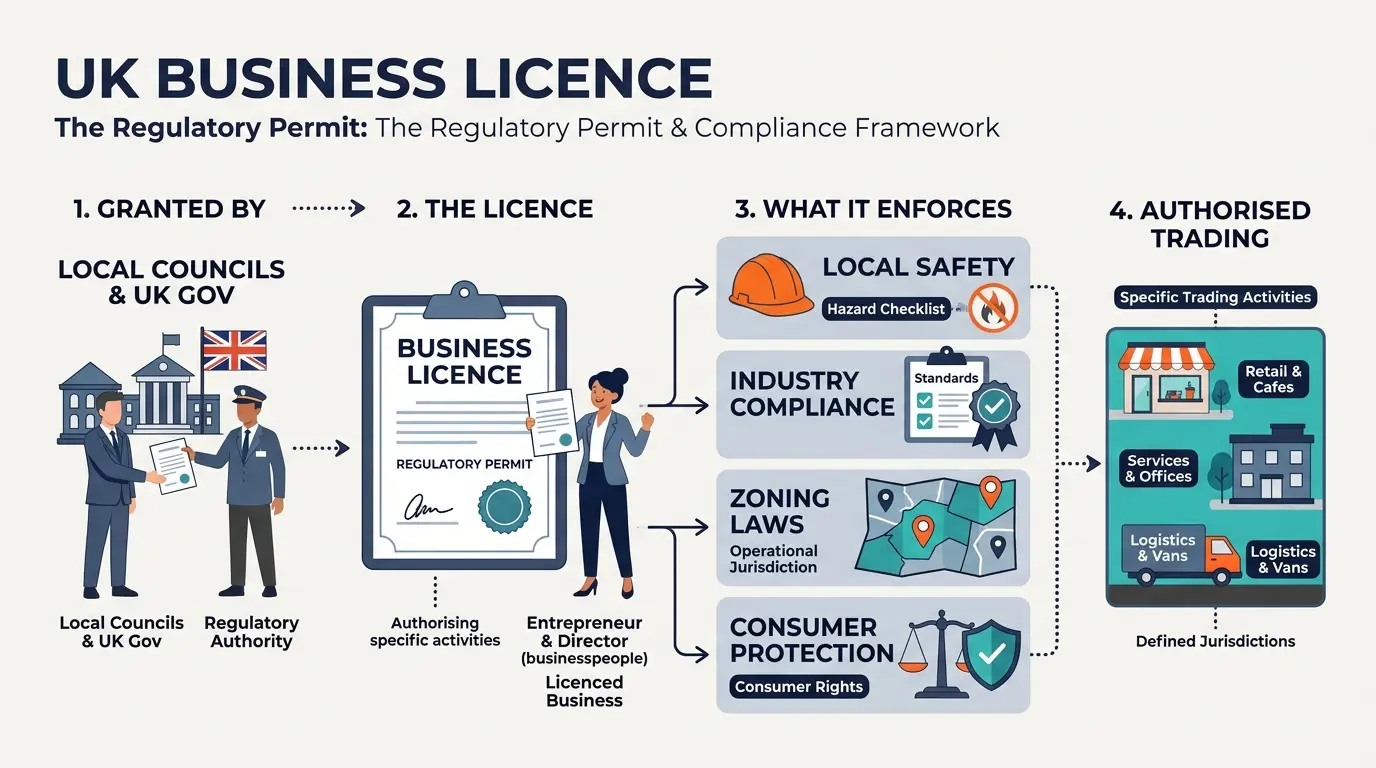
Local authorities enforce specific trade licensing criteria across various industries. Operating without required municipal permits triggers financial penalties, legal injunctions, or immediate closure orders. Regulatory oversight ensures local businesses operate within established public health, environmental safety, and consumer protection guidelines.
Trading activity classification dictates specific operational permit requirements. Three core regulatory areas include local council trading permits, specialized industry credentials, and environmental safety clearances. A restaurant requires food hygiene authorization, alcohol service licences, and music performance rights from local municipal bodies.
Licence obligations vary depending on physical location and commercial activity scope. Unlike permanent corporate creation documents, regulatory trade permits require scheduled annual renewals. Directors must maintain valid operational authorization to avoid statutory compliance violations and administrative fines.
How Does Incorporation Differ From Operational Licensing?
Incorporation establishes legal corporate personality, whereas business licensing grants operational permission for commercial trading. Company formation creates rights under UK company law, while trade licensing ensures compliance with local and sector-specific regulatory bodies.
The primary distinction centers on corporate formation versus daily business activity authorization. Incorporation establishes an independent legal personality separate from individual company directors and shareholders. This legal structure provides limited liability protection against corporate debt obligations and legal claims.
Operational licensing regulates specific commercial activities performed within municipal or industrial borders. A registered company can exist legally without possessing active operational trading permits. However, trading without mandatory sector licences constitutes an immediate violation of UK regulatory law.
| Comparison Feature | Certificate of Incorporation | Business Licence |
| Primary Purpose | Establishes legal entity existence | Authorizes specific commercial activities |
| Issuing Authority | Companies House | Local councils or regulatory bodies |
| Validity Period | Permanent lifetime validity | Requires annual or periodic renewal |
| Statutory Basis | Companies Act 2006 | Local bylaws and industry regulations |
Understanding these legal differences prevents operational delays and regulatory non-compliance. Directors must secure structural incorporation first before applying for industry-specific operational licences. Sequential compliance ensures smooth commercial launch timelines across all target UK markets.
When Do You Need a Certificate of Incorporation?
You need a Certificate of Incorporation immediately when establishing a limited company, opening business bank accounts, or entering corporate contracts. It validates legal entity status for tax registration, investor funding, and official commercial transactions.
Financial institutions require verified incorporation details before approving corporate account applications. Under strict UK Know Your Customer guidelines, financial underwriters inspect company registration numbers. Verification officers confirm legal entity standing using official registry documentation before granting banking access.
Commercial landlords and equipment vendors demand official formation proof during contract drafting. Lease agreements require legal entity details to assign corporate liability correctly. Without valid incorporation proof, landlords refuse property leases, stopping physical commercial operations.
Tax registration with HM Revenue and Customs requires official incorporation details. Companies must submit corporate registration numbers within three months of starting commercial trading. HMRC tracks corporate tax liabilities, Value Added Tax obligations, and Pay As You Earn payroll schemes using these statutory records.
When Do You Need a Business Licence?
You need a business licence before commencing regulated commercial operations within specific industry sectors or municipal zones. Trading without necessary permits exposes company directors to statutory fines, legal prosecution, and operational shutdown orders.
Regulated activities require specialized trade permits prior to commercial trading launch. High-risk commercial sectors include food preparation, alcohol distribution, financial services, transport logistics, and personal care services. Industry regulators conduct rigorous site inspections before issuing operational authorization certificates.
Local council regulations apply to physical business premises and public space operations. Three specific local authorizations include street trading permits, public entertainment licences, and commercial property usage clearances. Operating inside municipal boundaries requires strict adherence to local council bylaws.
Commercial expansion into new trading sectors requires additional regulatory permit reviews. Directors must assess local authority requirements when launching new service lines. Continuous regulatory monitoring prevents unauthorized trading violations as corporate activities expand across regions.
How Do You Obtain a Certificate of Incorporation?
You obtain a Certificate of Incorporation by submitting official formation documents, director details, and shareholder information to Companies House. Upon registration approval, Companies House issues the legal document containing your official company registration number.
Company formation requires accurate director and shareholder information submission. Applicants must provide full legal names, service addresses, residential addresses, and nationality details. Registered office addresses must located within the specific UK jurisdiction of incorporation.
Articles of Association and Memorandums of Association define corporate governance rules. These constitutional documents outline internal management structures, voting rights, and share allocation rules. Founders submit these statutory documents electronically or through certified corporate service providers.
Companies House reviews registration filings against UK statutory standards. Standard electronic processing completes within 24 hours of formal submission. Upon successful verification, the registrar issues the formal formation document alongside official registry entry publication.
How Do You Apply for a Business Licence in the UK?
You apply for a business licence by contacting your local council or relevant industry regulatory body directly. Applicants must submit operational details, pass safety inspections, and pay annual licensing fees before receiving trading approval.
The application process starts by identifying your specific local authority jurisdiction. Business owners enter physical office postcodes into official council databases to locate responsible licensing departments. Each municipal district maintains individual submission portals, inspection criteria, and fee schedules.
Applicants complete detailed questionnaire forms outlining commercial trading activities. Submissions require site floor plans, safety risk assessments, employee qualification credentials, and public liability insurance proof. Regulators evaluate application data against local public safety guidelines.
Official inspectors schedule site visits to verify environmental and physical compliance. Officers evaluate health standards, fire safety measures, emergency exits, and equipment maintenance logs. Passing physical site audits allows regulators to grant official operational trading permissions.
What Other Supplementary Company Documents Do UK Businesses Need?
UK businesses require additional statutory documents, including Certificates of Good Standing, Articles of Association, and Share Certificates. These auxiliary records validate legal compliance, corporate governance structures, and internal ownership distribution for third parties.
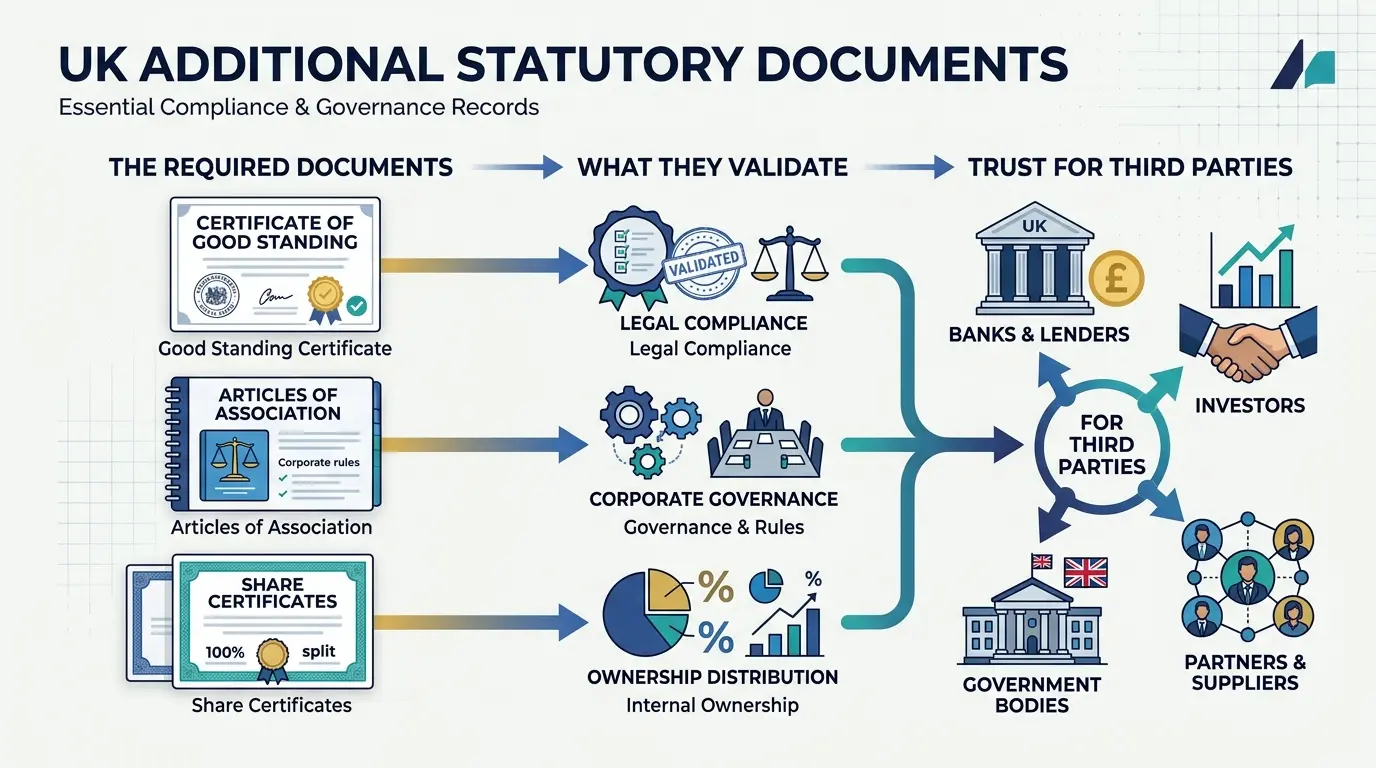
A Certificate of Good Standing confirms an entity maintains up-to-date filing records with Companies House. Overseas banks, international vendors, and foreign regulatory agencies request this document during cross-border expansion. It proves the entity faces no pending strike-off actions or administrative dissolution proceedings.
Articles of Association establish internal corporate operating rules and director responsibilities. Financial lenders inspect these constitutional documents during debt financing evaluations. Clear corporate rules protect shareholder investments and establish structured decision-making protocols.
Maintaining statutory books ensures total transparency during external corporate audits. Required registers include director registers, shareholder logs, and Persons with Significant Control records. Keeping current corporate registers prevents statutory fines under UK company compliance legislation.
When managing complex corporate filings, working with experienced formation specialists ensures administrative accuracy and regulatory compliance. You can order Supplementary Company Documents to maintain complete compliance registers for official inspection.
During corporate evaluations, understanding statutory documentation differences remains vital for directors. Review this guide on Certificate of Incorporation vs Certificate of Good Standing Explained to understand secondary document requirements.
When expanding operations or opening international accounts, fast access to official documentation is essential. You can Order Incorporation and Good Standing Certificates With Form My Company to secure certified statutory records quickly.
A Certificate of Incorporation establishes your company’s legal legal existence, while a business licence grants operational permission to trade. Navigating these separate compliance frameworks ensures complete protection against legal penalties and operational interruptions. Form My Company assists UK directors by delivering certified corporate documentation and streamlined filing services for all statutory business needs.
Explore More Supplementary Company Documents Guide,
What Do Investors Look for in Your Articles of Association?
What Are the Share Transfer Rules in Articles of Association?
Frequently Asked Questions
What are supplementary company documents for a UK business?
Supplementary company documents are official secondary filings, certified duplicate certificates, bound Articles of Association, and written resolutions beyond standard incorporation papers. These auxiliary records prove a company’s ongoing legal compliance, corporate structure, and operational status to financial institutions, courts, and regulatory bodies. Businesses can obtain verified corporate paper packs directly through the Form My Company [Supplementary Company Documents] service.
Why do banks and lenders request supplementary company documents?
Financial underwriters inspect supplementary documents like Certificates of Good Standing and solicitor-certified Memorandum and Articles to verify director authority, current filings, and ultimate beneficial ownership. These official extracts prevent fraud and fulfill strict Know Your Customer (KYC) and anti-money laundering regulations. Form My Company provides certified company packs tailored specifically for UK corporate bank account opening requirements.
How do I order certified copies of my company formation documents?
You can request solicitor-certified copies or duplicate certificates of incorporation through professional corporate formation specialists or directly via Companies House. Certified documents are verified as true copies of official public register entries and bound into a formal presentation pack for official use. Form My Company streamlines this process by sourcing, certifying, and delivering legally compliant document sets directly to your registered address.
What is the difference between core registration filings and supplementary documents?
Core registration filings, such as initial incorporation applications, permanently establish a company’s legal existence at formation. Supplementary company documents provide updated, on-demand extracts or certified duplicates that reflect continuous governance shifts, structural amendments, and active legal standing over the business lifecycle. Through Form My Company’s [Supplementary Company Documents] platform, directors access up-to-date statutory records needed for transactions or audits.
When should a company order a Certificate of Good Standing?
A business should order a Certificate of Good Standing when applying for commercial loans, expanding overseas, bidding on government contracts, or opening corporate bank accounts. This statutory certificate confirms that a UK limited company maintains up-to-date confirmation statements and faces no pending strike-off or liquidation proceedings. Form My Company arranges verified good standing certificates quickly to ensure zero delays during third-party compliance reviews.