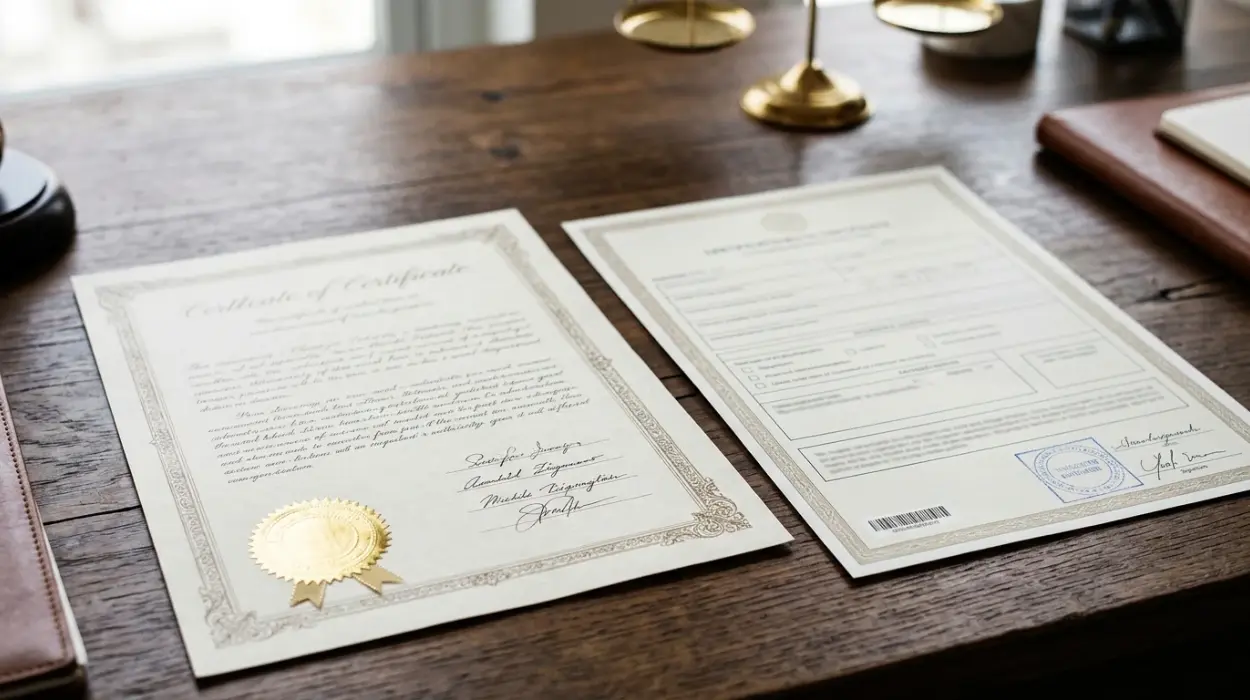
A Certificate of Incorporation proves the legal creation and legal existence of a UK company at birth, while a Certificate of Good Standing verifies that an existing company remains fully compliant, active, and up to date with Companies House filing requirements.
What Is a Certificate of Incorporation for UK Companies?
A Certificate of Incorporation is an official legal document issued by Companies House that confirms the legal birth, official registration, legal name, corporate structure, unique company number, and formal creation date of a limited company within the United Kingdom.
The Registrar of Companies issues this document upon successful registration. It acts as the legal birth certificate for a corporate body in the UK. Every registered business receives this document only once during its lifespan. The document displays the full legal name of the entity. It contains the official eight-digit company registration number assigned by Companies House. The certificate confirms whether the business is a private limited company or a public limited company. It also specifies the legal jurisdiction as England and Wales, Scotland, or Northern Ireland.
Businesses use this primary legal document to establish corporate identity. Banks require this document before opening a UK business bank account. Tax authorities request it during Corporate Tax and VAT registration processes. Commercial landlords inspect it before signing official office leases. Corporate investors require it to confirm legal entity status. Without this document, an enterprise cannot legally sign contracts or hire staff. It remains permanently valid throughout the operational lifespan of the business.
What Is a Certificate of Good Standing and When Is It Required?
A Certificate of Good Standing is an official statutory document issued by Companies House confirming that a company currently exists, has continuously filed required annual returns, maintains active status, and fully complies with all ongoing UK statutory corporate reporting obligations.
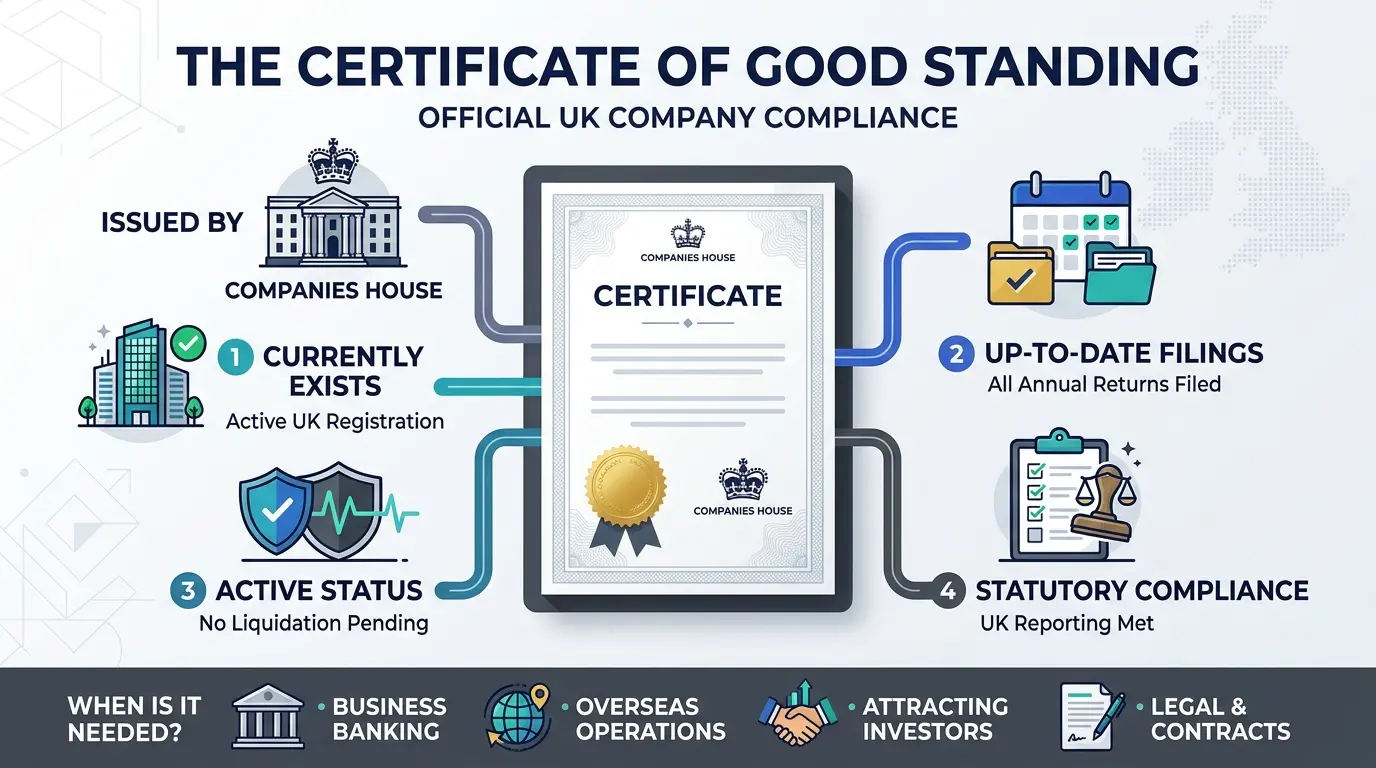
Companies House issues this compliance document only upon direct request. It reflects the real-time compliance status of an enterprise. It verifies that a business has filed all required confirmation statements. It proves the company has submitted all annual financial accounts on time. The document confirms that no legal liquidation proceedings are currently pending. It verifies that no official strike-off actions exist against the corporate entity.
Third parties request this verification during significant commercial transactions. Foreign banks require it before opening overseas corporate bank accounts. Overseas governments demand it when UK firms register international branches. Lenders examine it before approving commercial loans or credit facilities. Potential buyers check it during corporate merger and acquisition due diligence. The document remains valid for three months from the issuance date. Institutions require recent versions to ensure current statutory compliance.
What Are the Key Differences Between Incorporation and Good Standing Certificates?
The primary difference lies in purpose and timing: a Certificate of Incorporation proves initial legal creation permanently, whereas a Certificate of Good Standing confirms ongoing statutory compliance, active filing status, and legal validity at a specific current point in time.
| Feature | Certificate of Incorporation | Certificate of Good Standing |
| Primary Purpose | Confirms initial legal formation | Verifies ongoing statutory compliance |
| Issuance Frequency | Issued once at incorporation | Issued on demand upon request |
| Document Validity | Valid permanently | Valid for three to six months |
| Key Information | Company name, number, date | Active status, officer names, compliance record |
| Primary Use Case | Bank opening, initial contracts | Cross-border trading, loans, investments |
A Certificate of Incorporation establishes the legal entity. A Certificate of Good Standing verifies operational compliance. You receive the incorporation certificate automatically upon successful company registration. You must apply separately for a good standing certificate when third parties demand proof.
The incorporation certificate contains static historical data. The good standing certificate contains dynamic current data. For example, three specific details appear on good standing documents: current director details, active registered office address, and confirmation of paid-up share capital. Understanding these differences helps corporate officers maintain legal records effectively. You can review our guide on is a Certificate of Incorporation the same as a business licence to understand secondary licensing rules.
Why Do Banks and Overseas Authorities Require These Official Documents?
Financial institutions and foreign regulatory bodies demand these legal documents to verify corporate identity, eliminate financial fraud risk, satisfy anti-money laundering regulations, confirm director authority, and validate the active legal existence of a corporate entity.
Global anti-money laundering laws require banks to authenticate corporate clients strictly. Banks inspect the Certificate of Incorporation to confirm that the legal entity exists. They examine the Certificate of Good Standing to confirm the business is not dissolved. Foreign regulators demand both documents when expanding commercial operations overseas. Cross-border authorities must verify that the UK entity operates legally before granting international operating permits.
Risk management departments analyze these legal documents during due diligence. Lenders examine director details to verify authorized signers. Insurance underwriters review corporate standing before issuing professional liability policies. International suppliers request verification before extending commercial trade credit. You can order supplementary company documents to secure official apostilled copies for foreign use. Proper documentation prevents operational delays in international commerce.
How Do You Obtain Official Copies of Company Certificates from Companies House?
You obtain official company certificates directly from Companies House by submitting an online application, paying the required statutory fee, selecting standard or express delivery, and specifying required details like director names or share capital.
The application process requires exact company details. Applicants enter the official eight-digit company registration number into the portal. You must select specific options depending on third-party requirements. Standard electronic delivery takes four working days. Express processing completes within 24 hours. Physical paper copies require official postal shipping.
When requesting a Certificate of Good Standing, you can customize included information. You can include current director names, secretary details, and registered office addresses. You can also include share capital breakdowns and object clauses. If foreign authorities require legal authentication, the document must undergo apostille certification. The Foreign, Commonwealth & Development Office validates the document for international legal recognition.
What Happens If a Company Fails to Maintain Good Standing?
If a company fails to maintain good standing through late filings or missed statutory submissions, Companies House imposes financial penalties, marks the register as delinquent, and eventually initiates compulsory strike-off procedures to dissolve the business.
Failing to submit confirmation statements on time damages corporate standing instantly. Missing annual account filing deadlines triggers automatic civil financial penalties. Penalties escalate from £150 to £1,500 based on delay length. Repeated filing failures lead to criminal prosecution of company directors. Companies House publishes default notices on the public register immediately.
Losing good standing impacts daily business operations severely. Banks freeze business accounts upon detecting delinquent filing status. Commercial partners cancel existing supplier contracts to mitigate counterparty risk. Landlords terminate commercial lease negotiations immediately. To restore legal status, directors must file overdue accounts and pay accrued fines. You can order Incorporation and Good Standing Certificates with Form My Company to audit compliance and restore official standing.
How Do Supplementary Company Services Simplify Corporate Compliance?
Supplementary company services streamline administrative compliance by managing official document requests, monitoring statutory filing deadlines, obtaining legal apostilles, maintaining corporate registries, and submitting official filings directly to Companies House on behalf of directors.
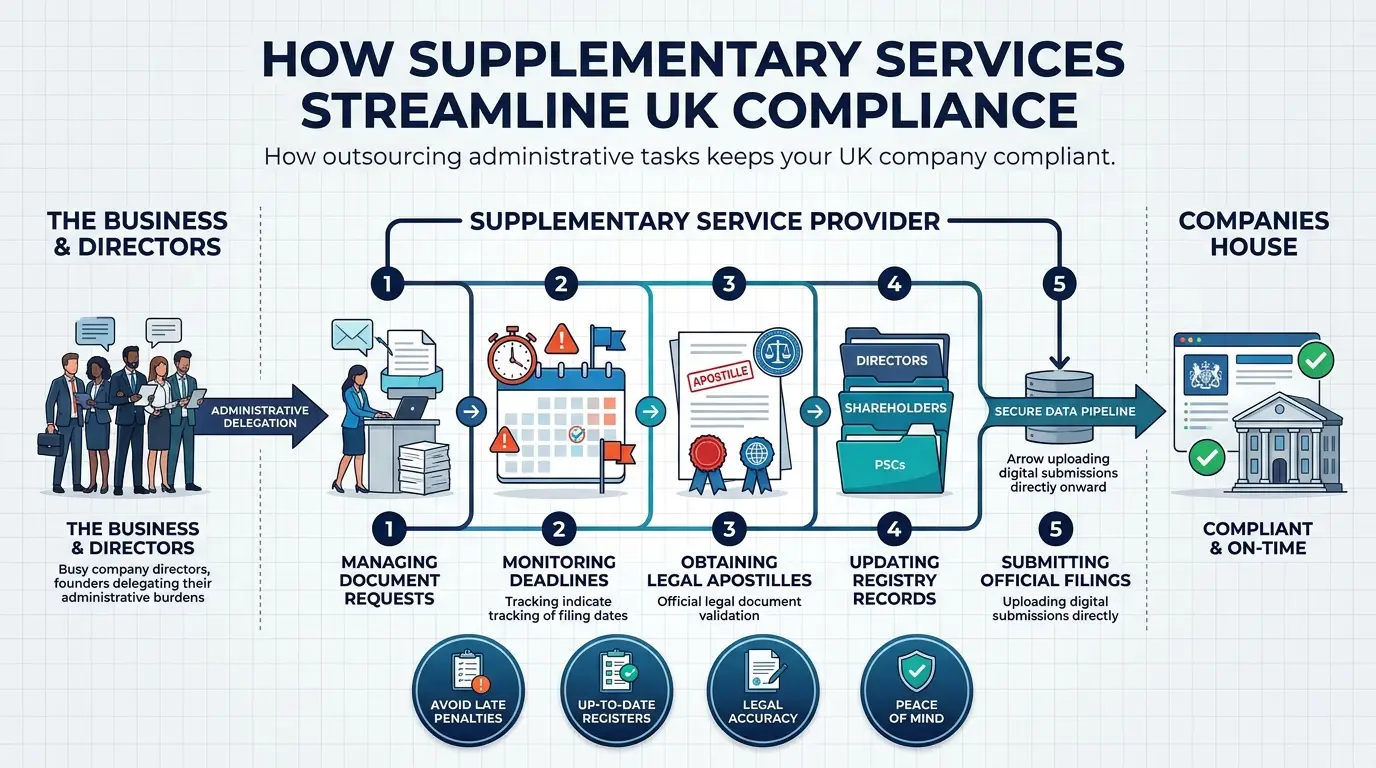
Managing corporate filings requires continuous administrative diligence. Company directors must track annual confirmation statement deadlines precisely. They must ensure financial accounts comply with UK accounting standards. Supplementary services handle administrative burdens efficiently. Professional corporate secretaries oversee registry updates to ensure public records remain accurate.
When expanding operations globally, legal document preparation requires expert handling. Specialized corporate service providers organize notarization and legalization workflows seamlessly. They liaise directly with government offices to prevent documentation rejections. Supplementary Company Documents services validate corporate filings using official UK compliance frameworks. Using professional assistance guarantees full compliance with statutory requirements. Form My Company assists directors in maintaining accurate corporate filings continuously.
A Certificate of Incorporation and a Certificate of Good Standing serve distinct compliance functions under UK company law. The incorporation certificate permanently proves initial corporate birth, whereas the good standing certificate verifies ongoing statutory compliance and active status. Businesses must maintain accurate filings with Companies House to preserve their operational standing, secure banking relationships, and execute international commercial agreements. Form My Company provides complete administrative support to help UK businesses obtain certified legal documents and maintain statutory compliance effortlessly.
Explore More Supplementary Company Documents Guide,
How to Keep a Display Copy and an Original Certificate Safe
How to Supply Incorporation Proof for Trade Credit Accounts
Frequently Asked Questions
What are supplementary company documents in the UK?
Supplementary company documents are official legal certificates and administrative filings issued by Companies House, such as Certificates of Good Standing, Memorandum and Articles of Association, or official change of name documents. These documents provide verifiable proof of a business’s current legal status, corporate structure, and statutory compliance. Businesses often order these documents through Form My Company when opening business bank accounts, securing loans, or expanding international operations.
Why do banks require a Certificate of Good Standing?
Financial institutions require a Certificate of Good Standing to confirm that a registered UK company is actively compliant with Companies House filing obligations and is not facing compulsory strike-off or liquidation. The document verifies that all annual accounts and confirmation statements are up to date before credit or corporate accounts are approved. Form My Company assists UK enterprises in procuring official certified copies to satisfy strict anti-money laundering and know-your-customer regulations.
How do I order certified company documents for international use?
To use UK corporate certificates overseas, foreign government authorities and banks require certified official document copies that are legalized with an apostille certificate from the Foreign, Commonwealth & Development Office. Applicants submit their document request online specifying required details such as director disclosures or share capital breakdowns. Form My Company simplifies this process by obtaining official filings directly from Companies House and managing notarization and apostille legalization for international compliance.
What is the difference between a Certificate of Incorporation and Articles of Association?
A Certificate of Incorporation acts as the official legal birth certificate proving the formal registration and unique company number of an entity, whereas the Articles of Association outline the internal governance rules, director powers, and shareholder rights. Both documents are core supplementary company documents required during due diligence, corporate restructures, and legal proceedings. Companies maintain official copies of both statutory records to demonstrate transparent corporate governance to stakeholders.
How long does it take to get official supplementary company documents from Companies House?
Standard electronic delivery of official company documents from Companies House typically takes three to four working days, while express processing can issue certified documents within 24 hours. Physical paper copies or legalized apostille documents require additional time for official registry signing and postal shipping. Utilizing the Supplementary Company Documents service through Form My Company ensures accurate filing requests, minimizing processing delays for urgent legal or financial transactions.