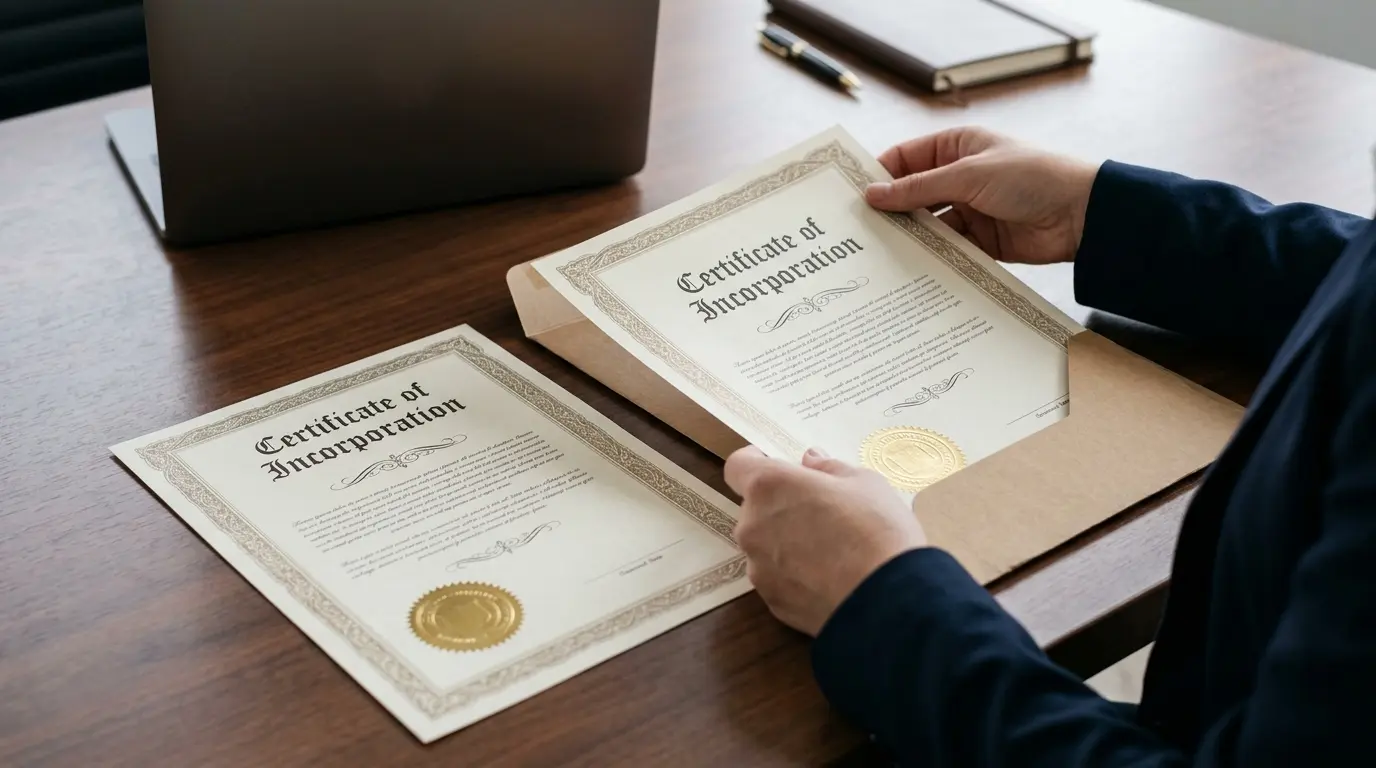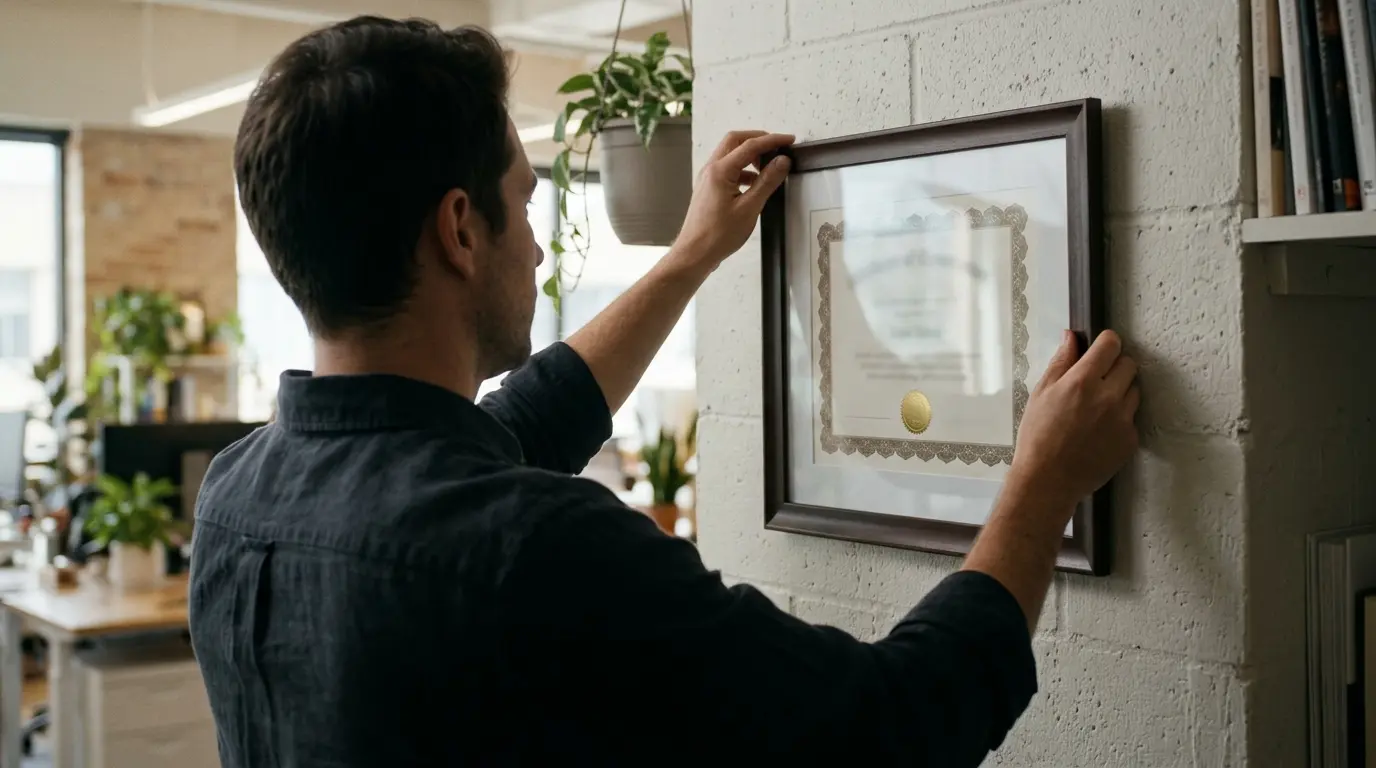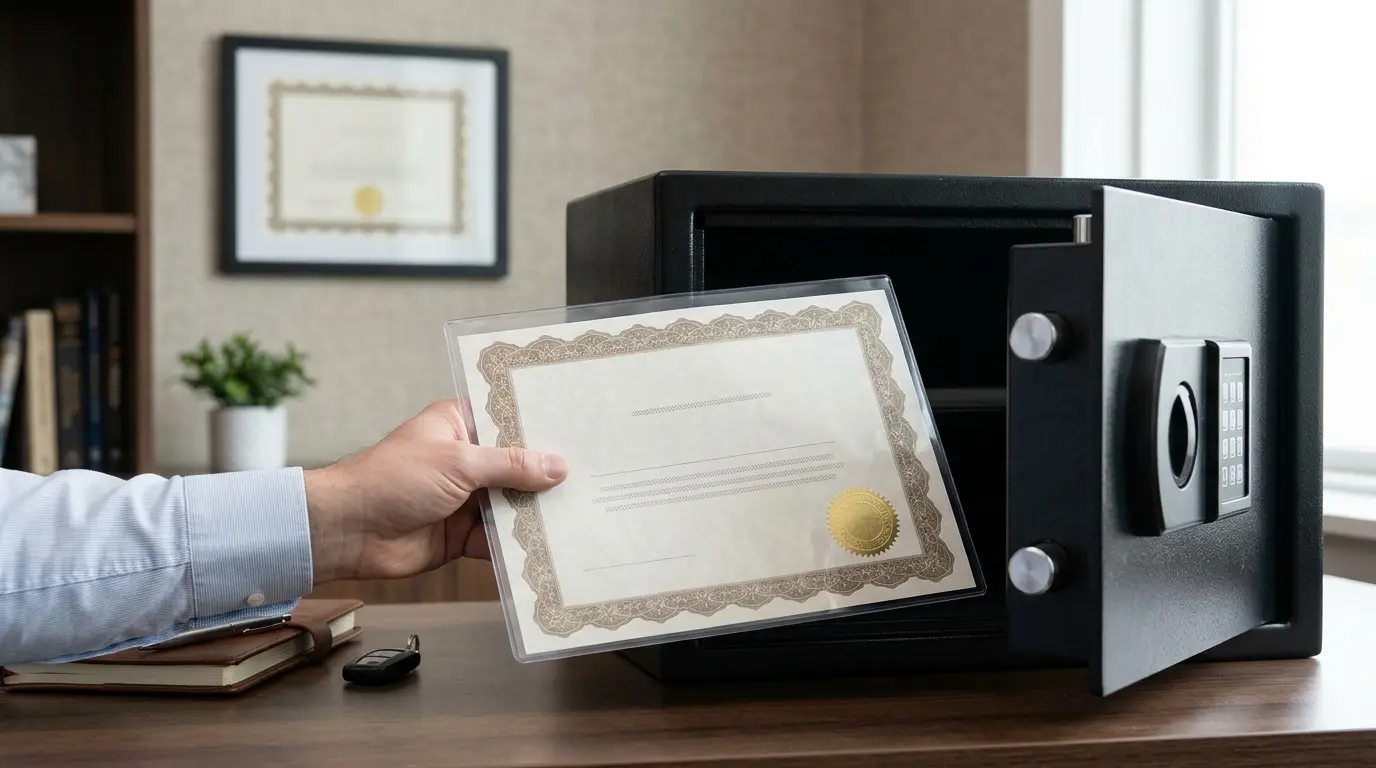
To keep a display copy and an original certificate safe, store your official original incorporation document in a fireproof archive safe while framing a durable, official duplicate copy for public office display. This dual-storage approach prevents permanent damage, physical theft, and regulatory non-compliance.
UK company officers receive important legal documents upon registration. The Certificate of Incorporation serves as legal proof of legal existence under the Companies Act 2006. Directors must safeguard this document against fire, moisture, and unauthorized alteration. Storing the primary original paper document in a secure location prevents physical degradation over time. Business leaders often display company credentials in public reception areas to build trust with clients, partners, and regulators. Placing the original certificate on an open office wall exposes the paper to direct sunlight, humidity, and physical damage. Framing an official duplicate document protects your legal primary record while meeting presentation standards.
Securing administrative files requires established document retention policies. The UK Companies House issues official registration papers during corporate formation. Corporate officers must separate operational documents from statutory archives. Placing primary certificates in locked storage reduces corporate identity theft risks. Fraudulent actors target unsecured corporate papers to falsify corporate filings or hijack bank accounts. Maintaining strict access controls over master legal documents ensures business continuity during legal audits.
Where Should You Store the Original Certificate of Incorporation?
Store the original Certificate of Incorporation in a locked, fireproof, and waterproof document safe kept at your registered office address or secure off-site archive. This practice safeguards the legal document against physical destruction, environmental decay, and unauthorized access.
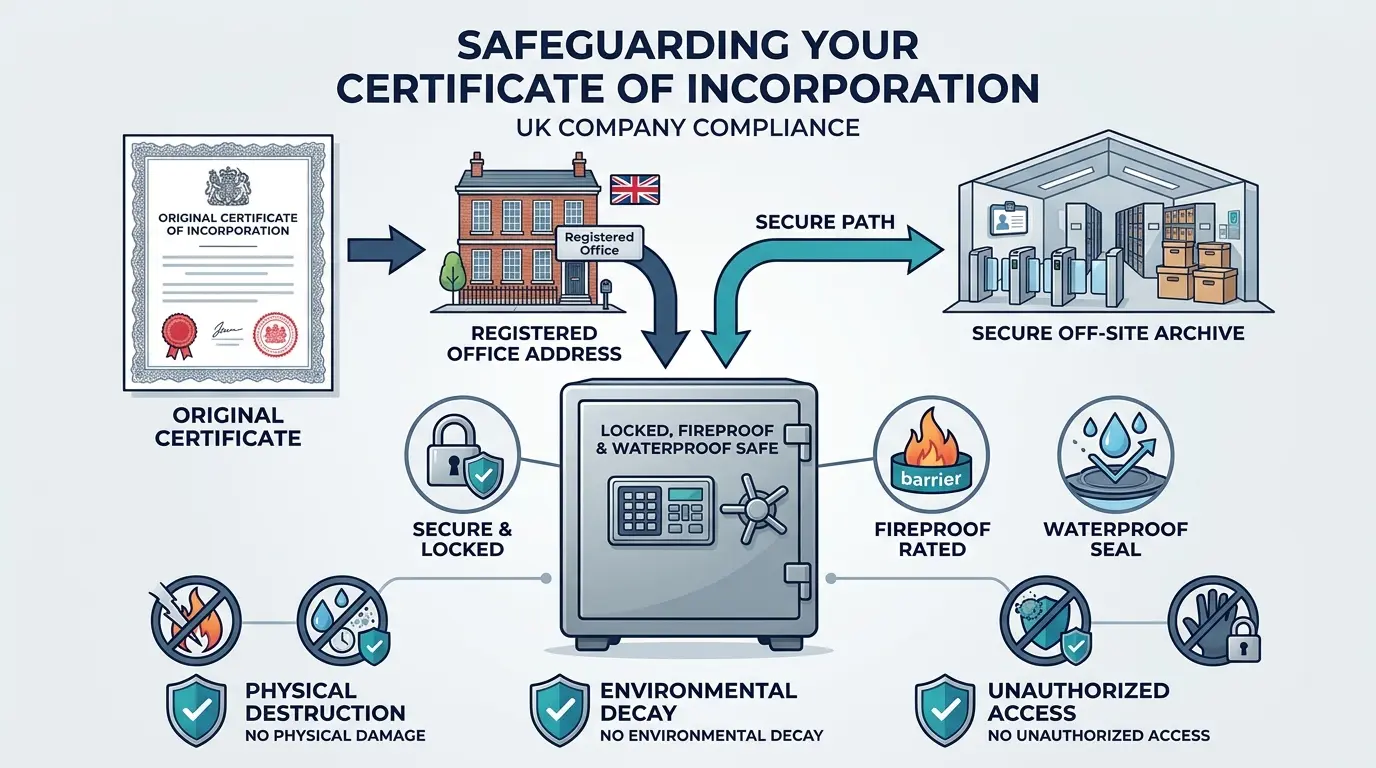
The primary Certificate of Incorporation contains vital registration data, including the unique company number and official incorporation date. Companies House issues this legal record once during company formation. Fireproof safes rated for paper protection maintain internal temperatures below 177°C during high-heat incidents. Storing statutory certificates inside an archival sleeve within a locked safe preserves paper integrity for decades. Damp conditions and high humidity trigger mold growth on natural paper fibers. Secure storage vaults control relative humidity levels between 30% and 50% to prevent paper degradation.
Corporate governance frameworks mandate restricted physical access to statutory records. Only designated company directors, corporate secretaries, or legal officers should hold keys or access combinations to primary archives. Maintaining an access log tracks every instance a statutory file leaves the vault. Off-site commercial archives offer specialized document storage solutions with climate control and 24-hour physical monitoring. Storing original documents in off-site facilities protects records against office-level disasters like plumbing leaks or electrical fires. Company officers can easily manage supplementary company documents to maintain regulatory compliance across all business filings.
Why Is Displaying an Original Certificate Risky for Businesses?
Displaying an original certificate risks permanent light bleaching, moisture damage, physical theft, and corporate identity fraud. Exposed legal documents allow unauthorized individuals to copy official registration details, seal layouts, and security features.
Direct sunlight contains ultraviolet radiation that breaks down paper lignin and chemical inks. Exposed original certificates experience severe fading, paper yellowing, and structural brittleness within months. Moisture condensation behind display glass creates ideal conditions for fungal growth and ink bleeding. Physical damage occurs during routine office maintenance, cleaning, or accidental wall impact. Replacing an original paper certificate requires formal administrative requests, causing unnecessary operational delays during legal transactions.
Identity thieves exploit exposed corporate documentation in public office spaces. High-resolution photography allows visitors to capture authentic security features, register numbers, and corporate seals. Fraudulent entities utilize captured document images to open illicit bank accounts, secure fraudulent credit facilities, or falsify commercial contracts. Displaying original documentation invites unnecessary operational vulnerabilities into your physical workspace. Modern compliance standards recommend keeping original legal artifacts inside protected storage while utilizing verified display copies for public viewing.
How Do You Choose the Best Display Copy Frame for Office Walls?
Choose a display copy frame featuring shatterproof acrylic glass, museum-grade UV protection, and an acid-free backing board. This structural combination shields duplicate certificates from environmental degradation, accidental impacts, and dust accumulation.
Standard glass frames present physical hazards in busy commercial environments. Shatterproof acrylic panels offer high impact resistance while reducing total wall hanging weight. UV-filtering acrylic eliminates up to 99% of harmful light wavelengths, preserving printed pigment vibrancy over extended periods. Acid-free matting prevents chemical leaching between the framing material and the printed document. Cheaper cardboard backings release acidic compounds that discolor duplicate paper prints over time.
Framing design should complement professional office interiors while reinforcing visual brand credibility. Anodized aluminum or solid hardwood frames provide structural rigidity against frame warping caused by ambient temperature changes. Sealed frame backs block airborne dust, insects, and atmospheric pollutants from contacting the printed surface. Wall mountings must utilize heavy-duty fixings anchored directly into structural wall studs. Secure hanging hardware prevents accidental falls caused by floor vibrations or physical contact in high-traffic corridors.
How Can Digital Backups Protect Your Physical Company Certificates?
Digital backups protect physical company certificates by creating permanent, searchable electronic duplicates stored across secure cloud servers. Digitized documents allow instant legal verification without risking physical damage to original paper records.
High-resolution document scanners create digital archival files from original certificates. Scanning documents at 600 dots per inch preserves fine security lines, official stamps, and detailed typography. Optical character recognition converts image files into searchable digital assets for corporate record systems. Storing digital certificates within encrypted cloud storage platforms ensures instantaneous document retrieval during financial audits or legal proceedings. Cloud repositories utilize 256-bit AES encryption to protect corporate records against unauthorized cyber access.
Redundant cloud backups maintain strict version control across distributed server nodes. Automated backup schedules eliminate human error in document management workflows. Third-party institutions, including commercial banks, insurance providers, and tax authorities, accept verified electronic PDF certificates for daily administrative checks. Utilizing digital assets reduces physical handling of sensitive archive files. Digital document management systems enable administrators to review how to keep a display copy and an original certificate safe within modern corporate compliance frameworks.
How Many Duplicate Certificates Should a Company Maintain?
A company should maintain exactly two duplicate certificates: one framed copy for public office display and one unframed working duplicate for administrative operations. Limiting duplicate copies maintains strict document control while satisfying daily operational needs.
Managing excess physical copies increases administrative confusion and document security risks. Uncontrolled duplication creates opportunities for lost or misplaced legal papers across corporate departments. Maintaining one framed display copy fulfills public presentation standards in client reception areas. Maintaining one unframed working duplicate satisfies immediate operational requirements, such as legal verification, commercial lease agreements, or supplier onboarding checks.
Corporate record keepers must maintain an exact inventory of all physical document duplicates. Marking administrative duplicates with subtle watermark identifiers distinguishes official working copies from primary legal originals. Working duplicates should remain inside locked filing cabinets alongside active corporate registers. Destroying outdated working duplicates via micro-cut paper shredders prevents corporate information leakage during administrative clearouts. Restricting document replication ensures complete oversight over corporate credentials.
What Are the Best Environmental Conditions for Paper Document Archives?
The best environmental conditions for paper document archives are a constant temperature between 15°C and 18°C and relative humidity levels between 30% and 50%. These controlled parameters prevent chemical decomposition, paper embrittlement, and biological growth.
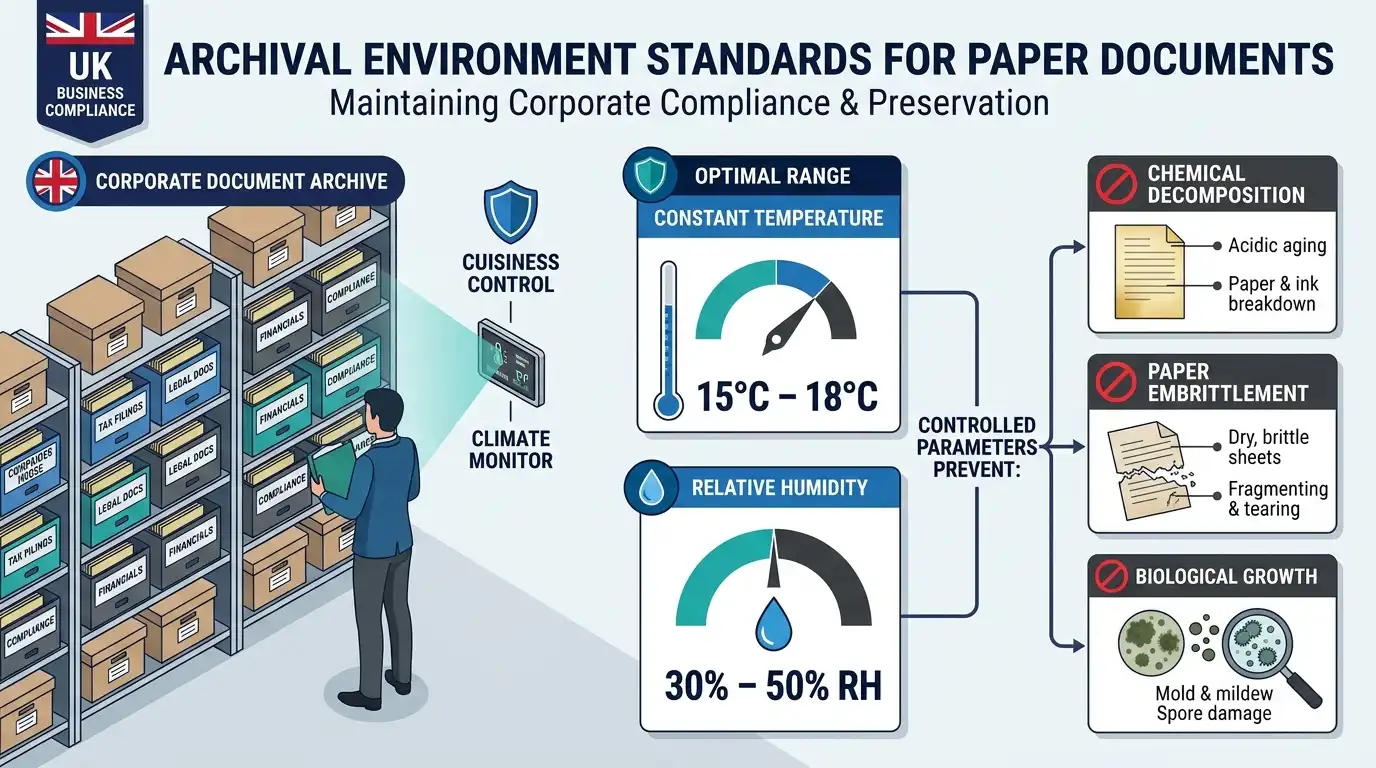
Temperature fluctuations accelerate chemical degradation processes within paper fibers. High ambient heat causes organic paper compounds to breakdown, resulting in paper yellowing and embrittlement. Relative humidity above 60% fosters fungal spore germination, causing irreversible foxing stains on legal documents. Relative humidity below 30% removes structural moisture from paper fibers, causing documents to crack when handled. Dedicated document storage areas require continuous climate monitoring using digital thermo-hygrometers.
Air filtration systems protect archived papers from gaseous pollutants and solid particulates. Sulfur dioxide, nitrogen oxides, and ozone chemically react with humidity to form acids that dissolve paper cellulose. High-efficiency particulate air filters remove dust particles that carry mold spores and abrasive grit. Document archives must remain free from direct sunlight and fluorescent lighting containing ultraviolet waves. LED lighting systems provide safe illumination inside archival rooms because LED bulbs emit zero ultraviolet radiation and minimal heat.
When Should You Order an Official Replacement Certificate?
Order an official replacement certificate when the primary original becomes physically damaged, defaced, lost in transit, or destroyed during an emergency. Official replacements restore legally recognized proof of corporate registration.
Physical damage occurs through water contact, chemical exposure, or improper handling during corporate relocations. Defaced documents containing unreadable registration numbers lose legal validity during official corporate audits. Lost records stall major commercial activities, including corporate acquisitions, banking facility setups, and international expansion registrations. Obtaining an official replacement certificate re-establishes corporate standing with regulatory authorities and commercial partners.
Companies House provides certified paper duplicates that carry official verification marks. Legal authorities and financial institutions require certified copies rather than standard photocopies for high-value transactions. Corporate officers must file formal requests to generate duplicate statutory documents. Business leaders can order a second printed certificate of incorporation with Form My Company to secure legally verified duplicate copies for immediate business operations.
Explore More Supplementary Company Documents Guide,
How to Get an Updated Certificate After a Company Name Change
How to Use Your Certificate of Incorporation to Verify Your Business
Frequently Asked Questions
What are supplementary company documents in the UK?
Supplementary company documents are official legal certificates and corporate records—such as Certificates of Incorporation, Certificates of Good Standing, and Share Certificates—issued to prove a business’s legal status and structure. Companies House registers these files to confirm corporate compliance, ownership details, and official company information. Businesses request supplementary company documents through Form My Company to satisfy regulatory audits, open merchant accounts, or finalize commercial agreements.
How do I order extra official copies of my company certificates?
Company directors can request official duplicate paper copies or legal certified printouts directly through an online corporate formation provider. Form My Company processes document applications by retrieving verified corporate records directly from the Companies House registry. Placing an order for supplementary company documents ensures your business receives legally recognized paper certificates for framing, banking verification, or archival storage.
Why do banks and lenders request supplementary company documentation?
Financial institutions require supplementary company documentation to verify a corporate entity’s legal existence, active status, and directorship structure during anti-money laundering (AML) checks. Documents like a certified Certificate of Incorporation confirm that the business operates in full compliance with UK corporate law. Ordering official supplementary company documents through Form My Company provides the verified proof necessary to open business bank accounts and secure credit facilities.
What is the difference between an original certificate and a display copy?
An original certificate is the primary statutory document issued at formation, which should be stored securely in a fireproof archive to prevent loss or physical damage. A display copy is an official duplicate certificate intended for public office display to demonstrate corporate legitimacy to clients and inspectors. Form My Company supplies extra legal duplicates so officers can maintain display copies while preserving original statutory records.
How long does it take to receive official supplementary company documents?
Standard processing and dispatch for official supplementary company documents usually takes between two to five business days depending on Companies House retrieval speeds and delivery selections. Express processing services expedite the generation and postage of certified paper certificates for urgent commercial transactions. Using Form My Company allows UK businesses to track document issuance status and receive verified statutory paperwork quickly.