
A UK company submitted through Companies House’ online service is usually registered within 24 hours. For UK company formation, the time from preparing an application to receiving confirmation depends on the route and the information provided. Choosing a package also means comparing its included services, not just its headline price.
It’s understandable to want clear answers before you begin: how long registration takes, what a formation package covers and which details or documents you’ll need. This guide explains the process in straightforward terms, including how to compare package options and understand what affects their cost, without making the paperwork feel like a barrier to getting started.
You’ll learn what company formation involves, what happens after you submit an application and what information to gather. We’ll also explain the main package differences, so you can choose support that suits your business and take the next step with confidence.
Key Takeaways
- Online registration is usually completed within 24 hours, so preparing accurate details can help keep the process moving.
- Understand how a limited company works, including the roles of directors, shareholders and people with significant control.
- Compare package features and support to find an option that suits your business, rather than focusing only on the headline price.
- Prepare the personal and business information needed for the application, including details for non-resident company officers.
- HM Revenue & Customs states that UK Corporation Tax rates start from 19% of profits, so factor tax obligations into your planning.
How long does it take to register a new company?
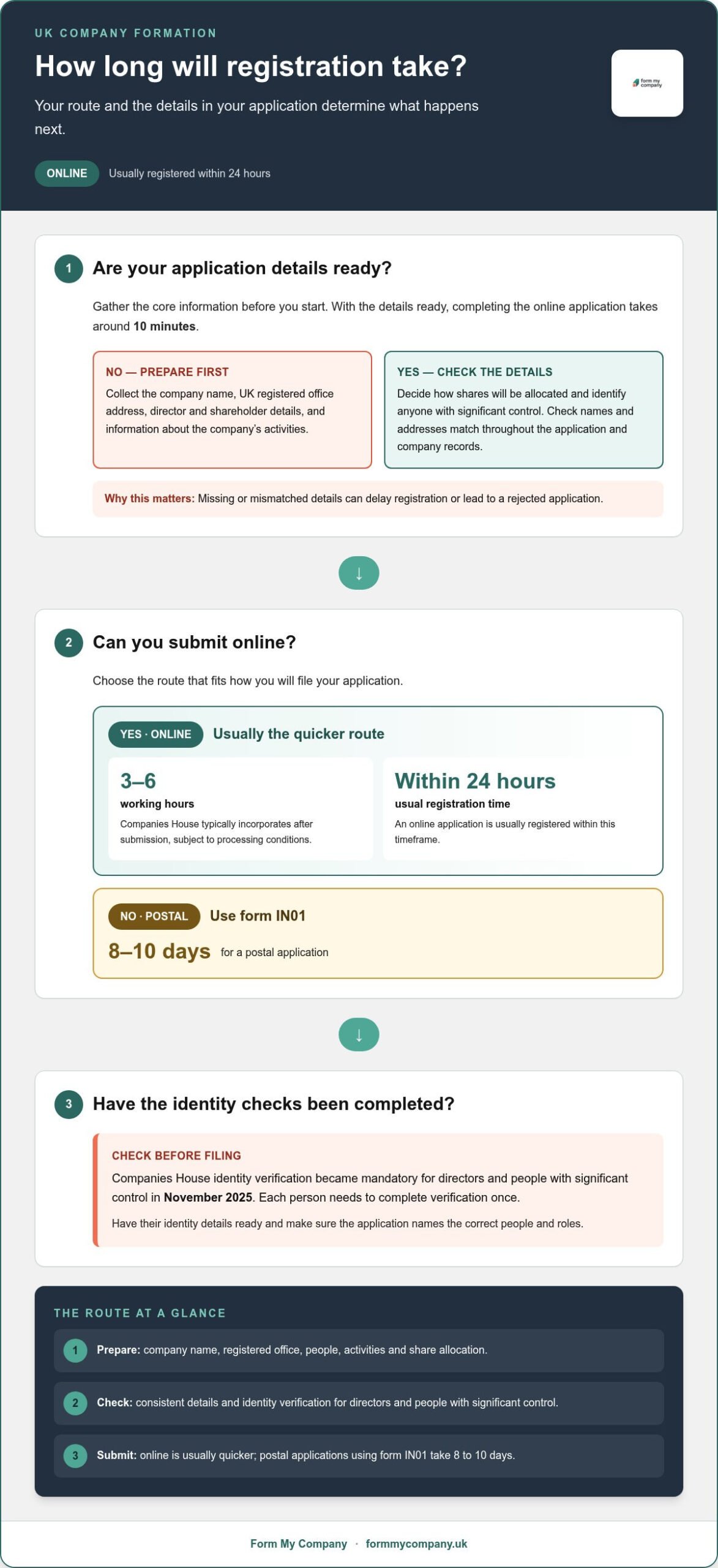
An online application is usually registered within 24 hours. Completing it takes around 10 minutes when you have the details ready. Companies House typically incorporates a company within 3 to 6 working hours after submission, subject to processing conditions. A postal application using form IN01 takes 8 to 10 days. For uk company formation, the online route is usually the quicker option.
Before applying, prepare a proposed company name, a UK registered office address, director and shareholder details, and information about the company’s activities. Decide how shares will be allocated and identify anyone with significant control. Check that names and addresses are consistent throughout the application and company records. Missing or mismatched details can delay registration or lead to a rejected application.
Companies House identity verification became mandatory for directors and people with significant control in November 2025. Each person needs to complete verification once. Have their identity details ready before filing, and make sure the application reflects the correct individuals and roles. This is one practical step to complete early when planning a uk company formation application with Form My Company.
Every company needs a UK registered office address. Companies House adds it to the public register after formation, and Companies House and HM Revenue & Customs use it for official notices. The address must meet the appropriate-address rules introduced in October 2023; a PO box does not qualify. Consider whether a home address should appear on the public register, or whether a registered office address service better suits your needs.
These are filing fees, separate from any formation package or registered office service. The price of those services depends on the case and is given after a quote request. Cost factors include the package selected, the application route and any address service you require.
VAT registration is separate from incorporation. According to HM Revenue & Customs, companies must register for VAT if taxable turnover exceeds £90,000 in any 12-month period. Voluntary registration can also be considered below that threshold, taking account of VAT on purchases and the impact on customers. HM Revenue & Customs states that UK Corporation Tax rates start from 19% of profits.
Incorporation also starts ongoing filing deadlines. Companies House says UK companies must file annual accounts within 9 months of the financial year end. According to HM Revenue & Customs, UK companies must also meet all associated fiscal deadlines following incorporation. Record each deadline separately to ensure full compliance.
What is Company Formation?
Company formation registers a legal structure with Companies House. You’ll need to choose a company name, provide a UK registered office address, appoint at least one director and record the shareholders or guarantors.
Directors, shareholders and guarantors
Directors manage the company and are responsible for its decisions and records. Shareholders own a company limited by shares, and one person can hold both roles. A company limited by shares needs at least one shareholder, who may also be a director. In a company limited by guarantee, guarantors take the membership role instead of shareholders. Decide who will own shares and how they will be divided before you apply.
People with significant control
A person with significant control, or PSC, has a significant influence over a company. This status helps make ownership and control visible on the public register. According to Companies House, a shareholder holding more than 25% of a UK company’s shares is required to register as a person with significant control. Consider both share ownership and who exercises control when preparing the company’s ownership details and documents.
Identity checks and eligibility
A UK limited-company director must be a natural person aged 16 or over, and each company must appoint at least one director. A shareholder can also be a director, so one founder may fill both roles. Companies House identity verification became mandatory for directors and PSCs in November 2025, and verification only needs completing once. Prepare each person’s identity details and ensure the application matches their records.
Company name and registered office rules
Choose a proposed company name and enter it consistently across the registration documents. The registered office is the company’s official address for notices and appears on the Companies House register after formation. It must meet the appropriate-address rules introduced in October 2023, and a PO box does not qualify. Consider whether a home or business address is suitable for public display before submitting the application.
After registration, keep ownership information, company records and accounts organised as the business develops. The articles of association set out how the company is run, so review them alongside the share ownership or guarantee details. Compare formation package inclusions with the structure you plan to register, and prepare the information for each director, shareholder or guarantor.
UK limited company formation packages and prices
Formation costs include the Companies House filing fee and any package or optional services. Compare what each package includes and make sure it suits the structure and needs of your business.
Formation packages and fees
A formation package may organise the application and provide different documents or support, so compare inclusions rather than headline figures alone. Package prices depend on the services selected and are given after a quote request. Factors include the formation option, document format and whether address services are required.
Before choosing, list what you need at incorporation and what you can arrange separately. A founder who needs digital formation documents may prefer the Digital Package. If you want printed documents or a registered address, compare packages that include those features. Check the terms of any ongoing service, including how it renews.
Company types and limited liability
A limited company has shareholders and directors, with ownership and management assigned to those roles. This structure differs from operating as a sole trader, where the business and individual are not separate legal entities. Compare the administrative responsibilities and ownership structure alongside the distinction in legal liability. Shares record ownership, while the articles of association set out how the company is run.
Operating as a sole trader can be simpler to administer, but it does not create the same legal separation between owner and business. A limited company must maintain company records and submit accounts and filings. Before registering, consider who will own the business, how profits will be distributed and whether a company structure suits your plans.
If your business has more than one owner, decide how shares will be allocated and who will have significant control. These arrangements determine the ownership information recorded at formation. Keep the details consistent in the application and company documents. A clear ownership plan also helps founders explain each person’s role when arranging business banking or other services.
A limited liability partnership, or LLP, is another structure for businesses run by partners. Its profits can be divided under flexible rules, and it is treated as transparent for tax purposes. Compare an LLP with a limited company by considering how partners will share profits and responsibilities. The structure affects registration details and ongoing administration, so decide which entity fits before choosing a formation package.
Compare options in this order: choose the legal structure, identify the documents and services you need, then review package inclusions and terms for ongoing services. Keep the Companies House filing fee separate from package costs and optional services.
Do I need to supply any documents for a UK limited company?
Company registration requires accurate information about the proposed company and the people involved. Non-UK residents should prepare the same core details: company name, UK registered office address, director and shareholder information, share ownership and business activities. Identity verification requirements also apply to directors and people with significant control, so prepare their identity information.
To form a UK company as a non-resident, provide the company’s details and information about the people connected to it. You’ll need to appoint a director, provide a UK registered office address and record the company’s ownership and control. Keep spellings, addresses and ownership details consistent throughout the application and company records.
Prepare a checklist before filing:
- Company details: choose a proposed company name and describe its activities using the relevant SIC codes.
- People: gather each director’s and shareholder’s full details, and identify anyone with significant control.
- Ownership: agree how shares will be allocated and record each shareholder’s details accurately.
- Address: decide which qualifying UK address will serve as the registered office.
- Verification: have identity information available for the Companies House checks required for directors and PSCs.
A director’s or shareholder’s overseas address does not replace the company’s UK registered office address. The registered office appears on the Companies House register, so consider privacy before using a residential address. Form My Company’s Registered Office Address Service gives businesses an option for receiving official correspondence without using a home address.
Preparing the application means checking more than the documents themselves. Make sure the proposed company name matches the application, personal details are consistent and share allocations reflect the founders’ agreement. For example, if two founders agree to equal ownership, record that arrangement clearly. Describe the company’s activities accurately too, as SIC codes indicate what the business does.
Common errors include incomplete details, inconsistent names or addresses, unclear share allocations and omissions in the ownership information. Around 10% of company formation applications are rejected, usually because of avoidable mistakes. Review the application before filing, paying particular attention to names, addresses, roles and the company’s ownership records.
Non-resident founders should plan for practical tasks after registration as well. Keep company documents and financial records organised, and make sure the people responsible can access official correspondence sent to the registered office. Accurate information at filing establishes a clear record with Companies House and helps with the company’s next administrative steps.
Company formation packages and pricing
Compare the Companies House filing fee separately from package costs and optional services. Your company structure, required documents and address needs can all affect the total. Start by deciding what the business needs at incorporation, then compare package inclusions against that list.
An online application is usually registered within 24 hours. These are Companies House filing fees, not the price of a formation package. Keep the amounts separate when reviewing your expected costs, so it’s clear which charges relate to incorporation and which relate to additional services.
A package may cover formation administration, documents or other support. Compare its inclusions against your requirements: a private company needing digital documents has different needs from one requiring printed documents or an office address. The price depends on the case and is given after a quote request. Cost factors include the company structure and the services selected.
Use this checklist to compare options:
- Core registration: identify which application support and formation documents the package covers.
- Document format: decide whether digital records suit you or printed documents would be useful.
- Address services: see whether an office address is included, optional or charged separately.
- Ongoing services: note any annual renewals and what each renewal covers.
- Filing fee: separate the Companies House charge from the package price.
Next, consider your company’s legal structure. Limited companies, LLPs and PLCs have different formation requirements and ownership arrangements. Form My Company offers formation services for these structures, including LLP and PLC formation. Decide who will own and manage the entity first, then compare package features with your choice.
Address services can also affect the overall budget. Work out whether your company needs a registered office address, a business address, or both. Check the service term, what mail handling covers and whether it renews annually. Record renewal dates alongside other company administration tasks, rather than treating the initial formation cost as the full ongoing cost.
For a clear comparison, list the filing fee, package features, optional services and any continuing costs separately. This makes it easier to compare packages and avoid paying for features you don’t need. Choose the company structure first, then compare package inclusions and total costs, including any ongoing address or filing services.
Form My Company: Digital Package
Form My Company helps you progress from choosing a company structure to preparing a formation application. Its Digital Package suits founders who want digital formation documents, while the Digital & Print Package offers a print option. If you’re comparing broader support, consider the Entrepreneurs Choice Package; for a partnership structure, Limited Liability Partnership (LLP) Formation may be relevant.
Choose a package based on your legal structure, the documents you want and the support you need. Have your company and director details ready to make a clear start on registration and the next steps for your business.
Explore the company formation packages, or visit formmycompany.uk to get started.
Turn your plans into a clear next step
Before starting UK company formation, decide which structure fits your plans, who will be involved and what support you need during registration. These choices make it easier to compare package features and select an option that suits your business, rather than relying on the package name alone.
Form My Company offers the Digital Package, Digital & Print Package and Entrepreneurs Choice Package. Compare these options against the documents and support you want, then choose the one that feels right for your next step. You can explore the available packages or discuss your formation plans directly.
Starting a company involves decisions, but you can take them one at a time. Contact Form My Company today to move forward with a clearer plan and get your new venture underway.
Frequently Asked Questions
Do I have to live in the UK to form a company?
No, you don’t have to live in the UK to form a UK company. Non-UK residents can be founders, directors or shareholders, subject to registration and identity requirements. The company still needs a UK registered office address. Plan how you’ll receive official correspondence and keep company information accessible while managing the business from abroad.
Can a non-UK resident start a company in the UK?
Yes, a non-UK resident can start a UK company. Decide who will be a director, who will own shares and how the company will be managed. Prepare consistent personal details for everyone named in the application, including information needed for identity verification. Plan how you’ll manage UK post and company records from overseas so documents and official correspondence reach the people responsible.
What documents will I receive after forming a new company?
After incorporation, you receive a certificate of incorporation confirming the company’s legal existence, company number and formation date. Formation documents also include the memorandum and articles of association, which set out the company’s constitution and operating rules. Keep digital copies securely with your company records. Banks may request incorporation documents when you apply for a business account, along with their own identity and account-opening information.
What type of company should I choose?
Choose a structure based on ownership, decision-making and how profits will be shared. A private company limited by shares suits owners who want shares to represent ownership. An LLP is organised around partners, while a company limited by guarantee has guarantors instead of shareholders. A PLC is another option with its own requirements. Consider the ongoing filing and record-keeping responsibilities before deciding.
How many shares do I need to issue?
A limited company can be incorporated with one share valued at £1. For a sole founder, that can make the ownership record straightforward. With co-founders, decide how to divide ownership before submitting the application, and record each person’s allocation accurately. The number and distribution of shares affect who owns the company, so choose an arrangement that reflects the founders’ agreement rather than selecting figures at random.
How many shares does a company need?
A UK company limited by shares needs at least one share and at least one shareholder. The shareholder can also be a director, so one person can establish and manage a company alone. A single £1 share is one possible starting structure. If there are several owners, allocate shares to reflect the agreed ownership and keep the company’s records aligned with the registration details.
What types of companies can you form in the UK?
Common options include private limited companies, public limited companies, limited liability partnerships and companies limited by guarantee. The right fit depends on the organisation’s ownership and purpose. For example, a business with shareholders may choose a company limited by shares, while a membership organisation may consider a guarantee structure. An LLP is designed for partners. Compare management responsibilities and filing requirements before choosing a legal form.
How do you register a limited company with Companies House?
Choose a company name and structure, then prepare details for the registered office, directors, shareholders and share ownership. Decide on the company’s activities and review its articles of association. Submit the incorporation application to Companies House with the required fee. Once approved, keep the certificate of incorporation and company number with your records. You can then use the company’s registered details for practical steps such as applying for a business bank account.