
A UK limited liability partnership (LLP) is a separate legal entity formed by at least two members to carry on a business for profit. Members’ liability is generally limited to their investment, plus any personal guarantees they give. An LLP must have at least two designated members at all times.
This mix of shared ownership and limited liability can make an LLP attractive, but it also brings specific responsibilities. Members need to agree how decisions are made, profits are shared and changes in membership are handled.
This guide explains how a UK LLP works, including members’ roles, management arrangements and the value of a clear partnership agreement. It also outlines Companies House and HMRC responsibilities, helping you assess whether an LLP suits your business and what is involved in setting one up.
Key Takeaways
- Understand how this business structure separates the partnership from its members and what limited liability means in practice.
- Learn how members can join or leave, and why clear leaver arrangements matter.
- See how members’ responsibilities, decision-making and profit-sharing can be set out in a partnership agreement.
- Know which annual accounts and other updates need attention for Companies House and HMRC.
- Get a clear overview of the information and decisions involved in registering a new partnership.
What is a limited liability partnership?
A UK LLP combines partnership-style shared ownership with a separate legal identity. Its structure affects members’ liability, management, tax treatment and the way the business is formed with Form My Company.
LLPs Compared with Partnerships and Companies
Unlike a traditional partnership, where partners generally have personal responsibility for business debts, an LLP is a separate legal entity. Members’ liability is generally limited to their investment, plus any personal guarantees. This distinction matters when considering how business obligations could affect members personally.
A limited company also has a separate legal identity, but its owners are shareholders and its managers are directors. An LLP has members rather than shareholders, and it has no shares to sell to raise capital. Designated members have formal responsibilities similar to directors, but they need not be shareholders. For example, an LLP can give designated members management duties without creating share ownership.
Tax treatment differs too. LLP members pay income tax through self-assessment, whilst limited companies pay corporation tax. Section 10 of the UK Limited Liability Partnerships Act 2000 concerns income tax and chargeable gains, according to The National Archives (legislation.gov.uk). The most suitable structure depends on the business’s circumstances, including how it plans to share profits and who will manage it.
The legal framework also distinguishes an LLP from a general partnership. The Limited Liability Partnerships Act is a UK Public General Act cited as 2000 c. 12, according to The National Archives (legislation.gov.uk). An LLP is incorporated at Companies House and can only be used by profit-making businesses. These points matter during formation because the structure is a registered legal entity, not simply an informal agreement between co-owners.
Formation and Liability Across UK Jurisdictions
LLP formation and liability depend on the specific UK jurisdiction, so rules can vary across different regions of the country. In Great Britain, LLPs became available from 6 April 2001 and are regulated by the Limited Liability Partnerships Regulations 2001. Northern Ireland has a separate governing statute, the Limited Liability Partnerships Act (Northern Ireland) 2002.
UK rules were consolidated across the country with the Companies Act 2006, which came into effect in 2009. The UK LLP remains a separate entity, and members’ liability is generally limited to their investment and any personal guarantees. A business comparing structures across UK jurisdictions should distinguish the governing legislation from the practical effect of limited liability.
Statutory requirements can differ substantially within the UK home nations depending on the exact registration details. For instance, specific filing requirements apply to partnerships operating across England, Wales, Scotland and Northern Ireland. Understanding these domestic distinctions ensures full compliance when setting up through Form My Company.
A business’s precise location and activities matter when deciding how to set it up. The term “LLP” does not mean the membership rules, liability protection or tax treatment are uniform across every domestic territory. A UK LLP with members situated across different home nations should distinguish its incorporation details from any regional rules that may apply to local operations. The relevant UK jurisdiction determines the legal framework for the entity and its members.
Membership changes and leaver arrangements
UK LLP members must act in the LLP’s best interests, and their liability is generally limited to their investment plus any personal guarantees. Designated members also have formal responsibilities, including duties related to the LLP’s statutory administration.
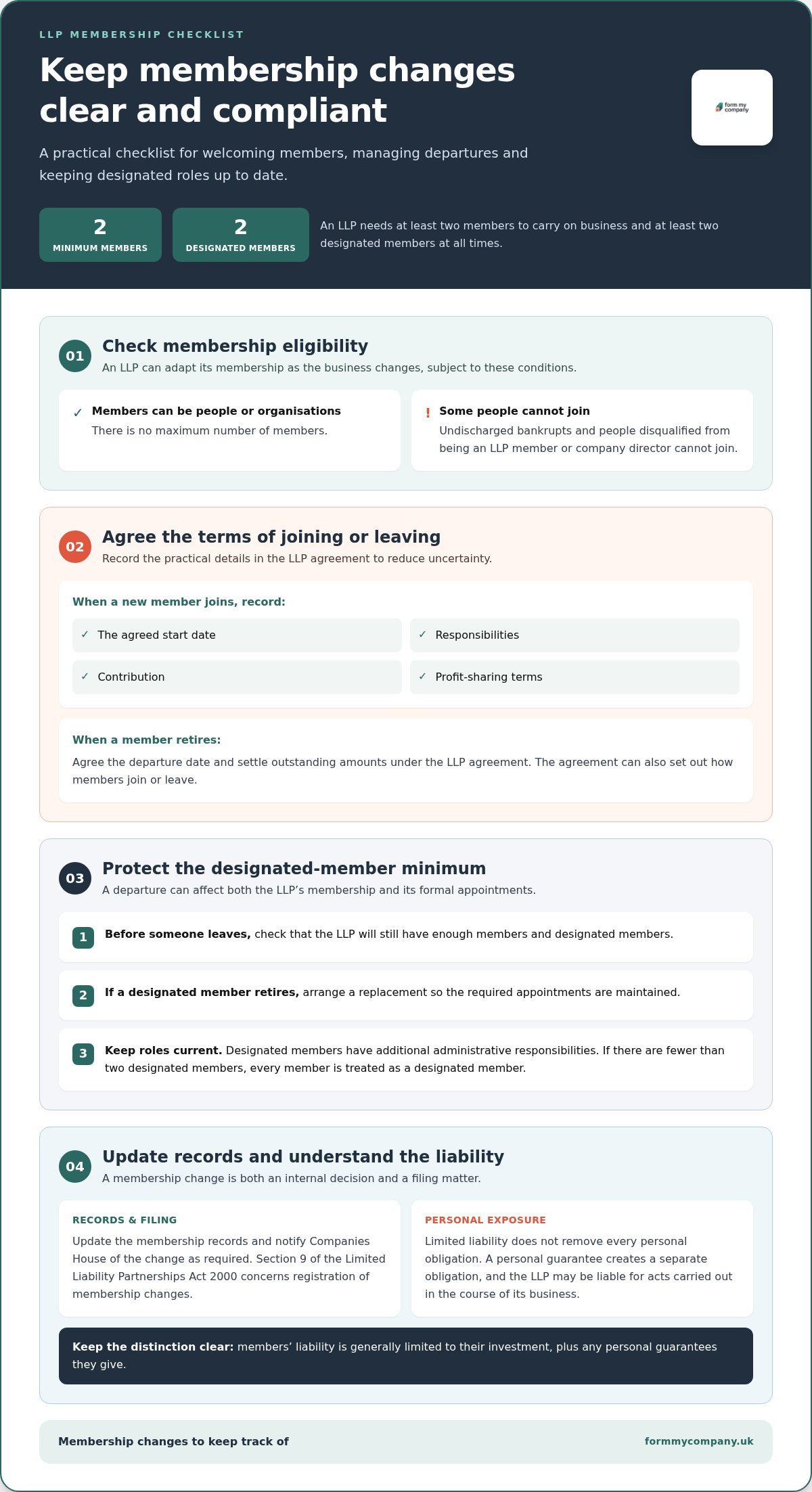
An LLP needs at least two members to carry on business and at least two formally appointed designated members at all times. If there are fewer than two designated members, every member is treated as a designated member. This matters when someone in a designated role leaves: the LLP must maintain the required appointments.
There is no maximum number of members. Members can be individuals or corporate bodies, but undischarged bankrupts and people disqualified from being an LLP member or company director cannot join. This gives an LLP flexibility to bring in a person or organisation as the business changes, while keeping eligibility requirements in mind.
Section 4A of the Limited Liability Partnerships Act 2000 concerns the minimum membership for carrying on business. Section 8 concerns designated members, and section 9 concerns registration of membership changes. Together, these provisions make membership changes both an internal decision and a filing matter.
When an LLP admits a new member, record the agreed start date, responsibilities, contribution and profit-sharing terms. When someone retires, agree the departure date and settle outstanding amounts under the LLP agreement. The agreement can set out how members join or leave, reducing uncertainty about the process.
Before a member leaves, consider whether the LLP will still have enough members and designated members. If the departing person holds a designated role, arrange a replacement to maintain the required appointments. Update the membership records and notify Companies House of the change as required.
Designated members have additional administrative responsibilities, so identify who holds those roles and keep the appointments current. If a designated member retires while another member joins, for example, record both changes and ensure the remaining appointments meet the minimum.
Limited liability does not remove every personal exposure. A personal guarantee creates a separate obligation, and the LLP itself may be liable for acts carried out in the course of its business. Members should distinguish their personal commitments from obligations incurred by the LLP.
Plan each membership change around three points: eligibility, the LLP agreement and notification to Companies House. This helps members manage an arrival or departure without overlooking minimum membership requirements or designated-member responsibilities.
Partner management and partnership agreements
An LLP agreement sets out how the business operates. It turns members’ shared expectations into practical arrangements for decisions, duties and profits.
Management and Members’ Agreements
Section 5 of the Limited Liability Partnerships Act 2000 concerns the relationship between members. A written agreement gives individuals a separate, practical framework for working together. It can record who makes routine decisions, which matters need wider approval, and how members handle disputes. These details matter when members contribute different skills, time or resources.
Define each member’s responsibilities clearly. One member might manage client work while another oversees finance and administration. The agreement can explain how they report progress, approve commitments and resolve disagreements. It should also set out how members call meetings, share information and record decisions, giving the business a consistent process to follow.
Designated members have statutory responsibilities alongside any management duties assigned by the agreement. Identify their roles and explain how internal decisions are made, while keeping those arrangements distinct from legal obligations. A member’s commercial role, such as leading a project, does not automatically make them responsible for every administrative task.
Profit Sharing and Default Rules
An LLP agreement should explain how profits are shared and how members’ responsibilities affect their entitlements. Without clear terms, members may disagree about whether distributions reflect equal shares, agreed contributions or work completed. A written formula helps each member understand the calculation before profits are allocated.
The agreement can also cover drawings, retained funds and approval of distributions. Members might agree to reserve money for planned costs before sharing the balance under their chosen formula. Clear definitions distinguish profits available for allocation from funds the LLP needs to meet its business commitments.
If the agreement does not address an issue, applicable default rules may shape the members’ relationship. The outcome may differ from what they assumed, particularly for decision-making or financial entitlements. Identify the matters members need to settle and record their decisions rather than relying on informal conversations.
Review the agreement when the business changes. A new member, a different contribution or a change in management may make existing terms unsuitable. Record agreed amendments in writing and ensure members understand their effect. A revised profit-sharing arrangement, for example, should state when it takes effect and which members it covers.
A useful agreement connects everyday management with the LLP’s purpose. It should cover responsibilities, decision-making, dispute resolution, profit-sharing and membership changes in one coherent document. Members can then use it as a working reference, not merely a record created at formation.
Companies House and HMRC filing requirements
UK LLPs have annual reporting duties to Companies House, while members have personal tax responsibilities. Members report income through self-assessment, and their National Insurance position is handled individually according to their circumstances.
Accounts and Companies House Filings
Annual accounts and an annual return must be submitted to Companies House each year. These filings matter because the LLP’s accounts and financial position are available for public view. Keep financial records organised throughout the year so the figures can be prepared and submitted accurately.
Plan for additional filings when the LLP’s details change. A change in membership, for example, must be registered with Companies House. The LLP may also need to register for VAT, depending on its income. Requirements depend on the change or obligation, so record business decisions and relevant dates promptly.
Since 30 June 2016, an LLP has been able to elect to send certain statutory register information to the registrar for the public register instead of keeping those registers itself. This option concerns specified register information, not a general replacement for every record. Members should understand which records are covered when arranging the LLP’s governance and document keeping.
HMRC Filings and Member Taxation
Each member reports their taxable income through self-assessment. Unlike a limited company, an LLP does not pay corporation tax on members’ shares of its profits. This distinction matters when members plan their personal tax affairs and decide how much profit to retain or draw.
HMRC and Companies House filings serve different purposes. Companies House receives the LLP’s annual accounts and statutory updates, while members report their own tax to HMRC. The LLP’s accounts do not replace an individual member’s self-assessment return. Members should keep records supporting their share of profits and personal tax reporting.
The LLP may have its own reporting obligations related to tax and business activity. VAT registration may be relevant to the LLP’s tax obligations. Distinguish the LLP’s obligations from members’ individual income tax and National Insurance responsibilities, rather than treating every filing as a company return.
Section 15 of the Limited Liability Partnerships Act 2000 concerns the application of company law. That application does not turn an LLP into a company with shareholders: LLPs have no shares to issue or manage. Governance therefore centres on members, statutory records and filings, not share ownership or share transfers.
For practical oversight, assign responsibility for each filing, keep accounts and membership records aligned, and note when changes must be reported. Separating Companies House submissions from members’ HMRC responsibilities helps prevent one filing from being mistaken for another.
LLP incorporation and registration
Registering an LLP gives the business a separate legal structure instead of leaving it as an informal arrangement between members. The incorporation document begins the process, and the certificate of incorporation is conclusive evidence that the LLP is registered under the LLP Act 2000. A limited liability partnership becomes a distinct legal entity through registration.
The National Archives (legislation.gov.uk) states that a UK LLP must have at least 2 persons subscribing their names to its incorporation document to carry on lawful business with a view to profit. Section 2 of the Limited Liability Partnerships Act 2000 concerns the incorporation document, whilst section 3 concerns incorporation by registration. The subscribers should agree the details before submitting the application.
Applications can be submitted electronically, by post or through a third-party formations company. Companies House charges £100 for digital incorporation using the standard filing service. Its same-day digital filing fee is £156 for applications received by 3pm Monday to Friday. A paper application costs £124, according to Companies House.
Choose the filing route based on the application format and timing. Same-day digital filing requires receipt by the stated weekday cut-off. Paper applications follow a different process and have a separate fee. Companies House filing fees are distinct from any formation support costs.
Check the proposed name before filing. LLP names are subject to part 3 of the Limited Liability Partnerships (Application of Companies Act) Regulations 2009 (2009/1804). When deciding whether a name is the same as another, characters after the first 60 characters are disregarded. Consider this rule when preparing a longer name for an application.
Before applying, agree the name, members and designated members. The application must include the information required for registration, and the structure should reflect how members intend to operate. An LLP has no shares to issue for investment, so it cannot raise funds by selling ownership shares. Plan separately how the business will fund its activities and acquire assets.
Once registered, the certificate confirms the LLP’s legal status. The LLP is distinct from its members, but personal guarantees can still create personal obligations. Registration does not protect members from commitments they have personally accepted. Consider incorporation alongside the business’s funding arrangements and the obligations members may take on.
If you’re ready to establish this structure, begin your LLP formation with the incorporation details and member arrangements prepared.
Form My Company: Digital Package
Form My Company provides LLP formation for entrepreneurs preparing to register a limited liability partnership. Its Digital Package is one way to handle formation digitally, alongside the Digital & Print Package and Entrepreneurs Choice Package.
Consider formation support once members have agreed the LLP’s name, roles and incorporation details. Preparing these decisions helps you move from understanding the structure to assembling the application. Choose the package that suits how you want to handle formation, then prepare the required information.
To discuss your next step, contact Form My Company or visit formmycompany.uk.
Take the next step towards setting up
Choosing a limited liability partnership is the beginning of shaping how your business will work. Turn your members’ shared plans into a practical setup, with clear expectations for organising the business and moving forward together.
Form My Company offers the Digital Package, Digital & Print Package and Entrepreneurs Choice Package. Consider which formation option suits the way you want to set up, then prepare to put your plans into action. A considered choice helps you focus on building the business and working effectively with your members.
If you’re ready to take that step, contact Form My Company for help. Start with a clear plan and move forward with confidence.
Frequently Asked Questions
Are there any drawbacks to setting up an LLP?
Yes. An LLP has reporting and administration duties, and its accounts are available for public view. It also has no shares, so it cannot raise capital by selling ownership shares. Weigh these limits against the structure’s flexibility. If a business expects to raise investment through share issues, for example, a limited company may be a more suitable structure to consider.
LLP and Ltd: What’s the difference?
An LLP is owned by members, while a limited company has shareholders and directors. An LLP has no shares, and members report income through self-assessment; limited companies pay corporation tax. Both are separate legal entities, but their ownership, management and tax arrangements differ. A founder planning to bring in investors through shares, for example, may prefer to explore a limited company’s ownership model.
LLP vs Ltd: Which should you choose?
Choose by considering how you will share control, distribute profits and fund growth. An LLP may suit co-owners who want a member-based structure and flexibility in managing the business. A limited company may suit a venture planning to raise investment through shares or establish shareholder and director roles. Tax treatment also differs, so compare both structures with your business plans and members’ circumstances before deciding.
What is an example of an LLP?
Imagine a consultancy formed by two independent professionals who want to run a profit-making business together. They could become members, agree how to divide profits and assign management responsibilities. If they later bring in another member, their agreement can guide the change. This illustrates how an LLP combines shared business activity with a separate legal identity.
What is the structure of an LLP?
An LLP is organised around its members, with the business treated separately from them. Members can manage the business under an LLP agreement that allocates responsibilities and sets decision-making arrangements. Designated members take on formal statutory duties. This role is distinct from simply managing a task, such as overseeing a client project or coordinating day-to-day work.
Who owns the partnership and what are the partners’ responsibilities?
Members hold rights in the LLP and share responsibility for its operation under their agreement. They should act in the LLP’s best interests and follow agreed processes for decisions, profit allocation and disputes. Designated members also handle specific statutory responsibilities. Members might assign one person to lead a project while recording who manages formal filings and business decisions.
What is an LLP in the UK?
A UK LLP is a business structure with a separate legal identity from its members. It is registered at Companies House and intended for profit-making businesses. Members generally risk their investment and any personal guarantees, rather than being automatically liable for every LLP debt. The structure combines member-based ownership with formal registration and ongoing reporting responsibilities.
How does a UK LLP differ from a limited company and an ordinary partnership?
A UK LLP has members and no shares; a limited company has shareholders and directors. Both have separate legal identities. An ordinary partnership does not have the same incorporated status, so partners may face greater personal exposure to business debts. The right comparison depends on how owners want to divide control, attract investment and manage personal exposure to obligations.