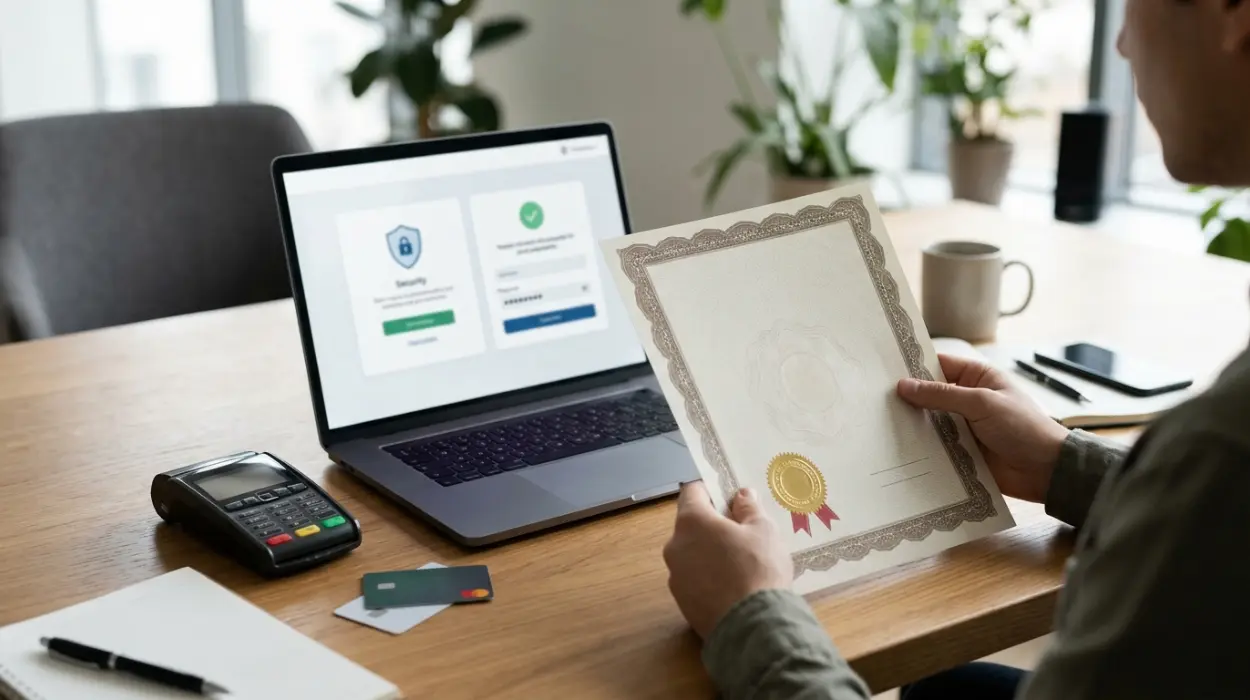
Payment providers ask for a Certificate of Incorporation to verify a company’s legal existence, confirm registered ownership, prevent financial fraud, and maintain compliance with anti-money laundering regulations before activating merchant accounts.
Payment acquirers must confirm that a legal entity officially exists before processing payments. Official incorporation documents provide legal proof of registration from Companies House. Acquiring banks utilize this documentation to establish legal entity status, mitigate risk, and execute mandatory regulatory checks.
What Legal Regulations Require Acquirers to Request Proof of Incorporation?
Acquiring banks require proof of incorporation to comply with international Anti-Money Laundering legislation, Know Your Customer regulations, Counter-Terrorist Financing rules, and national financial service authority standards that mandate strict identity verification for all corporate account holders.
Global financial frameworks enforce stringent compliance standards on payment processors. Anti-Money Laundering (AML) laws mandate that financial institutions identify the ultimate beneficial owners of corporate bank accounts. Know Your Customer (KYC) regulations compel payment acquirers to audit legal entities before opening merchant processing accounts. Payment service providers failure to verify corporate credentials risks heavy fines and license revocation from oversight authorities like the Financial Conduct Authority (FCA).
The legal status of a limited company separates business liabilities from personal ownership. Payment processors verify legal structures to establish clear jurisdiction and accountability. Official incorporation details validate that a company operates within legal registration guidelines. Payment processors store verified incorporation data to build audit trails for regulatory compliance reviews.
Financial institutions update compliance protocols continuously to combat corporate fraud. Proof of company formation guarantees that business applicants operate as legitimate legal structures rather than shell operations. Verifying corporate status protects the financial ecosystem from money laundering networks and illegal financial transfers.
How Does an Incorporation Document Help Acquirers Verify Business Legitimacy?
An incorporation document verifies business legitimacy by confirming the company name, official registration number, legal formation date, registered office address, and jurisdiction directly against official government registry database records.
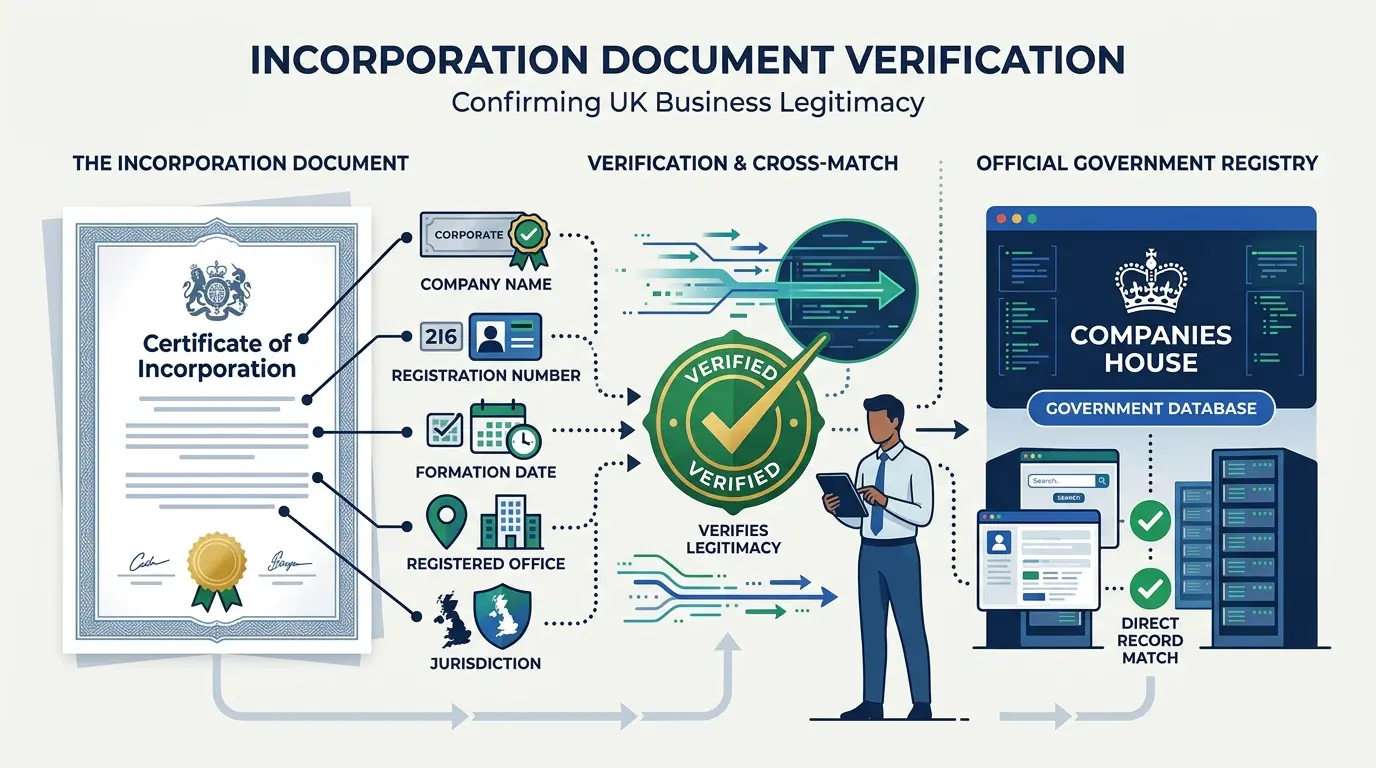
Payment gateways cross-reference incorporation document details against government registers. Verification checks confirm that the company holds active corporate status. A valid registration number links merchant processing applications to public corporate filings. Matching registration numbers proves that the entity maintains official corporate standing.
Acquirers evaluate risk profiles by inspecting corporate formation parameters. Older incorporation dates indicate operational history and financial stability. Official office addresses confirm geographical presence within authorized operational jurisdictions. Financial institutions flag mismatched corporate records immediately to prevent identity theft.
| Document Verification Parameter | Compliance Function | Operational Purpose |
| Registration Number | Database Matching | Verifies active registration on Companies House |
| Registered Address | Jurisdiction Mapping | Confirms physical legal base for taxation |
| Legal Entity Type | Structural Analysis | Classifies corporate liability and tax obligations |
| Incorporation Date | History Assessment | Evaluates operational longevity and risk level |
Digital verification systems scan statutory documents to authenticate official seals and registrar signatures. Automated compliance software compares submitted certificates against real-time company registry data. Validating incorporation records ensures that acquirers onboarding verified entities minimize chargeback exposure and operational risks.
Why Do Payment Processors Require Ultimate Beneficial Ownership Verification?
Processors require ultimate beneficial ownership verification to identify individuals controlling at least 25 percent of company equity, trace corporate governance hierarchies, map share capital distribution, and prevent anonymous corporate misuse.
Payment processors must identify every individual who exercises significant control over a corporate entity. Incorporation documents, alongside the Memorandum and Articles of Association, outline share distribution and voting rights. Acquirers verify ultimate beneficial owners (UBOs) to ensure transparency in corporate control structures. Financial regulations mandate that any individual holding more than 25 percent of shares undergoes personal identity screening.
Identifying corporate controllers prevents individuals from hiding behind complex multi-layered corporate structures. Processors analyze ownership records to identify direct shareholders and parent entities. Screening shareholders protects processing platforms from onboarded entities linked to sanctioned individuals or financial criminals. Clear ownership documentation accelerates the compliance review process for complex corporate setups.
Unmasking corporate hierarchies enables acquirers to perform criminal background and credit assessments on key stakeholders. Directors with significant control must provide government-issued identification matching the incorporation records. Verifying shareholders ensures that financial transactions remain traceable to accountable individuals.
What Financial Risks Do Processors Mitigate by Auditing Company Documents?
Processors mitigate financial risks by auditing company documents to reduce merchant fraud, prevent unauthorized chargeback exposure, detect high-risk business models, and eliminate unauthorized financial laundering operations.
Acquiring banks absorb significant financial liability when processing credit card payments. If a merchant collapses or commits fraud, the payment acquirer pays consumer refund claims. Auditing statutory incorporation filings ensures that the applicant possesses legal standing to enter binding financial contracts. Legal documentation confirms that corporate directors accept personal responsibility for contractual obligations.
Chargeback risks increase when unverified entities obtain merchant accounts. Fraudulent operators setup temporary shell accounts to process illegitimate transactions before abandoning the business entity. Reviewing incorporation files ensures that payment processors interact with traceable companies containing verified assets. Valid documentation allows processors to enforce financial recovery protocols if legal disputes arise.
High-risk merchant categories require enhanced due diligence before payment processing approval. Acquirers analyze corporate structure documents to classify operational models correctly. Correct classification prevents unauthorized merchants from processing payments under false industry codes. Comprehensive document audits safeguard acquiring banks against systemic payment network penalties.
How Does the Certificate of Incorporation Fit Into the Broader KYC Workflow?
The Certificate of Incorporation acts as the foundational baseline in the KYC workflow, establishing legal corporate existence before acquirers collect secondary identity proofs, process bank statements, and review business operations.
KYC verification follows a sequential legal compliance architecture. The primary step requires establishing that a legal entity exists independently from its owners. A company formation certificate serves as this foundational proof. Once the corporate entity is validated, acquirers request supplementary documentation to build a complete risk profile.
Processors combine corporate documents with secondary verification assets to complete onboarding audits. Directors submit personal proof of identity and proof of address to validate individual roles. Acquirers match corporate bank account details with the exact legal name listed on incorporation papers. Discrepancies between bank account titles and legal company names trigger immediate application rejections.
Businesses must provide current corporate documentation during merchant application reviews. Obtaining updated legal filings ensures smooth compliance approvals during onboarding routines. Companies seeking seamless verification can secure supplementary company documents to satisfy strict payment provider compliance checks. Proper documentation prevents processing delays and account freezes.
How Can Businesses Prepare Incorporation Documents to Guarantee Merchant Approval?
Businesses can guarantee merchant approval by updating public registry records, ensuring corporate names match bank accounts exactly, obtaining official apostille certificates for overseas accounts, and filing current statutory confirmation statements.
Preparation ensures fast onboarding through automated compliance systems. Companies must verify that registered details match public government registry files accurately. Outdated director addresses or unfiled annual statements create immediate compliance red flags. Updating corporate registries before submitting merchant applications eliminates verification delays.
Matching corporate branding with legal entities speeds up compliance approvals. Payment gateways audit merchant websites to ensure footers display legal company names and registered addresses. Transparency across web assets, legal documents, and processing applications confirms operational integrity. Misaligned business details force acquirers to request manual underwriting reviews.
Understanding how to pass merchant account KYC with your incorporation certificate enables business owners to streamline account activations. Organizations that organize corporate papers efficiently reduce underwriting friction. Providing accurate legal records allows payment acquirers to issue high-volume merchant processing accounts rapidly.
Why Do International Payment Providers Require Certified or Apostilled Company Papers?
International payment providers require certified or apostilled company papers to authenticate document validity across foreign legal jurisdictions, verify official registrar seals, and ensure cross-border regulatory compliance.
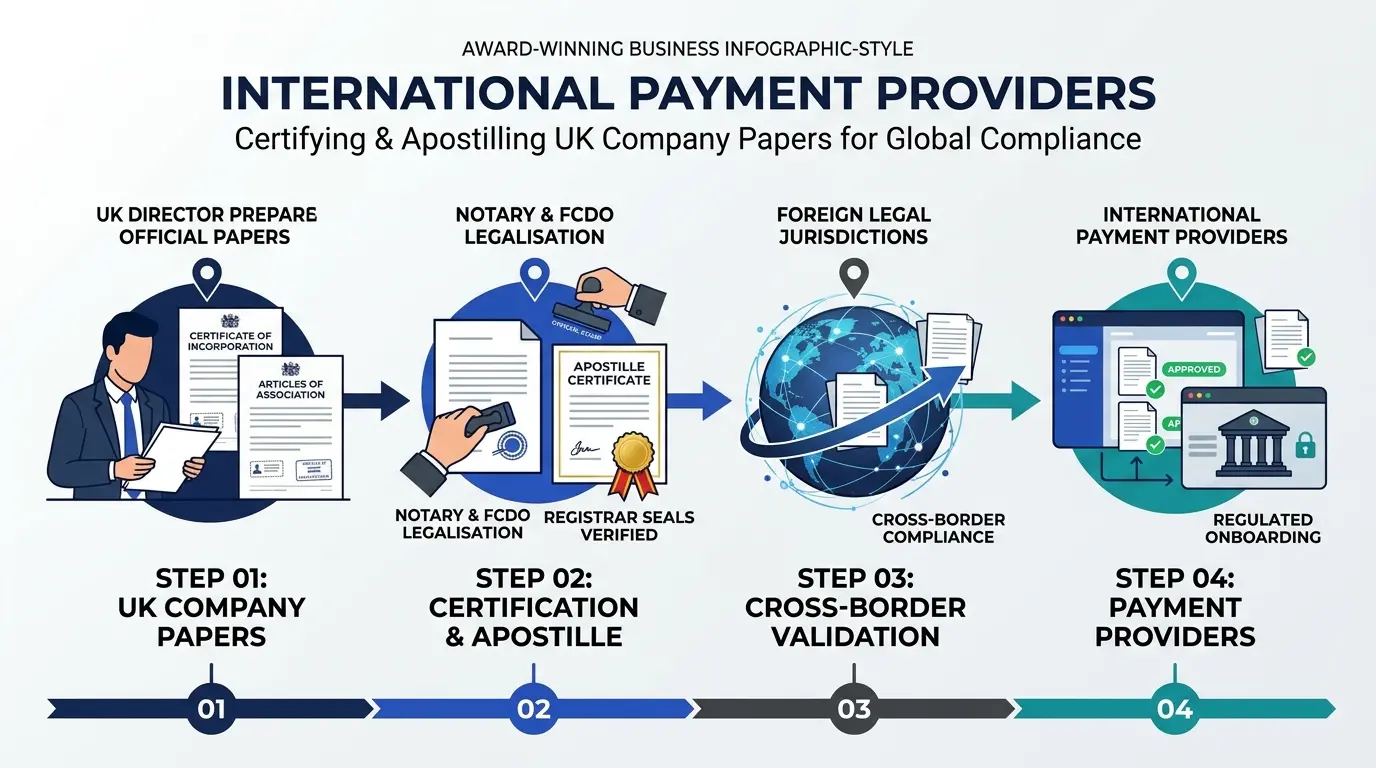
Cross-border payment processing requires elevated legal authentication standards. International payment providers cannot verify foreign corporate filings directly against domestic registries easily. An apostille certificate provides international legal authentication under the Hague Convention standards. Official legal apostilles prove that public document signatures originate from legitimate legal authorities.
Certified corporate documents reassure foreign acquiring banks about legal standing. Local solicitors or government registrars stamp certified copies to guarantee document authenticity. Foreign acquirers mandate certified papers to prevent foreign business applicants from presenting falsified incorporation documents. Authentic paperwork allows companies to expand overseas merchant operations securely.
Multi-currency processing accounts demand rigorous cross-border corporate audits. Foreign acquirers examine incorporation papers to verify international tax compliance and operational authority. Providing certified documents speeds up cross-border merchant applications. Verified international credentials enable businesses to collect payments globally without operational interruptions.
What Impact Do Outdated Corporate Documents Have on Active Merchant Accounts?
Outdated corporate documents trigger automatic merchant account suspensions, initiate emergency risk reviews, cause processing rolling reserves, and delay settlement payout transfers until refreshed legal filings pass verification.
Payment processors conduct periodic compliance audits on active merchant accounts. Financial institutions update risk profiles annually to maintain compliance with changing laws. If a merchant changes directors or registered addresses without submitting updated documents, compliance systems flag the account. Failure to supply current incorporation files results in processing freezes.
Acquirers freeze payout funds when company records show status changes like striking-off notifications. If Companies House displays overdue annual accounts, payment gateways halt transactions automatically. Unresolved registry issues signal potential business insolvencies to underwriting teams. Maintaining active corporate standing prevents unexpected payment disruptions.
Businesses must update payment processors immediately after executing corporate changes. Filing timely confirmation statements keeps corporate records compliant across global risk databases. Proactive document updates preserve uninterrupted payment processing capabilities. Companies maintain strong processor relations by keeping corporate records current.
Businesses requiring official legal papers can get a KYC-ready Certificate of Incorporation from Form My Company to maintain active merchant processing. Form My Company assists growing businesses by delivering compliant corporate records designed for international payment verification standards.
Strategic Summary
Payment providers mandate Certificates of Incorporation to authenticate business identity, fulfill Anti-Money Laundering mandates, and eliminate commercial fraud risks. Statutory incorporation records establish legal entity standing, map corporate ownership hierarchies, and confirm registered operational addresses. Providing accurate corporate documents streamlines Know Your Customer underwriting processes, prevents merchant account holds, and secures long-term payment processing privileges for commercial enterprises.
Explore More Supplementary Company Documents Guide,
What Do Investors Look for in Your Articles of Association?
What Are the Share Transfer Rules in Articles of Association?
Frequently Asked Questions
What are supplementary company documents and why are they needed?
Supplementary company documents are official legal certificates and statutory records—such as Certificates of Good Standing, Memorandums of Association, and change of company name certificates—that provide secondary proof of a business’s legal status. Financial institutions, acquiring banks, and government agencies often require these documents beyond a basic incorporation certificate to complete enhanced Know Your Customer (KYC) audits and confirm ongoing compliance. Businesses can request official statutory documents through Form My Company to ensure their corporate records meet international verification standards.
How quickly can a business obtain supplementary company documents in the UK?
Official supplementary company documents can typically be issued electronically within 3 to 24 hours depending on the specific certificate requested from Companies House. Fast-track digital delivery allows UK businesses to meet urgent merchant account onboarding deadlines and regulatory compliance requests without operational delays. Form My Company provides rapid access to verified supplementary company documents to keep business verification processes moving smoothly.
What is the difference between a Certificate of Incorporation and a Certificate of Good Standing?
A Certificate of Incorporation proves that a legal entity was officially registered and formed on a specific date in the past. In contrast, a Certificate of Good Standing serves as a supplementary company document that verifies the business is currently active, up to date with statutory filings, and has not faced dissolution or striking-off proceedings. Payment acquirers frequently request both documents to assess corporate longevity alongside current legal standing.
Do supplementary company documents require legal apostille or certification for international use?
Yes, international payment providers, foreign banks, and overseas regulatory bodies usually require supplementary company documents to be certified by a solicitor or apostilled under the Hague Convention. Legal apostille authentication verifies that public registrar seals and notary signatures are genuine across cross-border legal jurisdictions. Ordering apostilled supplementary company documents through Form My Company ensures international financial entities accept corporate filings for foreign merchant processing.
Why do acquiring banks request a Memorandum and Articles of Association during KYC?
Acquiring banks review the Memorandum and Articles of Association to audit a business’s internal governance rules, legal liability structure, and share capital distribution. These supplementary company documents allow risk underwriters to confirm corporate authority and identify ultimate beneficial owners (UBOs) holding controlling stakes in the enterprise. Submitting certified copies of these filings allows payment processors to complete mandatory Anti-Money Laundering (AML) checks before activating payment processing accounts.