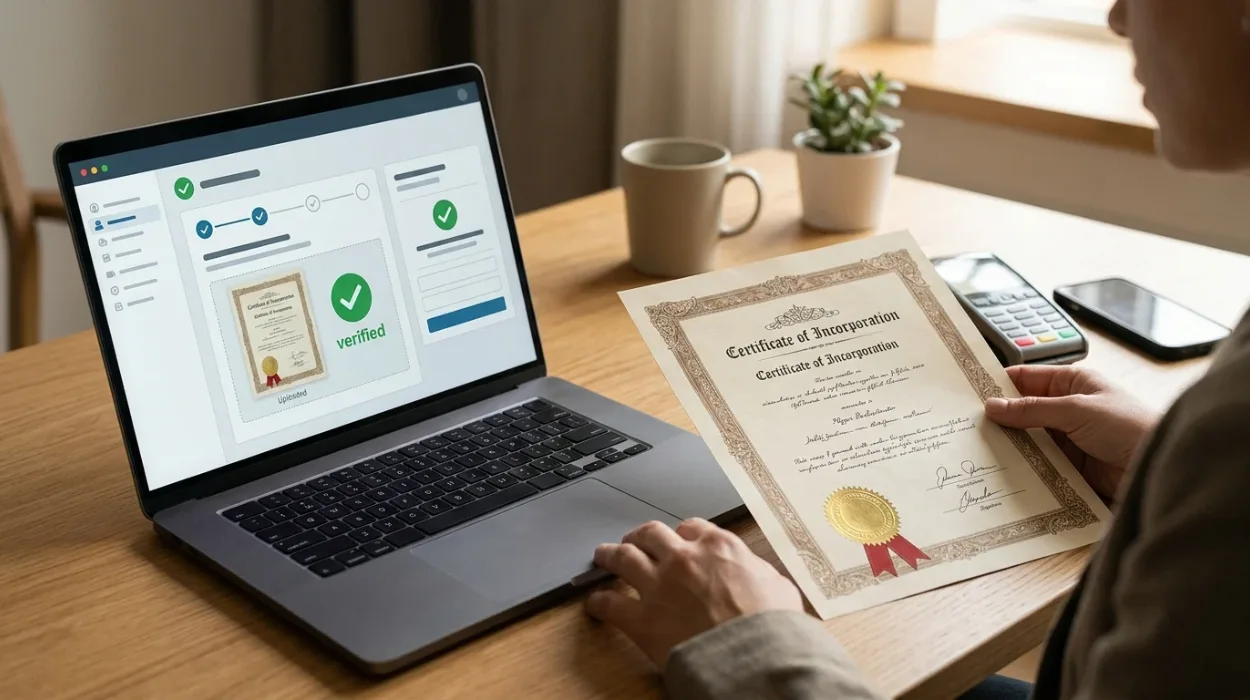
You pass merchant account Know Your Customer verification by submitting an official UK Certificate of Incorporation that contains accurate company registration numbers, matches your registered business address, and displays verified director details across all official Companies House records.
Why Do Payment Processors Request an Official Certificate of Incorporation?
Payment processors request an official Certificate of Incorporation to verify a legal entity’s registration, confirm corporate existence under UK company law, and prevent fraudulent merchant applications across global financial processing networks.
Financial institutions require verified proof of legal existence before opening merchant accounts. Under UK anti-money laundering regulations, acquiring banks must validate the legal identity of every corporate client. A Certificate of Incorporation serves as legal proof that Companies House officially registered your private limited company. Payment gateways cross-reference the registration number, legal company name, and incorporation date on the certificate against public records. This process ensures the business operates as an active legal entity rather than a shell company.
Processing networks assess corporate risk by examining official incorporation records. When a merchant submits an application, risk teams check whether the incorporation certificate matches the details on Companies House. Any discrepancy between your application details and your official company document triggers an automatic rejection or compliance review. Payment processors protect their operations by enforcing strict document standards during the initial merchant onboarding phase.
Providing verified documentation expedites payment gateway approval times. Acquiring banks reject incomplete applications that lack official corporate validation. Businesses must ensure their registration documents reflect current corporate structures before applying for merchant services. Maintaining accurate corporate records prevents processing delays and protects your enterprise from payment gateway account suspensions.
What Key Details Must Match on Your Incorporation Certificate for KYC Approval?
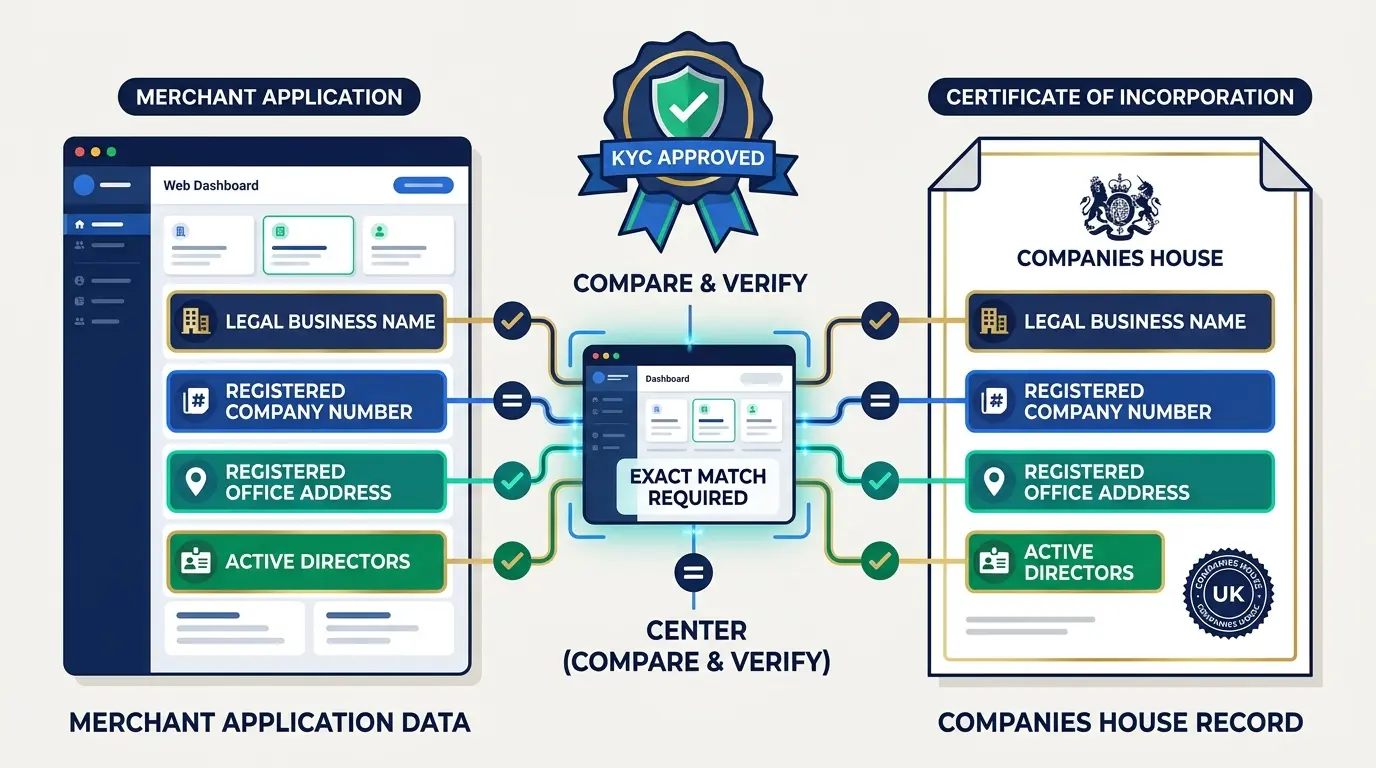
KYC approval requires exact matches between your merchant application and Certificate of Incorporation for legal business name, registered company number, registered office address, and active director credentials.
| Key Data Field | Required Matching Standard | Common Discrepancy Risk |
| Legal Business Name | Exact character-for-character match with Companies House | Trading names used instead of registered name |
| Company Registration Number | 8-digit official UK registration code | Transposed digits or missing leading zeros |
| Registered Office Address | Official address filed with Companies House | Using operational or trading address instead |
| Active Director Credentials | Full legal names matching government IDs | Omission of middle names or outdated director lists |
The legal company name must match your merchant account application character for character. Abbreviations, missing words, or trading names cause immediate identity verification failures during automated document scans. Acquiring banks scan the legal name against international financial sanction databases and corporate registries. Using a trading name instead of your registered limited company name stops the onboarding process instantly.
The 8-digit UK company registration number must align completely across all compliance documents. Automated verification systems query the Companies House database using this specific numerical identifier. Transposing numbers or omitting leading zeros prevents automated systems from retrieving your official file. Underwriters verify that your business maintains an active status on the official public register.
Registered office address details demand total consistency across your corporate filings. Merchant underwriters compare the registered address on your incorporation document with your business bank statements. Providing an operational address on your application while your certificate lists a registered agent address creates a compliance mismatch. Ensure your registered office address matches your official records across all submitted paperwork.
Director details listed on corporate documentation must align with official identity documents. Acquiring banks cross-reference director names on incorporation filings with passport scans and proof of address documents. If your incorporation records list a former director, compliance teams flag the application for manual review. Businesses must update corporate filings before submitting merchant account documentation to guarantee rapid approval.
How Do You Resolve Common Discrepancy Errors During Merchant Verification?
Resolve merchant verification discrepancies by updating outdated Companies House filings, requesting certified corporate status documents, and providing matching bank statements that display identical corporate registration details.
When corporate information changes, update your filings at Companies House immediately. Name changes, address updates, or director resignations require official statutory filings. Payment processors pull real-time data from the public register during risk reviews. Submitting an old Certificate of Incorporation while current public records show updated information causes identity validation failures.
Obtain official corporate validation documents to prove your business remains in good standing. Payment gateways often require secondary authentication if your original incorporation certificate is over 12 months old. Obtaining dedicated Supplementary Company Documents resolves these verification hurdles by providing payment gateways with fresh, officially certified proof of your company’s active status and legal standing. Merchant underwriters accept certified corporate extracts to confirm that your limited company remains active and compliant with statutory filing requirements.
Match your bank account details precisely to your official incorporation records. The business bank account name must match the legal corporate name printed on your incorporation certificate. Underwriters reject merchant applications when processing payouts flow into personal accounts or mismatched corporate entities. Aligning your banking records, tax registrations, and incorporation certificates creates an unbroken chain of corporate verification.
Submit clear, high-resolution digital copies of your official corporate documents. Scanners must capture all four corners of the certificate without cropping official seals, borders, or registrar signatures. Payment gateways utilize optical character recognition technology to extract company data automatically. Low-resolution images or blurry document uploads cause processing systems to reject files, forcing manual underwriting reviews that delay merchant account activation.
Which Additional Company Documents Do Payment Processors Require Alongside Incorporation Records?
Payment processors require Articles of Association, Share Certificates, a Register of Directors, a Certificate of Good Standing, and recent business bank statements alongside incorporation certificates.
Articles of Association establish the internal governance and legal operational powers of your business entity. Acquiring banks review these rules to confirm who holds authority to execute financial agreements and manage merchant accounts. If your business operates within regulated sectors, payment processors verify that your articles permit those specific commercial activities. Providing outdated or incomplete governing documents stalls the merchant risk assessment process.
Share certificates and confirmation statements validate ultimate beneficial ownership structures. Anti-money laundering compliance rules mandate that merchant acquirers identify every individual owning 25% or more of company equity. Underwriters cross-reference your share register against identity documents provided by major shareholders. Clear ownership records eliminate friction during complex corporate risk assessments.
Certificates of Good Standing confirm continuous compliance for established operating entities. When payment processors review older companies, they require proof that the business has filed all annual returns and tax accounts. You can explore Why Do Payment Providers Ask for a Certificate of Incorporation? to understand the precise regulatory frameworks driving these documentation requirements. Acquiring banks use these supplemental records to verify that Companies House has not initiated strike-off proceedings against your legal entity.
Recent corporate bank statements link your physical business operation to your legal registration. Acquiring banks inspect bank statements to verify operational liquidity, official trading addresses, and settlement account routing details. The bank account must belong directly to the registered corporate entity rather than individual shareholders. Providing consistent financial documentation alongside your incorporation certificate ensures seamless compliance approval.
How Does Form My Company Help You Secure Merchant KYC Approval?
Form My Company provides verified incorporation certificates, official certified corporate extracts, and compliance-ready documentation packages designed to meet strict acquiring bank KYC requirements.
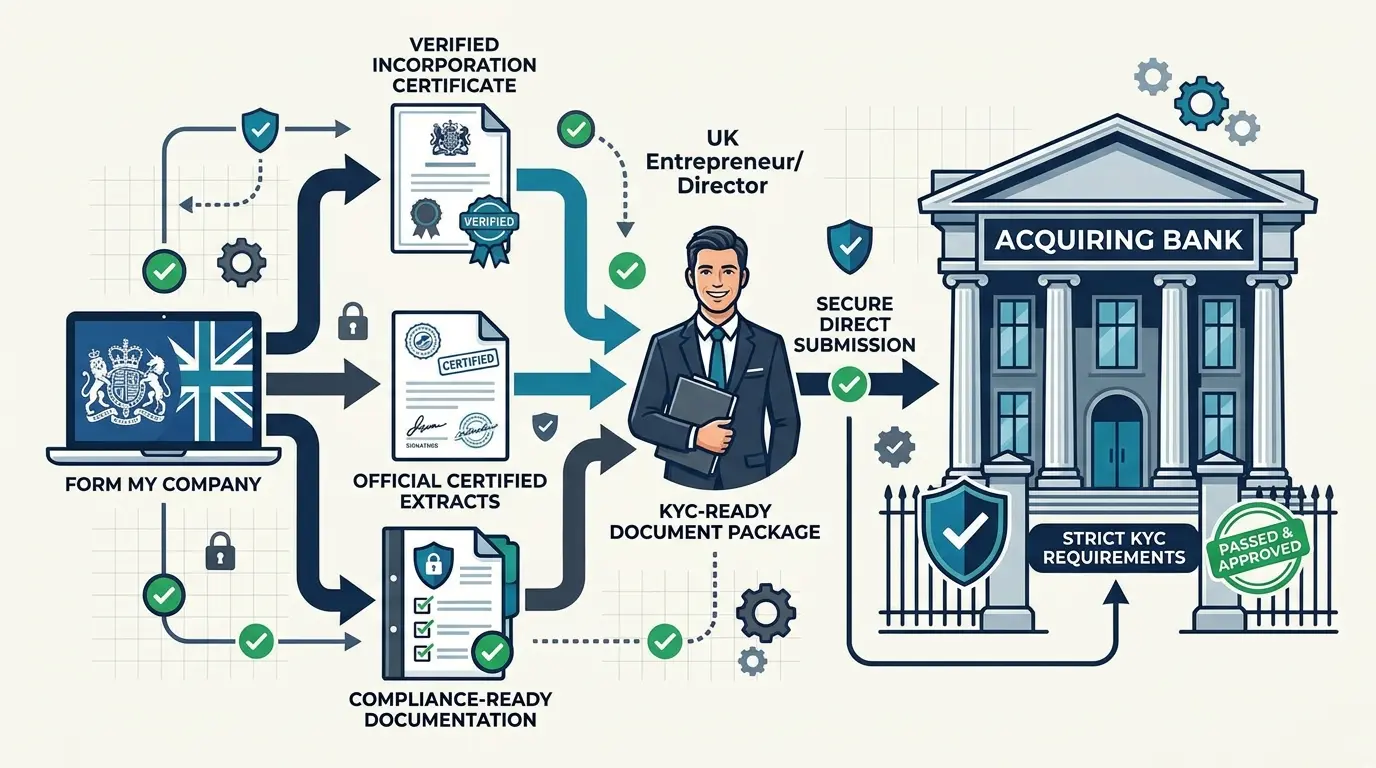
Securing merchant account approval requires fully compliant corporate documentation from day one. Form My Company structures legal entity registrations to meet the precise validation criteria of global payment processors. Our specialists verify all director information, legal business names, and registered office addresses against official UK corporate standards before filing. This proactive verification eliminates common documentation errors that delay merchant onboarding.
Established businesses facing complex compliance requests benefit from specialized document support. Acquiring banks frequently request updated corporate proofs, official apostilles, or certified status updates during annual account reviews. You can Get a KYC-Ready Certificate of Incorporation From Form My Company to receive verified, high-resolution documentation tailored specifically to bank compliance specifications. Utilizing professionally prepared corporate filings protects your business from merchant account holds and operational disruptions.
Maintaining precise corporate records remains essential as your enterprise expands into new payment channels. Form My Company assists growing businesses by delivering prompt, accurate statutory filings and official document updates. Our administrative team manages your compliance documentation so your business remains fully prepared for any merchant account audit or payment gateway review.
Explore More Supplementary Company Documents Guide,
Certificate of Incorporation vs Certificate of Good Standing Explained
How to Keep a Display Copy and an Original Certificate Safe
Frequently Asked Questions
What supplementary company documents are required for merchant account KYC?
Merchant account KYC verification typically requires supplementary company documents such as Articles of Association, Share Certificates, a Register of Directors, and a Certificate of Good Standing. These official filings validate beneficial ownership, legal structure, and active company registration. Form My Company provides certified Supplementary Company Documents to help UK businesses fulfill acquiring bank compliance requirements.
How do I obtain official certified corporate documents for bank compliance?
Official certified corporate documents can be requested directly through Companies House or ordered via corporate formation services like Form My Company. Bank underwriters require high-resolution or certified copies to confirm company status, registered office addresses, and director details. Ordering Supplementary Company Documents ensures corporate records meet strict financial verification standards.
Why do payment processors require a Certificate of Good Standing?
Payment processors request a Certificate of Good Standing to confirm that a registered business has continuously met statutory filing obligations and remains active on the public register. This supplementary document proves to acquiring banks that Companies House has not initiated strike-off or dissolution proceedings. Businesses can secure this proof using Form My Company Supplementary Company Documents during merchant account onboarding.
What is the difference between a Certificate of Incorporation and Articles of Association?
A Certificate of Incorporation serves as legal proof of a company’s formation and registration, whereas Articles of Association define internal corporate governance rules and director powers. Payment gateways inspect both documents during compliance reviews to verify corporate identity and signatory authority. Form My Company delivers these Supplementary Company Documents to streamline corporate identity verification.
Can outdated company documents cause merchant application rejection?
Outdated company documents frequently cause merchant application rejections due to data mismatches between submitted files and active Companies House records. Acquiring banks utilize automated compliance tools to verify current legal names, registered addresses, and active directors. Obtaining updated Supplementary Company Documents through Form My Company prevents verification delays and guarantees seamless onboarding.