
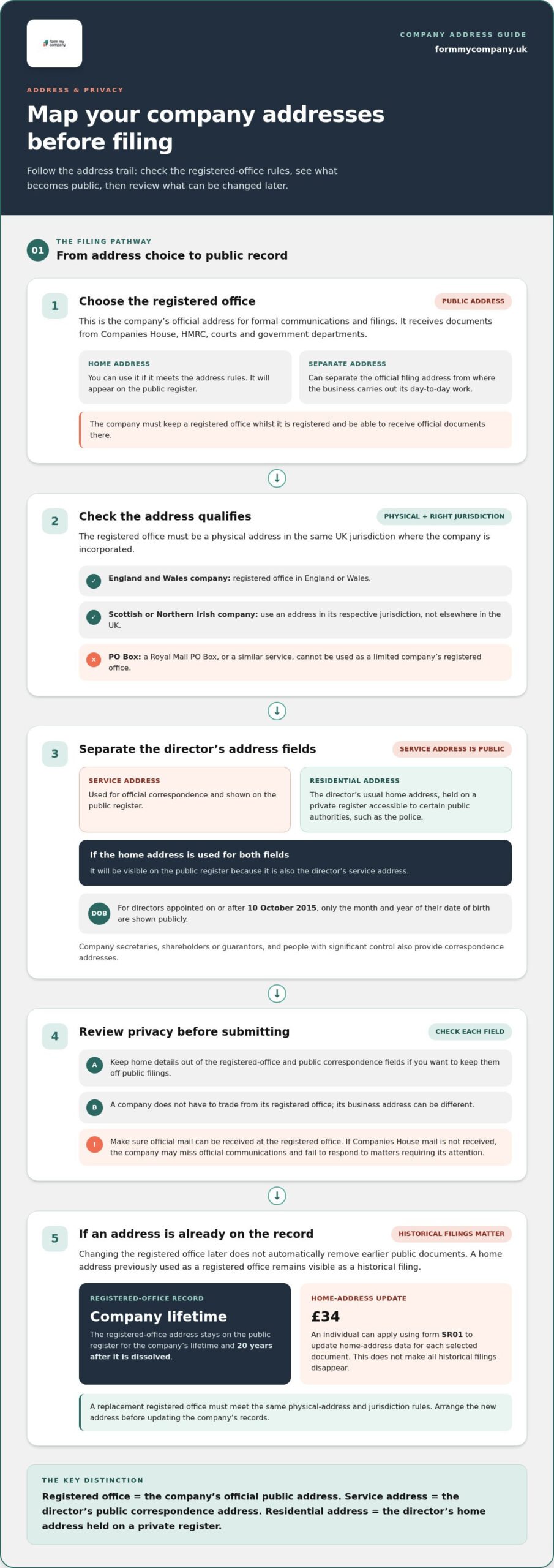
Your home address can be used for Companies House, provided it is a physical address in the same UK jurisdiction where the company is incorporated. It will appear on the public register if you use it as the company’s registered office. A PO Box can’t be used as a registered office address.
Using your home address can be a straightforward option for a new business, but it may also expose where you live. Before choosing an address for your company’s formation paperwork, understand which company and director addresses become public.
This guide explains what a registered office address is, how it differs from a director’s service address, and which details appear on the public register. It also covers PO Box rules and how a separate registered office can help keep your home address out of public company filings.
Key Takeaways
- You can use your home as a registered office if it meets the address requirements, but it will appear on the public register.
- A registered office must be a physical address in the company’s UK jurisdiction; a PO Box won’t meet the requirement.
- Directors’ residential and service addresses serve different purposes, and the service address is the one shown publicly.
- Companies House says a registered office address stays on the public register for the company’s lifetime and 20 years after it is dissolved.
- If you’re forming a company, Form My Company’s Digital Package can support you with the formation process.
What is a registered office address?
A registered office is a company’s official address for formal communications and filings. You can use your home address, but it will appear publicly and receive official documents.
Using a home as the registered office
You can use your home as the registered office if it meets the address rules for the company’s UK jurisdiction. This gives a new business an address for official correspondence without requiring separate premises. The trade-off is privacy: the registered office appears on the public Companies House register, making your home address visible to anyone viewing the company record.
The address is also the company’s official contact point for written communications from Companies House, HMRC, courts and government departments. You must be able to receive documents there and keep the registered office in place while the company is registered. Section 86 of the Companies Act 2006 covers a company’s registered office requirement.
Registered office and business address differences
A registered office is the company’s official address for statutory communications. A business address is where it carries out day-to-day work. The two can be the same, but a company does not have to trade from its registered office. For example, a founder might run a business from home while using a separate address for official filings.
This distinction matters when choosing what to make public. Using a separate registered office address service can separate the company’s official address from its working location. It doesn’t change where the business operates, and the company must still receive official documents at the registered office.
Address location and PO Box restrictions
The registered office must be a physical address in the same UK jurisdiction where the company is incorporated. A company incorporated in England and Wales must have its registered office in England or Wales. Companies registered in Scotland or Northern Ireland must use an address in their respective jurisdiction, not elsewhere in the UK.
A Royal Mail PO Box, or a similar service from another company, cannot be used as a limited company’s registered office. The address must meet the appropriate address standard under the Economic Crime and Corporate Transparency Act 2023. That means a PO Box alone won’t satisfy the requirement, even if post can be received through it.
Changing a registered office address
You can change the registered office by filing an address change with Companies House. The new address must meet the same jurisdiction and physical-address requirements as the original. A UK company must always have a registered office, so arrange the replacement address before updating the company’s records.
Use the new address for future official correspondence and update the company’s internal records. If the registered office does not meet the requirements, the company could be struck off the register. Choosing a suitable address from the outset helps keep filings accurate and gives official documents a valid destination.
Keeping a home address off the public Companies House register
To keep your home address private, don’t use it as the registered office or a public correspondence address. If Companies House mail sent to the registered office isn’t received, the company may miss official communications and fail to respond to matters requiring its attention.
Privacy risks of public address details
Putting your home address on the public register links your private residence to the limited company. Anyone searching the company record can see it, potentially revealing where you live or receive correspondence. Consider this before filing, as changing the address later will not automatically remove earlier public documents.
A home address previously used as a registered office remains visible as a historical filing, and residential addresses can’t currently be removed from the register. The Economic Crime and Corporate Transparency Act 2023 includes measures that will allow people to request suppression of home addresses from historical registered-office documents. The Companies (Disclosure of Address) (Amendment) Regulations 2018 also allow individuals to apply to update home-address data on the public record.
Directors’ addresses on the public register
Companies House distinguishes a director’s usual residential address from their service address. The residential address is held on a private register accessible to certain public authorities, such as the police. The service address is used for official correspondence and appears publicly. If a director uses their home for both, it will be visible on the public register.
Directors appointed on or after 10 October 2015 have only the month and year of their date of birth shown publicly. Their service address is still visible, so using a separate address can help avoid publishing their home. Company secretaries, shareholders or guarantors, and people with significant control also provide correspondence addresses.
Choose each address carefully before filing with Companies House. The registered office and a director’s service address are both public. Keeping them separate from your home can reduce the residential details shown in company filings, but it will not remove information already visible in historical records.
If a home address is already on the public record, an individual can apply using form SR01 to update it for £34 per selected document. This doesn’t mean all historical filings disappear. The application concerns home-address data, while the company’s public record may still include older registered-office documents.
Review each address field before filing, especially if a director plans to use one address for personal and company correspondence. Entering a home address in the wrong field can make it public, even if the director intended to provide it only as a residential address. Separate addresses help make the distinction clear.
What is a service (correspondence) address?
A service address is where a director receives official correspondence; their residential address records where they usually live. The distinction matters because Companies House displays the service address publicly.
If mail sent to the registered office is not received, the company may miss important official correspondence. Make sure the address can receive documents and that they reach the people responsible for company matters.
Service and residential address differences
A director must provide a usual residential address and a service address when setting up a limited company. The residential address is kept on a private register accessible to certain public authorities, such as the police. The service address is the director’s public contact point and can be different from their home.
Section 163 of the Companies Act 2006 refers to an individual officer’s service address. The UK Government introduced the two-address requirement in October 2009. Giving each address its correct purpose helps separate private residence details from public correspondence information.
Service addresses and director privacy
A service address can help keep a director’s home details off the public register, provided official paperwork can be delivered there. For example, a director may use an accountant’s address with permission, if the company remains contactable there.
A director’s service address can be overseas, although the limited company’s registered office must be in the UK. This gives directors flexibility, but the service address still appears on the public register. The residential address is recorded separately for official purposes.
Using a home as a service address
A director can use their home as their service address, but this makes the home address publicly visible. The service address can also be the company’s registered office or another address where the director can receive documents.
Consider the public record before using your home for correspondence. To keep your home details private, choose a separate physical address that can receive official paperwork. The registered office and service address have different roles, even when they are the same location.
Changing or protecting a home address
To protect a home address, provide a separate service address rather than repeating the residential address in the public correspondence field. If a director’s service address changes, notify Companies House within 14 days. The change is free, and the updated address becomes the public contact point.
Changing a service address is different from changing the registered office. Update the correct address so company mail and personal statutory correspondence reach the right destination. A separate address can reduce future exposure, but it will not automatically remove earlier filings that show a home address.
Review the address fields when appointing a director or updating company records. Keep the residential address accurate for private records, and use a deliverable service address for public correspondence. This lets directors receive official documents without using their home as the visible contact address.
Displaying the registered address
A UK company must show its registered office address on its website, invoices, letters and order forms. These details identify the company’s official contact point for customers, suppliers and government bodies. The requirement applies even if the company trades from another business address or operates remotely. An online company, for example, must still display its registered office on business correspondence.
The Companies Act 2006 and the Company, Limited Liability Partnership and Business (Names and Trading Disclosures) Regulations 2015 set out the disclosure requirements. Use the same registered office address across company materials and official filings. That consistency helps recipients identify where statutory correspondence should be delivered. If the address changes, update company records and replace the old address on current documents and online materials.
Companies House keeps the registered office address on the public record, so changing it does not make the earlier address disappear. According to Companies House, a UK company’s registered office address remains on the public register for the company’s lifetime and 20 years after the company is dissolved. This matters when deciding whether to use a home address: a later move won’t erase its earlier appearance in company records.
Keep the registered office address legible and consistent wherever it appears. When changing it, check the company website, invoice templates, letterheads and order forms. An old invoice template could still show outdated details after the registered office has moved. Updating these materials helps avoid confusion for customers and official bodies.
The registered office is an official contact address, not necessarily where the company operates. A business address can be used for day-to-day work, while the registered office receives official communications. A company can work from home, a shared workspace or another location while maintaining a separate registered office. This distinction determines which address belongs on statutory documents and public records.
Before filing an address change, make sure the new registered office meets the company’s jurisdiction requirements and can receive official post. Then update the Companies House record and the company’s own materials. Check every place the address appears, including digital invoices and the website, to avoid conflicting details across filings, customer documents and government correspondence.
Public display has a lasting effect, not just a short-term one. A founder choosing a home as the registered office should consider that address’s continued presence in the Companies House register. The display rule also means the address may appear on routine business documents, not only formal filings. Choose an address that works for both official correspondence and the company’s public-facing records.
Can a director use their home address as their service address at Companies House?
Yes. A director can use their home as a service address, but Companies House will display it publicly. The service address is for official correspondence, not the director’s private residential record. If privacy matters, choose a separate address before filing the director’s details or updating company records.
A service address must be a physical address where official paperwork can be delivered. It can be the company’s registered office, the director’s home or another suitable address. For example, a director working from home can use that address for service correspondence, knowing it will appear on the public register.
A director can also use an accountant’s address with permission, provided the company is contactable there. The service address can be overseas, although a limited company’s registered office must remain in the UK. The addresses serve different purposes: the service address receives personal statutory mail, while the registered office is the company’s formal contact address.
Section 163 of the Companies Act 2006 is the legal reference for an individual officer’s service address. It must be more than a label or a PO Box: official documents need a physical destination. Before using another person’s office, arrange permission and ensure correspondence can reach the director there. That keeps the public contact details practical as well as accurate.
If a director changes their service address, they must notify Companies House within 14 days. The update is free. Enter the replacement address as the service address, rather than changing the company’s registered office by mistake. For instance, a director moving house can update their public correspondence address while the company keeps its existing registered office.
Changing a service address updates the current public contact details, but does not remove a home address shown in earlier filings. If the home was also used as the registered office, it may remain visible in historical documents. Decide separately where company communications should go and where the director should receive personal statutory mail.
For a separate company contact point, consider a registered office address service. It can help distinguish the company’s registered office from a director’s residential address. Keep the service address deliverable too, because Companies House correspondence still needs to reach the director.
Form My Company: Digital Package
Form My Company helps you move from planning a company to completing its formation. If you’re ready to register a limited company digitally, explore the Digital Package. Consider which address you want to appear on the public register as you prepare your formation details.
For another structure, Form My Company also offers Limited Liability Partnership (LLP) Formation. The right option depends on the legal structure you plan to set up and the formation support you need. Review the package details to choose a route that fits your business plans.
Visit formmycompany.uk to compare the formation options and get started with Form My Company.
Set up your company with a clear address plan
Choosing an address is an opportunity to decide how you want your new business to present itself. Before proceeding, consider how your company structure, formation paperwork and public-facing details fit together. This helps you choose an option that suits your business plans and privacy preferences.
If you’re deciding whether you can use your home address for Companies House, consider which details you’re comfortable making public before submitting your formation information. Form My Company offers the Digital Package, Digital & Print Package and Entrepreneurs Choice Package for company formation. Compare the options with your plans for setting up and running the business.
Take the next step when you’re ready. Contact Form My Company for help with choosing a formation option that fits your plans. You can move forward with a clearer view of the choices ahead and focus on building your business.
Frequently Asked Questions
Can I remove my home address from previous filings?
Changing your current address doesn’t automatically remove your home address from older filings. You can apply using form SR01 to update home-address data for £34 per selected document. The Economic Crime and Corporate Transparency Act 2023 includes measures allowing people to request suppression of home addresses from historical registered-office documents. This is separate from changing the company’s current registered office or a director’s service address.
Can I use my home address as my registered office address at Companies House?
Yes, if your home is a physical address in the same UK jurisdiction where the company is incorporated and meets the address requirements. For example, a company incorporated in England and Wales needs its registered office in England or Wales. Your home address will appear on the public register, so consider whether you’re comfortable with that before filing.
Which Companies House addresses are publicly visible, and can a home address be removed?
The registered office and directors’ service addresses appear on the public register. A director’s usual residential address is held separately, but using the same address for home and service correspondence makes the home address public. Directors appointed on or after 10 October 2015 have only their birth month and year shown publicly. For an address already included in filings, an SR01 application may update data, but historic documents can remain.
What address requirements apply to a registered office in England and Wales, Scotland, and Northern Ireland?
The registered office must be a physical address in the same UK jurisdiction as the company’s incorporation. A company incorporated in England and Wales must use an address in England or Wales; a Scottish company needs an address in Scotland, and a Northern Irish company needs one in Northern Ireland. A PO Box alone does not meet the registered-office requirement in any of these jurisdictions.
Can I use a PO box, virtual office, accountant, or company formation agent address?
A PO Box or similar mail-only service cannot be used as a limited company’s registered office. A virtual office, accountant’s address or formation agent’s address is suitable only if it provides a physical address that meets Companies House requirements and can receive official documents. Get permission before using an accountant’s or solicitor’s address. A director can use another service address if the company is contactable there.
What are the risks and privacy implications of using a home address for a UK limited company?
The main privacy risk is public visibility: a home used as the registered office or director’s service address can be linked to the company on Companies House. That information may remain in historical filings after you move or change addresses. Official correspondence must also reach the address. Before filing, decide whether you want your home to serve as a public company contact point.