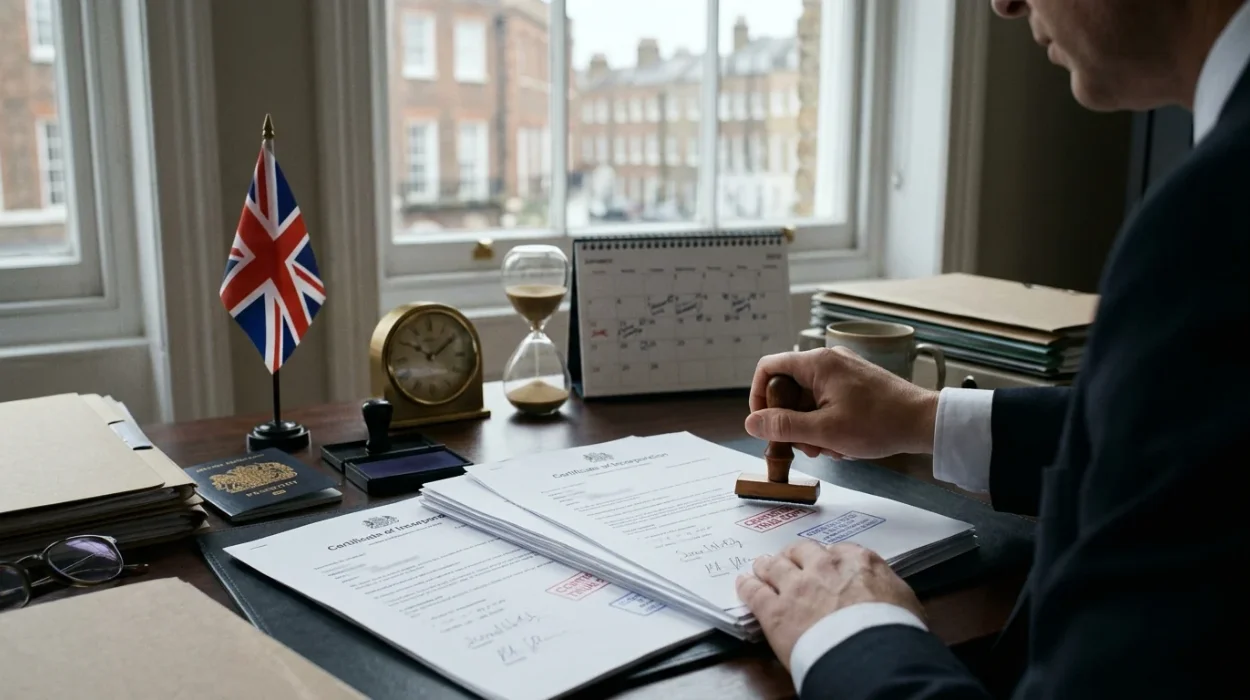
Certified company documents are verified copies confirmed as true representations of original paperwork by a solicitor or notary, while notarised documents undergo formal authentication by a registered notary public who verifies the identity, capacity, and signatures of the signatories for international legal acceptance.
What Is a Certified Company Document?
A certified company document is an official copy of a business record that a qualified professional checks against the original file, certifying with a signed statement and stamp that the copy represents a true, accurate, and complete replica of the original.
Qualified professionals, including practicing UK solicitors, accountants, and public notary officials, create certified documents. The professional examines the original document, creates a physical or digital reproduction, and applies a certification statement. This statement confirms that the copy matches the original record exactly.
UK financial institutions, courts, and regulatory authorities request certified documents during routine compliance reviews. Standard business operations require certified copies of Certificates of Incorporation, Articles of Association, and Share Certificates. The certification process verifies document authenticity without requiring the submission of original legal papers.
Professional certification prevents corporate fraud and maintains accurate public registers. If a company submits documents to UK banks or government agencies, certified copies satisfy identity and corporate status verification rules. Certified documents remain valid within domestic jurisdictions for routine legal and commercial transactions.
What Is a Notarised Company Document?
A notarised company document is an official corporate record authenticated by a notary public who verifies the identity, legal capacity, and authority of the signatories, applying an official seal, signature, and serial number for international legal recognition.
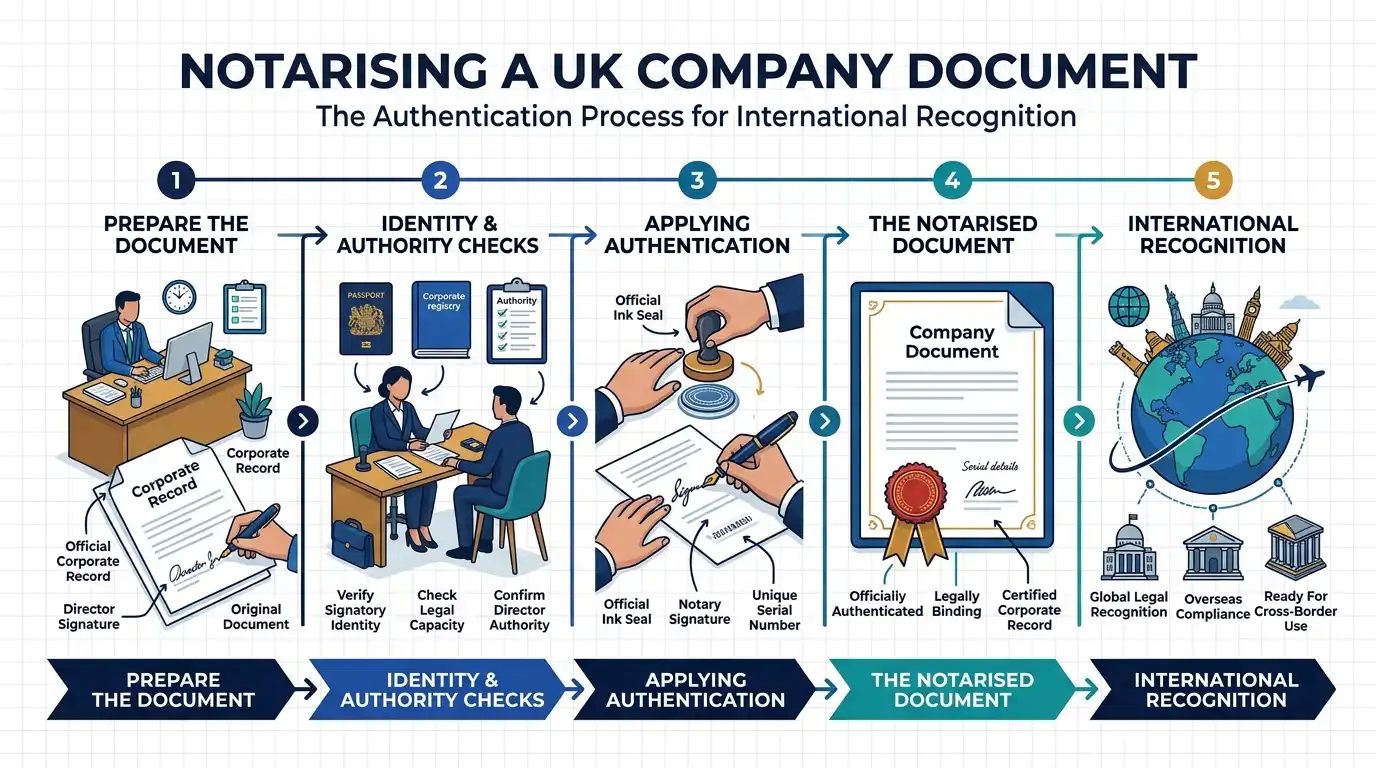
A notary public holds a specialized legal qualification dedicated to authenticating documents for international use. The notarisation process requires the notary to confirm the legal standing of the business, verify the authority of company officers, and witness the execution of signatures on corporate instruments.
Foreign governments, international banks, and overseas commercial registries demand notarised documents for cross-border transactions. Foreign jurisdictions require notarisation when UK companies open overseas branch offices, execute international commercial contracts, or enter foreign property transactions. The notary attaches a formal notary certificate, embossed seal, and signature to the corporate paper.
Notarisation provides a higher level of legal authentication than standard professional certification. Notaries check Companies House registers, verify director passports, and confirm corporate power under UK company law. When foreign authorities process corporate documentation, notarised papers serve as legally binding proof of authenticity.
How Do Certified and Notarised Documents Differ in Scope and Authority?
Certified documents prove that a copy matches an original record for domestic business use, whereas notarised documents authenticate legal capacity, officer identity, and signature validity for international commercial and legal acceptance across foreign jurisdictions.
| Feature | Certified Company Documents | Notarised Company Documents |
| Primary Purpose | Verifies copy matches original record | Authenticates identity, capacity, and execution |
| Authorized Professionals | Solicitors, accountants, notary publics | Registered notary publics exclusively |
| Jurisdictional Scope | United Kingdom domestic transactions | International and cross-border transactions |
| Verification Depth | Visual comparison of physical or digital copies | Legal check of corporate power and signatory identity |
| Apostille Compatibility | Limited acceptance for Hague Apostille | Required precursor for UK FCDO Hague Apostille |
The legal scope of each document type dictates its application in corporate governance. Domestic organizations request certified records to establish compliance during routine onboarding. When international regulators review UK business entities, notarisation provides the legal certainty required by foreign legal frameworks.
Cost and turnaround times reflect the depth of verification required for each process. Professional certification involves straightforward copy comparisons, resulting in fast processing times. Notarisation requires comprehensive legal due diligence, identity verification checks, and formal seal application, commanding higher administrative fees.
Choosing the incorrect verification type causes delays in corporate transactions. Submitting a domestic certified copy to a foreign registry usually leads to immediate rejection. Companies must evaluate the end-user requirements of receiving authorities before ordering document verification services.
When Does a UK Business Need Certified Documents?
UK businesses need certified documents when opening domestic business bank accounts, applying for UK commercial loans, registering with local trade bodies, or proving corporate status during domestic legal proceedings and compliance audits.
UK clearing banks demand certified copies of corporate formation documents before opening business accounts. Bank compliance officers inspect certified Articles of Association to confirm director powers and shareholder structures. Three primary domestic verification triggers include commercial lease agreements, UK tax registration, and local authority licensing.
Solicitors certify company records to streamline domestic commercial contracts. When corporate entities enter supply agreements or joint ventures in the UK, counterparties request certified documentation to validate business existence. Certification establishes trust between commercial partners without exposing original corporate certificates to loss or damage.
Companies House filings often require certified extracts during internal corporate restructuring. Directors submit certified board minutes and share transfer certificates to record corporate changes accurately. Fast access to certified documents ensures businesses maintain uninterrupted operational compliance across the UK.
If a company needs fast, compliant verification for domestic operational requirements, obtaining Supplementary Company Documents ensures all corporate copies meet UK legal standards.
When Does a UK Company Require Notarised Documents?
UK companies require notarised documents when expanding overseas, opening foreign bank accounts, establishing international subsidiaries, appointing foreign attorneys through powers of attorney, or bidding on overseas public tenders.
Foreign financial institutions require notarised corporate records before managing international business assets. Overseas banks enforce anti-money laundering regulations by examining notarised Certificates of Incorporation and Good Standing certificates. The notary verifies that the UK business exists in good standing on the official register.
International trade operations depend on notarised powers of attorney. When UK directors delegate authority to overseas managers, a notary public must witness the signing process and verify the directors’ identities. Foreign courts reject corporate representations unless supported by notarised legal instruments.
Overseas regulatory authorities demand notarisation for cross-border mergers and acquisitions. When a UK business acquires foreign property or assets, overseas land registries require notarised corporate deeds. Notarisation validates the transaction under international legal standards.
Before choosing an authentication path, reviewing Solicitor Certification vs Notarisation: Which Does Your Company Need? provides clear guidance on legal compliance requirements for overseas expansion.
What Is the Apostille Process and How Does It Relate to Notarised Documents?
An Apostille is an official certificate issued by the UK Foreign, Commonwealth & Development Office (FCDO) that legalizes a notarised or certified document for international recognition under the 1961 Hague Convention.
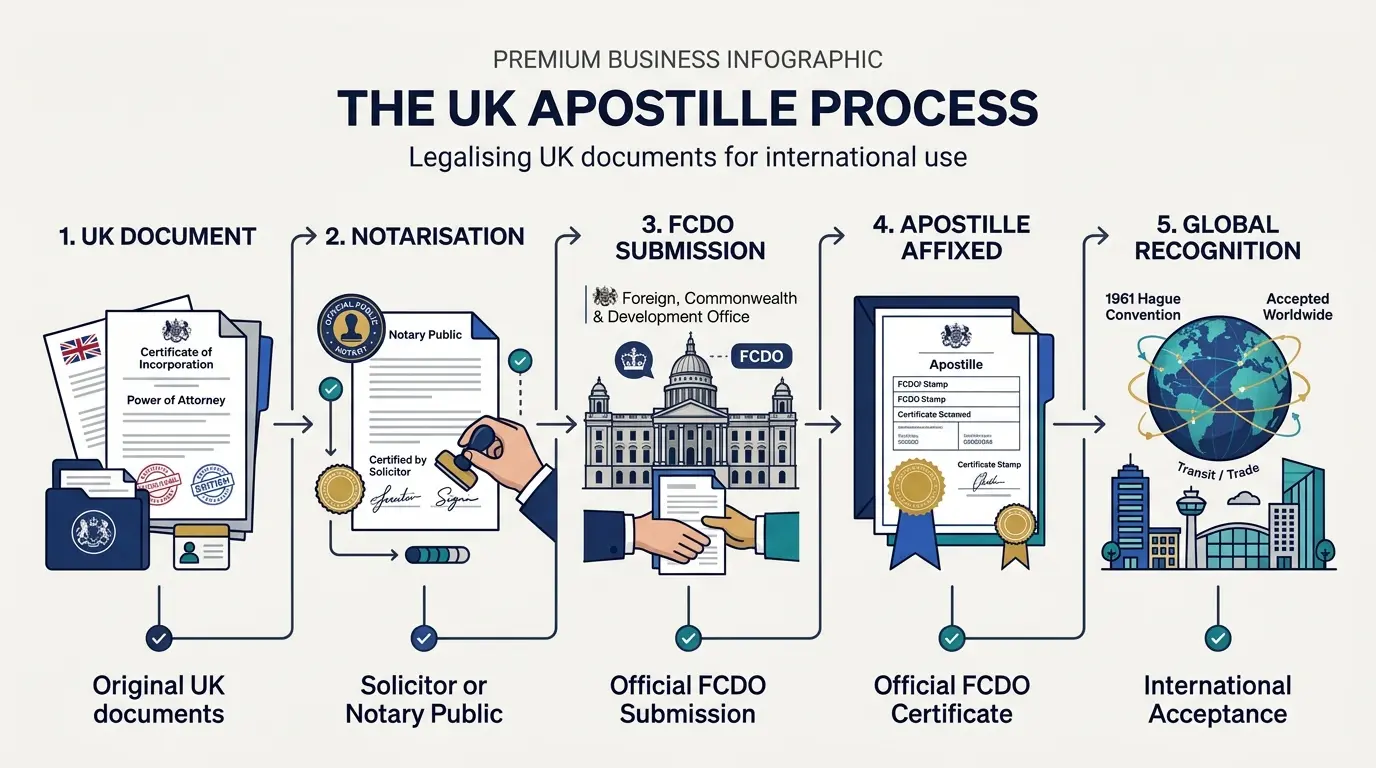
The Hague Apostille Convention simplifies document legalization between member nations. When a UK company presents corporate records in another member country, foreign authorities require an Apostille attached to the document. The FCDO verifies the signature, stamp, or seal of the issuing UK notary or official.
Notarisation serves as the primary prerequisite for obtaining an FCDO Apostille certificate. While the FCDO accepts limited solicitor-certified documents, most foreign government agencies strictly mandate notarised documents before granting legal validation. The notary’s registered seal allows the FCDO to verify signature authenticity instantly.
Non-Hague Convention countries require an additional step called embassy legalization. After notarisation and FCDO Apostille issuance, the document visits the target country’s embassy in London for final validation. Missing any stage of this process invalidates corporate paperwork abroad.
Understanding these authentication tiers prevents expensive operational delays during overseas commercial transactions. Proper sequencing guarantees that corporate filings receive immediate acceptance from international government agencies and legal registries.
How to Secure Certified and Notarised Company Documents Efficiently
Securing verified corporate documents requires selecting appropriate legal professionals, preparing original records, verifying recipient requirements, and choosing direct fulfillment services to prevent administrative rejections.
Businesses streamline compliance by auditing external requirements before submitting documents to third parties. Requesting written document specifications from overseas banks or registries prevents costly re-procurement. Companies must verify whether the recipient demands simple certification, notary authentication, or full Apostille legalisation.
Working with experienced corporate service providers eliminates the hassle of sourcing independent legal professionals. Direct legal procurement ensures corporate documents transition smoothly from Companies House retrieval to final verification. Automated document workflows save time and lower administrative expenses for growing firms.
Businesses can Skip the Solicitor Visit With Certified Documents From Form My Company to secure compliant, professionally verified records without scheduling in-person legal appointments. Fast document processing allows executive teams to focus on core strategic operations.
Form My Company handles legal document verification workflows for UK registered entities, delivering officially validated paperwork directly to business owners. Utilizing centralized corporate services ensures strict adherence to Companies House guidelines and international verification protocols.
Explore More Supplementary Company Documents Guide,
What Do Investors Look for in Your Articles of Association?
What Are the Share Transfer Rules in Articles of Association?
Frequently Asked Questions
What are supplementary company documents for a UK business?
Supplementary company documents are official legal records and certified extracts, such as Certificates of Good Standing, Articles of Association, and Change of Name Certificates, that supplement standard company formation files. Businesses request these records through Form My Company to prove active corporate status, verify director authority, and satisfy compliance requirements for third-party entities.
Why do banks require certified supplementary company documents?
Financial institutions require certified supplementary company documents to complete mandatory Know Your Customer (KYC) and Anti-Money Laundering (AML) checks before opening a business bank account. Obtaining officially verified corporate paperwork via Form My Company ensures clearing banks receive validated legal evidence of a company’s structure, ownership, and standing.
How quickly can I get supplementary company documents for my business?
Turnaround times for supplementary company documents depend on whether simple legal certification or full notary and Apostille legalisation is required. Form My Company provides expedited retrieval and verification options, allowing UK businesses to receive digital or physical certified copies within 24 to 48 hours.
What is the difference between standard and certified supplementary company documents?
Standard supplementary documents are simple administrative copies of public Companies House filings, whereas certified supplementary company documents include an official signed statement and stamp from a qualified professional confirming the document is a true, accurate copy. Services provided by Form My Company ensure that corporate files receive the appropriate level of legal certification required by domestic and foreign authorities.
Do foreign authorities accept UK supplementary company documents?
Foreign authorities accept UK supplementary company documents provided they undergo proper notarisation and legalisation through an FCDO Hague Apostille certificate. Ordering certified Supplementary Company Documents from Form My Company ensures corporate papers meet international verification standards for overseas business expansion, foreign bank accounts, and cross-border commercial transactions.