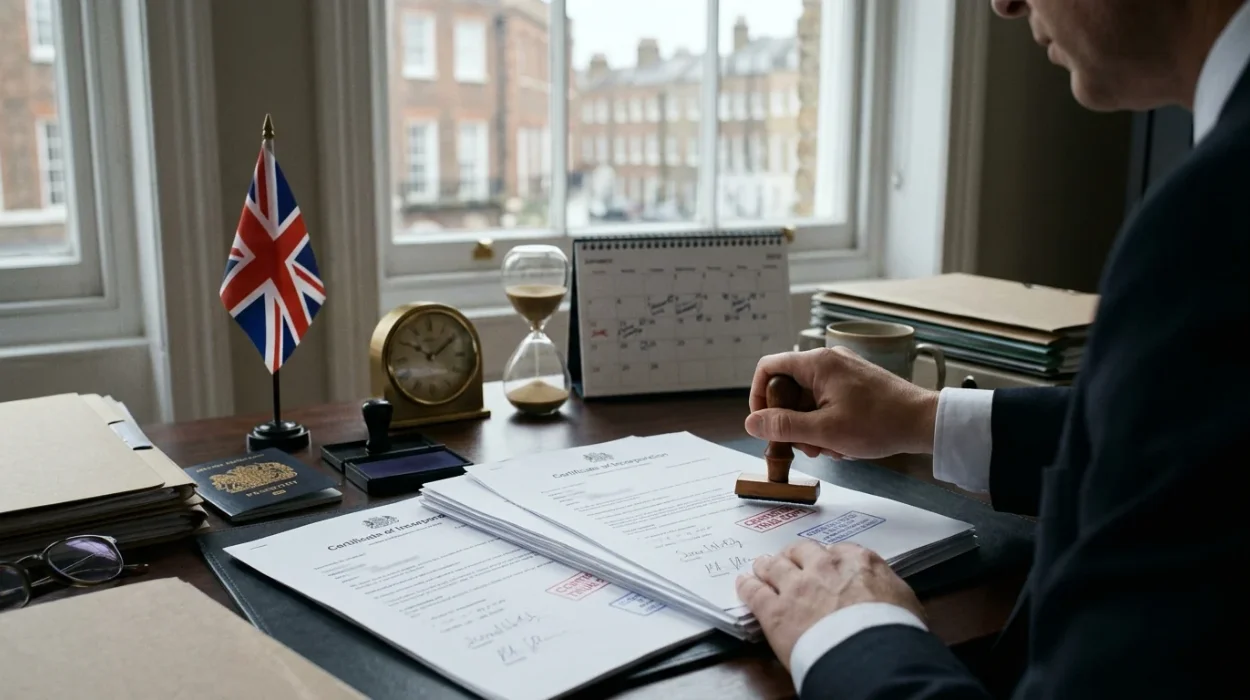
Your company needs solicitor certification for standard UK corporate compliance, including banking, leasing, and domestic contracts. You require notary public notarisation when submitting official company documents to foreign governments, international banks, or overseas courts that demand Hague Apostille legalisation and international legal authentication.
What Is Solicitor Certification for Company Documents?
Solicitor certification is the process where a qualified UK solicitor reviews a copy of a corporate document against the original, confirms its authenticity, and signs it to prove it represents a true, accurate copy for domestic legal compliance.
Solicitors act as legal officers within the United Kingdom. When a company presents corporate records to a bank, landlord, or government department, the recipient often demands proof of document legitimacy. A solicitor examines original filings from Companies House, confirms director identities, and verifies signatures. The solicitor then applies a formal stamp, writes a statement of truth, and signs the document.
This verification process satisfies standard UK regulatory and corporate requirements. UK financial institutions, insurance providers, and domestic vendors routinely accept certified copies of incorporation certificates, articles of association, and shareholder registers. Solicitor certification focuses primarily on confirming that a document copy matches the official record, keeping domestic verification simple, fast, and cost-effective.
What Is Document Notarisation by a Notary Public?
Document notarisation is an advanced legal authentication performed by a Notary Public who verifies the legal identity of signatories, confirms corporate authority, and certifies documents for international recognition and foreign government acceptance.
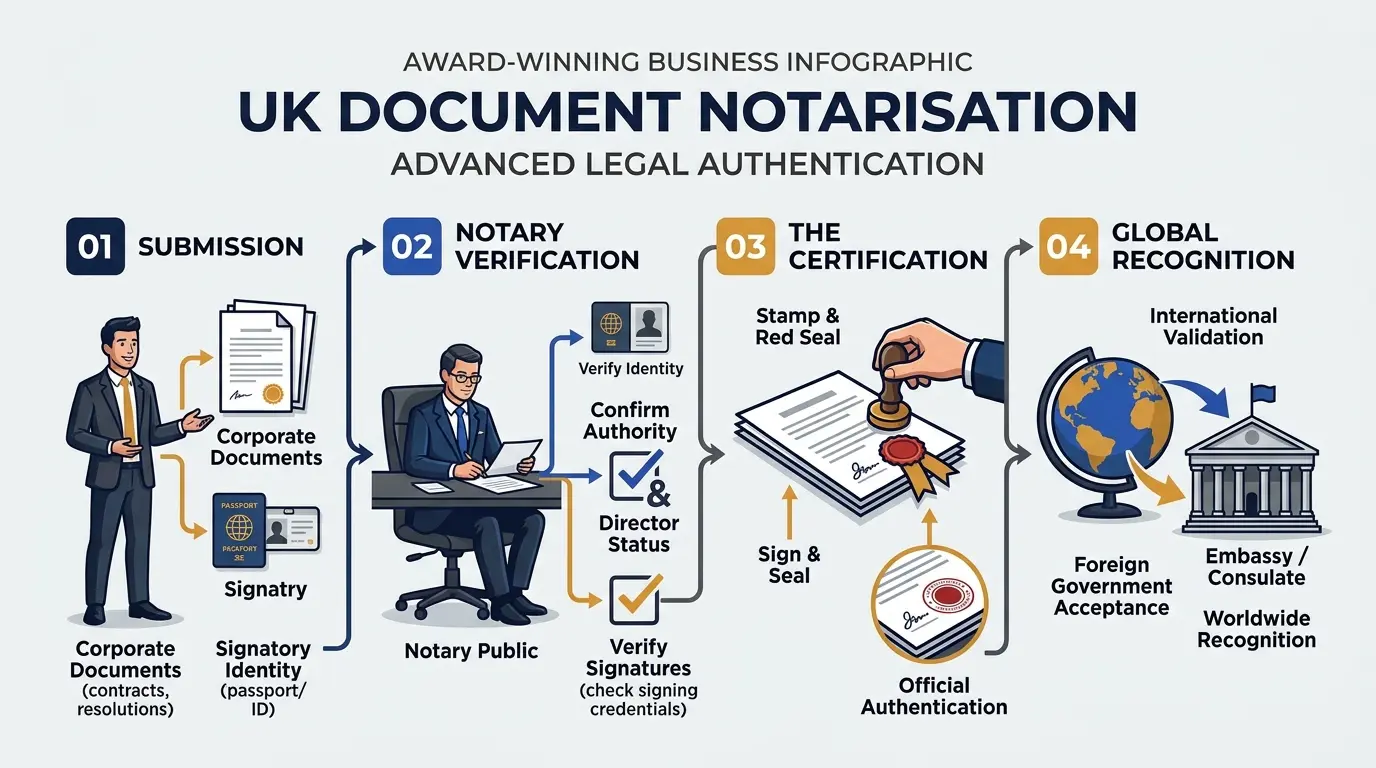
Notaries public hold a distinct legal office focused on international law and cross-border document validation. When a UK business operates abroad, foreign authorities cannot easily verify standard UK signatures. A notary public conducts deep background checks on company directors, reviews board resolutions, and verifies corporate power before affixing an official legal seal to the paperwork.
Foreign governments, international banking networks, and overseas courts strictly demand notarisation over standard certification. The notary creates a formal public record of the authentication, making the document legally valid under international treaties. Overseas jurisdictions require this higher level of scrutiny to prevent corporate fraud, tax evasion, and unauthorized international transactions.
What Key Differences Separate Certification from Notarisation?
Certification confirms that a document copy matches its original record for domestic use, whereas notarisation validates the underlying legal authority of signatories and authenticates documents for international cross-border recognition.
The operational scope of these two validation methods differs significantly. A UK solicitor validates document copies to satisfy domestic compliance frameworks, whereas a notary public verifies signatures, legal capacity, and corporate authority for foreign legal systems. Notarisation involves deeper identity verification protocols, including biometric passport checks and corporate registry audits, to satisfy international legal standards.
The table below contrasts the legal scope, jurisdiction, and primary use cases of each process:
| Feature | Solicitor Certification | Notary Public Notarisation |
| Primary Jurisdiction | United Kingdom (Domestic) | International (Global & Cross-Border) |
| Verification Scope | Confirms true copy of original document | Validates identity, authority, and signature |
| Legal Authentication | Solicitor stamp and signature | Official notary seal and public registry entry |
| International Acceptance | Rarely accepted abroad | Universally recognised by foreign authorities |
| Hague Apostille Ready | Limited foreign acceptance | Fully compatible with Foreign Office legalisation |
Understanding these distinctions helps corporate officers choose the precise level of verification required. Submitting an incorrect authentication type leads to immediate rejection by financial institutions and government bodies, causing costly business delays.
Which Document Verification Method Does Your Business Require?
Your business requires solicitor certification for UK-based transactions like bank account opening, whereas you require notarisation when expanding overseas, establishing foreign subsidiaries, or executing cross-border commercial contracts.
Determining the correct path depends on where the receiving party resides and operates. If a UK bank, commercial landlord, or local authority requests verified paperwork, standard certification fulfills all regulatory conditions. UK organisations rely on the legal standing of solicitors to confirm that company documents reflect accurate filings from Companies House without needing legalisation.
If your organisation conducts business outside the UK, foreign authorities will reject basic solicitor stamps. Cross-border mergers, international trademark filings, and foreign property acquisitions demand notarised paperwork. Foreign governments frequently require a Hague Apostille attached to the notarised record, which the UK Foreign, Commonwealth & Development Office issues only after proper legal authentication.
Which Official Corporate Records Commonly Require Verification?
Official corporate records requiring verification include certificates of incorporation, articles of association, director register extracts, good standing certificates, share certificates, and board resolutions for legal compliance.
Corporate entities present verified paperwork during major business milestones, funding rounds, and regulatory audits. When opening corporate trading accounts or securing commercial loans, lenders demand certified copies of foundational records to verify legal existence. Three core verification scenarios include validating director appointments, confirming shareholder equity structures, and proving active corporate registration status.
When expanding internationally, foreign registries mandate notarised copies of corporate charters and powers of attorney. Signing foreign commercial leases or appointing overseas directors requires notarised board resolutions that grant explicit signing authority. Verifying these records ensures seamless compliance across domestic and international legal frameworks.
How Do You Obtain Certified Company Documents Efficiently?
You obtain certified company documents efficiently by sourcing official records directly from Companies House and submitting them to accredited legal professionals for immediate verification and stamping.
Procuring verified paperwork through traditional law firms often involves scheduling in-person appointments, submitting physical original records, and waiting days for manual review. Modern corporate service providers streamline this process by accessing official digital registries, compiling necessary filings, and coordinating rapid legal validation through certified channels.
Businesses can secure official Supplementary Company Documents online without leaving their office. Professional legal fulfillment services obtain fresh register extracts directly from official registries and execute required certification protocols. Digital procurement eliminates administrative delays, ensures strict regulatory compliance, and delivers legally validated documents ready for immediate submission.
What Are the Risks of Choosing the Wrong Verification Type?
Choosing the wrong verification type causes immediate document rejection by foreign registries, creates operational delays, forfeits filing fees, and risks missing critical commercial contract deadlines.
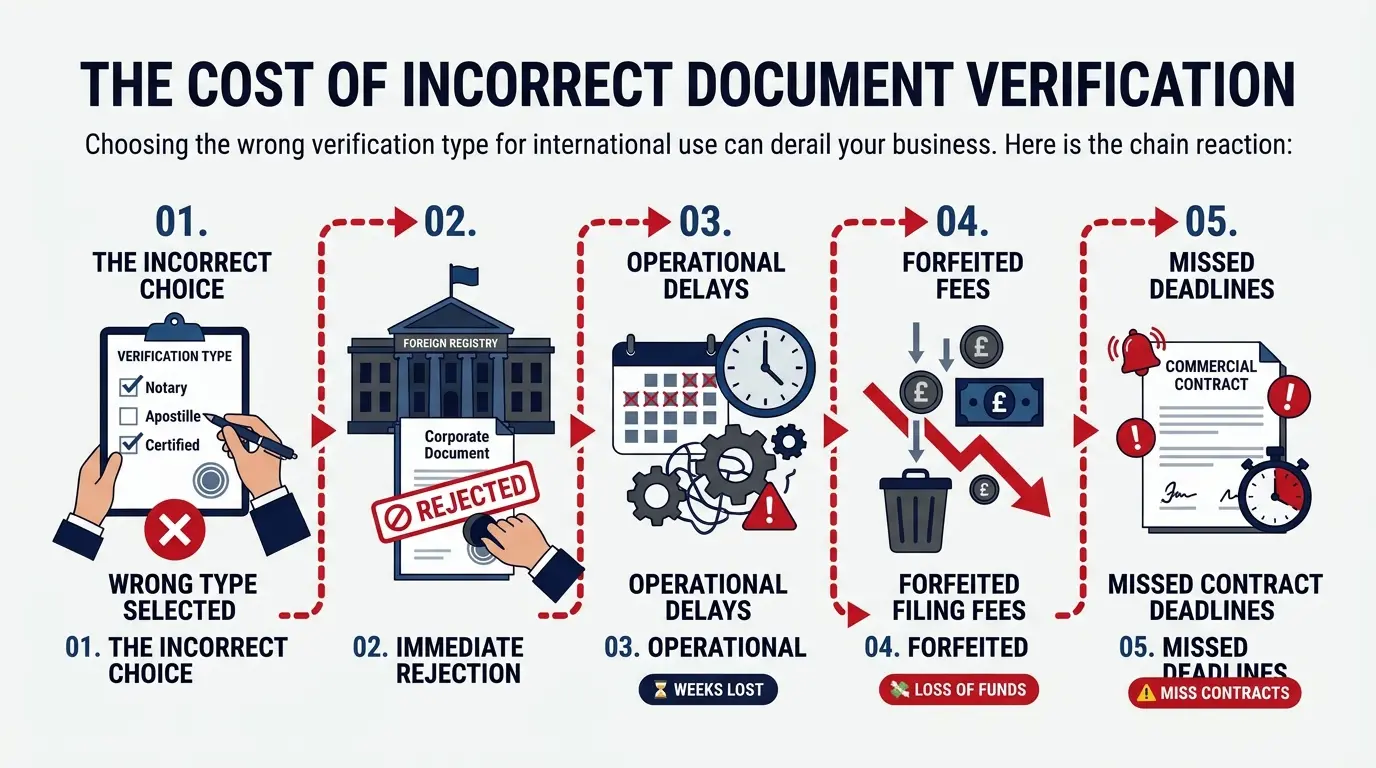
Submitting certified copies when notarised records are legally required halts international transactions completely. Overseas government agencies automatically reject paperwork that lacks proper notarisation and apostille seals. Rejection forces executives to restart the verification pipeline from the beginning, wasting administrative resources and delaying overseas operations by several weeks.
Conversely, paying for notary public services when basic certification suffices leads to unnecessary expenditure. Notary fees far exceed standard certification costs due to the international liability involved. Evaluating recipient requirements upfront ensures accurate compliance, protects operating budgets, and maintains momentum during corporate expansions.
How Does Form My Company Simplify Document Verification?
Form My Company simplifies document verification by managing the end-to-end retrieval, legal review, solicitor certification, and notary coordination for UK corporate entities.
Navigating legal verification frameworks requires clear guidance and reliable execution. To understand how basic verification differs from legalised international records, read about what is the difference between certified and notarised company documents before ordering your files. Selecting the correct service prevents processing errors and ensures acceptance by official institutions.
Corporate officers can also save valuable management time and skip the solicitor visit with certified documents from Form My Company through a streamlined online platform. Form My Company handles official registry retrievals, coordinates with qualified solicitors, and delivers fully compliant certified or notarised corporate records directly to your business.
Solicitor certification provides fast, cost-effective document verification for domestic UK corporate affairs, while notary public notarisation delivers the legal authentication required for international business operations. Form My Company delivers comprehensive document retrieval and legal verification services tailored to your specific corporate needs. By procuring correctly authenticated corporate records through professional management, your business maintains regulatory compliance, avoids costly administrative rejections, and executes commercial transactions efficiently across domestic and international jurisdictions.
Explore More Supplementary Company Documents Guide,
How to Prepare Certified Documents for a Government Tender Bid
How to Correct Errors on Your Company Incorporation Records
How do I obtain certified supplementary company documents in the UK?
You can request certified supplementary company documents directly through official UK corporate service providers like Form My Company or by ordering official registry copies from Companies House. A registered solicitor or notary public then reviews, signs, and stamps these official filings to prove they are accurate copies of the original records. This streamlined procurement process ensures your business receives legally validated paperwork ready for domestic or international submission.
What are supplementary company documents used for?
Supplementary company documents provide official proof of a business’s legal standing, corporate structure, and executive authority when dealing with third parties. Financial institutions, commercial landlords, government bodies, and investors frequently require these verified corporate records to conduct due diligence, open business accounts, or execute commercial contracts. Obtaining certified copies of these records confirms that a company operates in full compliance with UK regulatory frameworks.
Which company records are classified as supplementary documents?
Supplementary company documents include official corporate filings beyond the basic Certificate of Incorporation, such as Articles of Association, Certificates of Good Standing, Memorandum of Association, and official register extracts detailing directors and shareholders. Additional corporate records like change of company name certificates and board resolutions also fall into this legal category. Business entities order these legal records to verify specific administrative and ownership details for corporate audits or transactions.
Can I get supplementary company documents certified online?
Yes, UK businesses can order fully certified supplementary company documents online through specialized corporate fulfillment platforms like Form My Company. Digital corporate service providers retrieve official registry filings electronically and coordinate directly with licensed solicitors to execute the required certification protocols without requiring physical office visits. Once certified, these legal documents are dispatched to your business, significantly accelerating administrative workflows.
Do foreign authorities accept certified supplementary company documents?
Foreign authorities typically require supplementary company documents to undergo notarisation by a Notary Public and legalisation with a Hague Apostille rather than standard solicitor certification. While domestic UK organisations accept standard solicitor-certified records, overseas registries, banks, and foreign courts demand higher levels of international legal authentication to verify signature authority. Ordering notarised and apostilled corporate documents through Form My Company ensures your legal paperwork satisfies cross-border regulatory standards.