To correct errors on UK company incorporation records, file specific administrative forms directly with Companies House based on the error type. You must submit Form RP04 to rectify historical filings, update officer details via Form AP01 or CH01, or apply for judicial rectification for fundamental errors.
Why Do Errors Occur on UK Company Incorporation Records?
Errors occur on incorporation records when applicants submit inaccurate data during the initial registration process. Common causes include typographical mistakes in director names, incorrect residential addresses, wrong SIC codes, and errors in share capital allocation.
Companies House processes thousands of electronic filings daily. Human data entry mistakes account for 74% of all administrative discrepancies registered on public records. Applicants frequently mistype legal names or transpose numbers in birth dates during online submission.
Complex share structures create additional vulnerabilities during registration. Incorporators often miscalculate nominal values or confuse aggregate amounts with individual share values.
Failing to double-check official documentation leads to public filing mistakes. These administrative oversights cause immediate operational friction for new businesses. Banks reject merchant account applications when corporate details fail verification checks.
What Types of Errors Can You Amend on Companies House Public Register?
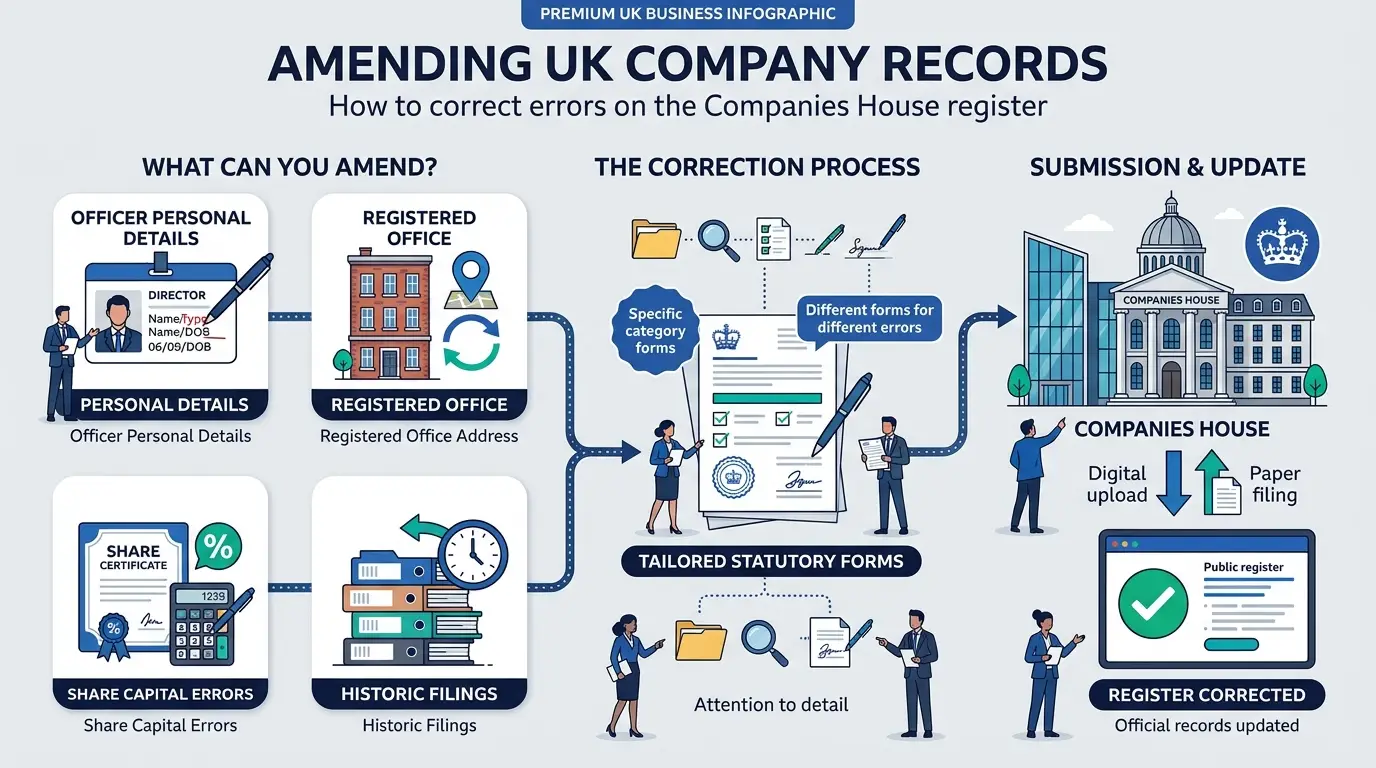
You can amend officer personal details, registered office addresses, share capital errors, and historic filings on the Companies House register. Corrections require statutory forms tailored to the specific category of misstatement.
Amending Director and Secretary Details
Director and secretary filings require absolute precision. You must rectify spelling mistakes in legal names using administrative correction procedures.
When a director changes their service address, submit Form CH01 immediately. If an incorrect date of birth appears on the public ledger, file Form RP04 alongside an amended original notice.
Correcting Share Capital and Allocation Discrepancies
Share capital errors demand immediate attention to prevent equity disputes. You cannot simply overwrite registered share allocations without statutory procedures.
If you register an incorrect currency or nominal value, file Form SH19 to statement of capital updates. For severe allocation errors, directors must obtain a court order to sanction statutory register adjustments.
How Do You Amend Minor Administrative Errors Using Form RP04?
You amend minor administrative errors by filing Form RP04 with Companies House alongside a correctly completed replacement document. Form RP04 notifies the Registrar that the replacement document rectifies a previously registered inconsistency.
Form RP04 serves as the official mechanism for second filings. You use this process when an existing document on the public record contains inconsistent or incomplete details.
Prepare the replacement document with accurate information before starting the filing process. Ensure the original document date matches the original submission period.
Complete Form RP04 by referencing the exact registration date and form type of the original filing. Attach the replacement paper or digital document securely to the form submission.
Submit the complete package to Companies House via WebFiling or post. The Registrar reviews the submission to ensure the replacement satisfies legal compliance standards.
Upon approval, Companies House places Form RP04 and the corrected document on the public register. The original flawed filing remains visible on the historic record, but the public index displays the replacement as the legally binding version.
How Do You Update Inaccurate Officer Information on Registered Documents?
You update inaccurate officer information by filing specific change notices or submitting second filings for existing officer appointments. Companies House mandates individual change forms for directors, secretaries, and persons with significant control.
When updating active director information, use Form CH01 for individual directors and Form CH02 for corporate directors. These forms update current records immediately without altering previous historical documents.
If the original appointment notice contained invalid personal data, submit Form RP04 alongside a revised Form AP01. This action amends the historical record created at company formation.
Updating Persons with Significant Control (PSC) details requires distinct statutory notices. Submit Form PSC04 to amend personal details for individual beneficial owners.
If you fail to register a PSC correctly during incorporation, file Form PSC01 alongside Form RP04 to rectify historical oversights.
Prompt submission ensures third-party verification systems access accurate information. Lenders and regulatory bodies query the public register during routine compliance checks. Accurate officer records prevent delays during corporate transactions and identity validation procedures.
What Is the Process for Rectifying Registered Office Address Mistakes?
The process for rectifying registered office address mistakes requires filing Form AD01 online or by post to register a valid UK physical address. Address changes take effect only after Companies House registers the new form.
An invalid registered office address prevents official government correspondence from reaching corporate officers. When an error occurs during incorporation, submit Form AD01 with the corrected address immediately.
Provide a complete physical address located within the same legal jurisdiction of initial registration.
Companies House validates the new address against official postal databases. If an unauthorised party uses your address as their registered office, file Form RP07 to request address removal.
The Registrar investigates unauthorised address registrations before moving the offending company to a default Companies House address.
When Is Judicial Rectification Required to Correct Incorporation Records?
Judicial rectification is required when statutory administrative forms cannot legally amend fundamental errors on the public register. You must apply for a High Court order to remove invalid documents, reverse unauthorized filings, or alter core share allocations.
Court orders become necessary when errors affect legal rights or statutory company capital. Section 1096 of the Companies Act 2006 empowers the court to order the Registrar to rectify the register.
You must instruct solicitors to draft a formal claim detailing how the incorrect entry causes material harm to company operations.
The High Court considers whether the error undermines register integrity before granting an order. Upon receiving a court order, Companies House removes or amends the invalid documentation permanently.
This process requires legal representation and incurs higher financial costs than routine administrative filings.
How Long Does Companies House Take to Correct Incorporation Records?
Companies House takes between 5 to 10 working days to process electronic correction forms submitted through digital portals. Paper submissions sent via postal mail require 15 to 20 working days for manual processing and verification.
Processing timelines vary depending on filing volume and submission complexity. Electronic submissions via WebFiling process faster than paper forms.
Form RP04 second filings require manual review by Companies House examiners, which extends standard processing windows by 3 to 5 business days.
If your filings require rapid processing, engage professional corporate service providers. Managing corporate filings through professional services prevents administrative rejections.
You can order essential administrative updates and Supplementary Company Documents to ensure public filings meet official Companies House standards.
Correcting errors quickly prevents operational delays. Uncorrected records stall bank account opening, slow down investment funding, and trigger compliance penalties.
How Can Professional Incorporation Services Prevent Filing Errors?
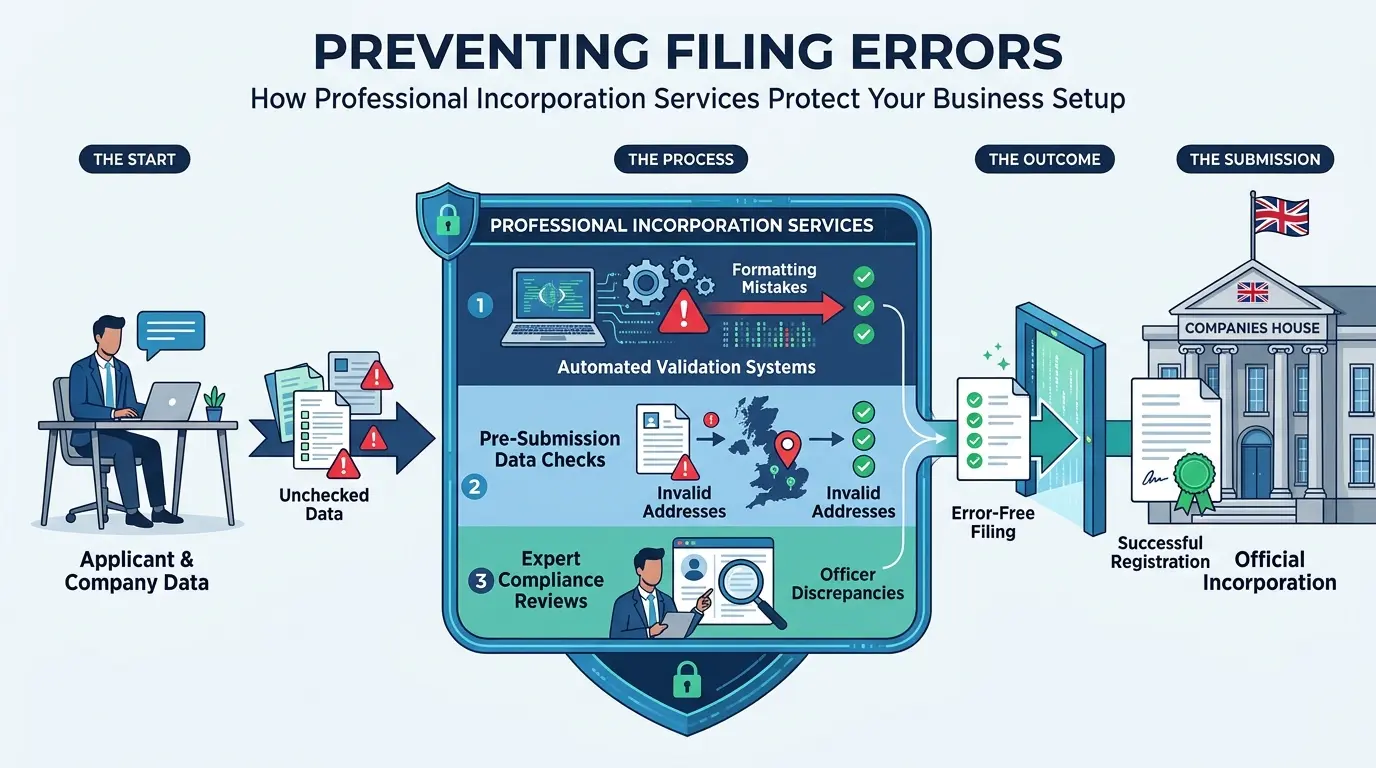
Professional incorporation services prevent filing errors by using automated validation systems, expert compliance reviews, and pre-submission data checks. These systems identify formatting mistakes, invalid addresses, and officer discrepancies before final Companies House submission.
Manual data entry carries inherent risks of human error. Professional incorporation platforms integrate direct API connections with official government registries.
These connections validate postal codes, director identity details, and share structures instantaneously during form completion.
When managing ongoing corporate governance, business owners must evaluate their public filing accuracy regularly. You can review what happens if the details on your certificate of incorporation are wrong to understand operational risks associated with uncorrected records.
Identifying discrepancies early allows you to take corrective action before third parties flag compliance issues.
Using professional corporate administration eliminates administrative overhead for growing businesses. Expert compliance teams review complex filings, ensuring share allocations and constitutional documents conform to UK company law.
If your initial setup contains structural errors, you can replace an outdated incorporation certificate with Form My Company to secure fully compliant corporate documentation.
Maintaining accurate records on the Companies House public register is a statutory requirement for every UK business. Administrative errors in officer details, registered addresses, or share structures disrupt operations, delay banking setups, and create compliance vulnerabilities.
Business owners can resolve most discrepancies efficiently by filing specific administrative notices like Form RP04, CH01, or AD01. Complex structural errors may require judicial rectification through court orders.
Implementing professional filing validation and routine compliance checks protects corporate integrity and ensures public registers reflect legal business realities.
Explore More Supplementary Company Documents Guide,
How to Pass Merchant Account KYC With Your Incorporation Certificate
Certificate of Incorporation vs Certificate of Good Standing Explained
Frequently Asked Questions
What are supplementary company documents for a UK business?
Supplementary company documents are official administrative filings and certificates that support or update a business’s core statutory records with Companies House. These include documents such as certificates of good standing, official change of name certificates, and updated share capital statements. Through Form My Company, businesses can order tailored Supplementary Company Documents to ensure public registers accurately reflect their legal structure.
How do I request certified copies of official company documents?
You can request certified copies of official corporate records online through designated formation agents or directly from the official Companies House registry. The Supplementary Company Documents service provided by Form My Company streamlines this procedure by procuring certified corporate certificates, official status reports, and filing documentation on your behalf. These authenticated papers are required by banks, legal advisors, and international regulatory authorities during formal compliance audits.
Why do banks require official supplementary corporate filings?
Financial institutions require official supplementary corporate filings to verify director credentials, confirm registered office addresses, and ensure business solvency during know-your-customer checks. Presenting current Supplementary Company Documents sourced via Form My Company proves legal existence and active statutory standing under UK company law. This documentation prevents account suspension and speeds up corporate bank account approval processes.
How long does it take to obtain supplementary business documentation?
Standard electronic delivery of corporate records typically takes 1 to 3 working days, while physical certified paper documents take 3 to 5 business days depending on registry processing speed. Form My Company expedites the procurement process for Supplementary Company Documents by submitting requests directly via electronic registry connections. Urgent orders can often be processed on the same day to meet critical legal or financial deadlines.
Can supplementary company documents correct errors on public registers?
Supplementary filings such as Form RP04 or updated officer change notices formally amend previously registered inaccuracies on the Companies House public ledger. Ordering specialized Supplementary Company Documents from Form My Company allows corporate directors to submit replacement notices that rectify historical errors in share capital, officer names, or business addresses. Rectifying public records promptly ensures legal compliance and preserves corporate credibility across commercial verification systems.