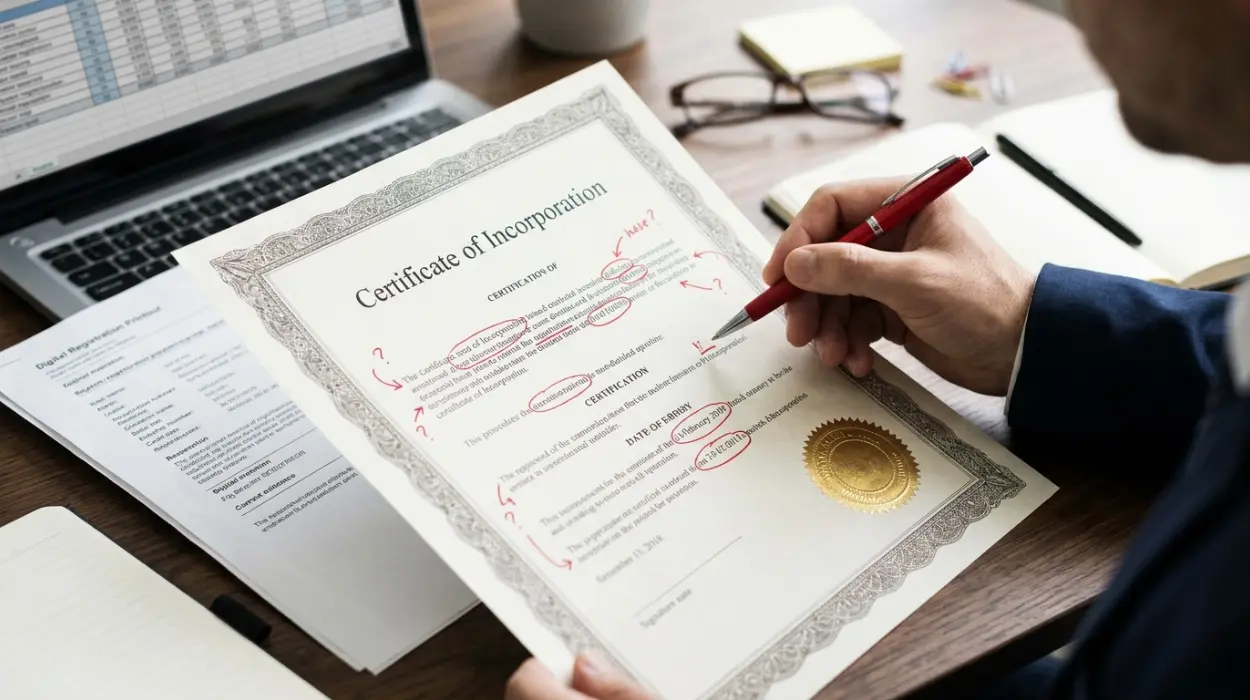
Inaccurate details on a Certificate of Incorporation render the legal identity of a business questionable under UK corporate law. Inaccuracies disrupt corporate bank account access, invalidate commercial contracts, trigger regulatory compliance fines, and halt funding rounds until official registers accurately reflect verified records.
Why Are Accurate Incorporation Details Legally Mandatory for UK Companies?
Accurate incorporation details establish the lawful existence and corporate liability framework for UK limited companies under the Companies Act 2006. Incorrect details invalidate official public registers, breach statutory transparency mandates, and expose company directors to administrative penalties.
Companies House maintains the official register of companies across England, Wales, Scotland, and Northern Ireland. The Certificate of Incorporation serves as legal proof that a corporate entity exists under law.
When details on this certificate contain errors, the legal standing of the business suffers. Corporate registry filings must reflect precise facts regarding company names, jurisdiction details, and formation dates.
UK compliance frameworks require strict accuracy to prevent fraudulent trading, money laundering, and identity manipulation. Incorrect information disrupts statutory reporting requirements and obscures beneficial ownership structures.
Inaccurate records trigger statutory notices from regulatory authorities. Companies House issues compliance warnings when public filings fail verification checks against registered records. Continued non-compliance results in compulsory strike-off action from the official register.
Directors bear personal legal responsibility for maintaining accurate statutory registers. Submitting false or inaccurate information during formation constitutes an offence under corporate compliance legislation.
How Do Inaccurate Formation Details Impact Business Banking and Credit Access?
Inaccurate formation details trigger failed Know Your Customer checks during bank onboarding, leading to immediate account freezes or application rejections. Financial institutions strictly require verified incorporation certificates matching official public records before extending corporate credit lines.
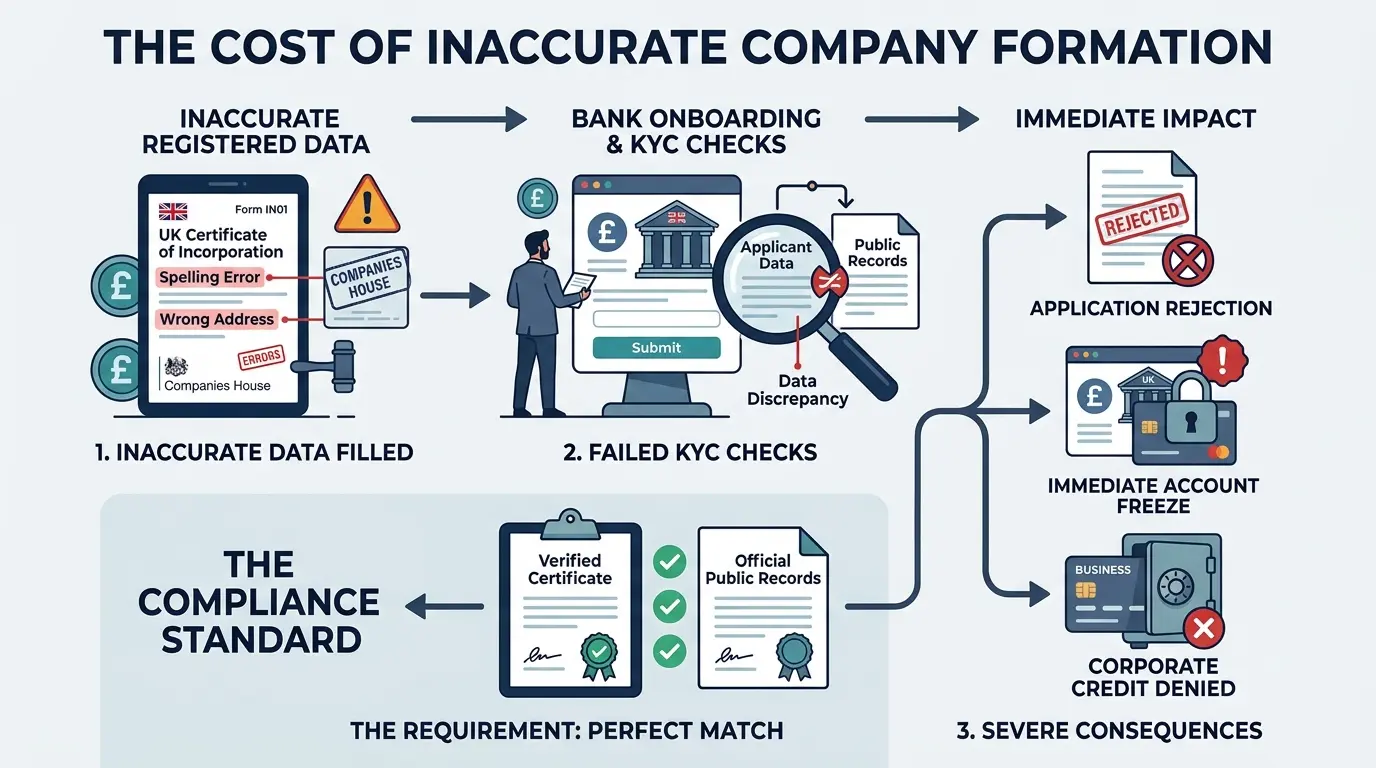
Financial institutions in the UK enforce rigorous anti-money laundering compliance standards before opening merchant accounts. Underwriters compare corporate paperwork directly against public registry data during initial risk assessments.
Discrepancies between physical certificates and official database records trigger immediate compliance holds. A misspelled company name or an incorrect registered office address fails automated validation algorithms. Banks reject applications that fail basic document verification procedures.
Existing business accounts face suspension when periodic compliance audits detect registry discrepancies. Lenders freeze working capital lines, payroll accounts, and credit facilities until official records align.
Commercial lenders calculate corporate credit scores using public filing data. Contradictory information across formation documents damages commercial credit ratings.
Impaired credit ratings prevent businesses from securing commercial mortgages, equipment leasing, and trade credit facilities. Corporate financial partners refuse risk exposure associated with unverified legal entities.
What Commercial Contractual Risks Arise From Incorrect Incorporation Certificates?
Incorrect incorporation certificates create ambiguity surrounding legal entity identification in commercial contracts, rendering agreements vulnerable to invalidation challenges. Counterparties can dispute liability, withhold payments, or terminate vendor agreements due to legal entity misdescription.
Legal contracts require precise identification of contracting parties to establish binding obligations. Entering commercial contracts using incorrect legal names creates dispute risks during contractual enforcement.
Opposing parties exploit legal name discrepancies to challenge contract validity in court proceedings. Judges require clear evidence that a contracting entity legally exists and possesses corporate capacity.
Inaccurate legal descriptions delay dispute resolution processes and increase legal expenditure. Vendor onboarding procedures require strict vendor validation checks before contract execution.
Corporate clients require verified formation documents during supplier risk assessments. Inaccurate certificates delay contract execution and result in lost commercial opportunities.
Insurance underwriters decline claims when policy documentation names a legal entity that contradicts public formation records. Insurers void coverage based on misrepresentation of legal identity details.
How Do Errors on Incorporation Documents Affect Investors and Due Diligence?
Errors on incorporation documents delay venture capital funding rounds and corporate acquisitions by failing professional due diligence checks. Equity investors pause capital allocations until legal counsel verifies clean statutory records and corrected certificates.
Venture capital firms and private equity investors perform exhaustive legal due diligence before injecting capital. Corporate solicitors review formation documents, articles of association, and statutory registers for accuracy.
Uncorrected formation errors raise immediate operational compliance concerns during capital raising. Investors view poor statutory record-keeping as a indicator of weak internal governance.
Correcting historical errors during live deal negotiations delays closing timelines significantly. Financial transactions often stall while companies file corrective documentation with corporate registries.
Delayed transactions expose businesses to market fluctuations and investor withdrawal risks. Valuation discounts occur when buyers identify unresolved corporate secretarial errors.
Acquiring entities deduct legal remediation expenses from final purchase price valuations. Pristine corporate paperwork maintains deal momentum and preserves business valuation targets.
Which Types of Inaccuracies Commonly Occur on Company Incorporation Certificates?
Common incorporation certificate errors include misspelled company names, incorrect legal structure designations, misstated formation dates, and inaccurate registered office jurisdictions. These technical errors stem from administrative oversight during initial online formation submissions.
A single typographical error in a company name creates a distinct legal entity concept on public registers. Omitting terms like “Limited” or “Ltd” alters official corporate records.
Selecting the wrong registered office jurisdiction during application causes administrative complications. Companies registered in England and Wales must maintain registered office addresses within that specific territory.
Errors in initial officer appointments and shareholder allocations distort legal ownership structures. Incorrect shares allocations disrupt dividend distributions and voting rights frameworks.
Misstating primary business activity codes misrepresents commercial operations to regulatory authorities. Misclassified entities face heightened regulatory scrutiny from taxation bodies.
Administrative filing mistakes occur frequently when submitting unverified formation data without professional review. Early detection prevents complex legal remediation procedures.
What Steps Correct Inaccuracies on Public Company Registers?
Correcting public company registers requires filing specific statutory amendment forms, administrative resolutions, or formal court applications depending on error severity. Companies House processes specific corrective filings to update official public registers.
Minor clerical errors require statutory notice filings to update public registers. Directors submit specific rectification forms to amend registered office addresses or officer details.
Substantial errors in company names require formal special resolutions from company shareholders. Shareholders must vote to approve official name changes through constitutional processes.
Companies House issues updated certificates following successful processing of statutory change filings. Business owners must learn how to correct errors on your company incorporation records to maintain regulatory compliance.
Filing errors concerning share capital structures require formal board approvals and legal filings. Certain capital misstatements require formal court orders to achieve legal rectification.
Remediation timelines vary from 24 hours for standard electronic filings to several weeks for paper filings. Fast-track processing resolves urgent compliance blocks during commercial transactions.
When Should Companies Order Supplementary Corporate Documents for Compliance?
Companies should order supplementary corporate documents when expanding internationally, opening offshore bank accounts, securing institutional investment, or updating legacy records. Supplementary documents provide legal confirmation of current corporate standing.
Certificates of Good Standing confirm a company operates continuously without pending strike-off actions. Foreign regulatory authorities require certified corporate documents before approving overseas branch registrations.
Official corporate registry extracts provide verified proof of current directors and share capital structures. Institutional lenders demand up-to-date documentation during annual credit line reviews.
Growing organizations utilize professional supplementary company documents services to obtain apostilled certificates for international trading compliance. Certified copies satisfy stringent international KYC frameworks.
Corporate rebrandings require updated official certificates displaying newly registered legal names. Outdated certificates fail modern digital validation checks executed by payment processors.
Maintaining current certified paperwork prevents operational interruptions across commercial banking channels. Strategic management teams order official corporate documentation ahead of planned expansion activities.
How Can Businesses Replace an Outdated or Incorrect Formation Certificate?
Businesses replace outdated formation certificates by requesting official replacement documents or issuing statutory corrections through certified corporate service providers. Official duplicate certificates display verified historical formation details alongside updated legal statuses.
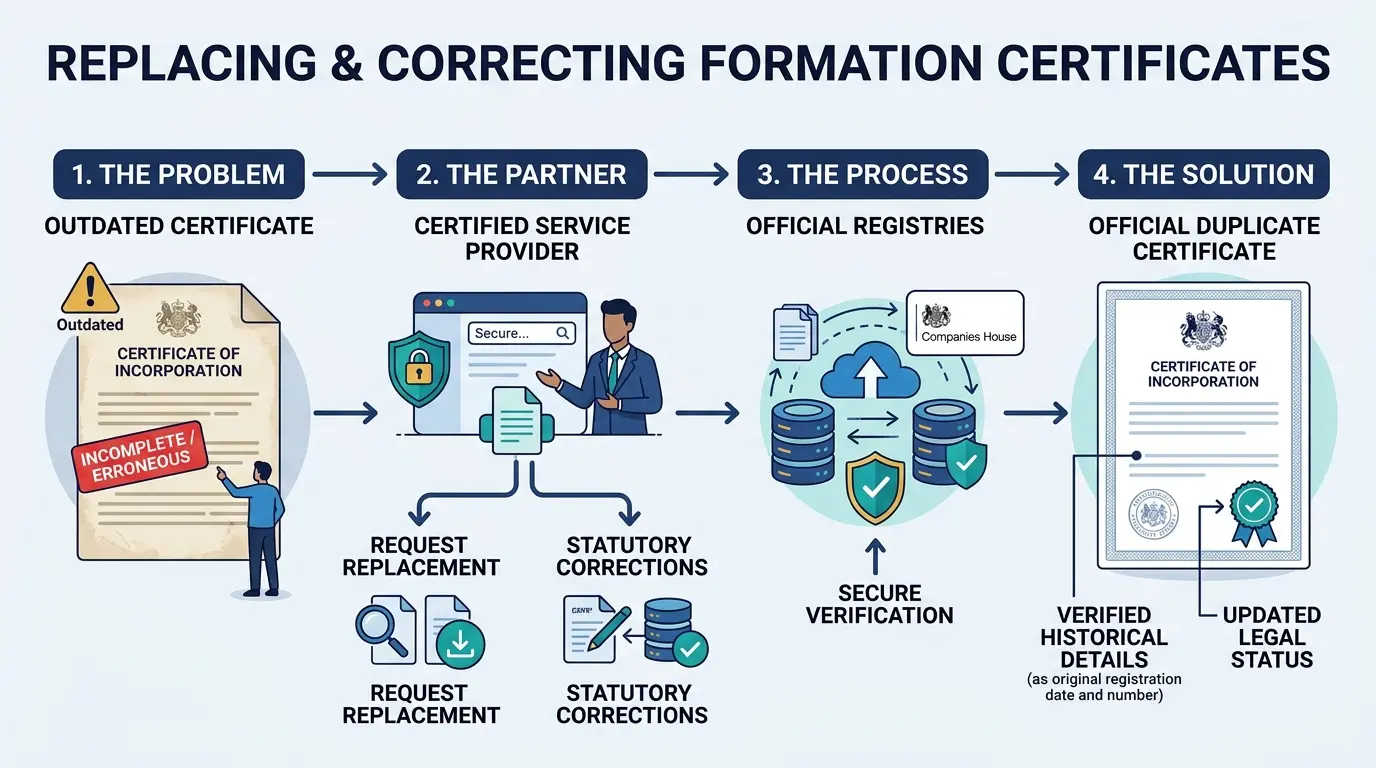
Replacing misplaced or invalid corporate documentation requires formal access to official registry archives. Replacement certificates serve as legal proof of historical incorporation.
Businesses facing identity discrepancies choose to replace an outdated incorporation certificate with Form My Company to ensure total regulatory compliance. Professional corporate services manage filings to eliminate administrative errors.
Direct registry integration accelerates document issuance for urgent commercial deadlines. Certified electronic copies deliver immediate verification for digital account opening procedures.
Legal teams review statutory registers before issuing replacement corporate documentation. Comprehensive audits identify hidden filing discrepancies across historical company records.
Correcting legal records ensures corporate documentation aligns perfectly across banking, legal, and regulatory systems. Proactive documentation management secures long-term corporate governance standards.
Inaccurate details on a Certificate of Incorporation compromise legal standing, disrupt financial operations, and create commercial contract liabilities. Corporate registers require strict accuracy to ensure ongoing compliance with UK business legislation. Addressing errors swiftly through statutory correction processes restores legal clarity, unlocks banking access, and satisfies institutional due diligence requirements. Form My Company assists businesses in obtaining verified supplementary corporate records and replacing inaccurate formation documents to maintain pristine regulatory compliance.
Explore More Supplementary Company Documents Guide,
What Do Investors Look for in Your Articles of Association?
What Are the Share Transfer Rules in Articles of Association?
Frequently Asked Questions
What are supplementary company documents in the UK?
Supplementary company documents are official, secondary legal records—such as Certificates of Good Standing, apostilled formation certificates, and official registry extracts—issued to supplement primary incorporation filings. Form My Company provides businesses with verified supplementary company documents to satisfy international compliance requirements, banking due diligence, and corporate audit procedures.
Why do overseas authorities require an apostilled company document?
Overseas institutions, foreign registries, and international banks require an apostille to verify the legal authenticity of a UK corporate document under the Hague Convention. Form My Company manages Foreign, Commonwealth & Development Office (FCDO) legalisation to certify that statutory company records match official UK public registers.
What is included on an official UK Certificate of Good Standing?
An official UK Certificate of Good Standing confirms that a company has continuously submitted mandatory filings to Companies House and remains free from pending liquidation proceedings. Ordering this document through Form My Company can also verify optional statutory details, including active director appointments, corporate secretarial records, and the registered office address.
How long are supplementary corporate documents valid for business banking?
While supplementary corporate records do not carry a formal statutory expiration date, most financial institutions and regulatory bodies require documents issued within the last 30 to 90 days. Obtaining freshly certified supplementary company documents via Form My Company ensures your corporate structure satisfies current anti-money laundering and Know Your Customer standards.
Can a company order duplicate incorporation documents after changing its official records?
Yes, UK businesses must replace outdated incorporation documents whenever statutory changes occur or administrative filing errors are corrected. Form My Company retrieves updated corporate extracts directly from Companies House archives to ensure current filings accurately align across all public and commercial registers.