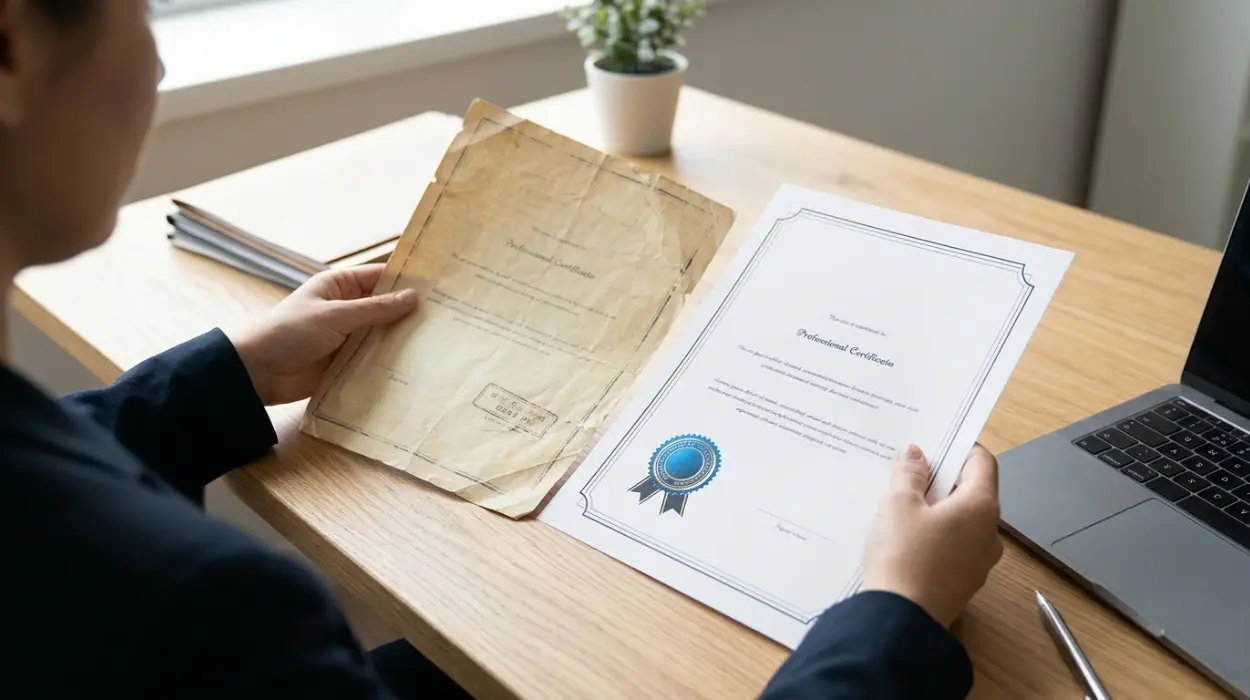
You replace an outdated incorporation certificate by filing formal amendment documents with Companies House to update official details, then ordering a newly issued certificate or certified duplicate through Form My Company to prove current legal status.
Why Must UK Businesses Update an Outdated Certificate of Incorporation?
UK businesses must update an outdated certificate of incorporation because financial institutions, legal entities, and regulatory bodies require verified, current proof of corporate structure before executing commercial transactions, approving loans, or issuing operational licences.
Companies House issues a Certificate of Incorporation when a business registers in the United Kingdom. This document serves as legal proof of formation. Over time, corporate changes occur. Companies change legal names, re-register corporate structures, or alter official company numbers. An old certificate containing former business names or dissolved structures fails legal compliance checks.
Financial institutions inspect official filings during routine checks. UK banks freeze accounts when corporate documentation conflicts with public registers. Third-party auditors decline contract approvals if legal names on contracts fail to match historical formation records. Outdated incorporation documents delay vital commercial transactions.
Updating company documentation maintains active operational status. UK corporate law obliges directors to present accurate regulatory filings to external stakeholders.
Modern regulatory frameworks mandate strict identity validation. When corporate details shift, corporate officers must align public register entries with physical paperwork. Obtaining updated corporate paperwork secures operational continuity and satisfies strict compliance protocols.
When Does a Certificate of Incorporation Become Legally Outdated?
A certificate of incorporation becomes legally outdated when a business alters its registered company name, changes its legal structure, consolidates corporate entities, or experiences official Companies House updates that render original registration details historical.
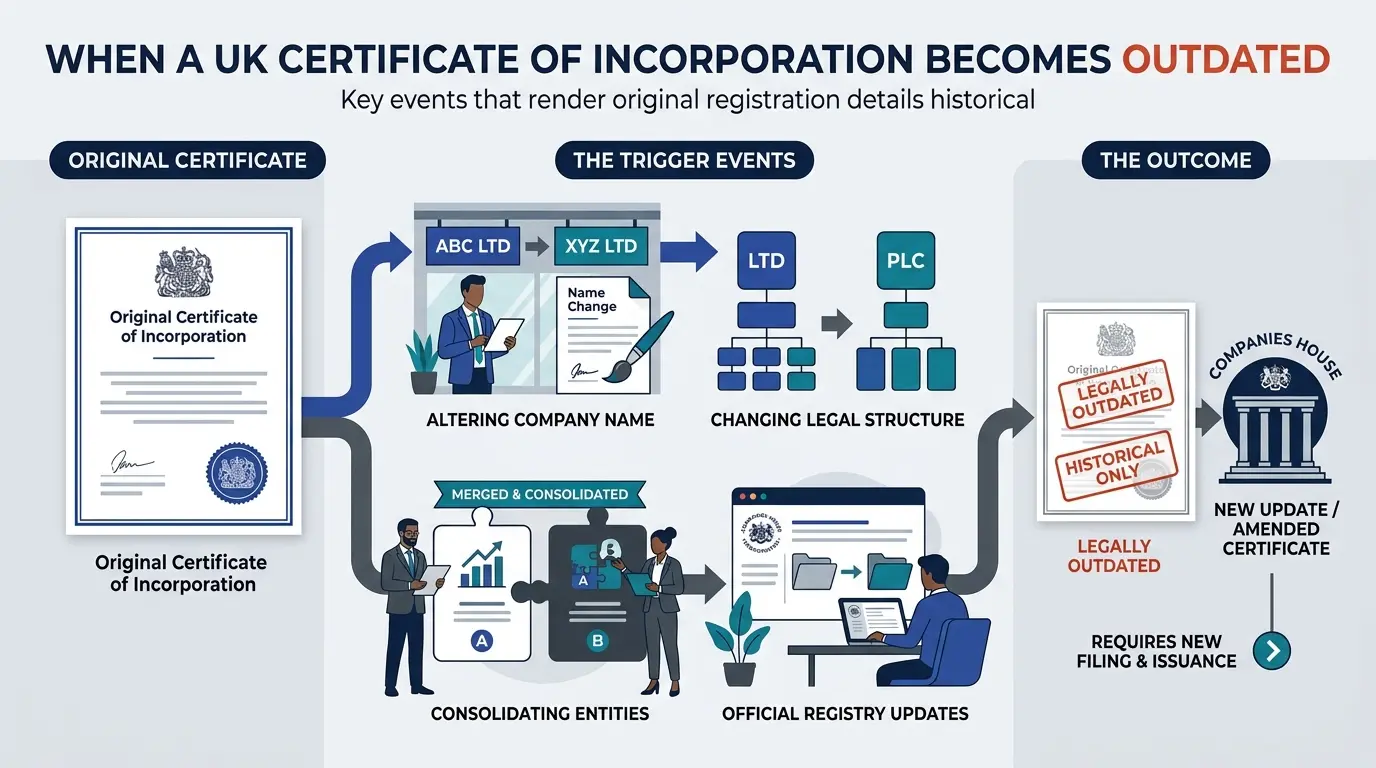
Original certificates display specific historical data captured at the exact hour of incorporation. Three primary events invalidate the operational accuracy of an original certificate: legal name alterations, corporate re-registrations, and structural capital revisions.
A formal name change requires special resolutions and administrative filings. Once Companies House approves Form NM01, the initial certificate no longer reflects the active legal title. Displaying a certificate showing a former name creates severe compliance mismatches.
Corporate entity changes also require document replacements. Converting a private limited company (Ltd) to a public limited company (PLC) changes legal liability structures. Original formation paperwork does not capture these statutory shifts.
When corporate restructuring occurs, historical documentation loses legal standing for external verification. Corporate officers must recognize these statutory triggers immediately. Failing to update corporate proof causes delays during legal due diligence.
What Documents Are Needed to Replace Outdated Incorporation Proof?
Replacing outdated incorporation proof requires filing statutory resolution forms, submitting official change notices to Companies House, and acquiring updated certification products such as official certificates of incorporation on change of name.
Replacing historical documents involves administrative filings and fresh certificate orders. When changing legal business titles, directors submit Form NM01 alongside written board resolutions. Companies House processes these submissions and generates a fresh Certificate of Incorporation on Change of Name.
If errors exist on historical filings, directors must correct underlying records before requesting new paperwork. You can review how to correct errors on your company incorporation records to ensure historical data matches public register entries precisely.
After rectifying register entries, companies obtain certified document duplicates. Official replacement packages include three main items: certified copies of name change certificates, official articles of association, and formal certificates of good standing.
Collecting these papers creates a complete legal audit trail. Modern enterprise clients demand both initial formation evidence and subsequent modification certificates before signing commercial vendor agreements.
How Does the Process of Replacing an Outdated Certificate Work?
The process of replacing an outdated certificate works by auditing public register entries, submitting missing statutory updates, registering required resolutions, and ordering freshly issued corporate documentation from certified corporate service providers.
Updating company documentation requires precise sequential execution. Skipping administrative steps leads to document rejection by statutory authorities.
First, complete a thorough register audit. Check current public details against internal corporate secretarial books. Determine whether previous statutory changes were properly indexed by statutory authorities.
Second, draft mandatory corporate resolutions. Directors must hold formal board meetings to authorize document replacements or corporate name changes. Record these decisions in official company minute books.
Third, file appropriate statutory notices. Submit electronic forms directly to public registries. Pay statutory filing fees to initiate official registry updates.
Fourth, order replacement documentation packages. Businesses access professional Supplementary Company Documents to secure officially stamped certificates, replacement incorporation documents, and certified register extracts promptly.
Fifth, store certified replacements securely. Distribute digital versions to compliance teams and archive paper copies within official corporate record repositories.
What Issues Arise If You Rely on Outdated Incorporation Documents?
Relying on outdated incorporation documents causes severe operational issues, including frozen corporate bank accounts, rejected commercial loan applications, delayed vendor contract executions, and failed international trade compliance checks.
Operating with inaccurate business paperwork exposes organizations to compliance risks. Third-party risk management systems automatically flag non-compliant corporate entities.
Financial institutions conduct strict Anti-Money Laundering (AML) checks annually. If bank compliance officers discover mismatched corporate titles between public registers and account records, accounts face immediate operational restrictions.
Commercial transactions suffer when verification checks fail. Corporate buyers verify seller credentials using official registry records. If a business submits an original incorporation certificate bearing an old legal name, procurement departments halt contract execution.
International trade activities require official document legalisation. Foreign embassies reject apostille requests for outdated corporate paperwork. If corporate officers fail to address structural discrepancies early, business operations encounter avoidable barriers. You can analyze what happens if the details on your certificate of incorporation are wrong to understand the statutory consequences of uncorrected corporate records.
How Does Form My Company Simplify Document Replacement for UK Businesses?
Form My Company simplifies document replacement by managing statutory registry filings, auditing public records for accuracy, drafting board resolutions, and issuing certified corporate replacement documents directly to business owners.
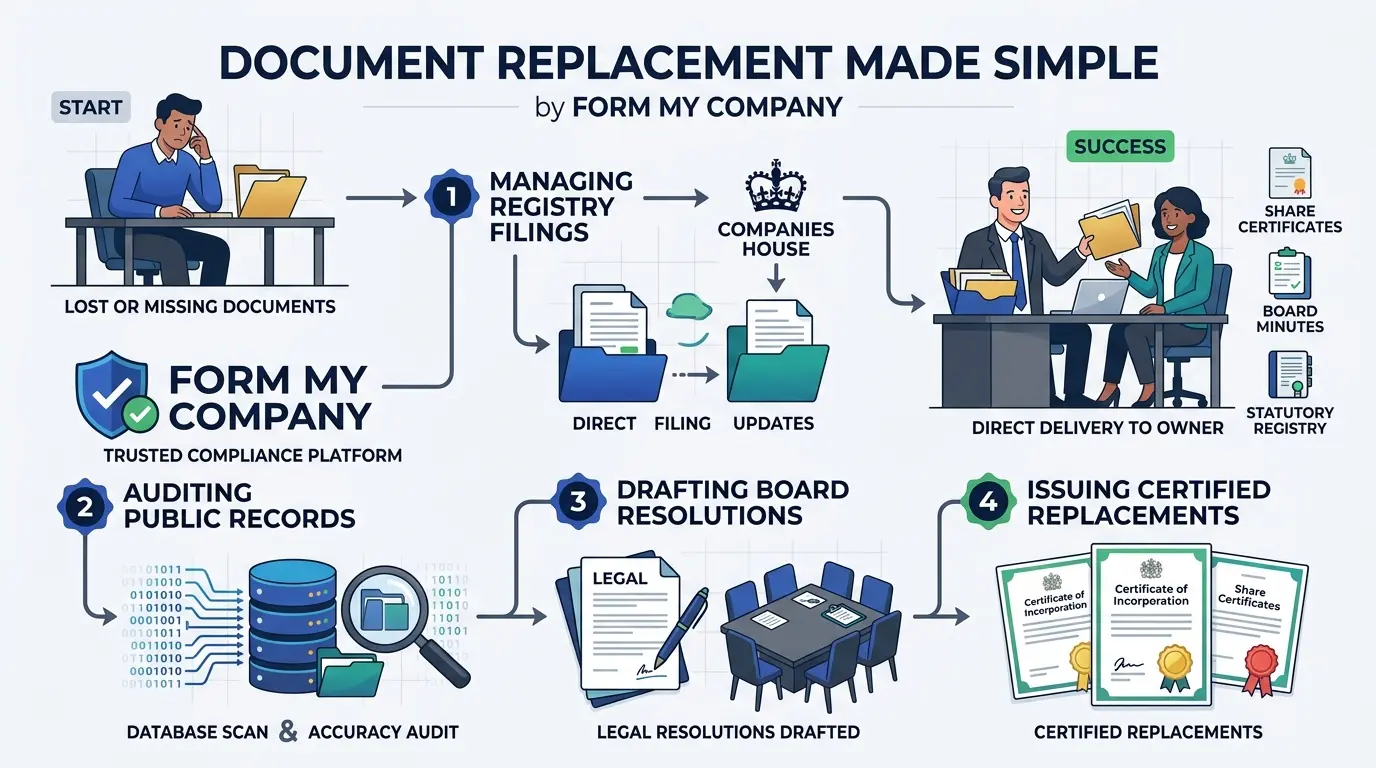
Navigating corporate administrative procedures requires time and legal precision. Form My Company eliminates administrative burdens by handling statutory document updates end-to-end.
Form My Company verifies public registry records against corporate requirements. Specialists identify filing gaps, prepare correct administrative notices, and submit documents directly to statutory authorities.
Form My Company prepares accurate legal documentation. Corporate secretarial experts draft compliant board resolutions, complete Form NM01 filings, and verify official registry responses.
Form My Company delivers official replacement documents rapidly. Corporate officers receive physical and digital copies of updated certificates, certified articles of association, and supplementary corporate records.
Through dedicated service channels, Form My Company ensures UK businesses maintain complete statutory compliance without operational disruptions.
What Are the Next Steps to Order Your Replacement Incorporation Certificate?
The next steps to order your replacement incorporation certificate involve collecting current company details, identifying necessary record updates, selecting certified replacement options, and submitting your order through a trusted corporate service provider.
Updating corporate paperwork maintains business credibility and ensures smooth commercial operations. Following a structured procedure accelerates document issuance.
Begin by reviewing current registry entries. Confirm that legal company names, registered office addresses, and officer details reflect active business operations.
Determine which statutory documents require replacement. Identify whether your organization needs basic duplicate certificates, official name change certificates, or comprehensive legalisation packages.
Partner with established corporate secretarial professionals. Submitting requests through experienced specialists guarantees regulatory compliance and prevents processing delays. Form My Company assists UK corporate entities by preparing statutory updates and delivering certified replacement documents promptly.
Explore More Supplementary Company Documents Guide,
Get a KYC-Ready Certificate of Incorporation From Form My Company
Order Incorporation and Good Standing Certificates With Form My Company
Frequently Asked Questions
How do I order certified supplementary company documents in the UK?
You can order certified supplementary company documents online through corporate service providers like Form My Company by submitting your registered company name or number. These official documents include certified duplicate certificates of incorporation, official articles of association, and change of name certificates. Registrars stamp and authenticate these paperwork packages to satisfy statutory requirements for banks, investors, and legal authorities.
What are supplementary company documents and why are they required?
Supplementary company documents are official legal filings and certified records that supplement a business’s primary Certificate of Incorporation. Banks, courts, regulatory bodies, and legal teams require these documents during identity checks, loan applications, and corporate due diligence. Services like Form My Company provide these verified statutory papers to prove current legal standing and active operational status.
Can I get an official replacement certificate of incorporation after a name change?
Yes, when a business updates its legal name, statutory registers generate an official Certificate of Incorporation on Change of Name. Companies can obtain fresh duplicate copies and certified administrative records through Form My Company’s Supplementary Company Documents service. These certified updates serve as legal proof that the historic entity and current corporate title are identical under UK law.
How long does it take to obtain certified company documents from Companies House?
Standard processing for official statutory document copies typically takes three to five working days, while expedited services can deliver digital or physical records within 24 hours. Services providing Supplementary Company Documents via Form My Company streamline public register searches to fast-track document retrieval. Processing times depend on whether you require electronic verification copies or physical certified documents stamped by the registrar.
Do banks accept digital copies of supplementary company documents for account opening?
Most UK financial institutions accept certified digital PDF versions of supplementary company documents if they carry verifiable digital stamps or official registry authentication. However, certain international banks and enterprise compliance teams still require physical paper documents with official apostille or registrar certifications. Using Form My Company allows corporate directors to request both digital and physical certified records to meet specific institutional criteria.