
A separate service address can help keep your home address from appearing as the current public correspondence address, though it may still appear in older records. A director service address is the public correspondence address you provide instead, while you still give Companies House your usual residential address for its private records.
It’s understandable to want a clear boundary between your home and your company, especially when company information is publicly available. Using another address keeps your home from appearing as your current service address, but it does not make your director details anonymous or remove information shown in historic filings.
This guide explains who must provide a service address, what correspondence it receives and how it differs from a registered office. You’ll also learn what appears on the public register and what to consider when choosing an address that can reliably receive official mail.
Key Takeaways
- Use a separate correspondence address to keep your home from appearing as your public service address, while understanding that Companies House retains residential details privately.
- Keep the two address roles clear: one receives official correspondence for the company, and the other is for correspondence addressed to its officers.
- Choose an address where official documents can be received promptly, and consider how it will be monitored or forwarded.
- Know which company roles must provide an address and what personal details remain visible on the public register.
- Check how changes and historic filings affect what people can see, so you can make informed privacy decisions.
Why do I need both a Registered Office Address and a Director Service Address?
A director’s service address change must be notified to Companies House within 14 days. Filing the change correctly is free. You can submit it online through WebFiling or by post using the completed form. The new address takes effect once Companies House registers it.
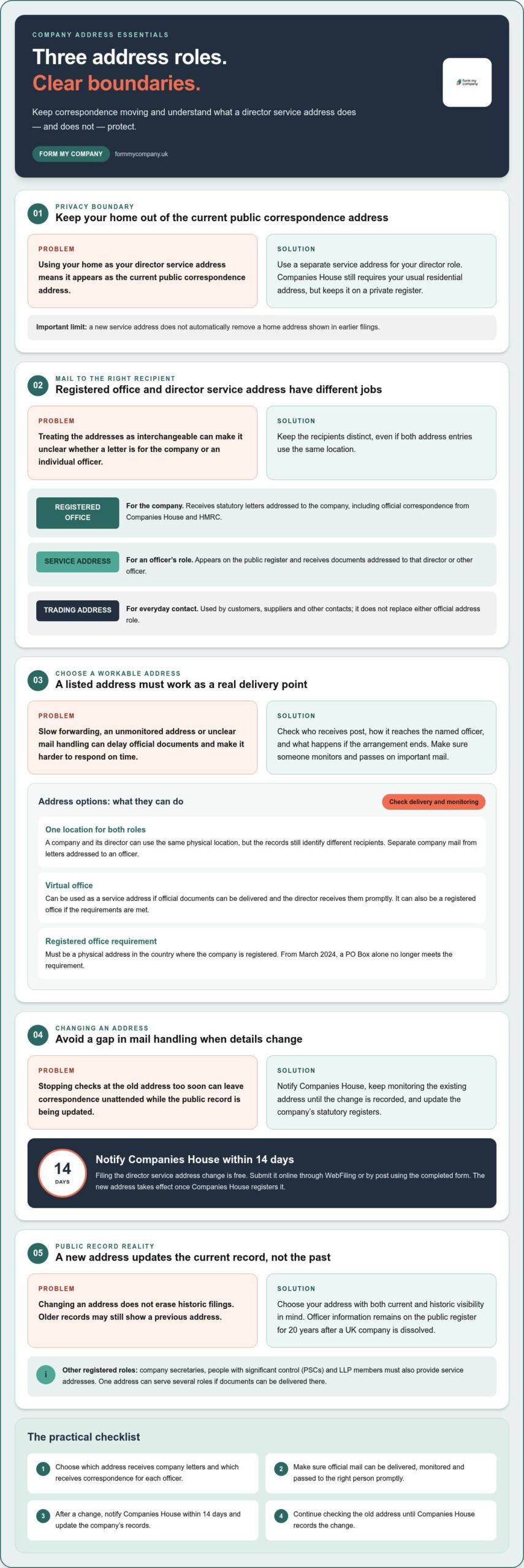
The addresses have different recipients. A company’s registered office receives statutory letters addressed to the company, including official correspondence from Companies House and HMRC. A director service address is the correspondence address for an individual’s role and appears on the public register. It receives documents addressed to that director.
You can use the same address for both purposes, but each entry still has a distinct role. For example, company mail and a director’s official correspondence might both go to one office. Alternatively, the director can choose another suitable address. The registered office must be in the country where the company is registered. A registered office address service provides an address for company correspondence.
Companies House also requires a director’s usual residential address. This is kept on a private register rather than shown publicly. Using a different director service address keeps your home from appearing as the current public correspondence address, but does not automatically remove a home address shown in earlier filings.
Address requirements also apply to other registered roles. Company secretaries, people with significant control (PSCs) and LLP members must provide service addresses when registered with Companies House. One address can be used for several roles, provided documents can be delivered there. Make sure someone monitors incoming mail and passes important correspondence to the right person.
To change an address, notify Companies House online or by post, then update the company’s statutory registers. Continue monitoring the existing address until Companies House records the change. This helps avoid a gap in handling correspondence while the public record is updated.
Some personal details remain visible alongside the address. For UK directors appointed after 10 October 2015, only the month and year of their date of birth are publicly available, according to Companies House. Their residential address remains private, while the service address is published. This distinction helps separate private residence details from public correspondence.
During company formation, decide which address will receive company letters and which will receive correspondence for each officer. If an officer later changes their details, notify Companies House within 14 days and update the company’s own records. Keeping the address information aligned makes it easier to manage official mail and maintain accurate records.
Differences between a director service address and registered office
The main risk of using an address provider is missed or delayed official mail. If Companies House or another government body sends a document there, you need a reliable way to receive it promptly and act on it.
A registered office belongs to the company. It receives official correspondence addressed to the company, including statutory mail. An officer’s service address belongs to their role and is published as their correspondence address. A limited company can use the same physical location for both, but the records still identify different recipients.
A business or trading address serves a different purpose: it gives customers, suppliers and other contacts a place for everyday correspondence. It may be the company’s premises, but it does not replace the registered office or an officer’s service address. For example, a director could use one address for personal statutory correspondence and a separate trading address for customer enquiries.
Virtual office addresses can be used as service addresses, provided they meet the practical need: official documents must be deliverable there, and the director must receive them promptly. A virtual office can also be used as a registered office, but the company’s registered office must be a physical address, not a PO Box. From March 2024, a PO Box alone no longer meets this requirement.
Using one address for an officer’s service address and the registered office can simplify mail handling. It does not merge the two legal roles. Make sure correspondence addressed to the company is distinguished from letters addressed personally to a director, secretary or other officer.
Changing an address doesn’t erase the company’s history. Information about a UK company’s officers remains on the public register for 20 years after the company is dissolved, according to Companies House. A new address therefore updates the current record, but older filings may continue to show a previous address.
Risks associated with an address provider are practical as well as administrative. Mail could be delayed if forwarding is slow, an address is no longer monitored, or staff fail to notify the right person. This can make it harder to respond to official correspondence on time. The address must work as a real delivery point, not simply as a label on the public register.
Before relying on an address, establish who receives post, how it reaches the named officer, and what happens if the arrangement ends. If the address is shared for company and personal correspondence, clear handling procedures help prevent a director’s letter being mistaken for company mail. Keep your contact details current so notifications and forwarded documents reach you.
Director service address and home address privacy
Companies House keeps a director’s usual residential address private but publishes their service address. This distinction matters if you want public correspondence kept separate from your home.
Using a home address
A director can use their home as the service address, but it will then appear on the public register. For someone working from home, this could make their residential location visible to anyone searching the company record. Companies House still requires the director’s usual residential address for its private records, even when another correspondence address is used publicly.
Protecting home address privacy
To keep your home off the public register as a current service address, provide a different address for official correspondence. The alternative must be somewhere documents can reach you promptly, either directly or through someone who can notify you or forward the post. This separates the public contact point from the private residential details held by Companies House.
Home or professional address choices
A professional address, such as an accountant’s address, is one option for a director who does not want to publish a home address. A virtual office address can also serve this purpose if official documents can be delivered and passed on reliably. Before using either, consider who receives correspondence, how they alert you, and what happens if the arrangement ends.
Changing the current service address does not automatically remove an old home address from previous filings. Historical documents can remain visible, so an address used before the change may still appear in the company’s filing history. Submit the new address to Companies House to update the current record, then consider whether older documents need a separate privacy application.
The Companies (Disclosure of Address) (Amendment) Regulations 2018 provide for an individual to apply to update home address data on the public record. From 27 January 2025, people can also apply to suppress a home address used as a former registered office address. These routes address different records, so identify whether the home appeared as an officer’s address or the company’s former office.
Keep copies of filings and note which documents contain the address you want removed. Changing the service address updates the current entry, while an application concerning historical information addresses earlier records. If your home was used for both roles, review the officer filings and registered office history separately. This helps direct each privacy request to the relevant record.
How a director service address appears on the public register
Companies House publishes a director’s service address as the correspondence address for their role. It is visible in the company’s officer information, separate from the residential address supplied privately to Companies House.
Can a director service address be kept private from the public? No. The address used for this purpose appears on the public register. To keep your home off the current public entry, provide a different suitable address for official correspondence. This prevents your residential address from appearing as the current contact point, but does not make your identity anonymous.
To find an officer’s address, search for the company on Companies House and open its officer information. The register displays the filed correspondence details for each relevant officer. It also includes directors’ names and nationalities. For UK directors appointed after 10 October 2015, only the month and year of their date of birth are publicly available.
What penalties apply for failing to provide or update a director service address? Directors must provide an address and notify Companies House of a change within 14 days. An omitted or outdated address can leave the public record inaccurate and make official correspondence harder to deliver, so submit the required update promptly.
A current filing change does not automatically remove an address from historic documents. The Companies (Disclosure of Address) (Amendment) Regulations 2018 provide for an individual to apply to update home address data on the public record. From 27 January 2025, people can also apply to suppress a home address previously used as a registered office. These applications concern different records, so identify where the address appears before applying.
Companies House also requires a registered email address for company communications. Newly incorporated companies must provide one during incorporation from 4 March 2024. For existing companies, the requirement applies when filing a confirmation statement with a statement date on or after 5 March 2024. The registered email address is not made public.
Update the company’s statutory registers as well as the public filing when an officer’s details change. These records serve different purposes: Companies House displays the public entry, while the company maintains its own statutory information. For example, after a director updates their correspondence details, the company should record the revised address internally too.
Before submitting a filing, distinguish the public correspondence address from the residential details held privately. If an earlier document shows a home address, changing the current director service address will not remove that historic entry. Treat the current filing and any request concerning older documents as separate tasks, and keep copies of submissions for the company’s records.
People required to provide a service address
Companies House requires a service address from people in specific registered roles, not everyone connected with a business. The key distinction is whether someone is registered as an officer or person with significant control, rather than simply owning shares.
Every UK company director must provide a service address during company formation or when appointed later. This applies to directors of private limited companies and public limited companies. If a company appoints a new director after incorporation, the appointment requires address details for the Companies House record.
Company secretaries also provide an address when registered with Companies House. A company may appoint a secretary after formation, so the requirement applies when they take up the role. A person acting as both director and secretary can use the same address for both entries, provided correspondence for each role reaches them.
People with significant control (PSCs) must provide a service address too. A PSC is recorded because they meet the relevant control criteria, not simply because they have a connection to the company. For example, a shareholder who is also a PSC has an address requirement attached to the PSC role.
Limited liability partnerships have their own relevant roles. LLP members must provide a service address when registered with Companies House. If a company or LLP uses a corporate entity in a relevant role, an address must be supplied for that entity as well as for individuals serving in applicable roles. The register therefore covers people and corporate bodies according to their formal positions.
Passive ownership alone does not usually create the same requirement. A shareholder who joins a UK company after formation does not have to provide a statutory address unless they also hold a role that requires one. The same distinction applies to guarantors who join later. By contrast, subscribers named in a company’s initial memorandum provide an address that appears on the public record.
At formation, identify each person’s role before collecting and filing their information. Separate directors, secretaries and PSCs from shareholders who hold no other reportable position. For an LLP, record its members distinctly. This role-by-role check helps prevent an address being missed or requested from someone with no relevant filing obligation.
Make sure the chosen address can receive documents and that the responsible person can pass them on promptly. If post is scanned or forwarded, agree who reviews it and how the named officer is notified. One address can serve several roles, but company filings must still show the correct details for each appointment.
If you’re preparing to register a company or LLP, explore company formation packages and organise the required role details as part of the process.
Form My Company: Digital Package
Form My Company helps new business owners form companies through its Digital Package. If you’re preparing to register a company, plan the director service address alongside the other details you’ll submit.
Choose the Digital & Print Package or Entrepreneurs Choice Package if either better suits your formation needs. For a partnership structure, Form My Company also offers Limited Liability Partnership (LLP) Formation. Consider your intended structure and decide which director service address should appear in the public company record.
Prepare the company and officer information before starting, including a correspondence address that can reliably receive official documents. A suitable director service address helps organise this part of the formation process, while keeping your address details accurate.
Visit formmycompany.uk to explore your options or contact Form My Company to get started.
Make your formation plans with confidence
Use your address decision as a prompt to organise the wider details of your new business. Before starting, identify who will hold each registered role, which correspondence address you intend to use, and how official post will reach the right person. A clear plan can make formation decisions easier to manage.
Form My Company offers the Digital Package, Digital & Print Package and Entrepreneurs Choice Package. Compare these formation routes with the way you want to set up your company. The right choice should fit your needs, while your director service address remains one you can reliably monitor for official correspondence.
You don’t need to have every future business decision settled before taking the next step. Start with the essentials, keep your address details organised and choose the formation option that suits your plans. Explore your company formation options with Form My Company, and move forward with a clearer plan for your business.
Frequently Asked Questions
How does a service address protect my privacy?
It lets you use an address other than your home for correspondence on the public company record. For example, a director working from home can provide a suitable professional address for public enquiries and statutory post. Companies House still holds the director’s residential address privately, so this does not make personal details completely anonymous. Make sure mail sent to the alternative address reaches you promptly.
Can I remove my home address from previous filings?
You can apply to remove or update certain home address information, but changing your current service address alone won’t alter old filings. The Companies (Disclosure of Address) (Amendment) Regulations 2018 provide for an application concerning home address data on the public record. From 27 January 2025, people can also apply to suppress a home address previously used as a registered office. Identify which filings show the address before applying.
Do I need a business address service at the point of company formation?
You need a registered office address before starting UK company formation, and company directors must provide service addresses. A separate trading address for customers and suppliers is optional. These addresses serve different purposes, so decide which correspondence each should receive. For instance, a home-based founder might arrange the required registered office and officer addresses without setting up separate customer-facing premises.
Does a service address have to be a real physical address?
Yes. Choose an address where official correspondence can be received reliably. A virtual office address can be used if it provides a suitable physical delivery point for those documents. The address can be outside the UK, but you must be able to receive mail there directly or through someone who will notify you or forward it.
Is it free to change my service address?
Yes, changing a director’s service address with Companies House is free when filed correctly. You can submit the change online through WebFiling or by post using the relevant completed form. Notify Companies House within 14 days of the change, then update the company’s statutory registers as well. Keep the existing address monitored until the new one is registered, so correspondence is not missed during the update.
What is a director service address in the UK?
A director service address is the correspondence address shown for a director on the Companies House public register. Official documents addressed to the director can be sent there. It may be the company’s registered office or another suitable address, including one outside the UK. The director must also provide a usual residential address to Companies House, which is held separately from the public-facing service address.
Is a UK company director required to provide a service address?
Yes. Every UK company director must provide one during company formation or when appointed later. The same address can be used for more than one company if documents can be delivered there. Keep the details accurate when an appointment begins, and update the filing if the address changes. This requirement applies to directors of UK companies, not merely to people who own shares.
Can a director use their home address as a service address?
Yes, a director can use their home address, but it will be publicly visible as their service address on the Companies House register. This may suit someone who can reliably receive official correspondence at home and accepts the public exposure. If you prefer to keep your home off the current public entry, provide another suitable correspondence address and make sure post sent there reaches you.