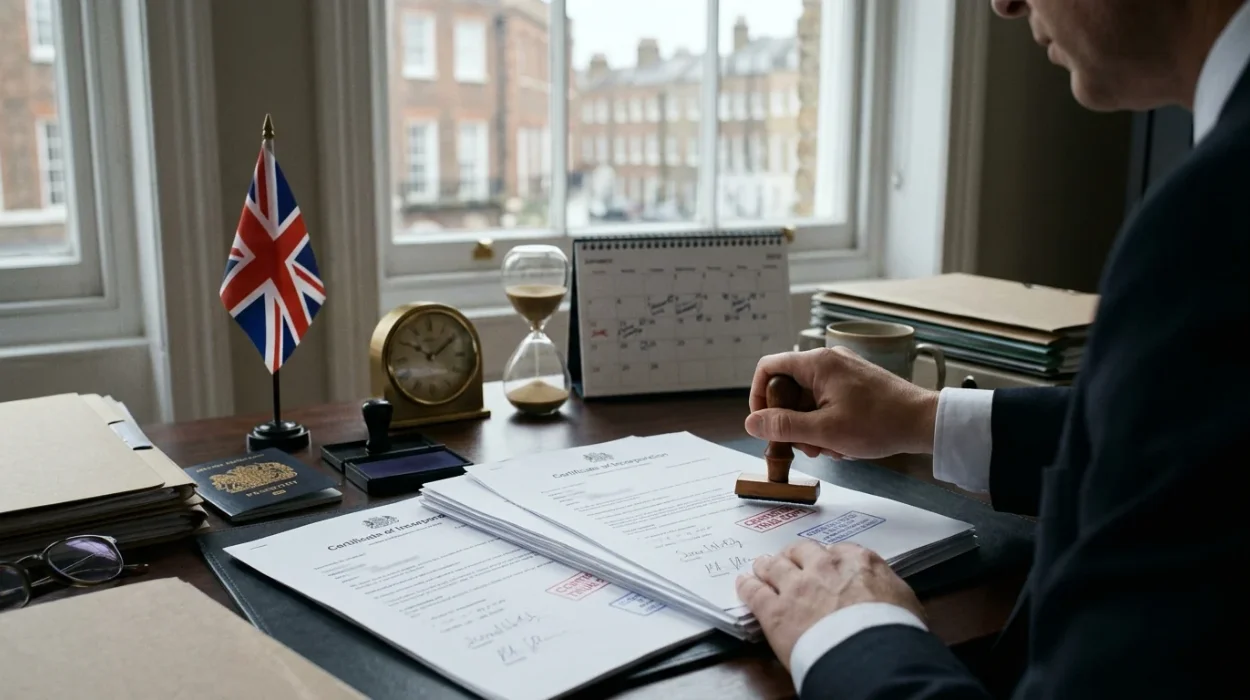
To prepare certified documents for a government tender bid, gather original corporate records, obtain verification from a UK solicitor or notary public, confirm legal apostille requirements, and submit tamper-evident digital or physical copies before the bidding deadline.
Why Is Document Certification Required in Public Sector Procurement?
Public sector buyers require document certification to verify corporate identity, prevent procurement fraud, ensure financial solvency, and confirm statutory compliance under UK regulations.
Procurement authorities review legal status during the initial Selection Questionnaire stage. Uncertified documents create legal liabilities for contracting authorities. Contracting officers validate company registration details against official databases. Certified corporate documents confirm that a business operates as a registered legal entity. Official verification protects public funds from fraudulent applications.
Authorities evaluate corporate stability before issuing public contracts. Certified financial statements provide evidence of trading capability and solvency. Procurement panels reject bids containing unverified financial claims. Certification legally binds corporate officers to the accuracy of submitted financial records.
Public sector contracts enforce mandatory compliance standards across supply chains. Certified documents prove adherence to anti-money laundering regulations, tax obligations, and data protection laws. Solicitors and regulatory bodies stamp these records to confirm legal authenticity. Contracting authorities rely on these certified papers to establish risk profiles for competing suppliers.
What Documents Are Required for a Government Tender Application?
Government tender applications require certified Certificate of Incorporation, Articles of Association, audited financial accounts, VAT registration certificates, and active director identification records.
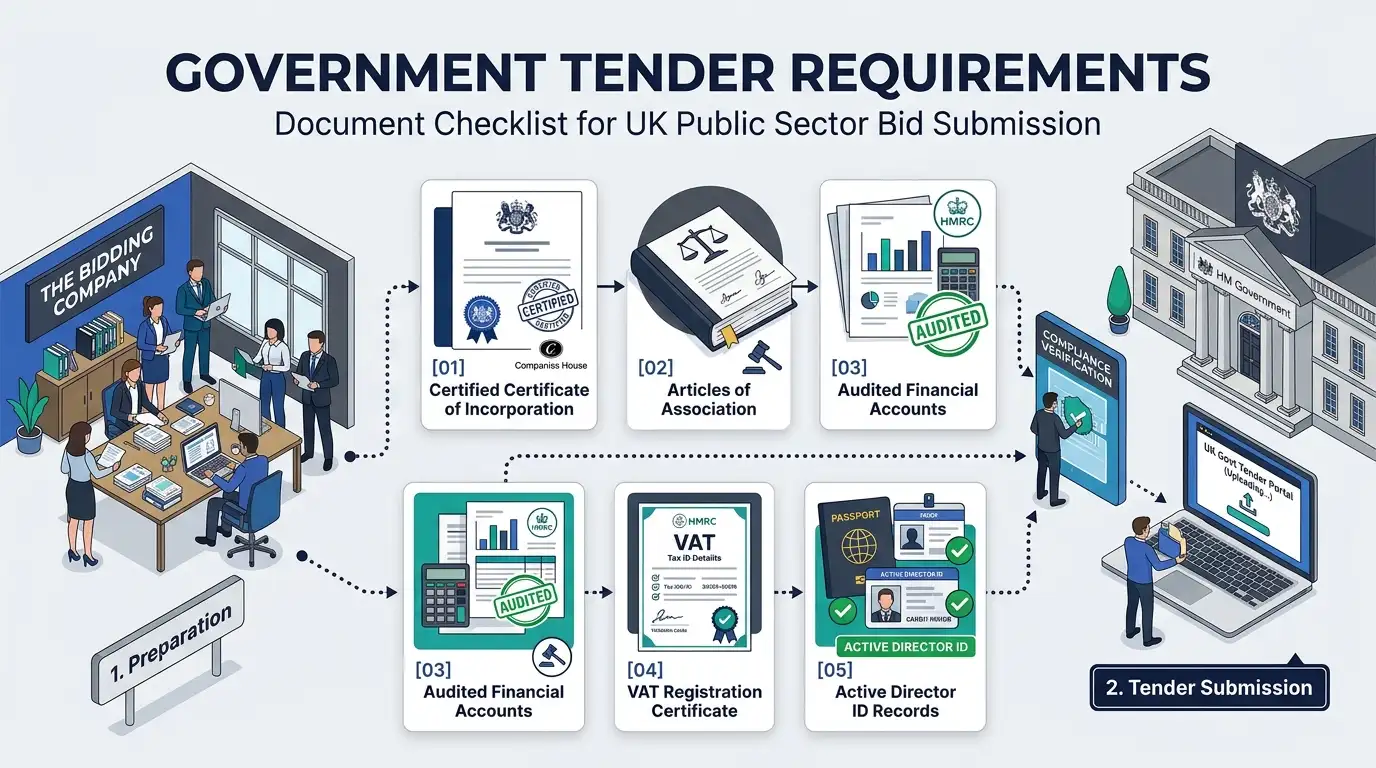
Public buyers evaluate corporate identity through baseline incorporation records. The Certificate of Incorporation establishes legal standing under the Companies Act 2006. Articles of Association define internal governance and director authorization limits. Procuring entities analyze these constitutional records to verify legal capacity to contract.
Financial evaluation requires standardized balance sheets and profit-and-loss statements. Bidders submit two to three years of certified annual accounts. Startups provide opening balance sheets certified by qualified accountants. Financial certification confirms cash flow stability and risk resilience.
Operational compliance mandates tax and insurance verification documents. Contracting officers inspect VAT certificates, Employers’ Liability Insurance policies, and Information Commissioner’s Office registrations. Certified compliance policies prove legal readiness to execute public sector contracts.
How Do You Certified Corporate Documents for a UK Tender?
You certify corporate documents by requesting official copies from Companies House, hiring a licensed UK solicitor or notary public for verification, and appending formal certification statements.
Document preparation begins with retrieving current corporate records from Companies House. Procurement teams pull official electronic PDF files or request printed certificates. Outdated records cause instant disqualification during preliminary compliance screens.
Licensed professionals inspect original records against true copies. A practicing UK solicitor or notary public examines each page. The certifying official writes a standard verification statement directly on the document. The statement confirms that the copy represents an accurate duplicate of the original record.
The certifying professional signs, dates, and stamps every document page. The stamp displays the individual’s full legal name, professional role, and regulatory registration number. Procurement portals reject submissions lacking clear professional credentials.
How Does Foreign Document Authentication Work for International Bidders?
Foreign document authentication requires legal translation by certified translators, notary verification in the country of origin, and an Hague Apostille certificate issued by the Foreign, Commonwealth & Development Office.
International companies face multi-layered authentication checks when entering UK public tenders. Non-English records mandate official translation by accredited language professionals. Translators attach a signed certificate of accuracy detailing their credentials. Contracting authorities reject uncertified translations.
The Hague Apostille process validates foreign legal documents across international borders. The Foreign, Commonwealth & Development Office issues apostille certificates for UK-bound filings. The apostille verifies the authenticity of the legal seal and signature of the issuing official.
Consular legalization applies when non-Hague Convention countries participate in tender procurement. Foreign embassies authenticate notary seals before document submission. Bidders must schedule legalization early because foreign processing timelines vary significantly.
How Do You Submit Certified Digital Documents to Procurement Portals?
You submit certified digital documents by converting verified papers into high-resolution, text-searchable PDFs, applying cryptographic digital signatures, and uploading files directly to official procurement portals.
Digital submission requires clear scanning protocols. Operators scan physical certified documents at 300 dots per inch in color. High-resolution scans preserve notary stamps, watermarks, and verification signatures. Low-quality scans cause portal rejection.
Digital signatures secure file integrity during transmission. Procuring entities specify Qualified Electronic Signatures compliant with eIDAS regulations. Electronic signatures prevent unauthorized document alterations post-certification.
Naming conventions determine document traceability inside procurement portals. File names must contain the bidder name, document type, and tender reference number. Clear file organization speeds up procurement panel evaluation.
What Common Certification Errors Cause Tender Disqualification?
Common certification errors include expired notary stamps, missing page signatures, uncertified translations, unverified document copies, and incorrect legal entity names.
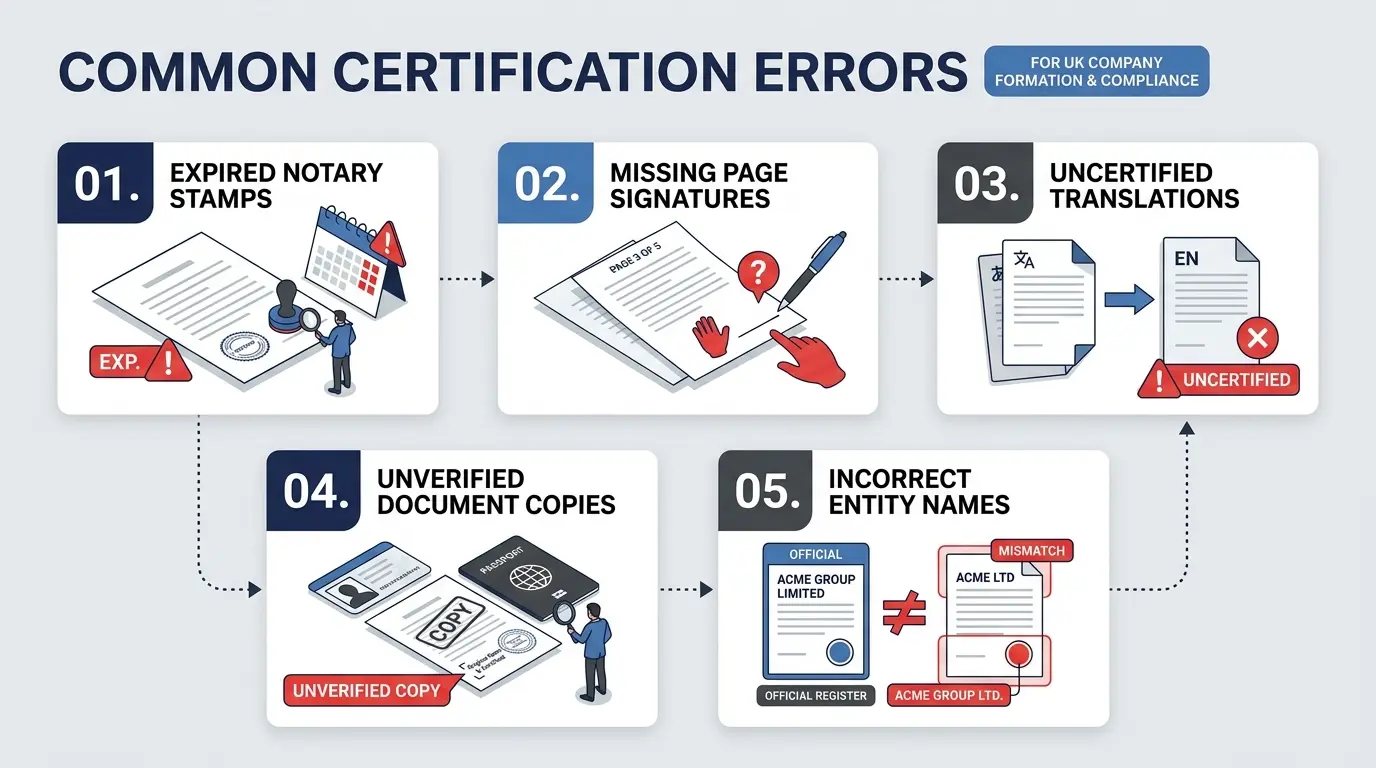
Timing errors invalidate legal certifications. Procurement frameworks stipulate that certified documents must be dated within 30 to 90 days of submission. Submitting outdated certificates leads to automatic administrative rejection.
Partial document certification fails legal compliance checks. Certifying officers must sign every page of multi-page corporate documents. Unsigned pages invalidate the entire certified package.
Name discrepancies create corporate identity conflicts. When corporate names change, companies must attach official name change certificates. Contracting officers disqualify bids showing mismatched legal entity names.
How Can Businesses Streamline Tender Document Preparation?
Businesses streamline tender document preparation by maintaining centralized corporate repositories, securing pre-certified document packages, and partnering with professional company document providers.
Maintaining an updated compliance vault eliminates rush preparation risks. Companies maintain digital repositories containing verified corporate filings. Document managers review vault assets quarterly to refresh expired items.
Standardized certification templates accelerate solicitor review times. Legal teams draft approved certification language matching public sector standards. Pre-formatted templates reduce administrative costs and processing delays.
Outsourcing document management simplifies procurement readiness. When preparing complex bids, organizations order specialized supplementary company documents to satisfy stringent tender specifications without internal operational bottlenecks. Experienced corporate service providers deliver correctly stamped, compliant filings aligned with public sector requirements.
Before entering competitive tenders, companies must review why public sector tenders ask for certified company documents to structure their compliance strategy effectively. Obtaining verified corporate filings early ensures seamless qualification during the Selection Questionnaire phase.
To ensure compliance across all bidding stages, organizations can get tender-ready certified formation documents from Form My Company to secure official, fully authenticated filings built for public sector evaluation. Form My Company handles certified document preparation, legal authentication, and official corporate filings, enabling businesses to submit fully compliant tender applications on time.
Explore More Supplementary Company Documents Guide,
How to Get All Your Formation Documents Certified in One Bound Pack
How to Pass Merchant Account KYC With Your Incorporation Certificate
Frequently Asked Questions
How do I get certified supplementary company documents in the UK?
You can order certified supplementary company documents directly through Form My Company by selecting the required corporate filings on our official portal. Our service manages the retrieval, legal certification, and official notary stamping of documents such as Certificates of Good Standing and Memorandum of Association. The certified documents are then delivered digitally or by physical mail to meet official compliance requirements.
What are supplementary company documents used for in government tenders?
Supplementary company documents provide official proof of a business’s legal standing, corporate structure, and statutory compliance during public sector bidding processes. Contracting authorities require certified records—including Articles of Association and Change of Name Certificates—to verify director credentials and prevent fraud. Form My Company assists businesses by preparing fully authenticated supplementary corporate records tailored for tender applications.
Which supplementary company documents do I need for business verification?
Business verification generally requires a Certificate of Incorporation, Articles of Association, annual financial returns, and a Certificate of Good Standing. Banks, legal bodies, and procurement panels review these supplementary company documents to confirm that an entity is actively registered with Companies House. Form My Company provides legal copies and official apostille services for all standard corporate documentation.
How long does it take to obtain certified corporate documents from Companies House?
Standard processing for official corporate records typically takes between 3 to 5 working days, while express options can deliver authenticated files within 24 hours. Form My Company expedites the retrieval and certification of supplementary company documents to ensure tight tender deadlines are met. Delivery times vary depending on whether physical solicitor apostilles or digital PDF certifications are required.
Can international businesses use UK supplementary company documents for overseas tenders?
Yes, UK-registered entities can submit supplementary company documents internationally once they are legalized via a Hague Apostille or consular authentication. Foreign government bodies and procurement boards require an official seal from the Foreign, Commonwealth & Development Office (FCDO) to validate UK legal records. Form My Company manages the entire international document authentication process, ensuring compliance with global regulatory standards.