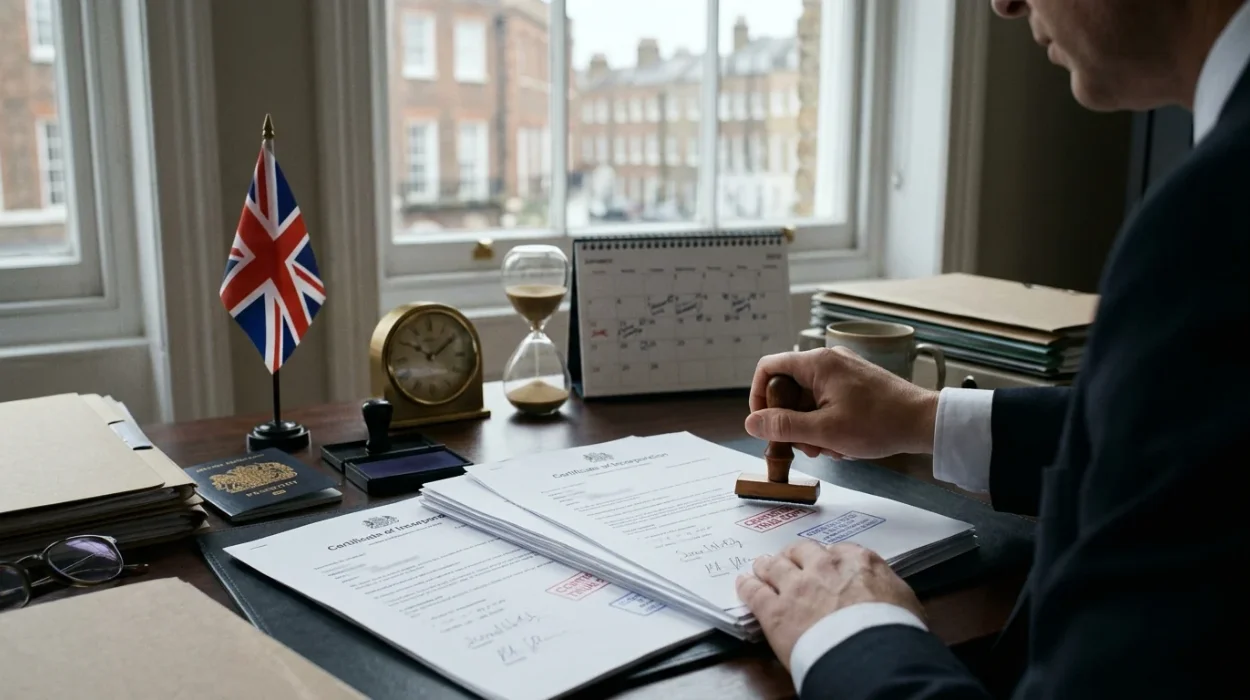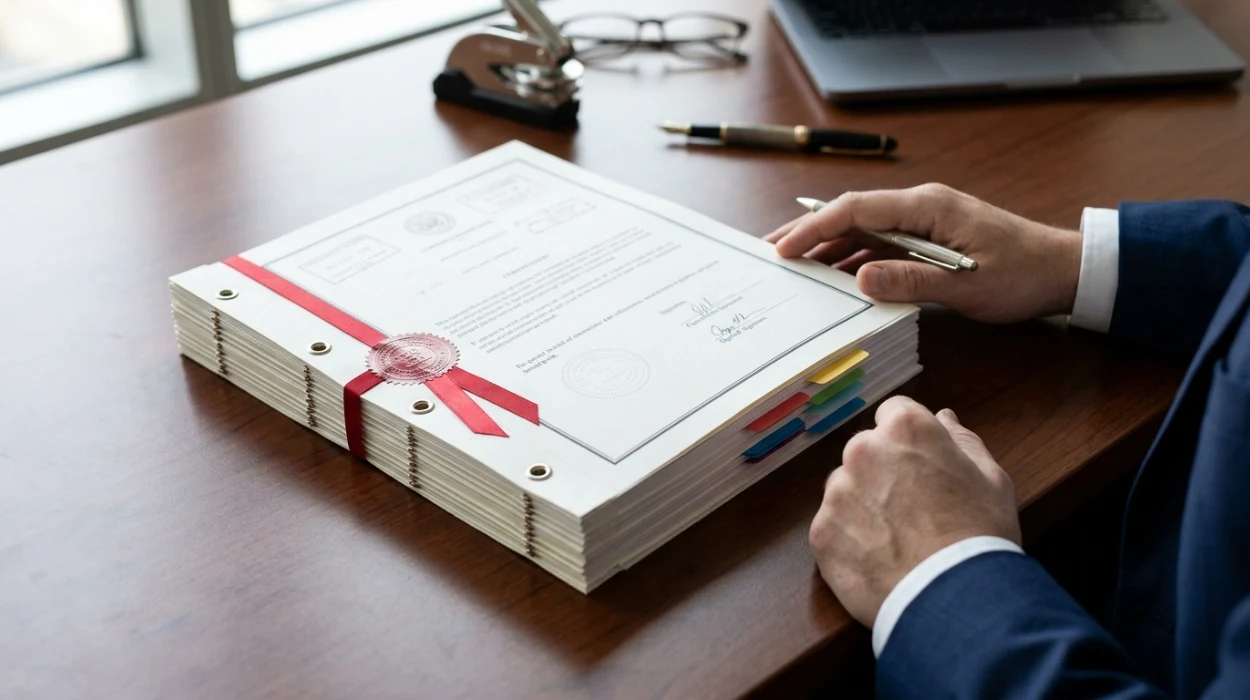
You can get all your formation documents certified in one bound pack by ordering a bound set of official UK incorporation papers through a corporate service provider or solicitor, who verifies the documents, applies an official certification stamp, and permanently binds them into a single legal pack.
What Is a Certified Bound Pack of Formation Documents?
A certified bound pack is an officially verified collection of UK company formation documents permanently fastened together under a single certification statement to prove a company’s legal registration, corporate structure, and current legal standing to external authorities.
Companies House issues individual digital or paper incorporation certificates when a business registers in the UK. International banks, foreign governments, and financial institutions frequently require physical proof of these corporate credentials. A bound pack consolidates your Certificate of Incorporation, Memorandum of Association, and Articles of Association into one physical unit.
A UK solicitor, notary public, or authorized corporate services agent inspects the original registry documents. The certifier attaches a cover sheet that confirms the authenticity of every enclosed page. The legal professional then uses secure binding tape, eyelets, or ribbon seal to bind the pages permanently.
This binding prevents unauthorized page insertion or removal. Legal systems recognize this single certified unit as a complete legal document. Consolidating your corporate papers into one bound pack reduces administrative costs compared to certifying each page individually.
Why Do Businesses Need a Bound Pack of Certified Documents?
Businesses need a bound pack of certified documents to satisfy strict overseas compliance requirements, open international business bank accounts, register foreign corporate branches, establish overseas trading partnerships, and complete high-value cross-border transactions.
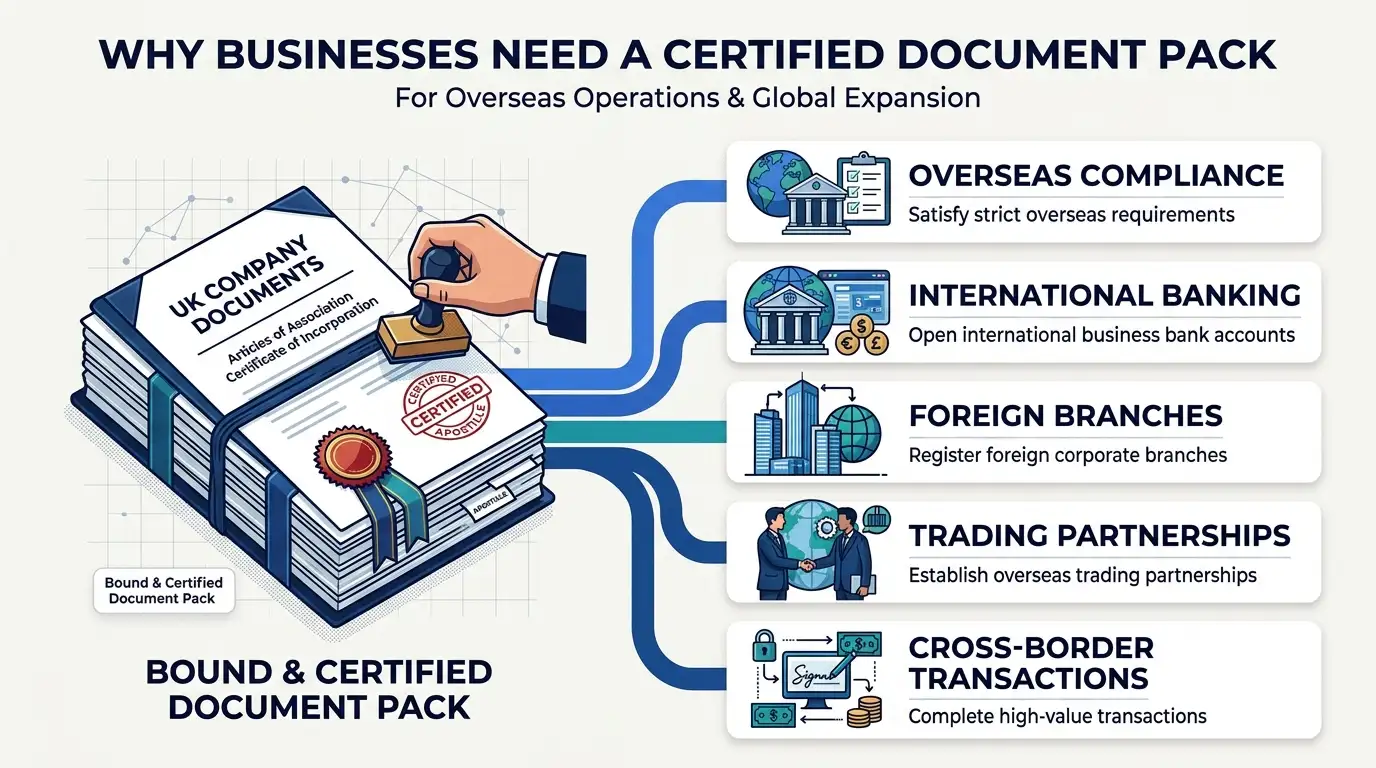
Overseas financial institutions operate under strict anti-money laundering regulations. International compliance departments require verified proof of corporate existence before opening corporate accounts. Presenting loose, uncertified copies leads to immediate application rejection. A certified bound pack proves that your corporate structure complies with UK law.
Foreign government agencies demand certified corporate records during branch registration. Authorities in jurisdictions like Dubai, Europe, and the United States require official verification of ownership structures. The bound format guarantees that no structural pages, such as specific Articles of Association clauses, were omitted during submission.
Overseas commercial property owners and enterprise clients demand certified documents before executing major contracts. Presenting a bound pack demonstrates high corporate transparency and legitimacy. Overseas registries often require this consolidated format before applying an official Hague Apostille certificate.
Which Documents Are Included in a Certified Bound Pack?
A certified bound pack includes the Certificate of Incorporation, Memorandum of Association, Articles of Association, register of directors, statement of capital, and official confirmation statements that detail current beneficial ownership.
The Certificate of Incorporation serves as the primary legal evidence of company creation. It displays the unique company registration number, official corporate name, date of incorporation, and governing jurisdiction. This document forms the top layer of your bound compliance pack.
The Memorandum of Association records the initial subscribers who agreed to form the company. The Articles of Association define the internal operating rules, voting rights, and share transfer restrictions. Including both governance documents ensures full legal transparency for overseas reviewing officers.
Recent filings complete the corporate profile. The pack incorporates current registers of directors, company secretaries, and Persons with Significant Control (PSC). If you recently updated company details, what are company formation documents and what do they include? answers how recent filings alter your core documentation set.
How Does the Certification and Binding Process Work?
The process involves retrieving official registry records, verifying document authenticity against Companies House data, compiling the required pages, applying a formal legal certification statement, and permanently binding the physical pack.
The process begins by extracting official digital documents from the UK public register. The certifying official compares these printouts directly against official Companies House database records. This verification ensures that the information matches current public records exactly.
The certifier prepares a formal cover sheet once verification concludes. This cover sheet contains specific legal wording that confirms the enclosed documents represent true copies of official records. The legal professional signs the sheet, prints their official credentials, and stamps the document with their firm’s seal.
The certifier aligns all pages and applies permanent legal binding across the left margin or top corner. The binding method uses tamper-evident tape, metal eyelets, or traditional legal ribbon. Removing any single page damages the binding material, which immediately voids the legal certification.
How Do You Choose Between Individual Certification and a Bound Pack?
You choose a bound pack when submitting multiple formation documents to a single authority to minimize legal fees, whereas you choose individual certification when different receiving parties require separate single documents.
International recipients usually specify their preferred certification format. Overseas banks, tax authorities, and foreign courts typically demand bound packs to review complete corporate structures. Submitting separate loose pages increases the risk of lost paperwork during international transit.
Cost considerations heavily influence this choice. Solicitors charge individual certification fees per document. Certifying four separate formation documents creates four distinct professional fee charges. A bound pack applies a single certification stamp to the entire collection, which lowers legal costs significantly.
Legal flexibility determines the final approach. If a foreign registry only requires a Certificate of Incorporation, an individual certified copy suffices. When a transaction requires full constitutional documentation, ordering a bound set through Supplementary Company Documents provides a complete, cost-effective compliance package.
What Is the Difference Between Certification and Apostille Legalisation?
Certification is the formal verification of document authenticity by a licensed solicitor or notary, while Apostille legalisation is official government authentication by the UK Foreign, Commonwealth & Development Office for international use.
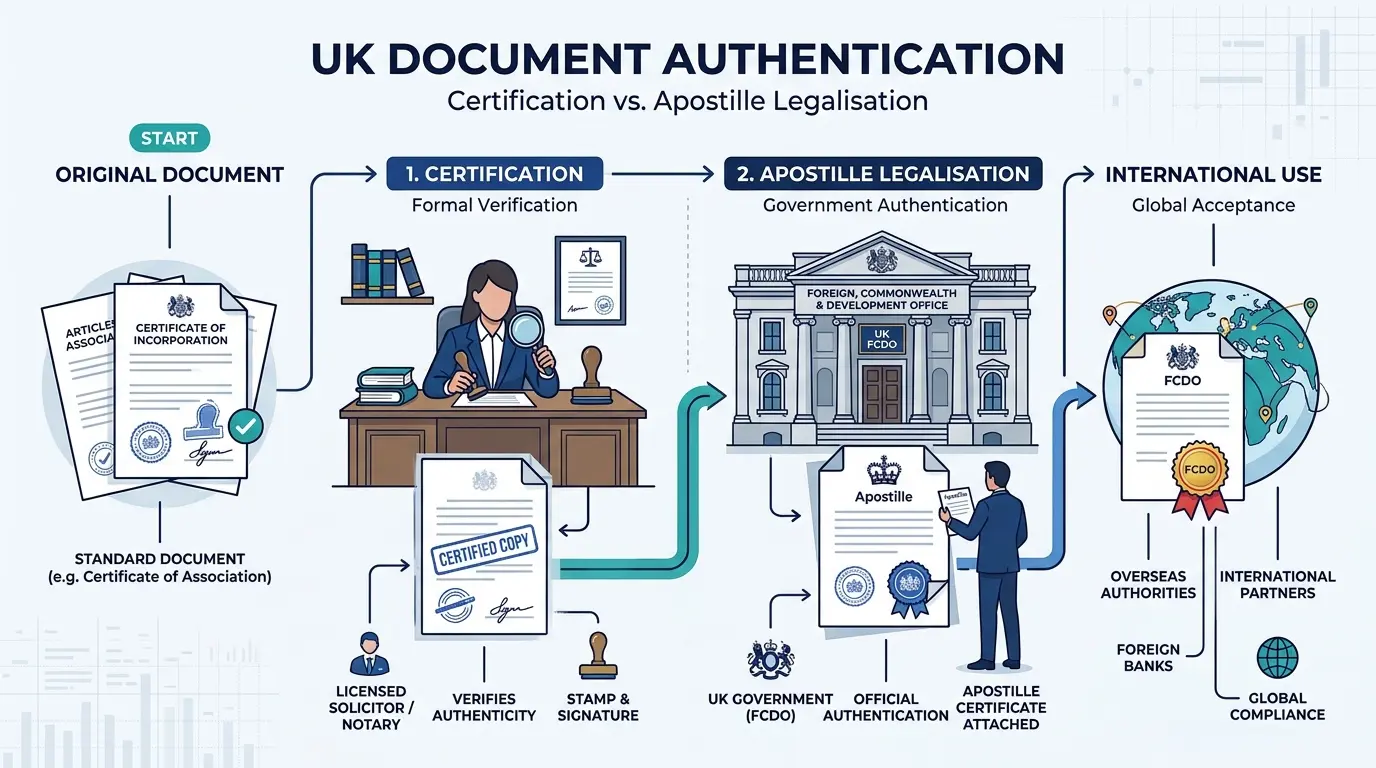
Solicitor certification acts as the mandatory first stage for international legal recognition. A UK lawyer examines the corporate papers and signs them to confirm their authenticity. However, foreign governments cannot independently verify individual UK solicitor signatures without official state endorsement.
Apostille legalisation provides this government endorsement under the Hague Convention of 1961. The UK Foreign, Commonwealth & Development Office (FCDO) checks the practicing status of the certifying solicitor. The FCDO then attaches an official Apostille certificate to the back of the bound pack.
Certain non-Hague Convention countries require an additional step called embassy legalisation. The destination country’s UK embassy inspects the FCDO Apostille stamp and adds their consular seal. Binding all papers into one pack ensures you pay only one FCDO Apostille fee instead of multiple individual government fees.
How Can You Order a Certified Bound Pack Online?
You can order a certified bound pack online by selecting a professional company formation provider, entering your UK company registration number, specifying required documents, and choosing your delivery address.
Online ordering platforms streamline the verification workflow. You enter your official UK company name or eight-digit company number into the order system. The automated platform retrieves your official company filings directly from Companies House records.
You select the bound pack option during the checkout process. You can add extra services such as FCDO Apostille legalisation or international courier delivery. Professional providers verify your details against current compliance standards before sending the file to their legal team.
The legal team prints, verifies, certifies, and binds your document pack. The provider dispatches the physical bound pack directly to your business address or overseas recipient. If you require swift international delivery, order certified company formation documents from Form My Company to secure fully verified bound corporate papers.
Obtaining a certified bound pack of company formation documents simplifies international compliance and legal verification. Consolidating your Certificate of Incorporation, Memorandum, Articles of Association, and statutory registers into a single bound document ensures full acceptance by foreign banks, registries, and courts. This unified format reduces legal certification fees and prevents document tampering. Form My Company manages the entire compilation, professional solicitor certification, and binding process to deliver fully compliant legal packs tailored for global business expansion.
Explore More Supplementary Company Documents Guide,
How to Pass Merchant Account KYC With Your Incorporation Certificate
How to Correct Errors on Your Company Incorporation Records
Frequently Asked Questions
What are supplementary company documents for a UK business?
Supplementary company documents are official legal filings beyond the basic Certificate of Incorporation, including certified copies of Articles of Association, confirmation statements, and change of name certificates. Businesses order these records through Form My Company to satisfy regulatory requirements, conduct due diligence, and present verified corporate proof to financial institutions.
How do I order certified copies of my company formation papers?
You can order certified copies of your company formation papers online by providing your registered company name or eight-digit company number to a corporate service provider. Form My Company retrieves official registry filings from Companies House, certifies their accuracy through legal professionals, and delivers bound or standalone physical copies required by overseas authorities.
Why do banks require certified supplementary company documents?
Financial institutions require certified supplementary company documents to complete mandatory anti-money laundering (AML) and Know Your Customer (KYC) identity verifications before opening business accounts. Obtaining certified statutory records through Form My Company’s Supplementary Company Documents service proves current legal standing, ownership structures, and official director authorization.
What is the difference between standard and certified company documents?
Standard company documents are basic unverified printouts or digital PDFs downloaded directly from public corporate registers. Certified company documents feature an official legal endorsement, signature, and stamp from a solicitor or corporate registrar confirming the paperwork represents an authentic, tamper-evident record of official UK company filings.
Can supplementary company documents be legalised with an Apostille?
Yes, supplementary company documents can be legalised with a UK Foreign, Commonwealth & Development Office (FCDO) Apostille for international legal recognition. Form My Company coordinates solicitor certification and Apostille legalisation to prepare official corporate papers for foreign embassies, overseas bank account openings, and international branch registrations.