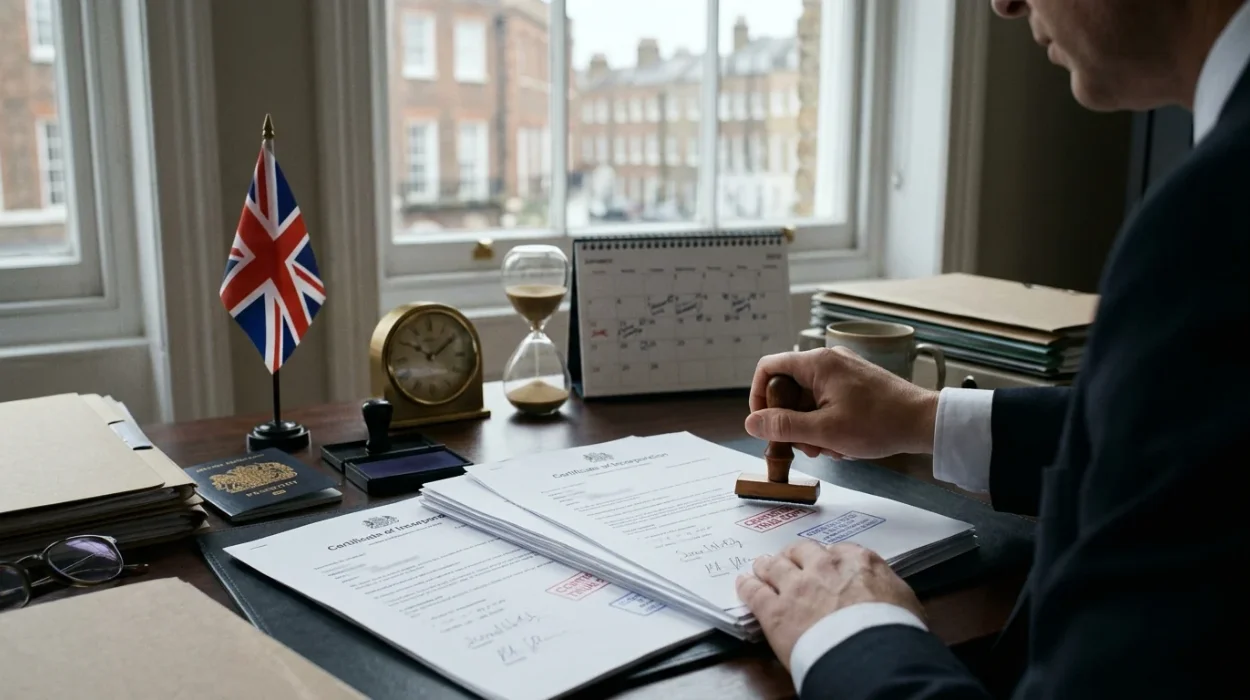
Public sector tenders require certified company documents to verify a bidding business’s legal existence, financial standing, and operational legitimacy. Certification proves that submitted corporate records match official Companies House registers, reducing fraud risks and ensuring compliance with UK procurement regulations.
What Are Certified Company Documents in UK Procurement?
Certified company documents are official corporate records that an authorized professional or government registry has validated as true copies of the original filings. Public procurement authorities rely on these verified records to establish corporate authenticity.
Public sector procurement teams manage significant public funds. They must ensure that every bidding entity operates legally within the UK. Certified documents serve as legal proof that a business entity exists in good standing. Procurement officers evaluate these records to confirm director identities, registered office addresses, and share capital structures. Uncertified copies do not carry the same legal weight during compliance checks. Bidding organizations must supply authenticated paperwork to meet mandatory threshold requirements.
Official certification verifies that corporate documents match the records held at Companies House. Contracting authorities examine certificate details to identify ultimate beneficial owners and regulatory compliance histories. Standard business documents without official stamps or signatures fail initial compliance screening. Procurement regulations require strict evidence to prevent fraudulent entities from securing government contracts. Obtaining official verification ensures that your submission advances to the technical evaluation stage without disqualification.
Why Is Document Verification Mandatory for Government Tenders?
Document verification is mandatory because public authorities must comply with statutory procurement frameworks and prevent contract fraud. Strict validation protects public funds and ensures equal competition among legally compliant suppliers.
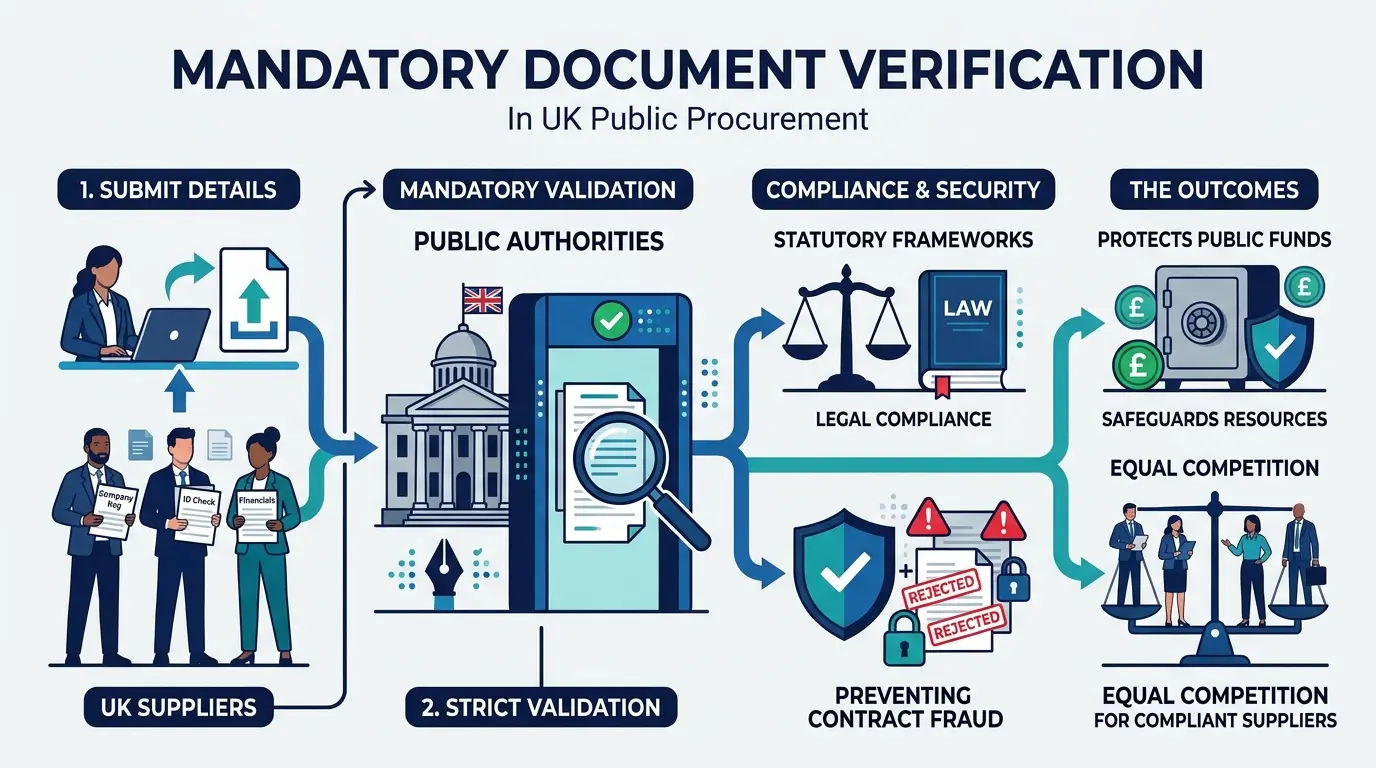
Government bodies operate under strict public procurement legislation. Regulations mandate thorough background checks on all potential contractors before contract award. Verification processes identify hidden corporate liabilities, improper registration details, or unauthorized business activities. Procurement teams analyze certified filings to confirm that bidding firms maintain active legal status. Failing to enforce strict document verification exposes public projects to operational failures and legal challenges from competing bidders.
Authenticating corporate filings reduces financial and reputational risks for government agencies. Public sector buyers must confirm that vendors possess the legal capacity to execute large-scale contracts. Verified documents reveal active director appointments, company solvency, and precise ownership percentages. This transparency ensures that contracting authorities partner exclusively with legitimate entities. Mandatory document validation establishes an accountable procurement environment across all government departments.
How Do Certified Documents Prove Corporate Legitimacy?
Certified documents prove corporate legitimacy by providing independent, third-party confirmation that a company’s legal filings are accurate, current, and legally binding. They validate official corporate standing with government registries.
Public sector buyers require definitive evidence of a company’s operational status. Certified Certificate of Incorporation documents prove that a business exists as a distinct legal entity. Certified Articles of Association confirm the internal governance rules and legal powers of the business. Official certification seals confirm that these documents represent the exact records filed with the statutory registrar. Independent verification removes doubts regarding document alteration or invalid corporate structures.
Contracting authorities examine verified company histories to assess organizational stability. Certified documents outline historical changes in company ownership, director appointments, and capital structure. This detailed record proves that a bidding firm maintains continuous compliance with corporate filing obligations. Legitimate companies readily demonstrate their standing through officially endorsed documentation. Presenting these validated files reassures procurement officers regarding your corporate integrity.
Which Specific Documents Do Public Sector Buyers Require?
Public sector buyers typically require certified copies of incorporation certificates, articles of association, confirmation statements, and official change of name certificates. These core filings validate total corporate identity.
Procurement specifications detail exact document submission requirements for every tender opportunity. Buyers examine four key corporate records during initial preliminary reviews:
Submit certified certificates of incorporation to prove initial legal registration
Provide verified articles of association to outline corporate authority limits
Supply current confirmation statements to demonstrate up-to-date registry filings
Attach official change of name certificates to verify historical identity updates
Procurement evaluators review these specific items to confirm that bidding entities meet all legal criteria. Submitting incomplete or uncertified variations results in immediate bid rejection.
Each required document serves a distinct validation function during the tender evaluation process. Certificates of incorporation establish official registration numbers and incorporation dates. Articles of association detail director powers and company execution protocols. Confirmation statements confirm current shareholder structures and active registered office addresses. Providing every required record in a certified format ensures full compliance with tender instructions.
What Is the Difference Between Standard and Certified Documents?
Standard documents are unverified copies that lack legal authentication, whereas certified documents bear official stamps, signatures, or digital validation from authorized bodies confirming their absolute accuracy.
Standard corporate documents are simple photocopies or downloaded digital files without formal endorsement. Anyone can edit or alter an uncertified electronic file using basic editing software. Public sector procurement departments cannot accept unverified paperwork due to severe risk management policies. Standard files lack the legally binding assurances required for high-value government contract awards. Bidding with uncertified paperwork creates immediate compliance failures during preliminary tender screening.
Certified documents undergo formal validation by authorized solicitors, notaries, or official registry officers. The certifying authority checks the document copy against official registry databases. They apply an official statement, date, signature, and professional seal to confirm validity. This process creates a legal audit trail that holds the certifier accountable for accuracy. Procurement officers accept certified documents because they provide undeniable proof of legal authenticity.
How Does Document Certification Prevent Tender Disqualification?
Document certification prevents tender disqualification by ensuring your bid meets all mandatory legal compliance gates before technical evaluations begin. Validated records eliminate administrative rejections.
Public sector tender evaluations follow a rigid two-stage selection process. Stage one focuses entirely on compliance, eligibility, and legal documentation checks. Procurement officers immediately disqualify bids that contain missing, unverified, or incorrectly formatted corporate filings. Disqualification at this stage prevents evaluators from reviewing your technical proposal or commercial pricing. Securing validated documents guarantees that your submission successfully passes preliminary administrative screening.
Administrative errors represent a leading cause of bidder rejection in UK public procurement. Contracting authorities must apply submission rules consistently across all competing contractors to avoid legal appeals. Evaluators cannot grant exceptions for uncertified paperwork under strict fairness guidelines. Proactively preparing authenticated filings protects your business investment in the bidding process. Ensuring full document compliance keeps your proposal active through final contract negotiations.
When Should Businesses Prepare Certified Files for Tenders?
Businesses should prepare certified files well before tender publications occur to avoid submission delays and compliance errors. Early preparation ensures immediate readiness when bidding portals open.
Public sector tender response windows are strictly time-limited, often closing within 30 days of publication. Requesting, certifying, and validating official records takes significant administrative lead time. Waiting for a tender announcement to order official paperwork creates unnecessary delivery risks. Procurement portals enforce absolute submission deadlines, refusing late file uploads without exception. Maintaining ready-to-use certified documents ensures seamless upload capabilities during active bidding periods.
Establishing an organized corporate document repository streamlines your overall tender response strategy. Businesses that bid regularly must maintain up-to-date authenticated records for immediate deployment. Reviewing document validity periods regularly prevents the submission of outdated corporate details. Utilizing professional supply services helps maintain a constant state of tender readiness. Bidders with pre-certified paperwork respond faster and avoid costly last-minute administrative errors.
To maintain continuous bidding readiness, businesses rely on expert solutions to source compliant corporate filings. Bidders streamline their tender preparation by ordering Supplementary Company Documents to receive fast, legally verified records for immediate submission.
How Do Certified Records Streamline Procurement Evaluations?
Certified records streamline procurement evaluations by enabling compliance officers to verify legal requirements quickly without conducting extended background investigations. Clear authentication speeds up evaluation timelines.
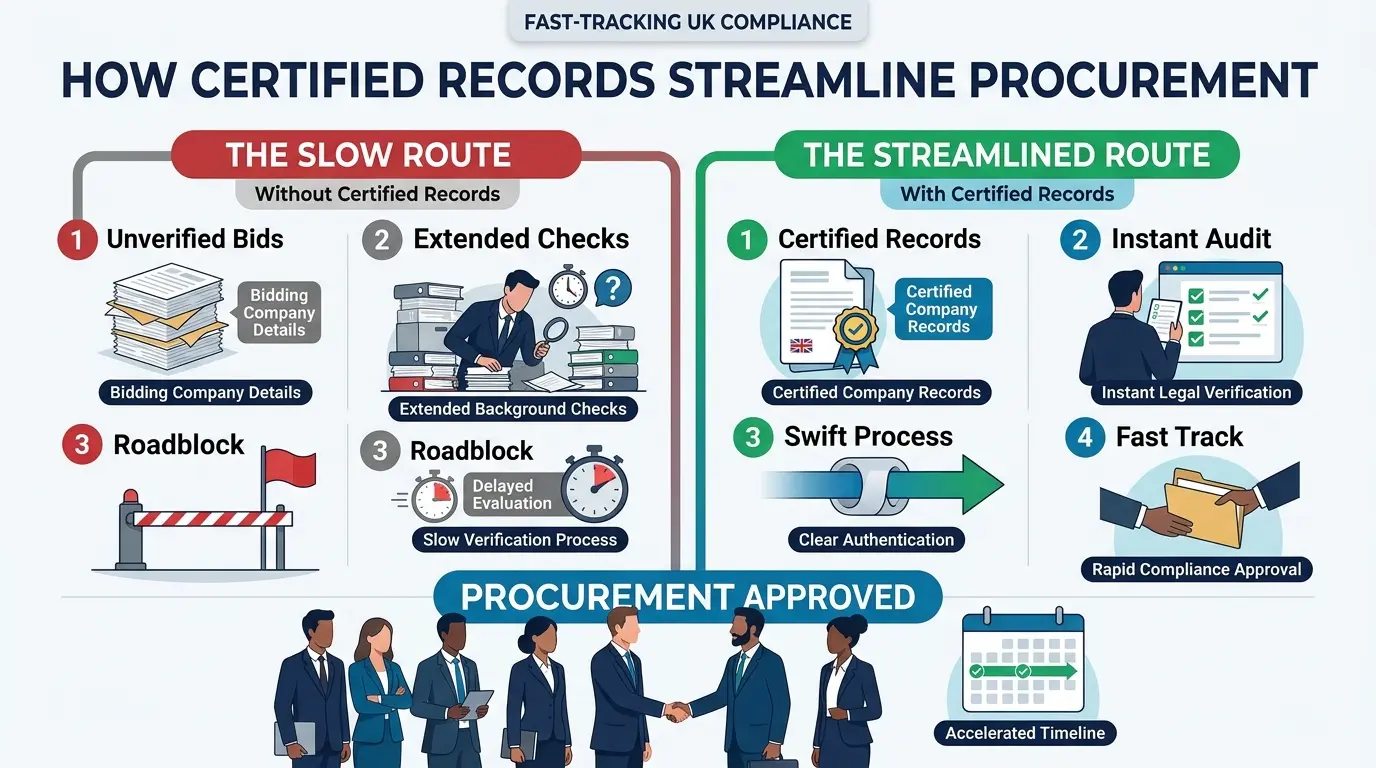
Procurement officers process hundreds of supplier applications during major tender exercises. Unclear or unverified corporate submissions force evaluators to pause reviews and issue formal clarification requests. Clarification processes create administrative friction and delay final scoring outcomes. Presenting clear, officially authenticated records allows evaluators to confirm legal eligibility instantly. Efficient verification moves your proposal smoothly into the scoring phase without administrative stalls.
Standardized certification markings allow evaluation teams to cross-reference corporate data against official UK databases effortlessly. Identity Verification Services validate director credentials using official UK compliance frameworks to confirm corporate governance standards. Clear documentation removes ambiguity regarding parent company structures, ultimate beneficial owners, and voting rights. Providing direct, transparent legal proof demonstrates operational maturity to public sector buyers. Efficient compliance reviews foster positive evaluator perceptions from the start of the tender review.
Proper document preparation requires following clear operational steps. When preparing your submission, review How to Prepare Certified Documents for a Government Tender Bid to structure your documentation accurately.
What Role Do Certified Documents Play in Contract Awards?
Certified documents play a critical role in contract awards by providing the final legal verification required before formal contract execution. Authorities require valid proof before committing public funds.
Passing technical and commercial evaluations does not guarantee final contract execution. Procurement rules require winning suppliers to complete final legal diligence checks before signing. Public authorities re-examine all corporate filings to ensure no legal changes occurred during evaluation periods. Submitting freshly certified records confirms that your corporate entity remains fully eligible for public funding. Validated documents provide the legal foundation for legally binding public sector contracts.
Failing final document checks at the award stage can result in contract cancellation and severe reputational damage. Public buyers will award contracts to second-place bidders if primary winners fail verification tests. Maintaining authenticated, pristine company files protects your status as the preferred supplier. Professional document support ensures that your corporate records remain legally sound throughout contract negotiations. Verified documentation secures your hard-won public sector business opportunities.
To ensure your filings meet all government standards without delays, Get Tender-Ready Certified Formation Documents From Form My Company and secure official authentication tailored for public sector submissions.
Public sector tenders require certified company documents to guarantee legal compliance, prevent corporate fraud, and protect public expenditures. Verified filings confirm your company’s official registration, operational stability, and governance structures to procurement evaluators. Sourcing authenticated records well in advance eliminates administrative rejections and keeps your bids competitive. Form My Company delivers fast, legally compliant certified corporate files designed to meet strict UK procurement standards. Partnering with Form My Company ensures your business maintains seamless tender readiness for every public sector opportunity.
Explore More Supplementary Company Documents Guide,
What Do Investors Look for in Your Articles of Association?
What Are the Share Transfer Rules in Articles of Association?
Frequently Asked Questions
What are supplementary company documents and why are they needed?
Supplementary company documents are official legal certificates and corporate records—such as Certificates of Good Standing, Articles of Association, and Change of Name certificates—that extend beyond standard incorporation files. Businesses require these authenticated records from Form My Company to prove legal standing, operational legitimacy, and compliance during public sector tender bids, bank account openings, and international contracts.
How do I get certified supplementary company documents in the UK?
You can order certified Supplementary Company Documents directly through Form My Company by selecting the specific corporate filings your business requires. Official registry copies are retrieved, verified against Companies House records, and certified by legal professionals to ensure full acceptance by UK contracting authorities and financial institutions.
Which supplementary company documents are usually required for government tenders?
Public sector procurement departments typically require certified copies of your Certificate of Incorporation, Articles of Association, current Confirmation Statement, and any official Change of Name certificates. Submitting these verified Supplementary Company Documents from Form My Company confirms your company’s legal existence, active status, and organizational structure during preliminary tender evaluation checks.
How quickly can Form My Company deliver certified corporate documents?
Form My Company offers fast processing for Supplementary Company Documents, delivering digital certified copies via email within 24 to 48 hours. Physical copies with official stamps or apostille certifications are dispatched quickly via tracked postal options to meet strict procurement and bidding deadlines.
What is the difference between standard Companies House documents and certified supplementary documents?
Standard corporate documents are unverified digital downloads or basic copies that lack formal legal endorsement, making them unsuitable for official procurement screening. Certified Supplementary Company Documents provided by Form My Company feature official stamps, signatures, or digital validation from legal authorities, guaranteeing their authenticity and compliance for high-value government tenders and legal matters.