
Regulators request certified company papers to verify a business’s legal existence, confirm accurate ownership details, prevent corporate fraud, and enforce compliance with national financial laws. Certified documents prove that official records match government registers exactly without unauthorized modifications or alterations.
When corporate entities operate in regulated industries, official monitoring bodies must validate the structural integrity of those businesses. Government databases like Companies House maintain master records, but third-party authorities need formal proof that an organization operates legally within set statutory frameworks. Certification bridges the gap between raw registry data and legally binding proof required for official applications.
Corporate governance frameworks rely on accurate documentation to mitigate financial crime and maintain market transparency. Independent verification prevents individuals from presenting forged, outdated, or altered corporate filings to financial institutions, courts, and foreign jurisdictions. By demanding verified papers, regulatory bodies establish a clear audit trail that links operating businesses directly to their registered officers and beneficial owners.
What Are Certified Company Papers in Corporate Governance?
Certified company papers are official corporate documents verified by a solicitor, notary public, or registry official as true copies of the original records filed with Companies House. They confirm legal status, corporate structure, officer identities, and statutory compliance.
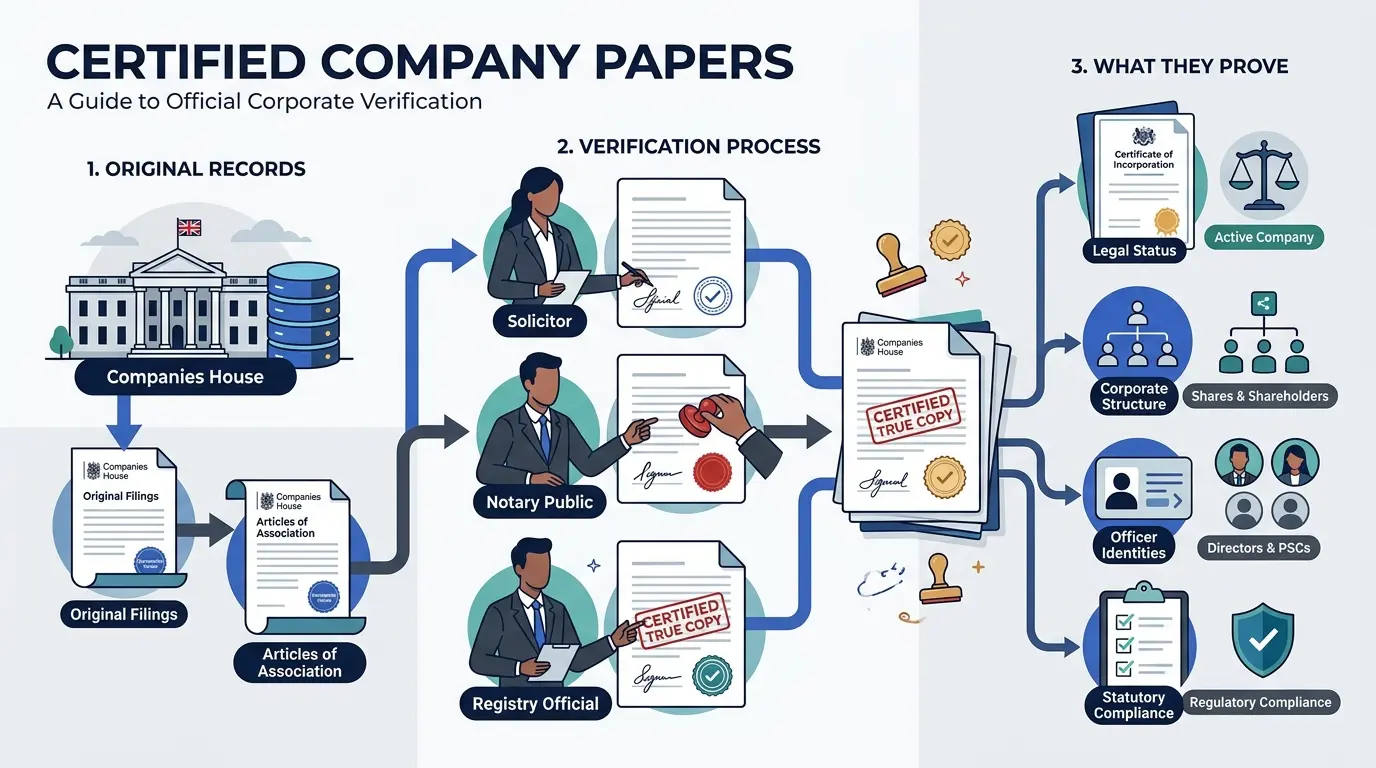
Official corporate records include articles of association, certificates of incorporation, filing histories, and register extracts. These items contain essential legal details regarding share allocations, director appointments, and registered office addresses. When a qualified professional signs or stamps these filings, the paperwork transitions from a basic printout to an authenticated document recognized by legal and regulatory frameworks globally.
Statutory authorities evaluate these authenticated files to verify that an organization adheres to ongoing administrative duties. Uncertified photocopies carry high risks of tampering, making them unacceptable for formal statutory reviews or international trade arrangements. Obtaining certified corporate records ensures that external stakeholders receive accurate information directly traceable to the official central register.
To support compliance workflows, businesses obtain Supplementary Company Documents to demonstrate legal standing and verified operational status to statutory bodies.
Why Do Government Bodies Need Verified Corporate Records?
Government bodies need verified corporate records to enforce statutory compliance, combat money laundering, validate beneficial ownership, and prevent corporate identity fraud. Certified paperwork ensures that regulatory agencies make decisions using legally binding data.
Regulators operate under strict legal mandates to ensure market integrity and protect public interests. When evaluating license applications, monitoring mergers, or inspecting financial activities, authorities require complete transparency regarding who owns and manages an enterprise. Verified paperwork ensures that bad actors cannot hide behind shell corporations or obscure management structures.
Systematic document checks protect national supply chains and financial markets from illicit capital flows. Verification frameworks demand that organizations substantiate every claim made on official applications. Using authenticated records streamlines cross-border enforcement, allowing foreign and domestic regulators to exchange reliable intelligence built on verified corporate facts.
Companies seeking regulatory approvals must compile their paperwork properly before submission. Learning how to prepare certified documents for regulatory applications reduces administrative rejections and speeds up approval timelines.
Which Regulatory Frameworks Require Certified Corporate Documentation?
Anti-money laundering legislation, banking compliance rules, international trade laws, and industry-specific licensing frameworks mandate certified corporate documentation. These legal structures require validated proof of identity, control, and operational legitimacy.
Financial sector oversight represents the primary driver for certified document requests. Under modern Anti-Money Laundering (AML) and Know Your Customer (KYC) regulations, banks and financial institutions must audit business clients thoroughly. They analyze three core documentation types: incorporation certificates, articles of association, and confirmation statements. Without certified copies, banks cannot open corporate accounts or execute international fund transfers.
Cross-border commercial operations also trigger strict documentation checks. When UK businesses set up foreign branches or submit bids for international tenders, foreign governments demand apostilled or legally certified incorporation papers. Similarly, specialized regulatory bodies supervising legal services, healthcare, and financial advice require verified proof of corporate structure before issuing professional operating licenses.
How Do Regulators Verify the Authenticity of Company Filings?
Regulators verify authenticity by checking professional stamps, reviewing notary certifications, cross-referencing Companies House digital registers, and inspecting security features like apostilles. These validation methods detect fraudulent alterations and confirm document accuracy.
Verification processes combine physical inspection with digital cross-checks against official databases. Official certifiers must state their legal capacity, sign the documentation, provide their professional contact details, and date the certification. Regulators contact certifying solicitors or notaries directly to confirm that the professional held an active practice license when authenticating the paperwork.
For international regulatory submissions, authentication requires higher levels of validation. The UK Foreign, Commonwealth & Development Office (FCDO) attaches an apostille certificate to confirm the signature and seal of the UK public official. This standardized validation procedure allows overseas regulatory authorities to accept UK corporate filings under the terms of the Hague Convention.
What Problems Arise When Uncertified Papers Are Submitted?
Submitting uncertified papers leads to application rejections, processing delays, statutory fines, operational suspensions, and heightened regulatory scrutiny. Regulators treat unverified filings as incomplete or potential fraud risks.
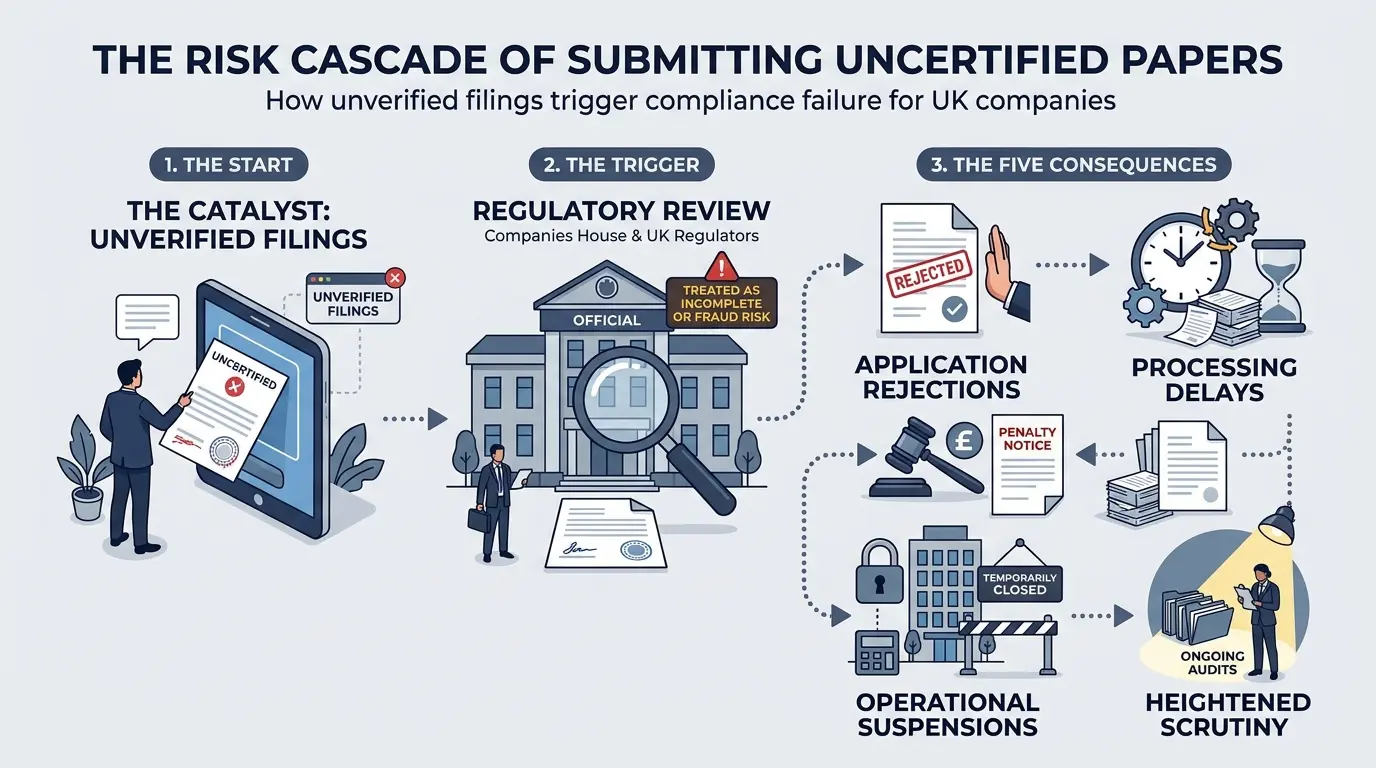
Regulatory agencies enforce zero-tolerance policies regarding missing or improper certifications. When an applicant provides standard photocopies instead of certified originals, processing portals automatically flag the file as non-compliant. This mistake halts licensing procedures, forcing companies to restart lengthy application cycles from the beginning.
Repeated submission of improper documentation damages a business’s reputation with statutory authorities. Regulators may list the company as a high-risk entity, triggering detailed investigations into its operational history and corporate governance practices. To avoid these operational delays, executives order regulator-ready certified documents from Form My Company to ensure their filings meet official statutory criteria on the first submission.
What Is the Process for Obtaining Certified Company Papers?
The process involves retrieving official records from Companies House, verifying the information against current entries, presenting the documents to a solicitor or notary, and applying official certification stamps.
Obtaining valid paperwork requires systematic administrative execution to avoid compliance defects. Executives must ensure that every corporate record reflects the most recent filings submitted to the public register. Any discrepancy between historical filings and active registry data causes immediate document invalidation during official review procedures.
The certification procedure requires specific legal phrasing written directly on the copies. The certifier writes a formal statement declaring that the document represents a true and accurate copy of the original record. When documents contain photographs of officers, the certifier must also confirm that the photograph provides a true likeness of the individual involved.
Regulators request certified company papers to maintain market integrity, prevent financial crime, and confirm the legal legitimacy of operating businesses. Authenticated documents provide official proof that a company’s structure, ownership, and operational history align with government records. Submitting certified filings prevents compliance rejections and protects businesses from operational disruptions. Form My Company assists organizations by delivering accurate, professionally verified corporate paperwork that satisfies strict regulatory standards.
Explore More Supplementary Company Documents Guide,
What Do Investors Look for in Your Articles of Association?
What Are the Share Transfer Rules in Articles of Association?
Frequently Asked Questions
What Are Supplementary Company Documents in the UK?
Supplementary company documents are official legal filings and certified extracts—such as Certificates of Good Standing, updated Articles of Association, and Share Certificates—that support primary incorporation records. These records verify a company’s ongoing legal status, corporate governance structure, and statutory compliance with Companies House. Businesses can request these authenticated records directly through the Form My Company Supplementary Company Documents service.
Why Do Regulators and Banks Require Certified Company Documents?
Financial institutions and regulatory authorities mandate certified company filings to verify corporate identity, prevent money laundering, and confirm active compliance under the Companies Act 2006. Certified copies prove that corporate structures, officer appointments, and share allocations match official public registers without alterations. Obtaining verified records through Form My Company ensures filings meet regulatory standards for compliance audits and corporate account openings.
What Is Included in a Supplementary Company Documents Pack?
A complete supplementary documentation pack typically includes official extracts such as Certificates of Good Standing, Certificates of Name Change, Memorandum and Articles of Association, and statutory register extracts. It may also contain recent Confirmation Statements, shareholder registers, and Persons with Significant Control (PSC) registers. Form My Company provides these comprehensive document bundles in both certified digital and physical hard-copy formats.
How Do You Obtain Certified Supplementary Corporate Documents for a UK Firm?
Companies can request official statutory extracts by submitting an order through a professional corporate service provider or directly via Companies House. Form My Company streamlines this retrieval process by sourcing, verifying, and certifying official corporate filings directly from central government databases. Certified paper copies are stamped by legal certifiers, while digital versions carry electronic verification for immediate use.
How Do Supplementary Company Documents Differ from Core Incorporation Files?
Core incorporation files establish a UK business’s legal existence at formation, whereas supplementary company documents reflect ongoing updates throughout the company lifecycle. While core registration papers remain static post-incorporation, supplementary extracts provide real-time proof of active status, officer modifications, and share capital changes. Form My Company helps limited companies maintain and access these evolving statutory records to ensure continuous compliance.