
Preparing certified documents for regulatory applications requires retrieving official corporate records, verifying director details against government databases, engaging qualified solicitors or notary public professionals for certification, and ensuring all notarised copies comply with strict statutory presentation standards established by UK regulatory bodies.
What Are Certified Company Documents in Regulatory Compliance?
Certified company documents are official business records verified, stamped, and signed by authorized legal professionals to confirm that the submitted copies represent true, complete, and untampered duplicates of original statutory files registered with Companies House and governing authorities.
Regulatory authorities demand verified corporate documentation to validate legal entity status during official filings. Businesses must submit authenticated copies of essential filings when applying for financial licenses, operating permits, or cross-border trade authorizations. Official entities including the Financial Conduct Authority, HM Revenue and Customs, and international trade registries maintain strict document standards.
Standard unverified copies fail to meet official compliance criteria. Authorized professionals—including practicing UK solicitors, public notaries, or chartered accountants—must physically inspect original records. The certifying officer adds an official statement, signature, registration number, and date onto each page. This authentication process protects regulatory frameworks from corporate fraud, identity spoofing, and falsified disclosures.
Certified filings usually include the Certificate of Incorporation, Memorandum and Articles of Association, confirmation statements, and registers of directors. When legal entities expand into international jurisdictions, authorities often require apostille legalisation on top of basic certification. Proper certification ensures immediate acceptance, preventing costly administrative delays or formal application rejections.
Why Do Regulators Require Certified Company Papers for Submissions?
Regulators require certified company papers to establish entity legitimacy, confirm active corporate standing, verify beneficial ownership structures, and prevent fraudulent applications through independent legal authentication performed by licensed regulatory professionals.
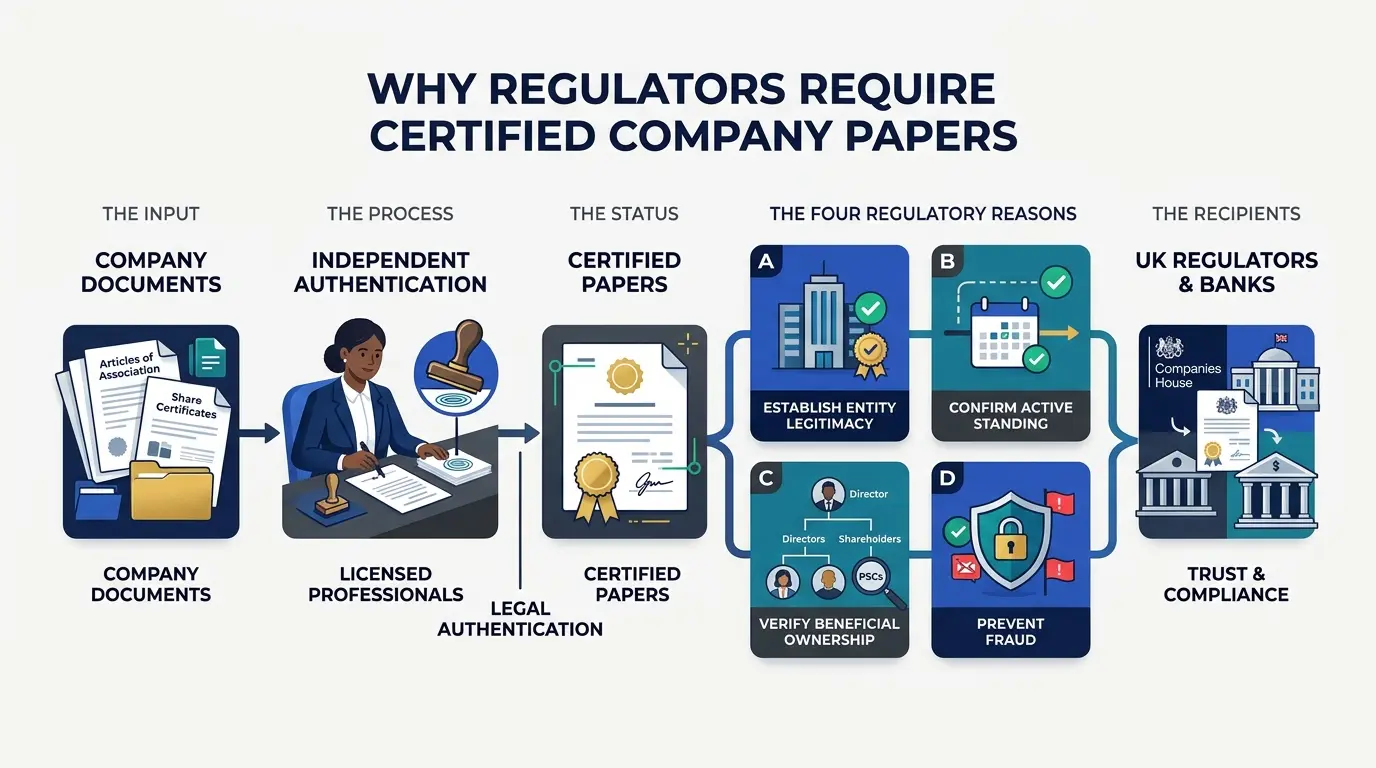
Statutory agencies must mitigate operational risk before issuing licenses or approving high-level corporate changes. In 2023, UK regulatory authorities flagged over 12,000 corporate filings due to verification errors or uncertified documentation. Requiring certified papers establishes a legally binding audit trail between the applicant entity and official government databases.
Certified filings validate critical corporate metrics for oversight bodies. Authorities review these files to verify voting rights, corporate ownership thresholds, officer appointments, and registered office addresses. Uncertified documents create legal liability because unauthorized actors could easily manipulate PDF records or alter shareholder details.
Furthermore, certified records satisfy anti-money laundering regulations and know-your-customer compliance frameworks. Financial institutions and government departments rely on authenticated documents to confirm ultimate beneficial owners. When corporate filings carry certified legal endorsements, oversight agencies process applications efficiently without initiating secondary identity investigations.
Which Essential Documents Require Formal Certification for Regulatory Review?
Essential documents requiring formal certification include Articles of Association, Certificates of Incorporation, shareholder registers, confirmation statements, official director registers, and financial statements required during formal regulatory evaluation processes.
Regulatory applications demand specific combinations of corporate documentation based on the licensing authority and industry sector. Knowing which papers require legal authentication prevents submission errors and shortens compliance timelines.
Key corporate records typically subject to certification standards include:
Obtain legal proof of incorporation through certified certificates from Companies House
Authenticate internal governance frameworks using signed Articles of Association
Confirm operational leadership using verified registers of directors and secretaries
Validate ownership distribution through authenticated shareholder registers and allotment records
Demonstrate ongoing compliance using recent statutory confirmation statements
Each document category proves a specific dimension of corporate structure. For example, banking regulators review share registers to trace parent entities and subsidiary ownership networks. Healthcare and gaming authorities inspect director details to conduct background checks. Submitting complete sets of legally certified documents ensures full transparency during regulatory reviews.
How to Prepare Certified Documents Step by Step?
Preparing certified documents involves gathering current Companies House records, reviewing details for accuracy, selecting an accredited legal professional, executing formal certification statements, and attaching necessary apostille legalisations for international regulatory bodies.
Step 1: Audit and Retrieve Official Corporate Records
Carefully audit your current company file on Companies House to confirm all records reflect up-to-date corporate details. Retrieve clean, high-resolution copies of required filings, ensuring no text, signatures, or official stamps are obscured.
Step 2: Select a Qualified Certifying Authority
Engage a practicing UK solicitor, notary public, or accredited commissioner for oaths authorized to verify business records. Ensure the legal professional holds active registration with relevant regulatory oversight bodies, such as the Solicitors Regulation Authority.
Step 3: Execute Formal Certification Endorsements
Present original or verified digital records to the legal professional for physical inspection. The certifier writes a formal declaration directly on the document, affirming it represents a true and accurate copy of the original record.
Step 4: Verify Certification Markings and Details
Check that each page contains the required legal elements: full name, signature, professional capacity, registration number, firm stamp, and date. Omission of any single detail can result in immediate rejection by regulatory caseworkers.
Step 5: Secure Apostille or Legalisation if Required
When submitting documents to overseas regulatory bodies, present the certified papers to the Foreign, Commonwealth & Development Office for apostille legalisation under the Hague Convention protocol.
What Common Certification Errors Cause Regulatory Rejections?
Common certification errors include using non-accredited certifiers, omitting mandatory legal declarations, submitting outdated statutory files, presenting low-resolution scans, and failing to secure required apostille attestations for cross-border applications.
Regulatory agencies enforce strict guidelines when reviewing corporate documentation. Even minor administrative oversights cause formal rejections, forcing businesses to restart complex application procedures from the beginning.
Frequent document preparation mistakes include:
Submitting outdated records that fail to reflect recent shareholder or director changes
Engaging non-accredited individuals who lack legal authority to certify corporate filings
Missing specific legal wording required by statutory oversight bodies
Providing incomplete multi-page documents missing crucial schedule attachments
Uploading low-resolution digital scans that obscure legal stamps or certifier signatures
To prevent these issues, companies must establish robust internal review protocols before submitting paperwork. When business teams need to verify complex corporate filings, choosing specialist support simplifies compliance workflows. You can order regulator-ready certified documents from Form My Company to ensure complete alignment with official statutory standards.
Understanding why regulators request certified company papers helps organizations maintain rigorous record-keeping practices. Implementing standardized preparation checks eliminates avoidable administrative errors and protects filing timelines.
How to Maintain Certified Document Validity for Future Filings?
Maintaining certified document validity requires establishing centralized document repositories, tracking expiration dates on time-sensitive filings, conducting routine statutory audits, and updating certified papers whenever corporate structures change.
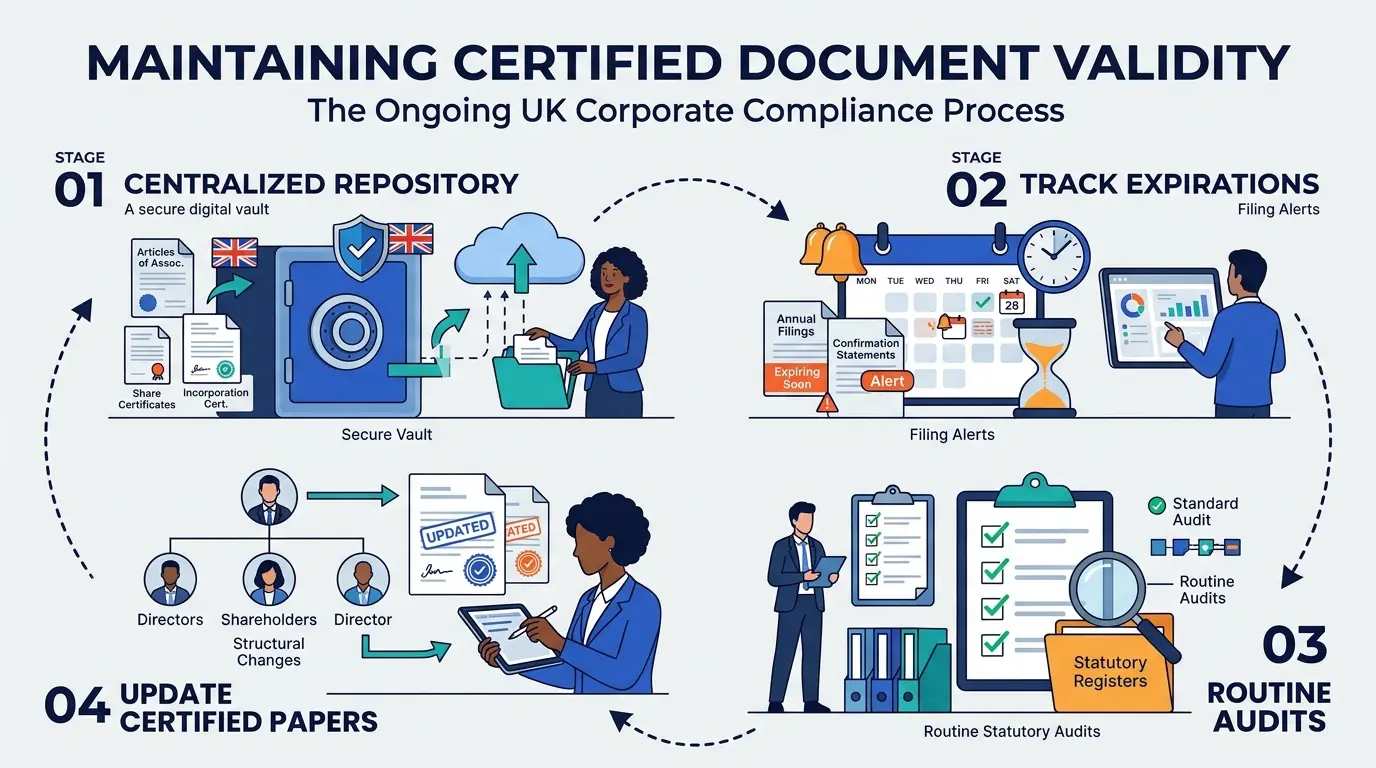
Certified documents maintain high credibility when backed by proactive corporate maintenance. Regulatory bodies frequently reject verified documents older than 3 to 6 months, particularly confirmation statements and registers of directors. Establishing structured compliance routines ensures organizations always maintain filing-ready documentation.
Create a secure digital vault to store certified master copies and original legal attestations. Store digital files in high-resolution vector formats to maintain legibility during electronic submissions. Categorize documents by date, regulatory purpose, and certifying officer to streamline administrative access across departments.
Monitor corporate changes continuously. When shareholders transfer equity, directors resign, or registered office addresses change, update Companies House records immediately. Request fresh certified copies following any material changes to ensure prospective regulators evaluate accurate entity information.
Organizations scaling operations often outsource complex statutory paperwork to dedicated specialists. Engaging professional assistance for supplementary company documents allows internal teams to focus on core operations while maintaining full regulatory compliance.
Preparing certified documents for regulatory applications requires meticulous attention to detail, strict compliance with statutory formatting rules, and verification by accredited legal professionals. By understanding document requirements, following structured preparation steps, and avoiding common certification errors, businesses successfully navigate complex regulatory reviews. Maintaining updated, pre-certified records ensures seamless operations, whether expanding domestic services or entering international markets.
Explore More Supplementary Company Documents Guide,
Solicitor Certification vs Notarisation: Which Does Your Company Need?
How to Prepare Certified Documents for a Government Tender Bid
Frequently Asked Questions
What are supplementary company documents for a UK limited company?
Supplementary company documents are official legal certificates and statutory filings—such as Certificates of Good Standing, amended Articles of Association, duplicate Certificates of Incorporation, and official director or shareholder registers—that detail a business’s current operational status. Form My Company provides these Supplementary Company Documents to verify corporate legitimacy during regulatory reviews, banking setups, and legal due diligence.
Why do UK regulators and banks require certified supplementary company documents?
Regulators and UK financial institutions require solicitor-certified supplementary company documents to verify active corporate standing, confirm beneficial ownership, and prevent identity fraud before issuing licenses or approving business bank accounts. Ordering verified files through Form My Company ensures each document includes an official solicitor statement, signature, and registration details required by compliance frameworks.
How quickly can a UK business obtain certified supplementary company documents?
Businesses can acquire digital or physical certified supplementary company documents through Form My Company in as little as 24 to 48 hours depending on whether standard or priority processing is chosen. Standard electronic copies from statutory registers are issued rapidly, while physical bound packs certified by a practicing UK solicitor are processed and dispatched directly to your registered UK address.
Which documents are included in a supplementary company document package?
A comprehensive supplementary company document package typically contains an updated Certificate of Incorporation, Memorandum and Articles of Association, statutory confirmation statements, and registers of directors or shareholders. Form My Company tailors these packs to match specific operational requirements, ensuring all constitutional filings reflect real-time records.
Do supplementary company documents expire for regulatory applications?
While statutory company records remain permanently valid on the public register, most UK regulators, lenders, and foreign authorities require supplementary company documents issued within the past 3 to 6 months to guarantee current compliance. Ordering fresh, updated extracts via Form My Company prevents administrative rejections caused by outdated corporate information during formal application reviews.