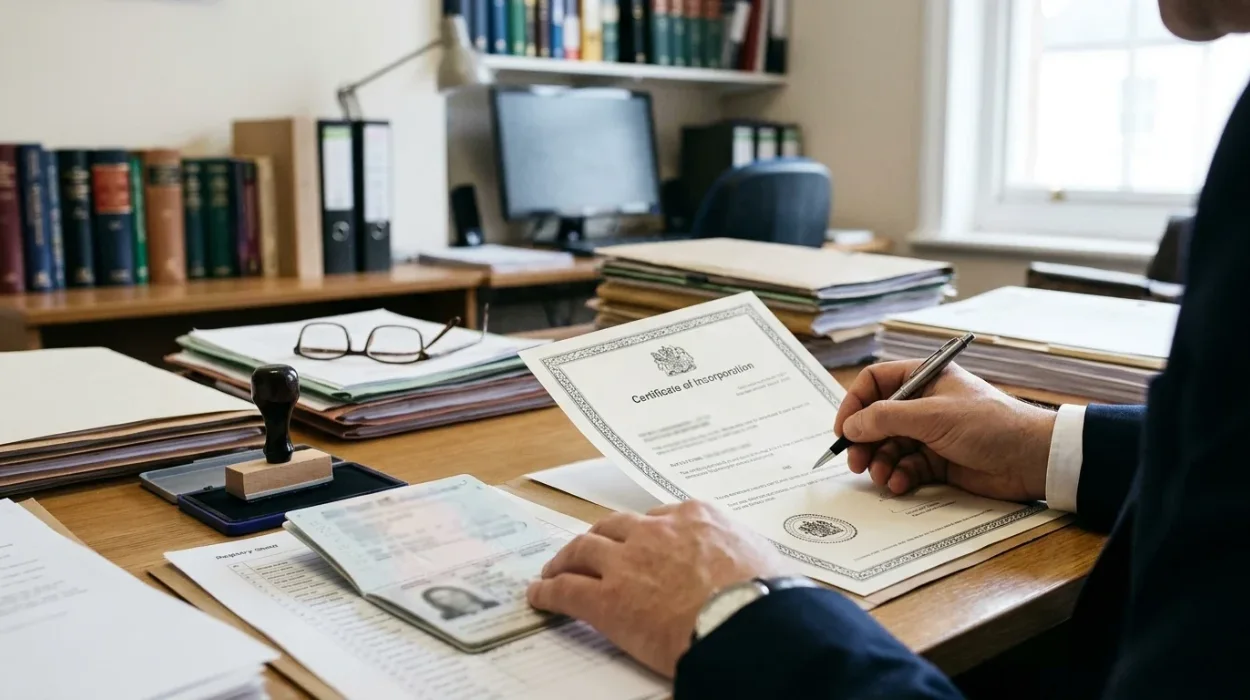
A solicitor verifies document authenticity, confirms original copy status, inspects director identity credentials, and cross-references Companies House records before certifying UK company documents. They validate signatures and ensure all statutory records meet strict anti-money laundering regulations.
certifying company documents requires rigorous regulatory checks under UK law. Solicitors act as legal gatekeepers to ensure public registers and financial institutions receive verified records. The certification process prevents corporate identity fraud, mitigates money laundering risks, and upholds corporate transparency.
Why Do UK Solicitors Inspect Company Documents Before Certification?
Solicitors inspect company documents to ensure legal validity, prevent corporate identity theft, and satisfy statutory Anti-Money Laundering regulatory standards. This verification protects financial institutions, foreign registries, and commercial partners from reliance on fraudulent or altered corporate records.
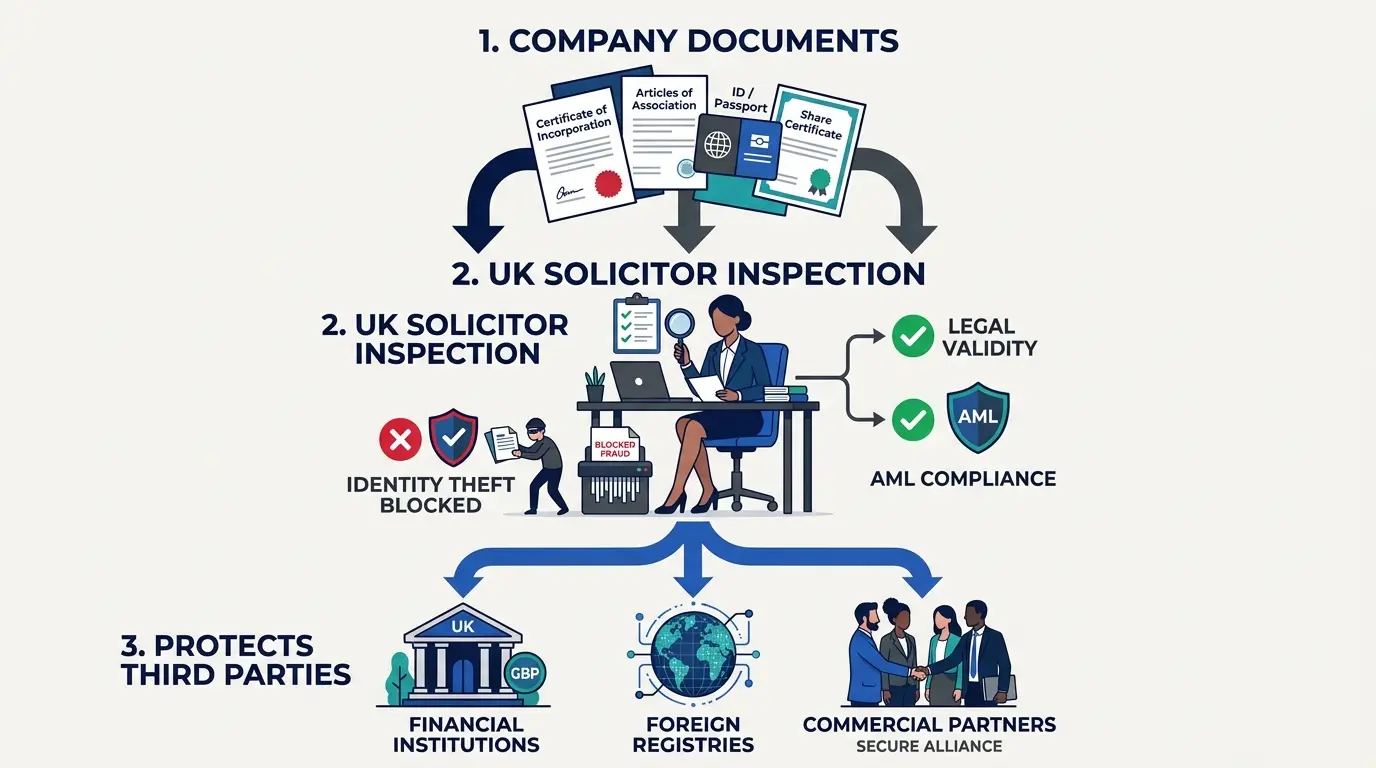
Corporate identity theft accounts for millions of pounds in commercial fraud across the UK annually. Fraudulent entities often alter articles of association, share certificates, or certificates of incorporation to misrepresent authority. Solicitors examine every paper or digital page to confirm that content matches official filings. This statutory duty ensures that third parties can trust certified copies in legal proceedings.
Money laundering regulations force legal professionals to establish the precise provenance of corporate files. Solicitors act as compliance officers when adding their certification stamp to company paperwork. Unverified documents can lead to regulatory penalties for the legal practice involved. Rigorous physical and digital inspection safeguards the integrity of the wider UK business ecosystem.
Financial institutions demand verified company files prior to opening commercial bank accounts or issuing credit lines. Banks accept certified copies only when a qualified solicitor confirms authenticity against official registries. Thorough inspection prevents delays in corporate financing, mergers, and cross-border commercial transactions.
How Do Solicitors Verify the Originality of Corporate Files?
Solicitors verify originality by examining physical security features, inspecting original wet-ink signatures, and cross-checking digital copies directly against the Companies House register. They confirm the document contains unaltered text, accurate official stamps, and genuine authority seals.
Physical examination remains the primary baseline for document verification. Solicitors inspect paper thickness, official watermarks, embossed seals, and ink absorption patterns on statutory forms. Altered documents frequently display microscopic print inconsistencies, mismatched fonts, or irregular alignment. Legal specialists flag these visual anomalies immediately during the visual audit.
Digital verification complements physical inspection for modern UK company administration. Solicitors access the online Companies House database to review filed incorporation certificates and confirmation statements. They compare historical PDF filings with the presented document to verify matching text, dates, and filing numbers. Discrepancies between official public records and presented papers result in immediate rejection.
Signature verification requires checking wet-ink marks against official director specimen signatures. Solicitors validate whether the signing party held actual authority on the date of execution. When inspecting electronic signatures, legal professionals check cryptographic certificates to ensure the file was not tampered with post-signing.
What Identity Checks Do Solicitors Perform on Company Directors?
Solicitors perform identity checks by validating government-issued photo ID, verifying proof of residential address, and running electronic Anti-Money Laundering background checks. They match director details against official Companies House register entries to confirm active legal appointments.
UK anti-money laundering law obliges solicitors to verify the identity of individuals managing corporate entities. Solicitors require official identification documents, including valid passports, UK photocard driving licenses, or national identity cards. They inspect these items for security features like holograms, micro-printing, and valid Machine Readable Zones.
Address validation requires recent supporting documentation issued within the preceding three months. Acceptable proof includes utility bills, bank statements, or council tax demand notices. Solicitors confirm that the residential address matches the director details listed in internal company books and public filings.
Electronic AML databases check directors against global sanction lists, politically exposed person registers, and adverse media databases. Biometric facial recognition software often compares live selfies against submitted photo ID documents. Legal professionals document these verification results to build a compliant audit trail before certifying any corporate papers.
How Are Articles of Association and Incorporation Certificates Validated?
Solicitors validate these constitutional documents by comparing filed articles against Companies House records, verifying company registration numbers, and checking current company status. They confirm that internal clauses, share structures, and officer appointments remain legally accurate.
The Certificate of Incorporation serves as the birth certificate of a UK corporate entity. Solicitors inspect the company number, exact registered name, and date of incorporation against government records. They confirm that the company holds an active status and has not entered liquidation, administration, or strike-off proceedings.
Articles of Association dictate internal governance, director powers, and shareholder rights. Solicitors review the entire constitutional document to ensure no unauthorized amendments exist. They compare the presented articles against special resolutions filed on the public register to confirm that no subsequent changes override the text.
Share capital structures stated within the articles must match current confirmation statements. Solicitors calculate voting rights, dividend entitlements, and share class restrictions during the check. Accurate statutory documents ensure that overseas registries and courts accept the certified copies without requiring further corporate clarification.
What Information Must a Solicitor Include in the Certification Stamping?
Solicitors must include a specific legal statement confirming a true copy, their full legal name, professional signature, date of certification, and official law firm address. They add their legal regulator identification number to provide complete regulatory accountability.
The certification wording must follow strict legal conventions to remain valid across UK and international jurisdictions. The solicitor writes or stamps a precise declaration directly onto the document copy. Standard text confirms that the document represents a true, accurate, and complete copy of the original record seen by the legal professional.
The certification block requires comprehensive practitioner details to enable independent verification. The solicitor signs the stamp using wet ink and prints their full legal name below. Including their Solicitors Regulation Authority identification number allows receiving institutions to verify their professional standing online.
Dated certification stamps establish the precise timeline of legal verification. Most financial institutions require document certification completed within three to six months of submission. Clear, legible stamps prevent administrative rejections by overseas embassies, corporate registries, and banking compliance teams.
How Do Cross-Border and Apostille Requirements Change Document Checks?
Cross-border requirements force solicitors to perform notary verification, verify international translation accuracy, and format certification stamps for Foreign, Commonwealth & Development Office apostille legalization. These additional steps satisfy international Hague Convention legal standards.
Foreign authorities often demand extra legal validation beyond standard UK solicitor certification. When documents target international use, solicitors must format their certification to allow subsequent Apostille endorsement. The Foreign, Commonwealth & Development Office inspects the solicitor’s signature against their official database before issuing an Apostille certificate.
Foreign language corporate documents require certified translations before legal verification can proceed. Solicitors verify the credentials of the professional translator and check that the sworn translation attaches correctly to the source document. They certify both the English translation and the native copy simultaneously.
International commercial law mandates strict adherence to the Hague Apostille Convention rules. Overseas courts, foreign corporate registries, and international banks reject documents lacking proper legal chaining. Thorough preliminary checks by UK solicitors prevent international transaction delays and costly cross-border legal disputes.
What Causes a Solicitor to Refuse Document Certification?
Solicitors refuse certification when presented with illegible copies, missing pages, mismatched director records, suspected fraudulent alterations, or unverified identity credentials. They also reject documents when the original corporate record cannot be independently cross-checked.
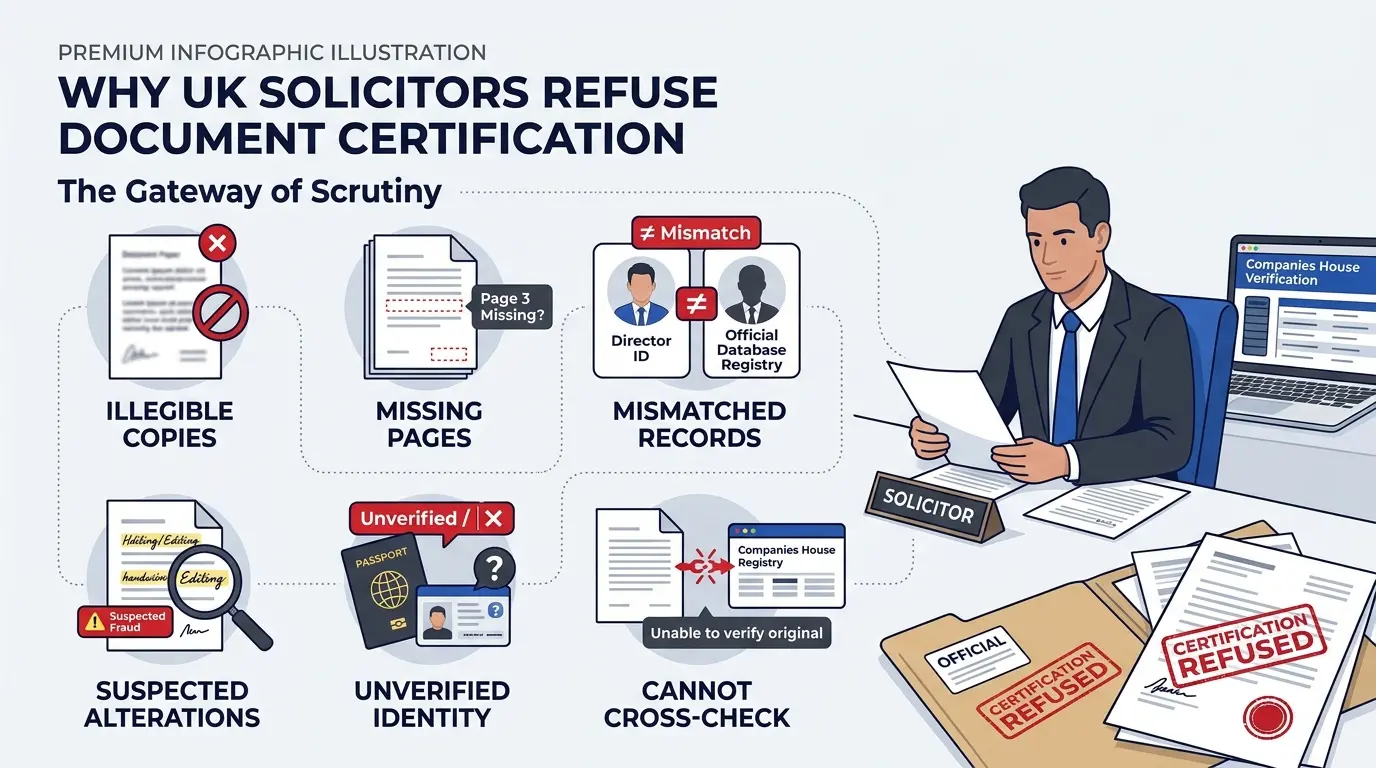
Incomplete documentation represents a primary trigger for certification refusal. If a company presents incomplete Articles of Association missing schedules or signature pages, the solicitor must halt the process. Every corporate document submitted for legal stamping must exist as a complete, uninterrupted record.
Discrepancies between presented paperwork and public database records require immediate clarification. If a company lists a director who does not appear on the official register, solicitors cannot certify the file. Unreported share transfers or outdated registered office addresses similarly prevent legal endorsement.
Suspected fraud or failure to satisfy Anti-Money Laundering checks results in mandatory refusal. Solicitors maintain legal duties to report suspicious financial or corporate activities to the National Crime Agency. Attempting to certify altered, misleading, or unverified company records exposes the solicitor to civil liability and professional disbarment.
Streamlining Your Company Document Certification Process
Obtaining verified business files requires precise compliance with statutory checks and legal standards. Ensuring that corporate records, director identification, and public filings align before seeking legal endorsement saves administrative time and prevents banking delays. Professional corporate service providers coordinate these requirements to deliver legally sound documentation for domestic and international business operations.
Companies navigating complex corporate filings can secure professional assistance through Supplementary Company Documents to manage statutory record preparation. Understanding verification requirements helps business owners maintain accurate records. For practical step-by-step guidance on document approval, review how to make sure your certified copies are accepted first time. When expanding corporate operations or opening international accounts, companies can get correctly certified company documents from Form My Company to ensure complete regulatory compliance. Form My Company assists UK enterprises by delivering fully compliant corporate documentation tailored to strict legal standards.
Explore More Supplementary Company Documents Guide,
What Do Investors Look for in Your Articles of Association?
What Are the Share Transfer Rules in Articles of Association?
Frequently Asked Questions
What are supplementary company documents for a UK limited company?
Supplementary company documents refer to post-incorporation corporate records—such as Certificates of Good Standing, updated Articles of Association, and official change of officer filings—that complement core formation papers. Form My Company retrieves and verifies these official records directly from Companies House to maintain valid statutory registers.
Why do banks and lenders require certified supplementary company documents?
Financial institutions mandate certified corporate records to verify active legal status, director authorities, and accurate ultimate beneficial ownership structures during compliance checks. Ordering verified Supplementary Company Documents through Form My Company ensures your statutory filings meet strict anti-money laundering and corporate due diligence standards.
What is the difference between core incorporation papers and supplementary company documents?
Core incorporation files establish a company’s legal existence at formation, whereas supplementary records reflect real-time operational updates, share allotments, and ongoing regulatory filings. Form My Company provides certified copies of both current and historical Supplementary Company Documents to ensure complete transparency for audits, financing, and cross-border transactions.
How long does it take to obtain certified supplementary company documents?
Standard digital extracts are typically generated within 24 hours, whereas certified hard copies or legalised documents can take between 2 to 5 working days depending on government processing times. Through the Supplementary Company Documents service by Form My Company, businesses can expedite document retrieval and certification to meet urgent banking or legal deadlines.
Which specific filings fall under supplementary corporate records?
Key records include Certificates of Good Standing, share transfer forms (J30), PSC notifications, board resolutions, and annual confirmation statements. Form My Company manages the sourcing, validation, and delivery of these essential Supplementary Company Documents so your business remains fully compliant under the Companies Act 2006.