
To ensure certified copies are accepted the first time, you must instruct an active UK solicitor or notary to verify the original document, write the exact mandatory certification wording, sign, date, and print their official details clearly on every page.
What Is a Certified Copy of a Company Document?
A certified copy is an official duplicate of a company document that a registered UK solicitor or notary public verifies, stamps, and signs to confirm it represents a true and accurate reflection of the original record.
Organizations require certified copies to prevent corporate fraud, prevent identity theft, and satisfy anti-money laundering regulations. When filing official records, third parties need independent verification before accepting company documentation. Solicitors check original certificates of incorporation, articles of association, or share certificates against official registers. They apply an official ink stamp, write the mandatory regulatory statement, and record their professional credentials directly on the document. Financial institutions, government agencies, and international bodies accept these certified papers as legally binding representations of your business records.
Why Do Banks and Authorities Reject Certified Copies?
Banks and government bodies reject certified copies when certification statements lack required statutory phrasing, professional details appear faint or incomplete, documents show missing pages, or certifying professionals lack valid, active UK practising certificates.
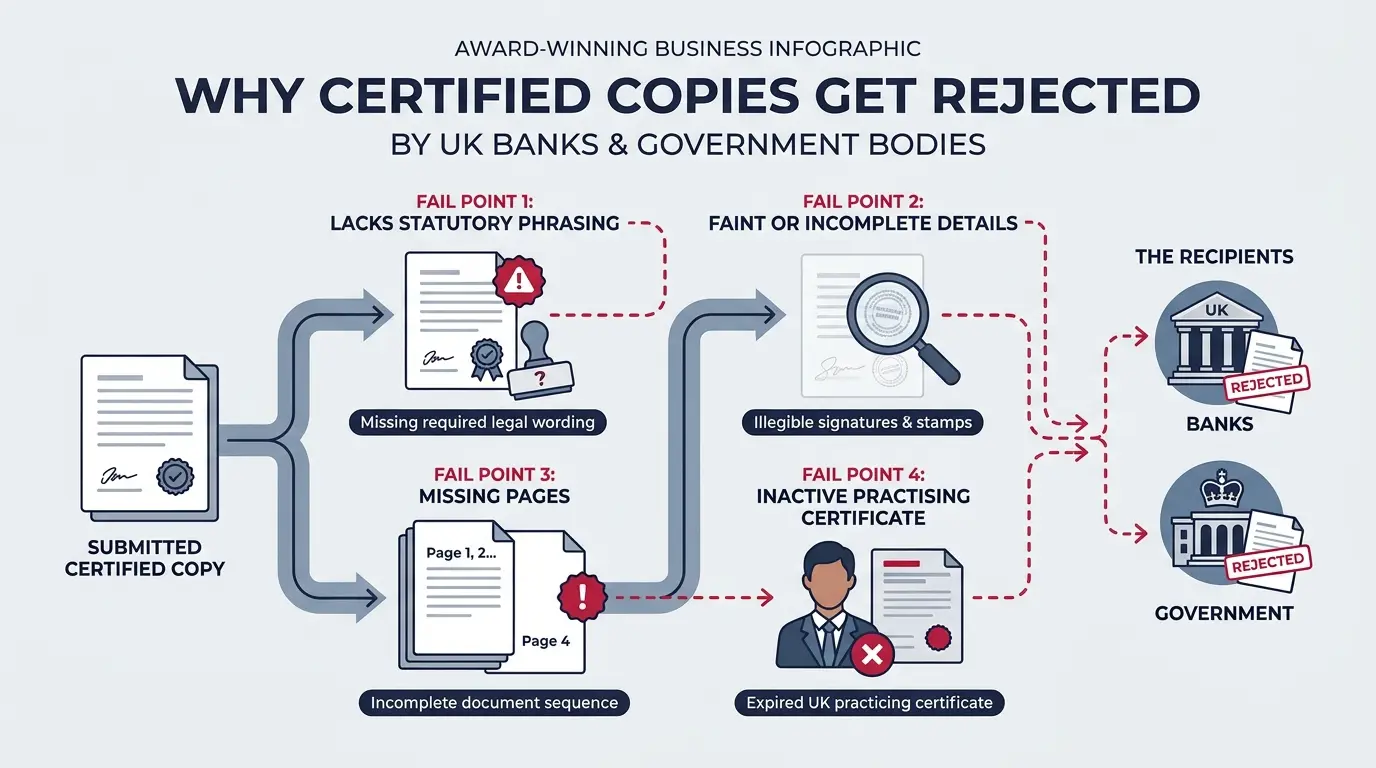
Official bodies enforce strict compliance criteria when inspecting submitted documentation. Rejections occur when solicitors use generic wording rather than precise statutory phrases. If a certifier forgets to state that they viewed the original document, banks disqualify the submission automatically. Incomplete contact information, unreadable professional registration numbers, or missing physical signatures also trigger immediate refusal. Furthermore, regulatory authorities reject partial submissions that omit schedules or back pages. Ensuring your representative submits complete files prevents costly administrative delays during critical business operations.
What Specific Information Must the Certifier Include?
A valid certification must contain the certifier’s full legal name, original signature, current date, physical workplace address, contact phone number, professional title, and official regulatory registration details written directly on the page.
Regulatory standards mandate specific identification markers on every certified document. The certifying professional must write a clear statement confirming that the copy represents a true duplicate of the original document. If the document includes a photograph, the certifier must state that the image presents a true likeness of the individual. The certifier writes their full legal name alongside their official designation, such as Solicitor of the Senior Courts of England and Wales. They must list their Law Society or Solicitors Regulation Authority number to enable instant third-party validation.
Which Documents Typically Require Official Certification?
Corporate transactions require certified copies of incorporation certificates, articles of association, registers of directors, registers of shareholders, proof of registered address, bank statements, and director identification documents.
Different corporate actions demand specific documentation to establish legal standing and ownership structure. Bank account applications, international trade agreements, and commercial property leases require verified business credentials. You must present valid records to external stakeholders when expanding commercial operations or securing credit facilities. Ordering specialized Supplementary Company Documents ensures you receive professionally verified corporate files tailored to strict institutional specifications.
Three common types of corporate documents needing certification:
Verify company status using official certificates of incorporation
Validate corporate governance using updated articles of association
Confirm executive identity using government-issued photo identification
How Do You Select an Eligible Certifying Professional?
You must select a practicing UK solicitor, notary public, or registered commissioner for oaths who holds a current, unrestricted license with an official regulatory body like the Solicitors Regulation Authority.
Not all professionals possess legal authority to certify documents for commercial use. Banks and overseas registries reject certifications executed by unauthorized personnel, accountants without notary status, or retired legal professionals. Before booking an appointment, verify the professional’s status on the official Solicitors Regulation Authority register. Confirm that the certifier maintains active indemnity insurance and holds explicit legal authority to authenticate documents. Choosing an accredited legal expert guarantees that third-party institutions honor your certified paperwork immediately upon submission.
If you want to understand the preliminary steps legal experts complete during an inspection, review What Does a Solicitor Check Before Certifying Company Documents? to streamline your preparation process.
What Is the Step-by-Step Process for Document Certification?
Document certification requires gathering original records, scheduling a physical or digital verification session with a qualified solicitor, inspecting original features, executing certification statements, and reviewing completed copies.
Preparing your paperwork correctly accelerates the authentication process and eliminates administrative errors. You gather physical originals and verify that every page remains legible and undamaged. The solicitor inspects security features, watermarks, and official seals against the physical original. After confirming authenticity, the certifier prints or stamps the mandatory statement onto the copy. They sign each page using permanent ink and apply their official firm stamp. Finally, you review the completed document to confirm all registration numbers, dates, and signatures appear clearly.
How Do Overseas Requirements Differ for International Use?
International authorities require an apostille certificate or embassy legalization attached to certified copies to validate the legal status of the certifying UK solicitor under foreign law.
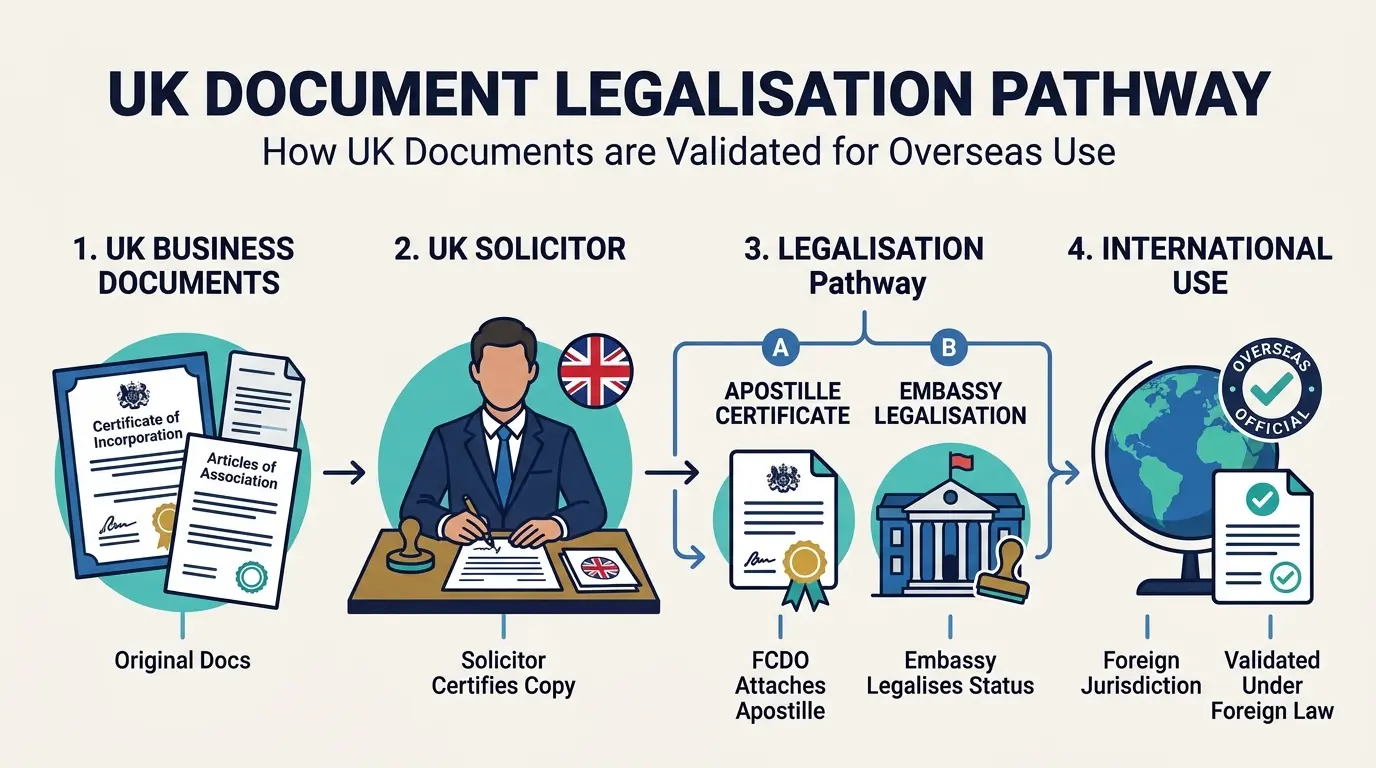
Foreign governments and international banks do not recognize standard UK legal certifications without additional government validation. When submitting documents outside the United Kingdom, you must obtain an Hague Apostille from the Foreign, Commonwealth & Development Office. This government certificate verifies the signature and seal of the UK solicitor. Certain non-Hague member nations demand further embassy legalization steps through their local consulates. Failing to secure necessary diplomatic legalizations leads to foreign regulatory rejections and stalls cross-border commercial transactions.
How Can You Prevent Common Submission Errors?
You prevent submission errors by verifying certifier credentials, reviewing text legibility, confirming complete page counts, checking date freshness, and ensuring signature alignment prior to formal filing.
Proactive quality control eliminates frequent administrative mistakes before you submit documents to external organizations. Always check that the date on the certification falls within the timeframe requested by your bank, which typically ranges from 30 to 90 days. Confirm that multi-page documents contain certification stamps on every page or feature a properly bound, certified cover sheet. Ensure that digital scans of the certified physical copies maintain high resolution so scanning software reads every stamp detail accurately.
To eliminate certification risks and secure compliant paperwork directly, you can Get Correctly Certified Company Documents From Form My Company to satisfy institutional requirements efficiently.
Securing prompt acceptance of certified company documents relies on strict adherence to legal standards and institutional expectations. Rejections occur when submissions lack proper certification statements, missing certifier credentials, or incomplete page sequences. By engaging qualified solicitors and verifying every statement before submission, you protect your business operations from unnecessary administrative delays. Form My Company assists commercial enterprises by coordinating exact corporate document certifications that satisfy bank, government, and international compliance standards on the first attempt.
Explore More Supplementary Company Documents Guide,
How to Prepare Certified Documents for Regulatory Applications
How to Speed Up Certification When a Deadline Is Close
Frequently Asked Questions
How do I order Supplementary Company Documents in the UK?
You can order Supplementary Company Documents directly online through specialized corporate service providers like Form My Company. You simply select the required corporate filings or certified certificates, provide your company registration number, and submit your request. Form My Company then retrieves, verifies, and delivers the official documentation electronically or via courier.
What are Supplementary Company Documents used for?
Supplementary Company Documents provide official proof of a business’s legal standing, corporate structure, and operational status. Financial institutions, government agencies, and international partners frequently require these official records during bank account openings, commercial contract negotiations, and compliance audits. Common examples include Certificates of Good Standing, Articles of Association, and official change of name certificates.
How quickly can I receive certified Supplementary Company Documents?
Delivery times for Supplementary Company Documents depend on whether you choose electronic copies or official physical certifications. Digital copies are typically retrieved and delivered on the same working day, while physical certified or apostilled documents generally take between 2 to 5 business days. Form My Company offers expedited processing options to ensure urgent regulatory and banking deadlines are met.
Can Form My Company certify Supplementary Company Documents for international use?
Yes, Form My Company arranges official document certification and apostille services for overseas commercial transactions. A qualified UK solicitor verifies the authenticity of the records before the Foreign, Commonwealth & Development Office (FCDO) attaches an Hague Apostille certificate. This process ensures your Supplementary Company Documents are legally recognized by foreign governments and international banks.
What is the difference between standard and certified company documents?
Standard company documents are basic informational extracts retrieved from the UK Companies House register for general business verification. Certified Supplementary Company Documents undergo formal validation by a registered solicitor or notary public who stamps, signs, and attests that the copy is a true reflection of the official record. Third-party institutions and lenders strictly require certified versions to satisfy legal and anti-money laundering compliance.