
Your registered office and your director’s service address do different jobs. A registered office is the official physical address for company correspondence, including mail from Companies House and HMRC.
It’s understandable to want to meet this requirement without putting your home address on the public record. A registered office address service lets you separate your company’s official address from where you live, but it does not replace a director’s service address. This guide explains what each address is for, the UK rules your registered office must meet, and how to keep your home details private.
You’ll also learn what to consider when choosing an address and how to plan for renewals and ongoing costs. By the end, you’ll understand the requirements and practical options available when setting up or running a UK company.
Key Takeaways
- Choose a registered office in the correct UK jurisdiction for your company’s registration.
- Use a separate director’s service address to help keep your home address off the public register.
- Make sure the registered office is a physical, appropriate address where company post can be received and delivery acknowledged.
- Keep track of your address service’s renewal date and the terms that apply to each renewal period.
- Understand which address each company record requires before you submit or update your details.
What is a registered office address?
A registered office is a company’s official address for formal correspondence and public records. In the UK, it must meet the rules for the company’s registration jurisdiction and be in place before registration.
Address in the registration country
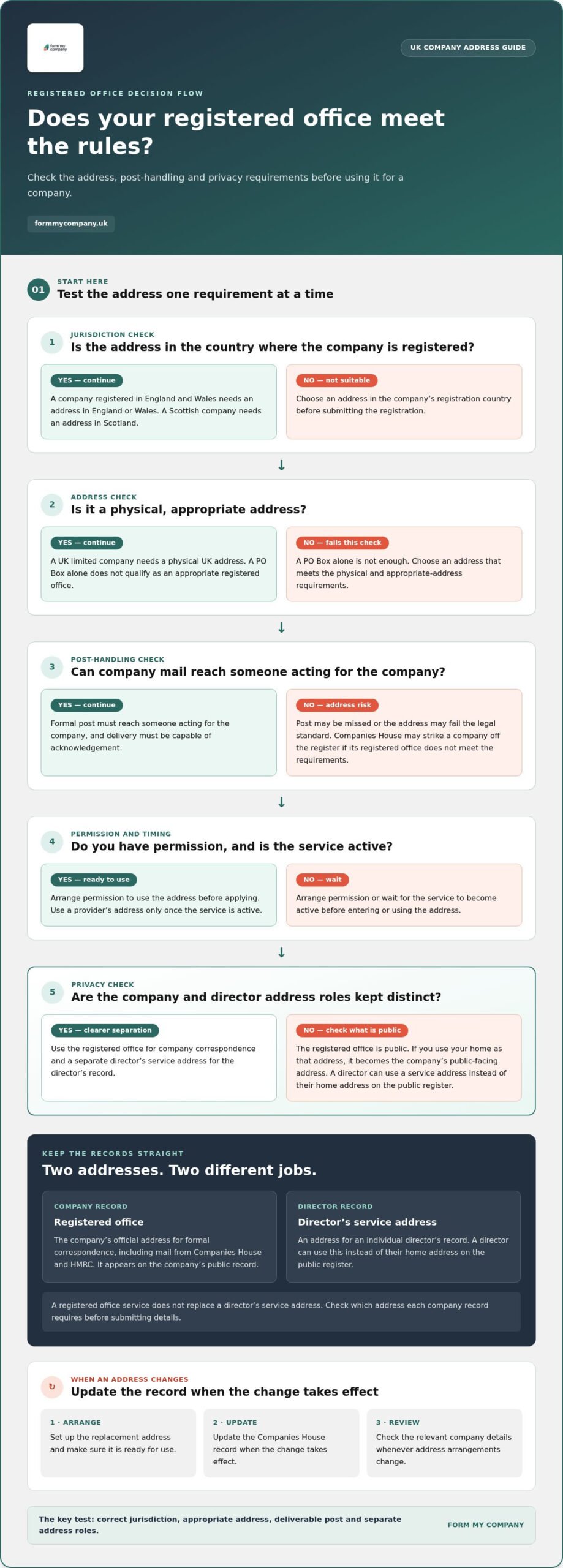
A registered office must be in the country where the company is registered. A company incorporated in England and Wales must use an address in England or Wales, whilst a Scottish company must use an address in Scotland. Every UK company must maintain a registered office under the Companies Act 2006. LLPs registered in England and Wales have a similar requirement under the Limited Liability Partnerships Act 2000.
When assessing an address service, check that the address is in your company’s jurisdiction, can receive formal post, and meets delivery requirements. Find out how correspondence is handled and make sure the service and renewal terms are clear.
Displaying the address on company documents
Displaying the registered office means showing the company’s official address where required on business documents and communications. UK companies must display it under the Companies Act 2006 and the Company, Limited Liability Partnership and Business (Names and Trading Disclosures) Regulations 2015.
Use the registered address consistently on relevant company materials and official records. Companies House and HMRC also send correspondence there. If the address changes, update the Companies House record when the change takes effect so it does not become outdated.
Address services in formation packages
A formation package that includes an address service brings company registration support together with an address for official correspondence. Package contents vary, so check whether the address is included or needs to be arranged separately before choosing.
Consider the address separately from the wider formation decision. Your legal structure, registration jurisdiction, and need to keep your home address private can all affect which formation and address services suit your plans. Check that the arrangement includes the specific address provision you need.
Using an address to form a company
When registering a company, you must provide its registered office address. Choose an address in the correct jurisdiction and arrange permission to use it before submitting the application. A UK limited company needs a physical UK address for registration, which an address provider can supply.
To set up or change an address, arrange the new address, then enter it during formation or update the Companies House record after a change. Wait until the service is active before using a provider’s address. A provider’s address must meet the same requirements as any other registered office. Under section 86 of the Companies Act 2006, according to UK Government, legislation.gov.uk, company mail must reach someone acting for the company and delivery must be acknowledgeable.
The risk is missed formal post or an address that fails the legal standard. Companies House may strike a company off the register if its registered office does not meet the requirements. A registered office address service gives businesses an option beyond using a home address.
Privacy and keeping a home address off the public record
A company’s registered office is public, so using your home can reveal where you live. A separate address for the company can reduce that exposure.
Protecting a home address on the public register
To keep your home address private, use a different address for the company’s registered office and the director’s service address. Companies House recognises registered office services as a way for companies to keep their address private. A director can also use a service address instead of their home address on the public register.
Keep the two address roles distinct when preparing company details. For example, a director working from home can use a suitable registered office for company correspondence and a separate service address for their director record. This places the chosen business address, rather than their home, in the relevant public-facing fields.
Before submitting details, check which address each company record requires. Enter the registered office as the company’s official address, then provide the director’s service address for that individual’s record. Using one address for both roles may not provide the privacy separation you want.
Public availability of the registered office
The registered office is the company’s official address on its public record. Choose it with public visibility in mind. If you enter your home as the registered office, your home becomes the company’s public-facing address.
A director’s service address has a different purpose. The registered office is where company correspondence is directed; the service address relates to an individual director. Keeping the roles separate helps you decide which address belongs in each record.
Review the company’s details whenever its address arrangements change. Update the relevant record with the replacement address, and make sure the new address is ready for use. An address service can provide an alternative to publishing a home address; explore business address options as part of that decision.
Privacy depends on choosing the right address for each purpose, not on removing every address from view. Companies House still requires the company’s registered office, while a director can use a service address instead of their home. Treat each field separately when filing or changing company details.
Requirements for physical and appropriate addresses
Yes, a company can use a home address if it meets the physical and appropriate-address rules. Companies House requires an appropriate registered office under the Economic Crime and Corporate Transparency Act 2023; a PO Box alone does not qualify.
Appropriate registered office requirements
An appropriate registered office is a physical address that meets delivery and acknowledgement requirements. It must be in the company’s registration country, and someone acting for the company must be made aware of post delivered there.
That person must also be able to acknowledge delivery. According to UK Government, legislation.gov.uk, section 86 of the Companies Act 2006 requires an address where company mail is expected to reach someone acting for the company and delivery can be acknowledged.
In practice, consider how a letter addressed to the company would reach someone responsible. A suitable process allows posted or hand-delivered documents to be received, brought to the company’s attention, and acknowledged to the sender.
A PO Box alone does not meet the physical-address requirement. The address must also work in practice: if post arrives but nobody acting for the company becomes aware of it, the address does not meet the stated standard.
Use these points as a practical test before entering an address:
- It is a physical address in the company’s registration country.
- Someone acting for the company is made aware of delivered post.
- The sender can obtain confirmation that delivery occurred.
Using a home address as the registered office
A home address may serve as the registered office if it meets the same physical-address and delivery requirements. Company post must reach someone acting for the company, and delivery must be acknowledged.
The key question is not whether the property is residential, but whether the address can meet the delivery standard for official company correspondence. A home where someone receives company mail and alerts the responsible person may meet that practical test; a PO Box alone cannot.
Companies House rules require an appropriate address, not merely an address that can be entered on a form. The Economic Crime and Corporate Transparency Act 2023 sets this standard. A company could be struck off the Companies House register if it fails to provide a registered office address meeting the requirements.
Before using your home, consider that it will be the company’s official registered office and publicly available. If the address changes, update the company record to show the replacement registered office. Using a home does not remove the company’s responsibility to receive and acknowledge official post.
Apply the same test to a provider’s address as to a home address: it must be a physical location that meets the required standard, and post must reach someone acting for the company. Calling it a business address does not remove these requirements.
Annual service price and renewal costs
An annual address service is paid for by yearly periods, with the cost recurring as each service period renews. The total depends partly on the address location, so compare the renewal terms for the specific location you plan to use.
For a practical budget, separate the initial service period from later renewals. Note when the period starts and ends, what triggers renewal, and how the next charge is calculated. This helps you plan for the ongoing commitment instead of treating the initial payment as the full cost of maintaining the address.
Location can affect the cost of an annual registered office address service. Compare addresses that meet your company’s registration-country requirements, then weigh the location against your business needs. A prominent city address may matter to some businesses, while another suitable location may meet their practical requirements.
Before comparing renewal costs, check what the annual service covers: the address provided, the period covered, and how the service continues into the next period. Add the renewal date to your company calendar alongside Companies House filing dates and other recurring administration. A reminder gives you time to review the address before the current period ends.
Review these points when planning the yearly cost:
- Address location: compare the relevant location options, not just the service label.
- Renewal period: record when the current annual term ends and the next begins.
- Included service: identify what the address arrangement covers during that term.
- Company details: keep the registered office consistent with the active address arrangement.
Use renewal as a chance to reassess whether the address still suits the company. If your operating plans have changed, you may prefer another location, provided the replacement meets the relevant address rules. Coordinate any change with the service period and company records so the registered address stays accurate.
Do not compare annual costs in isolation. Consider the address’s suitability, renewal timing, and how company correspondence is handled. This helps you plan for the recurring expense and avoid treating an initial term as permanent. Keep the service terms and renewal information with your company records so the responsible person can review them before renewal.
Registered office versus director service address
A registered office belongs to the company, while a director’s service address is recorded for an individual director. Keeping these roles distinct helps you choose the right address for each company record.
Registered office: the company’s address
A registered office is the company’s official address for correspondence and public records. Companies House and HMRC use it to send company-related mail. It identifies the company’s formal address, not the director’s personal address.
For example, a company operating from a director’s home might use a separate registered office. The company’s official address then appears on its record, while the director can use a service address for their own record. The registered office must still meet the applicable requirements and receive company post.
This distinction matters because the registered office does not replace the address recorded for each director. Treat the company’s address and each director’s details as separate fields when preparing or updating information for Companies House.
Director service address: the director’s recorded address
A director’s service address is recorded for that director instead of their home address. Using one can help keep the director’s home off the public register.
It serves a different purpose from the company’s registered office. A director may want to keep personal details private, while the company still needs an official correspondence address. For instance, a home-based director can use a separate service address for their director record and a suitable registered office for the company.
Do not assume that changing one address updates the other. When a director’s details or the company’s registered office changes, identify the relevant record and update it separately. Keeping track of which address belongs to which record helps prevent entering the company address in a director’s field, or vice versa.
Use this quick comparison when completing company details:
- Registered office: the company’s official address for company correspondence and its public record.
- Director service address: the address recorded for an individual director, which can help keep their home off the public register.
- Home address: the director’s residential address, which is distinct from both roles when separate addresses are used.
Before filing, check each field’s label and purpose. If your priority is keeping your home out of the company’s public-facing details, plan the company address and director service address separately. Explore business address options for the company’s registered office.
Form My Company: Digital Package
Form My Company’s Digital Package supports company formation. If you’re preparing to register a company, consider the formation package alongside your registered office arrangements so the address details are ready for the application.
Form My Company also offers the Digital & Print Package and Entrepreneurs Choice Package. For a different legal structure, it provides Limited Liability Partnership (LLP) Formation. Choose according to the structure you plan to register and the formation support you need.
A formation package and an address service are separate choices. Make sure your registered office suits the company’s jurisdiction and is ready to use before submitting the registration details.
To discuss your formation options, contact Form My Company or visit formmycompany.uk.
Make your next company decision with confidence
Plan your address arrangement alongside your company’s next administrative steps, rather than leaving it until later. A registered office address service can help keep your home separate from the company’s official address. Match the arrangement to your company’s needs and formation choice.
Form My Company offers the Digital Package, Digital & Print Package, and Entrepreneurs Choice Package. Choose the formation option that suits your next step, then plan your registered office separately. This makes it easier to organise the details needed for registration and ongoing company records.
If you’re ready to move forward, contact Form My Company for help with your company formation options. Take the next step at your own pace, with a clearer plan for setting up your business.
Under section 86 of the Companies Act 2006, according to the UK Government on legislation.gov.uk, it must be an address where company mail is expected to reach someone acting for the company and delivery can be acknowledged.
Frequently Asked Questions
Can I get further guidance about the different address services?
Yes. Form My Company offers a Registered Office Address Service and Virtual Office Services. These services can help keep business correspondence separate from your home address. If you’re also forming a company, consider the address requirement alongside your formation choice. A registered office and a director’s service address serve different purposes in company records.
How is official government mail forwarded to me?
Mail forwarding means that post sent to the company’s registered address is passed on to you. Form My Company’s Fully Inclusive Package includes mail forwarding. Keep your correspondence destination current and update your details if they change. Companies House and HMRC correspondence may require attention, so arrange to receive forwarded post promptly and retain it with your company records.
Is mail forwarding free with this service?
Mail forwarding is included in Form My Company’s Fully Inclusive Package. Don’t assume it comes with every address arrangement or formation package. The cost of an address service depends on the case and is given after a quote request; factors include the service selected and its terms. Review what your chosen arrangement includes before relying on it to receive and forward company correspondence.
What is a registered office address service in the UK?
A registered office address service lets a company use an address as its official registered office. The address is used for company records and correspondence, not as the director’s personal address. For example, a home-based company can use a separate registered office to avoid listing its home as the company address. The address must still meet the requirements for the company’s registration jurisdiction.
What can a UK company use as its registered office address?
A UK company can use a physical address that meets the appropriate-address requirements for its registration jurisdiction. Someone acting for the company must be made aware of post delivered there, and the sender must be able to obtain confirmation of delivery. A PO Box alone is not suitable. A home address may be used if it meets these conditions, but it becomes the company’s public-facing registered office.
How much does a registered office address service cost in the UK?
There is no single UK-wide rate for an address service. The price depends on the case and is given after a quote request. Factors include the address location, service period and handling included. Compare the annual term and renewal conditions as well as the initial cost, so you understand the ongoing commitment. Don’t treat a first-year offer as the full cost of maintaining an address.
What services are included in a registered office address package?
Inclusions depend on the package. Form My Company’s Fully Inclusive Package includes a registered address and mail forwarding. A registered office address service provides an address for the company’s official registered-office record, but do not assume every package also includes forwarding or virtual office facilities. Compare the package details with your needs, especially if you expect post to be sent to a separate correspondence address.
Can a registered office address be in a different UK country from the company’s registered jurisdiction?
No. The registered office must be in the company’s registration country. A company incorporated in England and Wales needs an address in England or Wales; a Scottish company needs an address in Scotland. For example, a Scottish company cannot use an address in England as its registered office. Choose an address that matches the company’s registration jurisdiction, even if you operate elsewhere.