Certified company documents do not possess an arbitrary legal expiry date, but third-party institutions like banks, courts, and foreign registries routinely demand certified records issued within the past three to six months to verify ongoing corporate compliance and valid registration.
Why Do Banks and Authorities Reject Older Certified Company Records?
Financial institutions and regulatory authorities reject older certified records because historical filings fail to prove active legal standing, current director appointments, or recent shareholding adjustments, exposing transaction partners to significant fraud risks and statutory non-compliance penalties under current corporate laws.
Corporate records act as legal proof of an enterprise’s existence, structure, and operational authority at a specific moment. Companies House registers changes to officer appointments, registered office addresses, and share capital daily. An outdated document fails to reflect these critical updates, creating compliance vulnerabilities for international banks, courts, and legal partners.
Regulatory bodies enforce strict diligence frameworks under anti-money laundering legislation. Verification officers require evidence that an entity remains active, solvent, and lawfully registered on the official public register. Presenting documentation that predates recent filings invalidates compliance checks, leading to immediate transaction delays, frozen corporate accounts, or rejected commercial applications.
Obtaining fresh official paperwork eliminates compliance friction during corporate audits and international expansion. You can explore how often should you renew certified copies of company records to establish a systematic schedule for maintaining corporate readiness across all global jurisdictions and regulatory agencies.
What Are the Essential Steps to Obtain Updated Certified Company Records?
Updating certified company records requires selecting required corporate filings, submitting official requests through an accredited business service provider, requesting Companies House apostille or certificate authentication, and choosing courier delivery to ensure secure handling of legal documents.
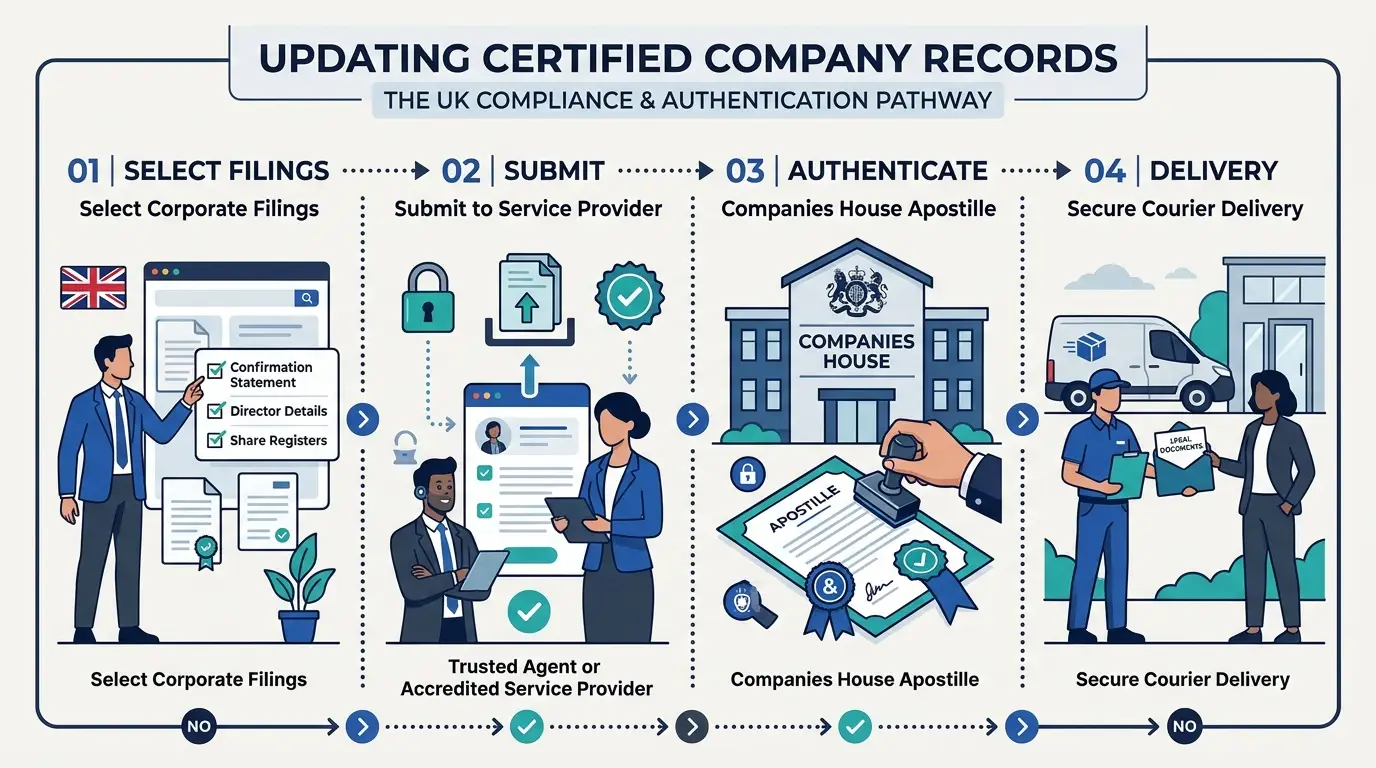
The updating process begins with a comprehensive audit of your corporate profile. Corporate secretaries review existing certificates against current public register filings to identify outdated legal details, modified officer lists, or changed capital structures. Identifying exact documentation requirements prevents duplicate requests and speeds up regulatory approval timelines.
Once you identify the required records, an official application goes directly to the registrar. Certified copies receive an official Companies House seal or watermark, confirming that the document precisely mirrors the official public register. Certain international transactions also demand apostille certification by the Foreign, Commonwealth & Development Office to achieve legal recognition abroad.
Businesses streamline this administrative workflow by outsourcing application management to corporate services specialists. Ordering supplementary company documents ensures your business receives legally validated duplicates, certificates of good standing, and authenticated memorandum articles tailored to your exact regulatory requirements.
How Does Form My Company Streamline the Company Document Renewal Process?
Form My Company streamlines corporate document renewals by providing direct integration with Companies House databases, managing mandatory apostille legalisation procedures, conducting pre-submission verification checks, and dispatching certified paper records via tracked global courier networks.
Navigating government portals and official legalisation channels often consumes valuable operational time. Form My Company eliminates administrative burdens by directly interfacing with registry authorities on your behalf. Direct integration allows expert specialists to process document orders rapidly, reducing administrative delays for time-sensitive commercial deals.
Verification experts audit every request prior to official submission to ensure corporate details match active public records. This preliminary review prevents filing rejections caused by minor typographical errors, pending annual updates, or incorrect corporate registration numbers. Experienced managers oversee the entire legalisation chain, including sworn notary attestations and legalisation procedures.
Choosing a dedicated corporate administration platform ensures continuous compliance across complex international frameworks. You can easily renew your certified company documents with Form My Company to secure updated statutory records, protect your enterprise against operational freezes, and maintain complete legal readiness for global trade.
Which Corporate Documents Require Periodic Renewal and Certification?
Corporate documents requiring periodic renewal and re-certification include Certificates of Good Standing, Certificates of Incorporation, Memorandum and Articles of Association, official Change of Name Certificates, and updated register extracts detailing current director appointments.
The Certificate of Good Standing serves as the primary document requiring frequent renewal. Banks and foreign authorities rarely accept this certificate if the issuing date exceeds three months. This document explicitly proves that your business maintains continuous filing compliance and remains actively registered without pending dissolution proceedings.
Certificates of Incorporation and constitutional documents require fresh certification whenever structural changes occur within the enterprise. Altering corporate objects, modifying voting rights, or executing name changes instantly invalidates older certified copies. Overseas regulators demand freshly authenticated Articles of Association to confirm current director powers during cross-border acquisitions.
Maintaining an updated corporate registry folder ensures immediate availability during unexpected legal or financial audits. Companies must audit their documentation inventory quarterly to identify records nearing common acceptance limits. Proactively replacing older duplicates prevents unexpected disruptions during critical business transactions, investment rounds, and international banking reviews.
What Are the Specific Risks of Operating with Expired or Outdated Documentation?
Operating with outdated company documentation triggers severe operational risks, including frozen commercial bank accounts, rejected international trade contracts, delayed cross-border mergers, stalled lease negotiations, and temporary suspension of regulatory trading licences.
Financial institutions conduct periodic Know Your Customer reviews on all active corporate accounts. When account managers request updated statutory records, failure to produce fresh certified copies within strict deadlines leads to immediate account restrictions. Blocked accounts prevent payroll processing, supplier settlements, and core operational transactions.
Cross-border commercial agreements depend heavily on valid corporate authentication. Overseas counter-parties and foreign government agencies reject legal agreements executed using historical certified records. If legal counsel identifies unverified corporate documents during due diligence, deal completion stalls, exposing your organisation to reputational damage and legal liability.
Submitting invalid corporate proof to regulatory agencies can lead to formal statutory warnings or fines. Compliance frameworks mandate accurate representation of corporate structures at all times. Maintaining fresh, officially certified records mitigates legal risks, protects executive directors, and ensures uninterrupted operational continuity across domestic and international markets.
How Often Should Your Enterprise Audit Its Official Statutory File?
Enterprises should conduct formal statutory file audits every six months or immediately following any major corporate restructuring, director resignation, share transfer, company name change, or registered office relocation to ensure continuous regulatory compliance.
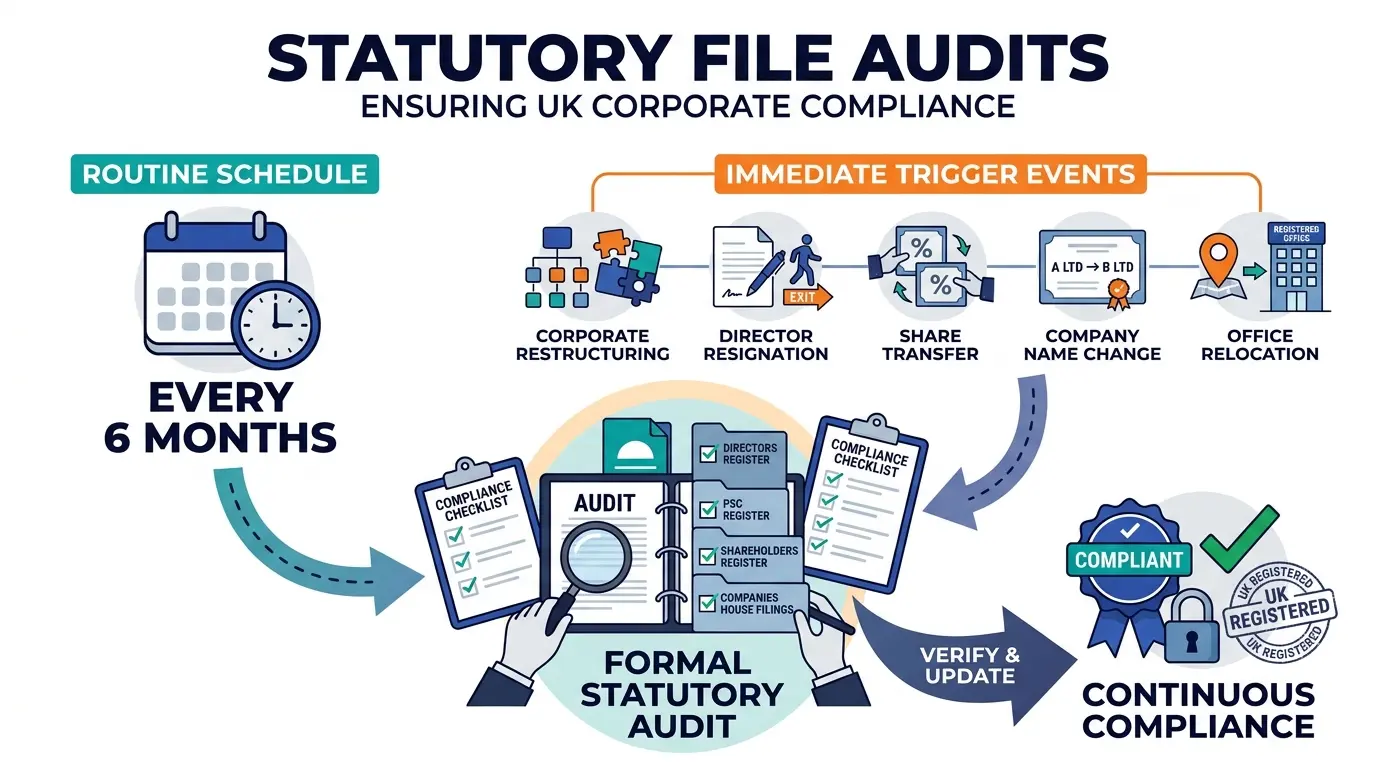
Bi-annual statutory reviews ensure internal records match official Companies House entries. During an audit, corporate secretaries cross-reference internal board minutes, share registers, and officer logs against public database entries. Detecting discrepancies early allows your compliance team to file corrective returns before external third parties request certified verification.
Immediate audits become mandatory following significant structural changes. Executing a share transfer or appointing a new director alters the legal composition of your enterprise. Proceeding with commercial negotiations without updating certified public files creates legal ambiguities that delay contract execution and institutional approvals.
Establishing an automated corporate maintenance schedule protects long-term business continuity. Systematic audits reduce emergency document procurement costs and ensure instant readiness when expanding into new markets. Regular statutory reviews demonstrate superior corporate governance to investors, lenders, and international regulatory authorities.
Explore More Supplementary Company Documents Guide,
Get Correctly Certified Company Documents From Form My Company
Order Regulator-Ready Certified Documents From Form My Company
Frequently Asked Questions
What are supplementary company documents and why are they needed?
Supplementary company documents are official legal records, such as Certificates of Good Standing, change of name certificates, and certified articles of association, that supplement standard incorporation paperwork. Financial institutions, foreign authorities, and corporate solicitors require these verified records from Form My Company to validate a business’s current legal status, corporate structure, and statutory compliance.
How do I order certified copies of my UK business records?
You can order certified copies of corporate records directly online through the Form My Company supplementary company documents portal. Once requested, official Companies House registry extracts and certified documents are retrieved, verified for legal accuracy, and dispatched via secure email or global tracked courier.
What is the difference between an uncertified copy and a certified company document?
An uncertified copy is an unofficial printout of filed corporate records used primarily for basic internal information. A certified supplementary company document issued via Form My Company carries an official registrar seal, watermark, or apostille, making it a legally recognized document accepted by high-street banks, courts, and foreign governments.
How long does it take to get supplementary company documents processed?
Standard processing for supplementary company documents through Companies House typically takes three to five business days. Form My Company offers expedited handling options that allow urgent requests, such as electronic certificates or same-day registry retrieval, to be fulfilled within 24 hours.
Do supplementary company documents require legalisation or an apostille for international use?
Yes, overseas authorities and international banks usually mandate that UK supplementary company documents undergo official legalisation or apostille certification by the Foreign, Commonwealth & Development Office (FCDO). Form My Company manages the entire verification process, ensuring your certified corporate records comply with international legal standards under the Hague Convention.