
Using a registered office service protects your personal privacy by keeping your private home address off the public Companies House register. A home address exposes your residential details to public databases, spam marketers, physical cold callers, and corporate identity fraud.
How Does Using a Home Address on Companies House Expose Personal Data?
Using a home address on Companies House exposes your personal data by publishing your private residential location to the searchable public register. Search engines, marketing brokers, and automated scraping tools index this address permanently, making your private residence accessible to anyone online.
Companies House acts as a fully open statutory registry for corporate entities in the United Kingdom. When a director lists a residential home address as a company’s registered office, statutory laws require Companies House to display that information publicly. Data aggregators and corporate intelligence software scrape this information daily to update commercial databases.
Public residential records attract unsolicited postal marketing, direct junk mail, and commercial sales solicitations to your personal doorstep. Third-party data brokers harvest published director addresses to build marketing contact lists without consent. Removing historical residential records from public registers requires formal statutory applications and administrative fees.
Physical safety and privacy risks escalate when corporate disputes or consumer complaints arise. Unhappy customers, litigious claimants, and cold callers can locate your family home using free statutory searches. Identity thieves regularly cross-reference public Companies House residential data with electoral rolls to orchestrate corporate impersonation fraud.
How Does a Registered Office Service Shield Director Address Details?
A registered office service shields director address details by substituting a commercial corporate location for your residential address on public registers. Statutory filings display the professional agency location, keeping your private home location completely off official public databases.
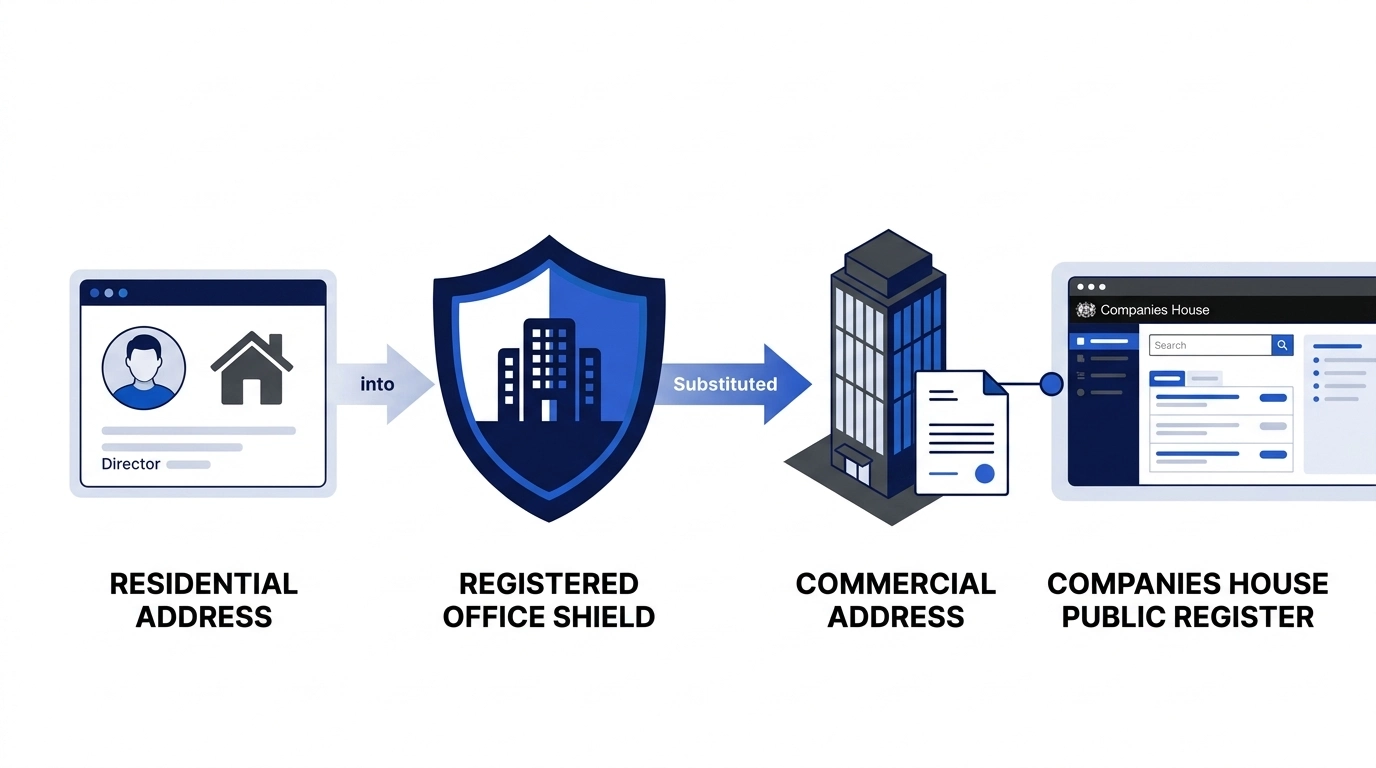
Professional address providers assign a legitimate corporate location to handle official correspondence for your enterprise. When statutory entities like HM Revenue and Customs or Companies House dispatch legal mail, agents scan and forward digital copies securely to your personal account. Your home address remains private throughout the statutory registration process.
Directors maintain statutory compliance while shielding their domestic living space from public scrutiny. Corporate laws mandate that companies maintain an official service address within their jurisdiction of incorporation. Utilizing a professional facility satisfies UK legal obligations under the Companies Act 2006 without compromising personal boundaries.
A professional corporate location builds trust with commercial clients, institutional banks, and prospective investors. A distinct commercial location prevents your business from appearing as an informal home operation during corporate background checks. Shielding your home details maintains a professional distance between corporate liabilities and personal family life.
What Are the Key Differences Between Residential and Commercial Business Addresses?
The key differences lie in statutory privacy, commercial credibility, junk mail volume, and physical security. Commercial business addresses protect home locations, project market authority, filter unwanted physical mail, and restrict public access to your personal property.
Residential locations fail to project corporate authority during statutory evaluation processes. Institutional lenders, corporate vendors, and prospective enterprise clients analyze registered office details during standard due diligence reviews. A dedicated commercial address establishes immediate institutional legitimacy and commercial market readiness.
Mail handling standards vary significantly between domestic properties and dedicated corporate facilities. Domestic addresses receive unrestricted physical mail, exposing homeowners to junk post and unsolicited sales material. Professional address providers filter non-statutory spam while digitizing official communications from regulatory bodies like HM Revenue and Customs.
When evaluating address options for corporate structuring, founders compare structural privacy features against personal operational preferences. Compare the primary operational parameters below to select the right address setup:
Businesses securing dedicated office locations often require additional statutory corporate filings to maintain full regulatory alignment. Companies manage their governance framework by obtaining supplementary company documents to update statutory records alongside their registered address configuration. Updating statutory details promptly preserves legal compliance across corporate registries.
Why Do Data Brokers and Scrapers Target Public Statutory Registers?
Data brokers and scrapers target public statutory registers because Companies House provides free, open, and legally verified personal data. Web scraping bots automatically extract newly registered director details to create commercial marketing lists and identity databases.
Automated web scraping scripts continuously index new corporate incorporations across the United Kingdom. Scrapers capture corporate director names, filing dates, registered office locations, and operational sectors within minutes of publication. Data harvesting firms resell these compiled records to commercial telemarketers, direct mail operators, and credit agencies.
When scrapers capture residential data, your personal home address distributes across dozens of online search engines and commercial directories. Removing your details from individual data broker databases requires exhaustive manual removal requests. Shielding your residential data before completing statutory registration prevents automatic distribution across secondary databases.
Commercial fraud syndicates analyze public corporate filings to identify active business owners. Fraudsters utilize published home address data to draft sophisticated phishing communications and fraudulent invoicing schemes. Suppressing your home address behind a professional statutory proxy mitigates exposure to targeted corporate identity theft.
How Do You Change an Existing Address on Companies House?
You change an existing address on Companies House by filing statutory Form AD01 through the official portal or an approved corporate agent. Submitting the updated commercial address updates statutory public records immediately.
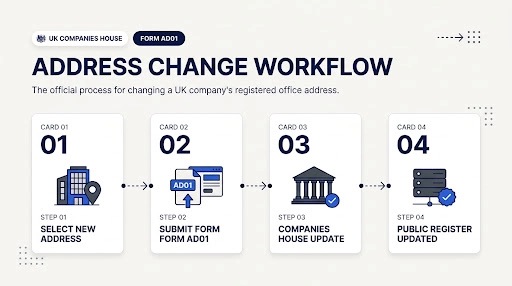
Corporate officers submit Form AD01 to notify the Registrar of Companies regarding official address adjustments. The statutory filing specifies the precise new location within the same UK jurisdiction. Processing electronic statutory submissions takes between 3 and 24 hours through automated filing portals.
Updating your registered office address does not automatically purge historical address records from legacy corporate filings. When a home address was previously listed on historical incorporation forms, that specific historical record remains visible within public document archives. Directors must file formal suppression applications under statutory privacy rules to remove historical home details from historical public documents.
When transitioning corporate address arrangements, business owners must evaluate whether their initial setup compromises long-term personal privacy. Readers looking into domestic registration risks can evaluate should you use your home address as a registered office to understand historic filing implications. Updating statutory records early limits ongoing digital data harvesting.
What Corporate Security Risks Arise From Public Address Visibility?
Public address visibility creates physical security risks, including unexpected doorstop visits from disgruntled customers, aggressive sales agents, process servers, and direct identity impersonation. Publicly listing your home address removes the physical barrier between corporate liabilities and personal family living.
Commercial disputes occasionally lead to unannounced physical visits at a company’s legal address. Disgruntled consumers, disgruntled ex-employees, and process servers service official legal notices directly to registered locations. When your registered office is your personal residence, these uncomfortable physical interactions occur directly at your family home.
Corporate identity fraud escalates when bad actors access verified residential details alongside director names. Fraudsters submit forged statutory documentation to change company details, order commercial goods under corporate credit lines, or obtain fraudulent loans. Restricting personal address visibility eliminates a critical data point used by identity thieves.
Physical security concerns affect remote workers, sole directors, and female entrepreneurs seeking personal safety online. Publishing domestic living details exposes household members to unwanted attention and stalking risks. Implementing professional address solutions builds a secure wall between corporate visibility and family living spaces.
Companies seeking comprehensive protection often back up their address shielding with official legal authorizations. Enterprise managers frequently choose to protect your privacy with a Form My Company Letter of Authority to ensure third-party corporate agents manage legal communications securely. Establishing strong corporate boundaries maintains complete operational security.
How Does a Registered Office Service Maintain Statutory Compliance?
A registered office service maintains statutory compliance by providing an official physical location within the legal jurisdiction for receiving official mail. The service accepts statutory notices from government bodies and forwards digital copies to company officers promptly.
Section 86 of the Companies Act 2006 mandates that every UK company must maintain a registered office address at all times. The address must reside in the same UK country where the business is incorporated, such as England and Wales, Scotland, or Northern Ireland. Professional address providers supply fully compliant locations within these required jurisdictions.
Statutory post includes official notices from HM Revenue and Customs, Companies House, the Insolvency Service, and courts of law. Registered office services process incoming statutory mail daily, scanning official documents into secure electronic files. Immediate digital notification ensures directors meet strict statutory response deadlines for tax filings and legal notices.
Commercial address facilities must hold proper anti-money laundering registration to comply with government financial regulations. Regulated providers verify director identity credentials using government-issued identification documents before activating address services. Choosing a fully compliant, regulated provider guarantees your corporate address meets all UK statutory standards.
Securing Your Corporate Privacy With Form My Company
Form My Company delivers professional registered office solutions designed to protect corporate director privacy. Our services replace your domestic living address with a prestigious commercial location on Companies House records, preventing public exposure across search engines and marketing databases. Form My Company handles statutory mail processing efficiently, scanning and delivering official government communications securely to your digital dashboard while keeping your personal domestic address entirely confidential.
Explore More Supplementary Company Documents Guide,
How to Use Certified Formation Documents to Apply for Business Finance
How Often Should You Renew Certified Copies of Company Records?
Frequently Asked Questions
What are supplementary company documents in the UK?
Supplementary company documents are official legal certificates and administrative filings that supplement basic UK incorporation paperwork. These statutory records include certificates of good standing, share certificates, director change forms, and official legal authorities required by banks, courts, and regulatory bodies. Business founders order these verified filings through Form My Company to validate corporate status, update statutory details, and demonstrate legal compliance.
Why do businesses need supplementary company documents?
Businesses require Supplementary Company Documents to complete mandatory due diligence when opening corporate bank accounts, securing external investment, or expanding international operations. Financial institutions and legal entities demand certified statutory documents to verify company ownership, director authority, and legal standing on official UK registers. Form My Company provides certified copies and updated corporate records to ensure seamless corporate verification and compliance.
How do I order certified supplementary company documents?
You can request official Supplementary Company Documents online by submitting your company registration details through an accredited corporate service provider. Providers like Form My Company retrieve certified statutory files directly from Companies House, including official status certificates, corporate amendments, and legal authority documents. Once processed, your verified documents are delivered electronically or by physical post depending on institutional requirements.
How quickly can supplementary company documents be issued?
Standard electronic delivery for Supplementary Company Documents typically takes between 3 to 24 hours depending on the specific filing or certificate requested. Official hard-copy certified documents requiring courier delivery or apostille legalization may take several business days. Form My Company processes statutory requests directly through corporate registration portals to ensure rapid retrieval and submission.
What is the difference between incorporation documents and supplementary company documents?
Incorporation documents are the initial legal filings—such as the Certificate of Incorporation, Memorandum, and Articles of Association—created during company formation. Supplementary Company Documents are secondary filings generated throughout the company’s lifecycle to reflect statutory updates, verify current operational standing, or prove corporate authority. Service providers like Form My Company help directors maintain and update both types of statutory records to uphold regulatory alignment.