
The Home Office requires UK businesses to submit at least four mandatory supporting documents from Appendix A within 5 working days of applying. These documents prove trading presence, corporate bank account operation, employer liability insurance, tax compliance, and physical business premise operations in the UK.
UK businesses applying for a sponsor licence must demonstrate legitimacy, active operations, and full compliance with UK immigration law. The Home Office enforces strict document submission deadlines to verify that sponsorship applications align with legal standards. Employers fail compliance audits when they submit incomplete paperwork or miss the strict five-day window. Understanding exact evidence requirements ensures smooth application processing and prevents immediate rejection.
Why Does the Home Office Require Supporting Documents for a Sponsor Licence?
The Home Office requires supporting documents to verify that a UK business operates legally, maintains financial stability, and possesses authentic trading premises. Supporting evidence protects the immigration system from fraudulent entities and ensures businesses can fulfill employer compliance duties.
The UK Home Office regulates skilled worker recruitment through rigorous vetting procedures. Immigration officials analyze corporate records to establish that an organization exists as a genuine operating business. Verification checks cross-reference company numbers, tax registrations, and banking activities against official government databases.
Failure to establish genuine trading activity leads directly to application refusal and cool-off penalties. The Home Office verifies that key personnel within the organization possess clean background records. Authorised officers evaluate organizational charts to confirm internal hierarchy and accountable management structures. Proper documentation safeguards legitimate employers while preventing unverified entities from issuing sponsorship certificates.
What Mandatory Documents Must Every UK Company Provide?
UK companies must submit mandatory documents including corporate bank statements, VAT registration certificates, proof of business premises, and audited annual accounts. The Home Office cross-checks these records to confirm operational status, legal standing, and tax compliance across the United Kingdom.
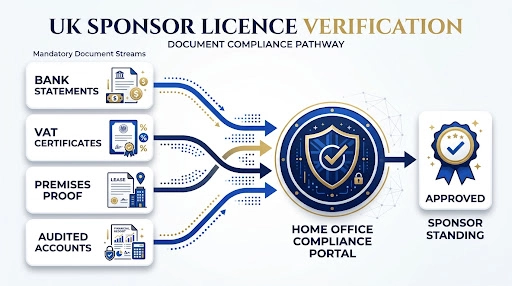
Appendix A specifies mandatory document combinations based on corporate structure and operational background. Startups operating under 18 months face distinct requirements compared to established corporate entities. Every business must supply evidence establishing an active corporate bank account with an Financial Conduct Authority (FCA)-regulated bank.
Official corporate records validate current tax standing with HM Revenue and Customs (HMRC). Organizations must supply PAYE reference numbers, Accounts Office references, and recent tax returns. Proof of ownership or lease agreements for physical business premises confirms operational infrastructure. You can secure supplementary company documents to verify corporate filings, share structures, and registered address details before submitting your application.
Which Financial Records Validate Business Authenticity?
Financial records validating business authenticity include corporate bank statements, audited annual accounts, corporate tax returns, and HMRC payment receipts. These financial files prove solvency, active commercial trading, and ongoing compliance with UK tax obligations for prospective sponsor organisations.
Financial transparency underpins every successful sponsor licence application. The Home Office inspects financial statements to ensure the company maintains sufficient operational funds. Bank statements must display regular commercial transactions matching declared business activity. Audited accounts prepared by registered accountants carry significant weight during official evaluation processes.
Newly established businesses without audited records must present opening balance sheets and investor funding proofs. HMRC corporate tax documentation confirms registered status and timely payment histories. Businesses operating without clear financial trails trigger mandatory site visits and compliance reviews. Providing clear financial histories accelerates decision timelines and reduces administrative clarification requests.
How Do Legal and Regulatory Documents Prove Compliance?
Legal and regulatory documents prove compliance through Employer’s Liability Insurance certificates, professional body registrations, sector-specific regulatory permits, and commercial property leases. These legal credentials establish that an organization meets statutory UK operating standards and workplace safety regulations.
Regulated industries must submit proof of registration with recognized governing authorities. Healthcare providers present Care Quality Commission (CQC) certificates, while financial firms provide Financial Conduct Authority approvals. Sector-specific licenses demonstrate that the business operates within established legal frameworks.
Employer’s Liability Insurance certificates confirm coverage of at least £5,000,000 to protect workforce operations. Franchise operations must supply signed franchise agreements detailing corporate permissions and operational boundaries. Property lease documents must show valid planning permission for commercial commercial use. Maintaining up-to-date corporate compliance files simplifies validation procedures for immigration officers.
What Documents Are Required for Startups and Small Businesses?
Startups and small businesses must submit corporate bank account confirmation, proof of office premises, PAYE registration notices, and director background credentials. These initial evidence items prove genuine early-stage operations for companies trading for less than 18 months.
Early-stage companies often lack multi-year financial track records or historic tax returns. The Home Office accommodates young enterprises by accepting foundational corporate records. Startups must provide formal letters from FCA-regulated banks confirming active business accounts. Business bank statements showing initial equity investments or revenue streams establish financial viability.
Planning corporate submissions requires structural planning to avoid administrative oversights. Employers often learn how to prepare company documents for a sponsor licence application by auditing current corporate records against Appendix A checklists. Lease agreements must reflect direct corporate occupancy rather than generic virtual address subscriptions. Early-stage businesses must also demonstrate clear recruitment requirements for skilled positions.
How Should Businesses Prepare and Format Supporting Evidence?
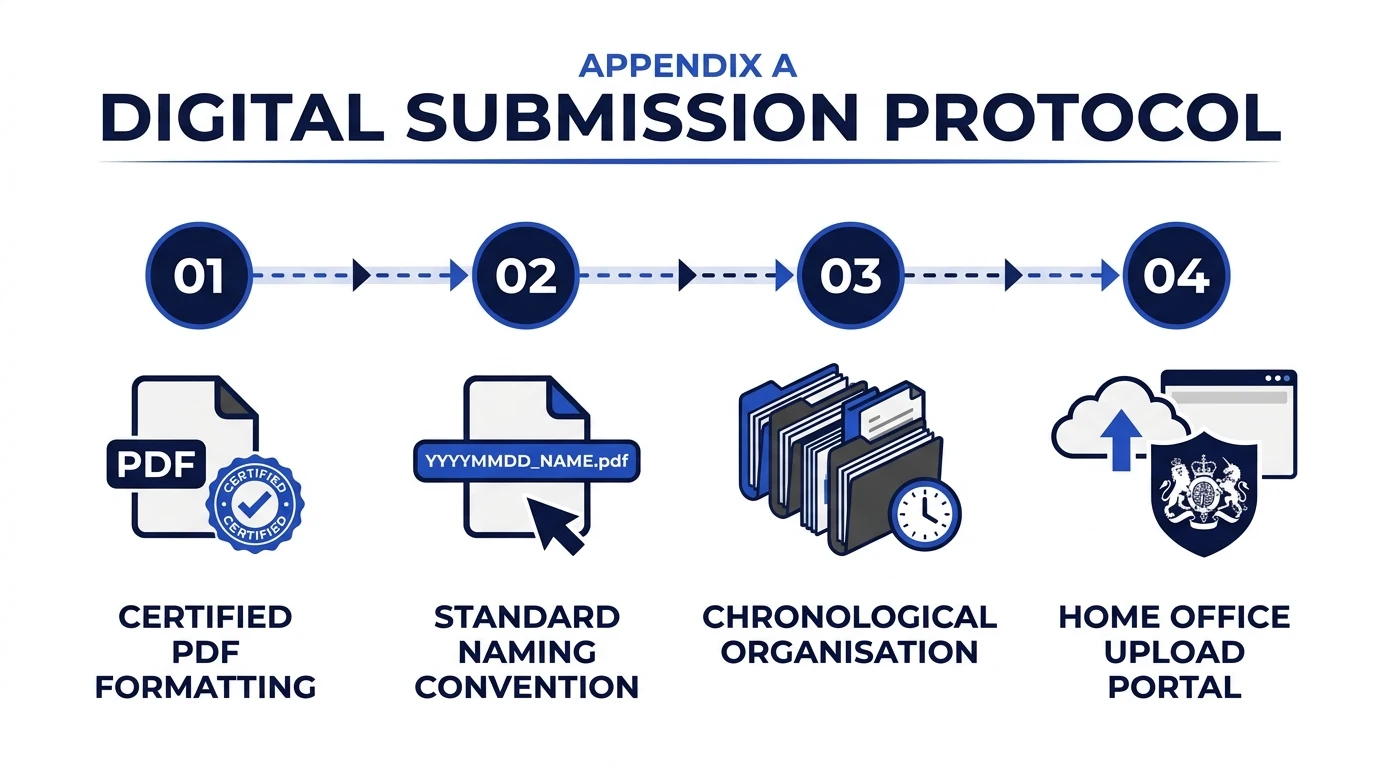
Businesses should format supporting evidence as clear, certified PDF files matching Appendix A submission naming conventions. Organizations must organize digital records chronologically, verify document authenticity, and upload files through the official Home Office online portal.
Immigration caseworkers review thousands of corporate document submissions weekly. Unclear scans, missing pages, or uncertified translations cause unnecessary processing delays. Every non-English document requires a certified translation accompanied by translator credentials and contact details. Digital scans must capture complete documents, including formal letterheads, stamps, and signatures.
Document files require structured naming conventions corresponding directly to Appendix A table categories. Submitting clear index sheets speeds up caseworker reviews and reduces clarification requests. Key personnel must verify that corporate naming details match registered Companies House entries exactly across every document. Proper preparation prevents technical rejections due to unreadable files or formatting errors.
What Are the Key Roles and Responsibilities of Key Personnel?
Key personnel responsibilities include managing the Sponsorship Management System (SMS), maintaining reporting duties, verifying employee right-to-work status, and retaining compliance records. Named individuals assume legal liability for sponsor licence obligations and Home Office communication.
The Home Office requires businesses to assign specific corporate roles during application submissions. Organizations appoint an Authorised Officer, Key Contact, and Level 1 User. The Authorised Officer assumes ultimate legal responsibility for sponsorship compliance and operational standards. Level 1 Users manage day-to-day administration within the online Sponsorship Management System.
Appointed key personnel must submit clean background verification records without unspent criminal convictions. Named individuals must be settled workers or British citizens, except under specific corporate exemptions. The Home Office verifies employment status and physical location for all named officers. Businesses ensure long-term compliance stability when they assign qualified, trained professionals to key personnel roles.
What Happens After Document Submission to the Home Office?
After document submission, Home Office caseworkers review evidence, perform background checks, cross-reference government databases, and potentially conduct unannounced site visits. Verification processes confirm business legitimacy before official approval or refusal determinations are issued.
Caseworkers assess submitted paperwork against Appendix A validation matrices upon receipt. Officials verify bank details, premises leases, and HMRC registrations through direct agency checks. The Home Office schedules pre-licence site visits if paperwork triggers operational questions. Compliance officers inspect physical premises and interview key personnel during these audits.
Applications containing complete, validated documents usually progress smoothly through evaluation phases. Missing files or deadline breaches lead to immediate application rejection and forfeited processing fees. Successful evaluations result in sponsor licence grants and SMS access credentials. Many expanding UK firms choose to get sponsor licence-ready company documents from Form My Company to streamline corporate paperwork preparation before initial submission.
Securing a Home Office sponsor licence requires meticulous preparation, strict adherence to Appendix A rules, and clear evidence of business legitimacy. UK companies must provide at least four verified supporting documents demonstrating trading history, bank account operations, tax compliance, and physical premises. Meeting the mandatory five-day submission window prevents administrative rejections and protects business expansion plans.
Form My Company assists growing businesses by delivering compliant, structured corporate documentation tailored for official submission. Proper preparation ensures your business meets Home Office standards, passes compliance checks, and secures international talent smoothly.
Explore More Supplementary Company Documents Guide,
Get Fast Certified Formation Documents From Form My Company
Skip the Solicitor Visit With Certified Documents From Form My Company
Frequently Asked Questions
What are supplementary company documents and why are they needed?
Supplementary company documents are official legal and administrative records, such as certificates of good standing, articles of association, share certificates, and official register extracts, that prove a business’s legal structure and operational compliance. Organizations often require these documents to verify corporate identity during UK sponsor licence applications, bank account openings, commercial contract negotiations, and international trade filings. Form My Company provides certified supplementary company documents to help businesses satisfy strict legal, regulatory, and Home Office verification standards.
How do supplementary company documents assist with a UK sponsor licence application?
Under Home Office Appendix A guidance, UK businesses applying for a sponsor licence must present verified evidence of active trading, corporate governance, and registered structure. Official supplementary company documents confirm company registration details, director appointments, share distribution, and registered office addresses needed to pass compliance audits. Form My Company prepares tailored documentation packages to ensure all submitted corporate files align precisely with Home Office submission requirements.
Where can a business obtain certified supplementary company documents in the UK?
Businesses can request official supplementary company documents directly through Companies House or obtain professionally verified and formatted packages from corporate service providers. Working with Form My Company ensures that all requested records, including certificates of incorporation, change of name certificates, and official register duplicates, are current, properly certified, and formatted for legal and government review.
Which supplementary company documents are required to open a UK business bank account?
UK financial institutions typically require a Certificate of Incorporation, Memorandum and Articles of Association, confirmation of registered office, and a current Register of Directors and Shareholders to verify corporate ownership. Banks review these supplementary company documents to fulfill Know Your Customer (KYC) and Anti-Money Laundering (AML) legal regulations before approving business accounts. Form My Company supplies verified document bundles that meet standard banking compliance checks.
How quickly can Form My Company deliver supplementary company documents?
Form My Company processes and delivers official supplementary company documents digitally within 24 to 48 hours for standard requests, with expedited processing available for time-sensitive corporate submissions. Digital PDF copies are formatted for immediate electronic filing, while physical certified copies can be issued when hard-copy verification is required by banks, immigration authorities, or courts.