Form My Company maximizes your business savings by auditing historical purchases, identifying eligible startup expenses, structuring accurate HMRC documentation, and submitting precise pre-registration VAT recovery claims. This process recovers up to 20% value-added tax on past business purchases to preserve cash flow.
Why Is Reclaiming Pre-Registration VAT Critical for New UK Businesses?
Reclaiming pre-registration VAT restores substantial capital directly into your company bank account during early trading phases. Securing these refunds offsets initial capital expenditure, lowers net operational costs, and strengthens early business cash flow balance sheets.
New business formations incur significant upfront costs long before formal value-added tax registration occurs. Companies purchase tools, computers, software subscriptions, office supplies, and professional advice to establish operations. Standard UK value-added tax rules permit businesses to recover 20% VAT on qualifying startup expenditures retroactively. Failing to lodge these recovery claims leaves thousands of pounds of recoverable working capital unclaimed.
Early cash flow stability determines the long-term viability of newly registered UK enterprises. Recovering historical input tax transforms past expenditures into active liquidity for ongoing commercial operations. When companies implement structured claim processes, they protect their working capital while maintaining strict compliance with official Revenue and Customs standards. Understanding the core difference between input tax and output tax remains vital when managing cash accounting systems. If startup founders analyze how cash flow works under alternative schemes, reviewing what is cash accounting VAT and how does it help small business cash flow? provides key foundational knowledge on tax timing mechanics.
Which Purchases Qualify for Pre-Registration VAT Recovery Under HMRC Rules?
HMRC permits VAT recovery on physical goods purchased within four years of tax registration that remain on hand. Services purchased within six months prior to the official VAT effective date also qualify for full input tax recovery.
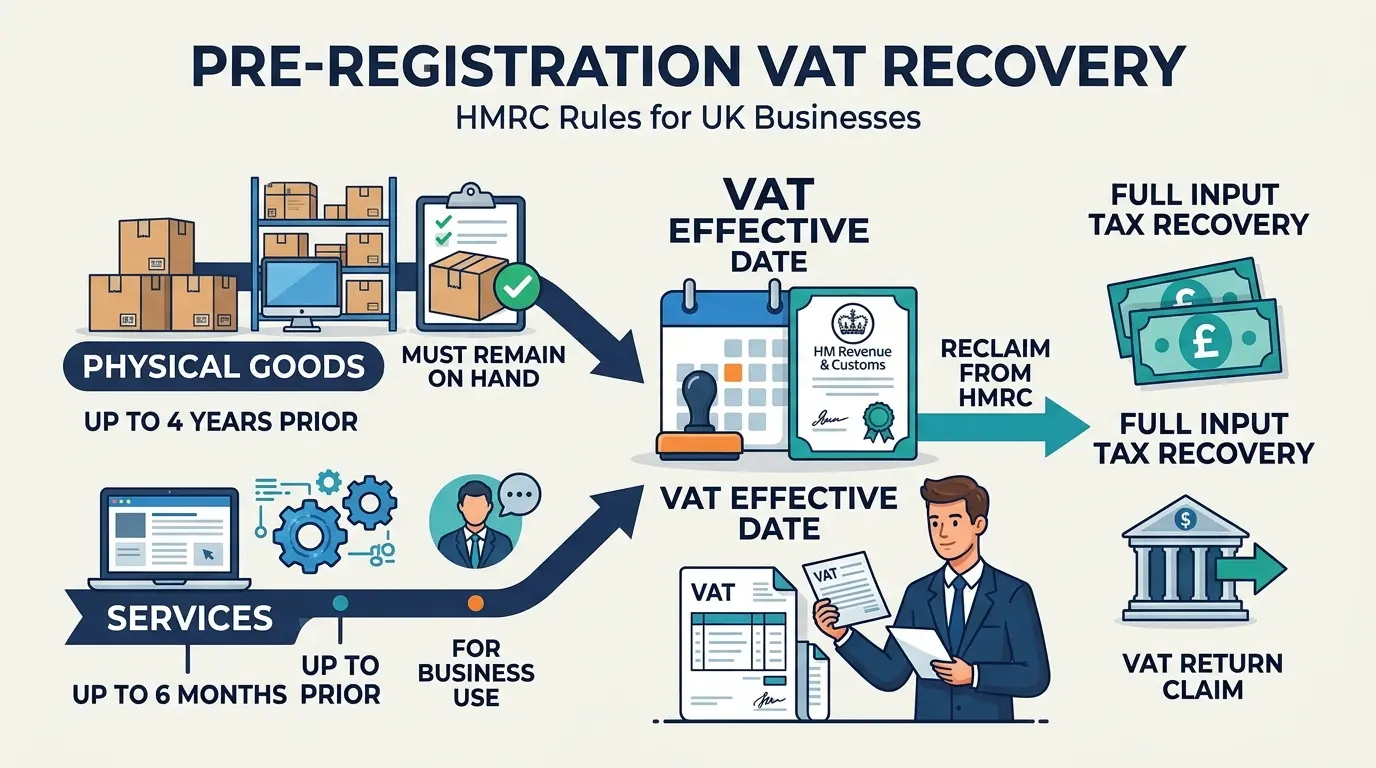
Determining asset eligibility requires precise categorization under distinct statutory time limits set by UK tax authorities. Physical goods include equipment, tools, machinery, office furniture, stock for resale, and tangible raw materials. These physical assets must meet a specific condition: your business must still own or use them on the date your official VAT registration becomes effective. If your company consumed, sold, or disposed of goods prior to registration, HMRC strictly disallows input tax claims on those specific items.
Services follow a significantly shorter statutory timeframe under standard HMRC rules. Qualifying services encompass legal consultation, accountancy advice, web development, marketing campaigns, architectural planning, and rented premises costs incurred within six months prior to registration. Digital subscriptions, software licenses, and utility bills paid during this six-month window also qualify for input tax recovery. Businesses must retain full tax invoices detailing seller registration numbers, net amounts, and specific VAT charged for every line item claimed.
What Are the Key Time Limits for Pre-Registration Input Tax Claims?
The UK tax authority enforces a strict four-year limit for tangible goods and a six-month limit for services. Missing these statutory deadlines permanently forfeits your right to reclaim input tax on past purchases.
Time limits calculate backward from the exact effective date of VAT registration issued by HMRC. For example, a company registering on October 1, 2026, calculates its four-year window for goods back to October 1, 2022. The six-month window for services extends back to April 1, 2026. Every expense invoice must fall strictly within these calculated date boundaries to achieve successful tax recovery.
Accurate date verification requires detailed review of payment proofs, delivery notes, and tax invoice dates. HMRC rejects claims where invoice dates predate the allowable statutory windows even by single days. When business owners evaluate historic spending profiles, consulting comprehensive guides on how to reclaim pre-registration VAT on goods and services purchased before trading ensures accurate calculation of qualifying expense windows prior to submission.
What Documentation Does HMRC Require to Validate Your Pre-Registration VAT Claim?
Validating pre-registration claims requires itemized VAT invoices, detailed evidence of business purpose, proof of payment, and physical inventory records confirming goods remain present on the registration date.
Documentation standards enforced by tax authorities remain exceptionally stringent during historical tax audits. Generic credit card slips, bank statements, or basic order acknowledgments do not satisfy statutory proof requirements. Every claim item requires a formal tax invoice displaying the supplier’s valid nine-digit VAT registration number, transaction date, detailed description of supply, rate of tax applied, and total VAT charged.
Businesses must establish clear audit trails linking historical purchases directly to commercial activities. Maintaining organized digital records prevents claim rejections during official tax authority inspections.
Essential validation documents include:
Retain original VAT invoices with clear line-item breakdowns
Compile matching business bank statements showing completed transfers
Maintain active inventory logs listing physical stock on hand
Log asset identification numbers for equipment and machinery
How Does Form My Company Streamline the Pre-Registration VAT Process?
Form My Company audits historical receipts, categorizes eligible goods and services, calculates accurate claim totals, and structures your initial VAT return to ensure full compliance and fast processing.
Navigating complex input tax regulations requires dedicated professional oversight to avoid costly calculation errors. Form My Company reviews historical business records to separate eligible purchases from non-claimable operational expenses. Certified tax specialists verify supplier registration numbers, check date boundaries, and confirm asset retention metrics. This thorough preliminary review protects businesses against penalty assessments stemming from over-claimed input tax values.
Our team compiles validated expenses directly into your first official HMRC tax return submission. By aligning historical expense records with statutory filing standards, we eliminate administrative burdens for growing business founders. Seeking professional VAT registration assistance guarantees that your company submits fully compliant claims while maximizing allowable input tax recovery sums.
What Are the Most Common Pitfalls When Claiming Historical Input Tax?
Common mistakes include claiming consumed goods, missing valid tax invoices, exceeding statutory time limits, claiming non-business personal expenses, and failing to account for goods sold prior to registration.
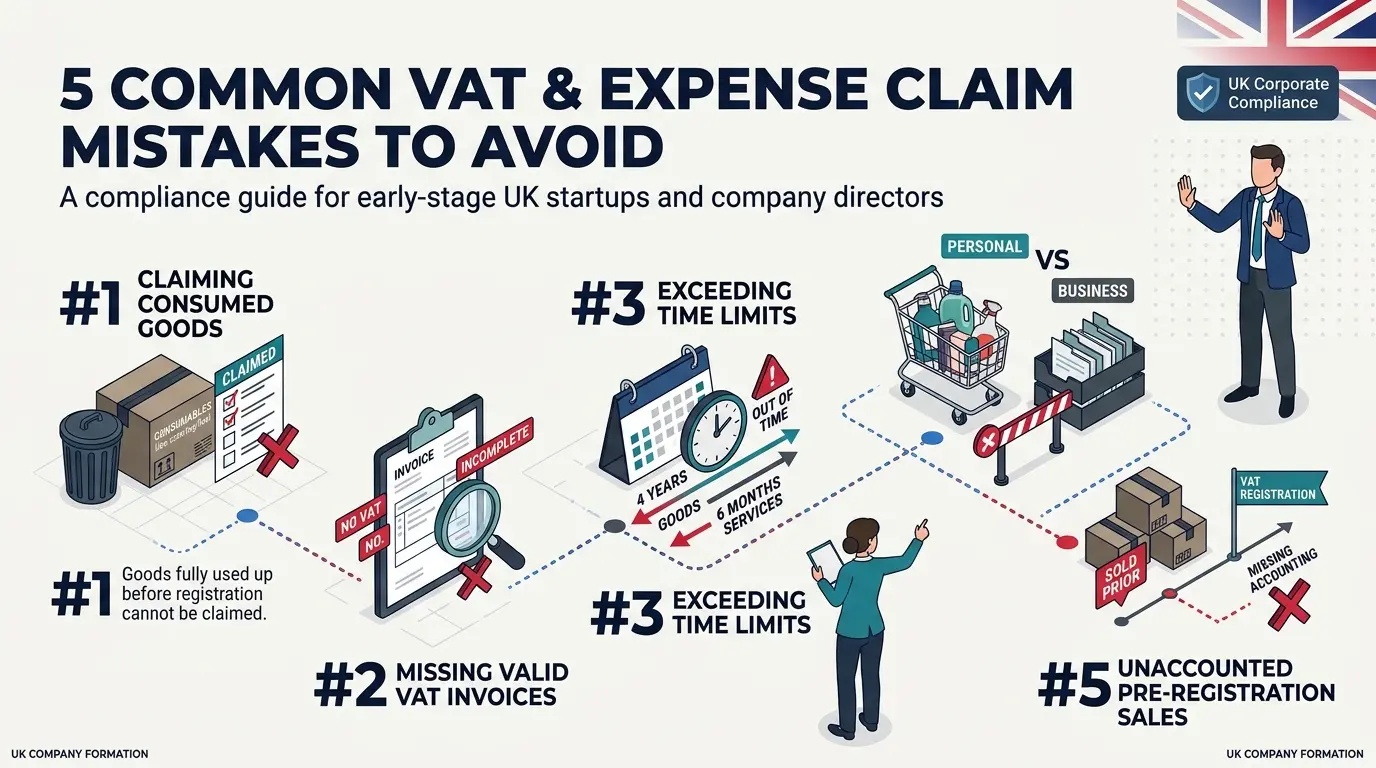
One major error involves claiming VAT on physical items consumed or sold before the registration effective date. For instance, office stationery used up three years prior to registration cannot be claimed, as the physical goods no longer exist. Similarly, raw materials converted into finished products that were sold prior to registration become completely ineligible for input tax recovery.
Another frequent pitfall involves inadequate documentation practices across initial operational phases. HMRC immediately disallows input tax claims supported only by simplified receipts lacking broken-down VAT amounts. Furthermore, miscalculating service dates past the six-month deadline results in automatic rejection during tax assessments. Partnering with experienced professionals prevents these costly administrative mistakes.
How Do Pre-Registration Claims Affect Your First Official VAT Return?
Pre-Registration VAT claims are included directly in Box 4 of your initial VAT return, offsetting output tax owed and generating a net tax refund from HMRC.
Your first formal VAT return consolidates ongoing operational tax calculations with historical pre-registration input tax sums. Box 4 of the return records total input tax, including validated historical claims on goods and services. If historical input tax exceeds output tax collected from customers during the first period, HMRC issues a direct tax refund to your corporate bank account.
When tax authorities receive returns featuring substantial pre-registration claims, automated audit triggers frequently prompt information requests. HMRC routinely requests supporting invoices and inventory logs before releasing multi-thousand-pound refunds. Structured presentation of documentation ensures fast verification and smooth payment release. Form My Company manages these tax authority queries directly, ensuring your business receives its entitled capital without unnecessary delay.
Reclaiming pre-registration VAT provides essential funding to offset early operational costs for growing UK companies. Validating historic goods within four years and services within six months ensures full statutory compliance with HMRC frameworks. Form My Company identifies qualifying purchases, prepares accurate documentation, and submits optimized claims through dedicated business services.
Explore More VAT Registration Assistance Guide,
Stress-Free HMRC Setup: Why UK Founders Trust Form My Company for VAT Registration
Choose the Right Scheme: How Form My Company Guides You Through Flat Rate VAT Setup
Frequently Asked Questions
How does Form My Company assist small businesses with VAT Registration Assistance?
Form My Company simplifies the UK tax onboarding process by evaluating your business turnover, gathering necessary HMRC documentation, and submitting your application accurately. Our VAT Registration Assistance ensures your business selects the optimal VAT scheme to maintain compliance and maximize early cash flow recovery.
How long does HMRC take to process a VAT registration application?
HMRC typically processes online VAT registration applications within 10 to 30 working days, though additional information requests can extend this timeframe. Form My Company verifies all business evidence and tax details prior to submission to prevent administrative delays and secure your VAT number promptly.
Can I reclaim VAT on expenses incurred before my official registration date?
Yes, UK businesses can recover VAT on physical goods purchased up to four years prior to registration—provided they are still on hand—and on qualifying services purchased within six months of the effective registration date. Form My Company reviews your historical receipts and incorporates valid pre-registration input tax into your first official VAT return.
Is VAT registration mandatory for all UK businesses?
VAT registration becomes mandatory when a business’s taxable turnover exceeds the statutory HMRC threshold of £90,000 within a rolling 12-month period or is expected to cross it within the next 30 days. Voluntary registration is also permitted below this limit, allowing businesses to claim back input tax on operational purchases.
What documents are required to complete VAT registration in the UK?
Completing VAT registration requires proof of business identity, your Unique Taxpayer Reference (UTR), Bank account details, incorporation certificates, and evidence of trading activity. Utilizing professional VAT Registration Assistance ensures all corporate credentials and financial records meet HMRC statutory compliance standards.