

UK businesses reclaim pre-registration Value Added Tax by reporting eligible historical purchases on their first official VAT return. HM Revenue and Customs permits recovering tax on physical goods bought within four years and services purchased within six months prior to your effective date of registration.
How Far Back Can UK Businesses Reclaim Pre-Registration VAT?
Businesses recover input tax paid on physical goods purchased up to four years prior to registration. HM Revenue and Customs restricts pre-registration tax recovery on services to purchases made within six months of your official effective registration date.
HM Revenue and Customs establishes two distinct statutory timeframes for recovering Value Added Tax incurred prior to official registration. The four-year window applies exclusively to physical goods, machinery, tools, and office inventory. This extended timeline allows founding directors to recover substantial capital expenditure incurred during early research and business setup phases.
The six-month window governs all intangible service purchases made before your effective date of registration. Services include professional legal fees, accountancy charges, web design costs, software subscriptions, and commercial architectural work. These time limits run precisely back from your official registration date, making accurate records essential for valid claims.
Which Pre-Registration Goods Qualify for Input Tax Recovery?
Qualifying goods include physical assets, raw materials, office equipment, and stock purchased specifically for business operations. You must retain physical ownership of these items on your official VAT registration date to submit a valid tax recovery claim.
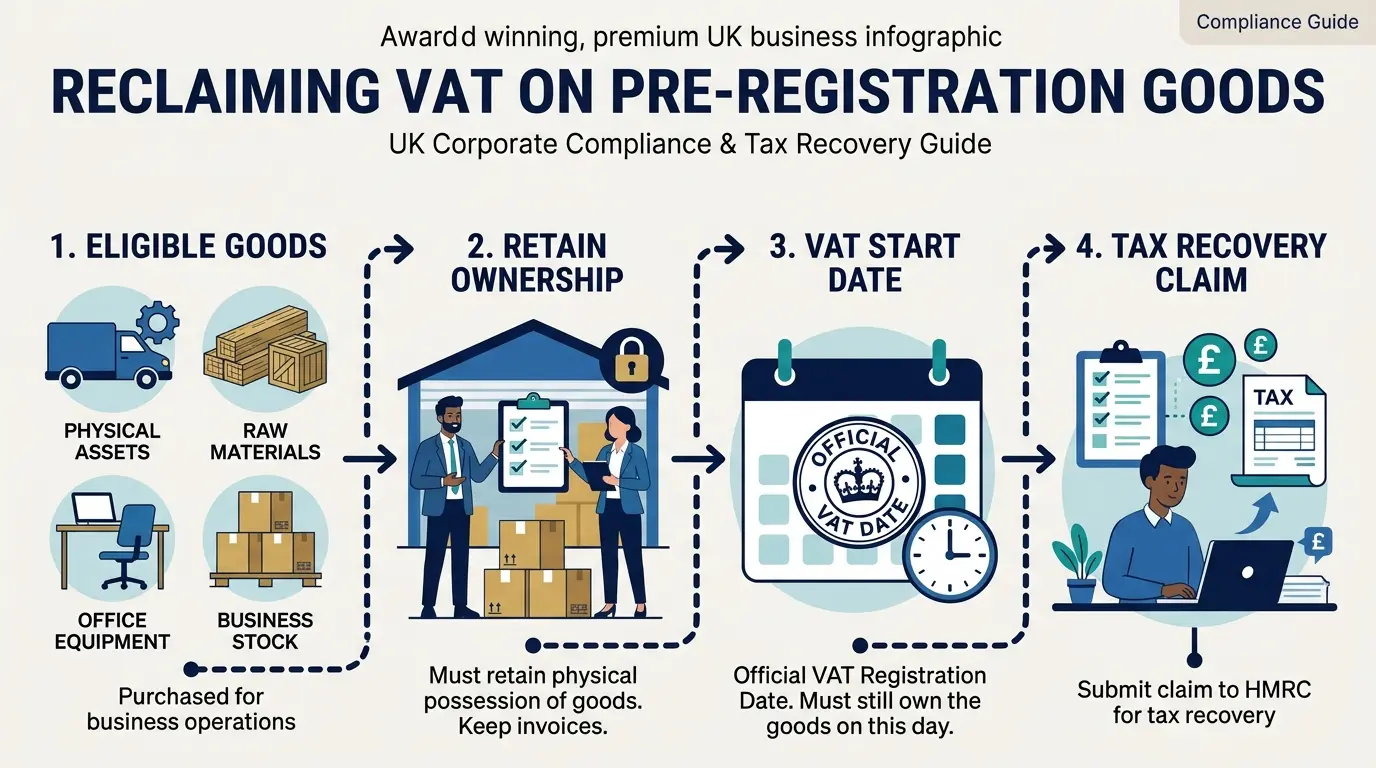
Physical goods qualify for tax recovery if your business bought them strictly for commercial purposes. Eligible items include computer hardware, office furniture, machinery, tools, and raw materials. When founders purchase assets prior to trading, the business recovers the full input tax amount on its initial tax filing.
HM Revenue and Customs strictly enforces the physical possession rule on the registration date. You cannot recover tax on goods that your company consumed, sold, or discarded before registration took effect. For example, stationery used up during setup or inventory sold to early customers fails to meet statutory recovery requirements.
Capital assets like machinery or vehicles remain eligible provided they are still operational within the business. If your company uses an asset for both personal and commercial purposes, you apportion the claim accordingly. You only recover the percentage of tax that matches actual business usage.
Which Pre-Registration Services Are Eligible for VAT Reclaim?
Eligible services comprise professional fees, software subscriptions, legal advice, accountancy services, and marketing expenses incurred within six months of registration. These services must relate directly to ongoing business activities and operational establishment.
Services purchased during the startup phase qualify for tax recovery under strict timing conditions. Acceptable expenditures include professional accountancy fees, legal consultation, web development, digital advertising, commercial rent, and domain registration. HM Revenue and Customs mandates that these service expenses support the core operations of the registered business.
The service must not relate to goods that your business sold or consumed prior to registration. If an accountant audited books for a sole trader business that closed before company formation, that service fails eligibility tests. The underlying benefit of the service must cross over into your active trading period.
Service contracts spanning across your registration date require proportional tax split calculations. You claim pre-registration input tax on the portion falling within the six-month window. The remaining portion processes as standard input tax on subsequent regular return filings.
What Documentation Is Required to Support Pre-Registration Claims?
Valid recovery requires itemised VAT invoices, proof of payment, an accurate asset inventory list, and clear records of business usage. HM Revenue and Customs rejects claims lacking proper documentation displaying valid supplier identification numbers.
Maintaining robust audit trails protects your business during routine HM Revenue and Customs compliance checks. Every claimed expense requires a valid invoice detailing the supplier name, address, tax registration number, and tax rate applied. Simple credit card slips or retail receipts lacking statutory tax breakdowns do not satisfy evidentiary standards.
You must compile a comprehensive stock inventory showing all goods held on your registration date. This record logs purchase dates, invoice numbers, net values, and exact tax amounts paid. This inventory proves that your business retains physical possession of claimed assets when registration begins.
Bank statements serve as secondary evidence verifying that your business actually settled the outstanding invoices. If a director paid for items using personal funds, you must document the director loan reimbursement. Clean cross-referencing between invoices, bank lines, and inventory logs prevents tax authorities from disallowing legitimate input tax.
How Do You Calculate and Submit Pre-Registration Input Tax?
Calculations require totaling eligible input tax across verified invoices and entering the single sum into Box 4 of your first electronic VAT return. You submit this claim directly through HM Revenue and Customs software online.
Calculating your initial claim requires separating historical purchases into physical goods and service categories. First, verify that all physical goods were bought within four years and remain in stock. Second, sum the tax paid on eligible services purchased within the six-month pre-registration window
After totaling these figures, you combine the pre-registration amount with standard input tax incurred during your first official accounting period. You enter this grand total into Box 4 (VAT reclaimed on purchases) of your online return submission. You do not submit individual historical invoices unless HM Revenue and Customs issues a formal request for information.
Submitting an unusually high Box 4 entry often triggers automated compliance inquiries. Tax authorities frequently hold refund payments while inspecting historical documentation. Preparing your supporting evidence before filing ensures rapid responses to compliance queries and prevents extended refund delays. When evaluating cash flow setups, businesses often review what is cash accounting VAT and how does it help small business cash flow? to optimize ongoing tax reporting structures.
What Common Mistakes Cause Rejection of Pre-Registration Reclaims?
Rejection occurs when claiming tax on sold goods, missing six-month service deadlines, lacking valid invoices, or failing to prove physical asset retention. Claiming expenses for non-business usage also prompts immediate audit adjustments.
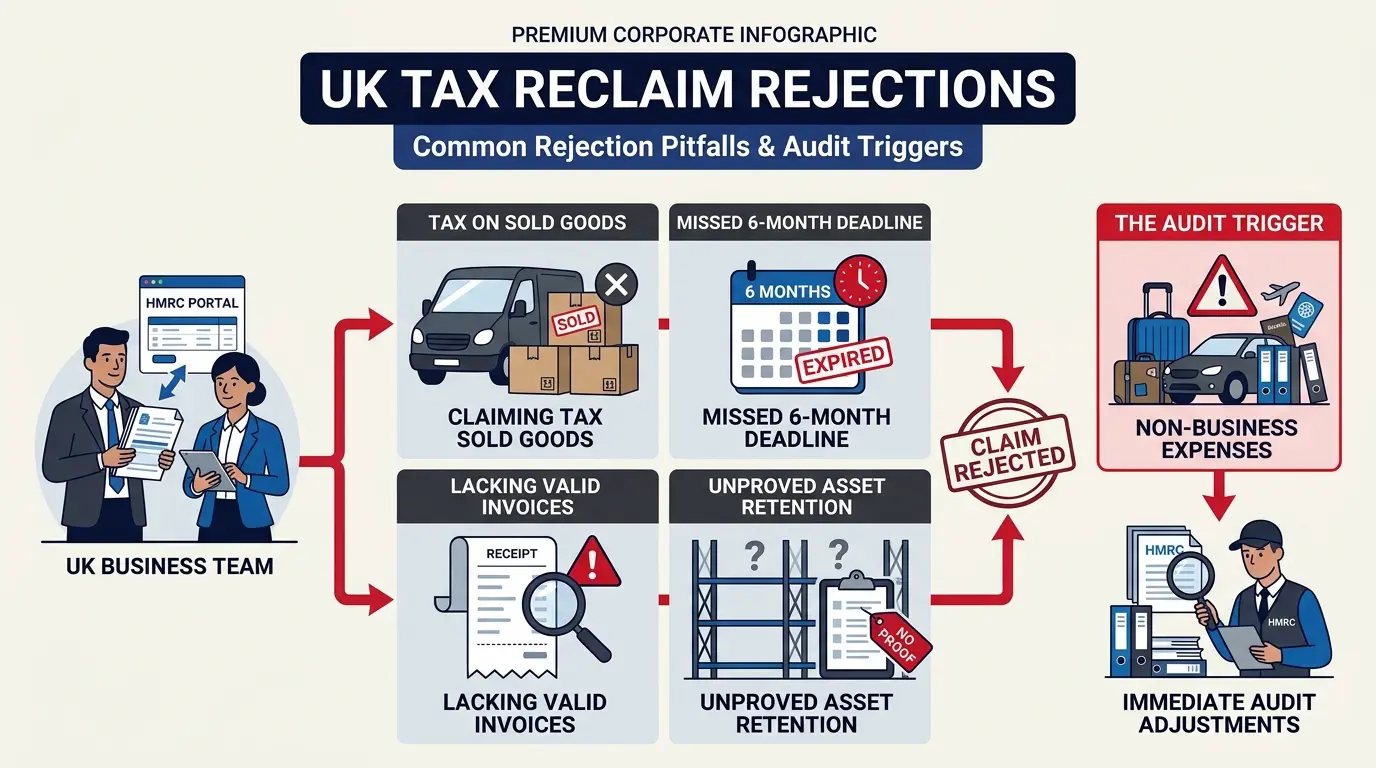
Failing to verify physical stock on the registration date represents the most frequent error during historic reclaims. Directors often attempt to claim tax on raw materials long after conversion into sold finished products. HM Revenue and Customs compliance systems identify these discrepancies by cross-referencing historic purchase dates against trading records.
Another frequent mistake involves miscalculating the six-month time limit for service expenditures. The deadline calculates back from your effective date of registration, not your application submission date. If your registration takes effect on 1 July, services purchased before 1 January fall outside statutory recovery limits.
Claiming full input tax on assets used partially for personal activities also triggers tax penalties. Vehicles, mobile devices, and home office equipment require accurate business-use apportionment. When business owners seek assistance with tax filings, choosing reliable VAT Registration Assistance ensures full compliance with statutory recovery rules.
How Can Form My Company Streamline Your Pre-Registration Tax Recovery?
Form My Company simplifies tax recovery by auditing historical invoices, verifying eligibility windows, compiling stock logs, and filing your first return accurately. Experienced specialists prevent costly compliance delays and maximize statutory tax recovery.
Form My Company assists business owners through every step of historical tax recovery. Specialists review your pre-registration purchases to separate eligible physical assets from service fees. This detailed audit guarantees that every claimed pound meets strict statutory guidelines set by tax authorities.
Our team compiles the required documentation, including itemised stock registers and verified invoice schedules. By organizing audit trails prior to submission, we reduce the risk of processing holds and official inquiries. Form My Company manages communications with tax officials to resolve documentation requests quickly.
Form My Company ensures your initial tax return accurately reflects all pre-registration expenses without breaching statutory time limits. Professional management of your registration process protects working capital during critical startup phases. Discover how maximize your savings: how Form My Company assists with pre-registration VAT claims delivers optimal financial setups for growing companies.
Explore More VAT Registration Assistance Guide,
How to Calculate Your Taxable Turnover Accurately to Avoid HMRC Fines
How to Determine the Exact Moment Your Business Must Register for VAT
Frequently Asked Questions
What does Form My Company include in its VAT Registration Assistance service?
Form My Company provides end-to-end guidance through the official HM Revenue and Customs application process, ensuring your business submits accurate company details and financial information. The service includes determining your effective date of registration, selecting the correct VAT scheme, and verifying all required supporting documentation. This structured assistance minimizes application delays and ensures full compliance with statutory UK tax requirements.
How long does HMRC take to complete VAT registration with professional assistance?
HM Revenue and Customs typically processes standard business VAT registration applications within 30 working days. Utilizing Form My Company’s VAT Registration Assistance reduces application errors, missing information, or administrative rejections that often delay the issuing of your 9-digit VAT number. Once approved, HMRC issues a formal certificate of registration detailing your effective trading date and accounting periods.
Can Form My Company help reclaim pre-registration VAT on historical business expenses?
Form My Company assists businesses in identifying eligible pre-registration input tax on goods purchased up to four years prior and services bought within six months of registration. Specialist advisers review historical invoices and stock inventories to compile valid claims for your first VAT return submission. This structured audit ensures your business recovers maximum legitimate expenditure while remaining fully compliant with HMRC rules.
Do startup companies need to register for VAT before reaching the threshold?
UK businesses must register for VAT if their taxable turnover exceeds the statutory £90,000 threshold within a rolling 12-month period. However, startups can apply voluntarily before reaching this limit to reclaim input tax on startup expenses and improve commercial credibility with corporate clients. Form My Company evaluates your financial projections to determine whether voluntary registration aligns with your operational goals.
What documents are required for VAT Registration Assistance with Form My Company?
To complete the application, businesses must provide official proof of identity, business bank account details, company registration numbers, and a clear summary of commercial activities. Form My Company checks all corporate records and director documentation against official UK compliance standards prior to HMRC submission. Proper document verification prevents compliance holds and ensures efficient processing of your business tax registration.


