

Cash Accounting VAT is an official HM Revenue and Customs scheme that allows businesses to pay Value Added Tax only after receiving payment from customers. This framework prevents cash flow bottlenecks by aligning tax liabilities directly with cleared bank receipts rather than issued sales invoices.
What Is the HMRC Cash Accounting Scheme for VAT?
The HMRC Cash Accounting Scheme is a tax reporting method for small businesses with an annual VAT-exclusive turnover under 1.35 million pounds. It allows companies to account for output tax and reclaim input tax strictly on the dates money leaves or enters their bank accounts.
HM Revenue and Customs created the Cash Accounting Scheme to assist small enterprises with working capital management. Standard VAT accounting requires businesses to calculate tax liabilities based on the date printed on an invoice. If a customer delays payment for 60 or 90 days, the business must still pay the owed VAT to HMRC on time. This creates immediate working capital strain for growing enterprises.
Under the Cash Accounting Scheme, tax obligations trigger only when money physically transfers into your business account. The scheme remains available until your VAT-exclusive taxable turnover exceeds 1.6 million pounds annually. Once enrolled, businesses automatically gain bad debt protection. If a client fails to pay an invoice entirely, you do not pay VAT on that unpaid amount. This eliminates the complicated administrative process of reclaiming overpaid VAT on bad debts from HMRC later.
Eligibility requires that your business maintains up-to-date tax returns and has no outstanding VAT penalties. Certain commercial transactions remain excluded from the scheme. Imports, exports, lease-purchase agreements, and invoices paid in advance for more than six months must use standard invoice accounting rules.
How Does Cash Accounting VAT Improve Small Business Cash Flow?
Cash Accounting VAT improves cash flow by matching tax payments directly to actual cash receipts. It eliminates out-of-pocket tax liabilities on unpaid customer invoices, protecting trading liquidity and reducing reliance on short-term debt.
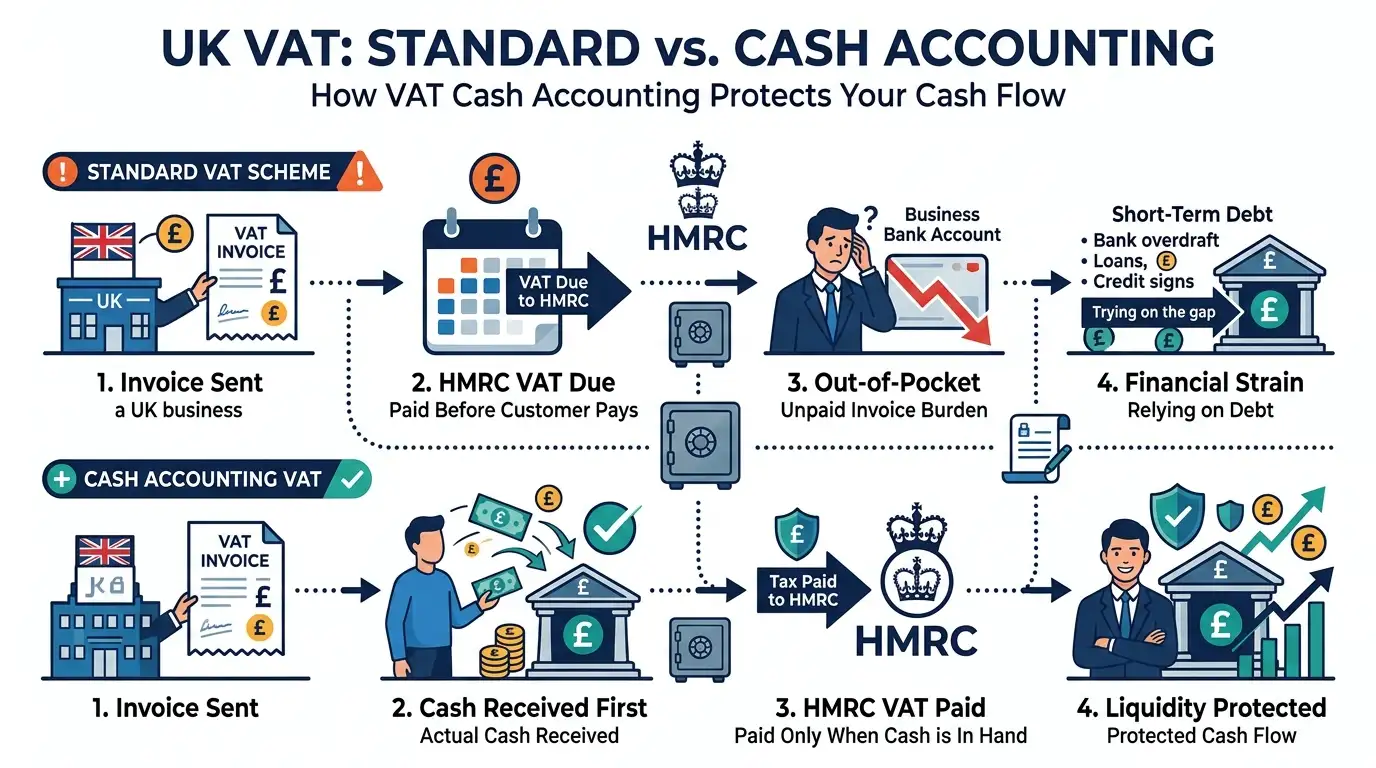
Working capital predictability remains the foundation of commercial stability. When companies operate under standard invoice accounting, extended customer payment terms directly drain operational funds. A business issuing a high-value invoice at the end of a VAT quarter incurs an immediate tax liability. Cash Accounting VAT neutralizes this financial exposure completely. You pay VAT to HMRC only after the customer clears the invoice balance.
Trading liquidity improves significantly when dealing with slow-paying corporate clients. Small supplier enterprises often accept 30-day, 60-day, or 90-day credit terms to secure large contracts. Cash Accounting VAT ensures your bank account balance supports every tax payment deadline. If payment delays occur, your VAT liability shifts automatically to the subsequent accounting period.
Bad debt relief operates automatically within this regulatory framework. If a buyer enters insolvency or defaults on an invoice, your business incurs zero VAT loss. Standard accounting requires businesses to pay HMRC upfront and claim relief after six months of non-payment. Cash Accounting VAT removes this capital lockup, preserving operational stability during client defaults.
Who Is Eligible to Use the Cash Accounting VAT Scheme?
Businesses qualify for the Cash Accounting Scheme if their estimated VAT-exclusive turnover is 1.35 million pounds or less over the next 12 months. Companies can remain in the scheme until their annual taxable turnover reaches 1.6 million pounds.
HMRC establishes clear quantitative thresholds to determine scheme eligibility for UK corporate entities. Small companies, sole traders, and partnerships must monitor their taxable turnover continuously. Taxable turnover includes all goods and services sold that are not exempt from Value Added Tax
Maintain up-to-date VAT returns with HMRC
Clear all outstanding VAT payments and penalties
Keep estimated taxable turnover below 1.35 million pounds
If past tax compliance issues exist, HMRC can reject scheme participation until you resolve all arrears. Certain business legal structures and operations cannot utilize cash accounting principles. If you operate under margin schemes or buy goods on lease-purchase terms, standard accounting rules apply to those transactions. Businesses trading under conditional sale agreements must also exclude those specific sales from cash accounting calculations.
Monitoring the upper threshold of 1.6 million pounds prevents compliance penalties. When annual turnover exceeds this limit, the business must transition back to standard invoice accounting at the end of the current tax period.
What Are the Main Advantages and Disadvantages of Cash Accounting VAT?
The primary advantage of Cash Accounting VAT is immediate cash flow protection and automatic bad debt relief. The main disadvantage is delayed input tax recovery on credit purchases of inventory or business services.
Evaluating VAT reporting schemes requires a detailed review of your commercial payment structures. For companies offering extended credit terms, the advantages outweigh potential administrative limitations.
| Operational Aspect | Scheme Advantage | Scheme Disadvantage |
| Cash Liquidity | Aligns tax payments with cash receipts | Delays input tax reclaims on credit purchases |
| Debt Exposure | Provides instant bad debt relief | Requires tracking actual payment receipts |
| Administration | Simplifies record-keeping for cash transactions | Complicates bank reconciliation across periods |
Cash flow alignment remains the single greatest advantage for service-based businesses and trade contractors. You never fund HMRC liabilities using business reserves before receiving buyer payments. Automatic bad debt protection reduces accounting overhead by eliminating formal write-off applications for unpaid client invoices.
Delayed input tax recovery represents the primary financial drawback of this scheme. If your business purchases machinery, stock, or raw materials on 60-day credit terms, you cannot reclaim input VAT until you pay the supplier invoice. Startup companies with heavy upfront capital expenditure may find standard accounting yields faster tax refunds during early trading phases.
Businesses considering early registration can optimize their tax position by evaluating pre-trading expenses. Reviewing how to reclaim pre-registration VAT on goods and services purchased before trading ensures startup founders recover historical setup costs effectively while choosing the correct accounting scheme.
How Do You Join the Cash Accounting VAT Scheme?
Joining the Cash Accounting VAT Scheme requires no formal application form or written approval from HMRC. Eligible businesses adopt the scheme simply by starting to account for VAT based on payment dates at the start of a tax period.
HMRC designed the joining mechanism to minimize administrative friction for qualifying corporate entities. You do not wait for written authorization or official confirmation certificates from tax authorities.
Implementation follows four practical administrative steps:
Verify annual VAT-exclusive turnover remains below 1.35 million pounds
Confirm business tax payments and return submissions are current
Update accounting software settings to cash accounting mode
Report output and input tax based on cleared bank transactions
Accurate record-keeping remains a statutory requirement under Making Tax Digital compliance frameworks. Digital records must capture the exact date money enters or leaves your business bank account. Invoices must align with bank statements, cash receipts, and electronic transfer slips.
If your business is not yet registered for Value Added Tax, completing your official tax setup correctly prevents early reporting errors. Securing professional VAT Registration Assistance guarantees accurate tax classification and immediate access to appropriate scheme selections.
How Does Cash Accounting VAT Impact Pre-Registration Expense Reclaims?
Cash Accounting VAT allows businesses to reclaim pre-registration input tax once official VAT registration takes effect. Qualifying purchases require valid tax invoices and clear payment records matching statutory HMRC time limits.
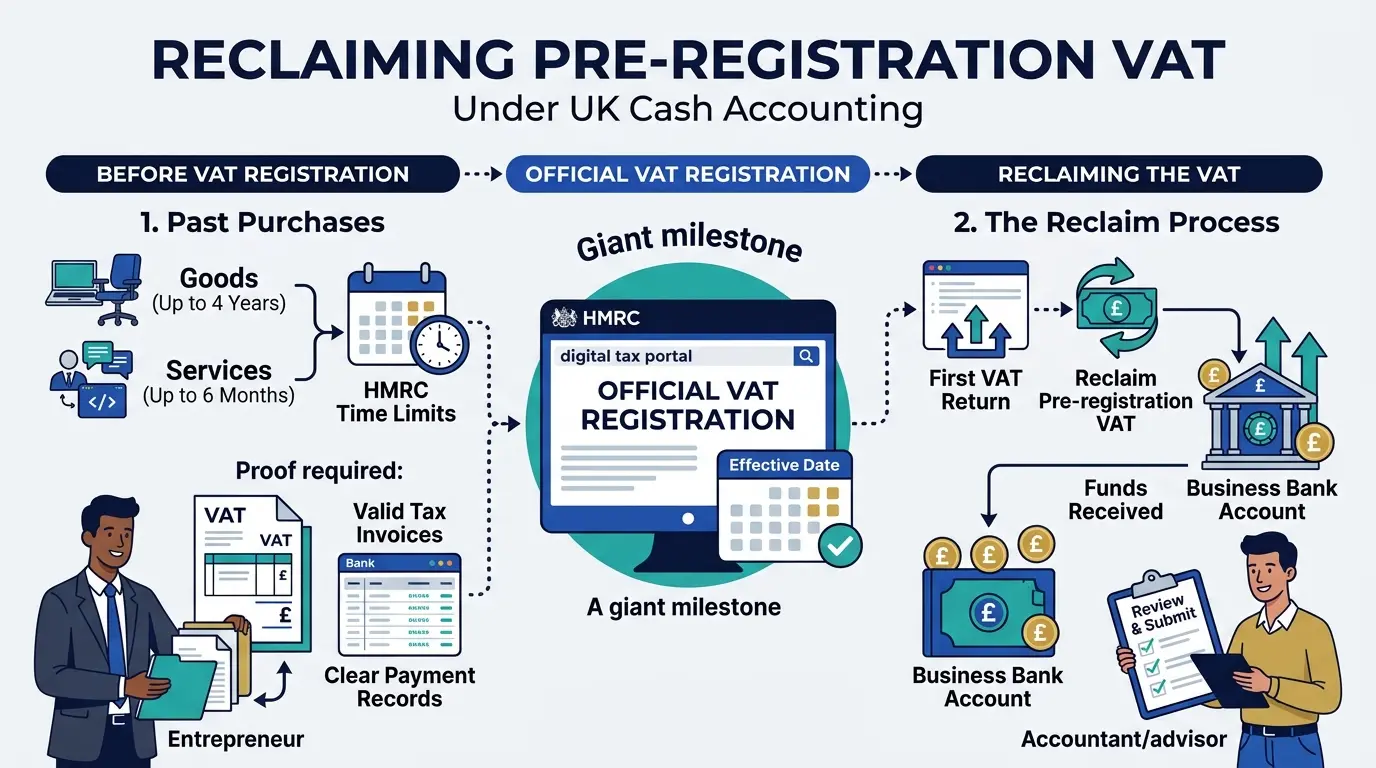
Tax legislation permits newly registered enterprises to recover VAT paid on setup costs prior to formal registration. HMRC sets distinct time limits for historic commercial purchases: four years for physical goods still held by the business, and six months for services consumed prior to registration.
Under cash accounting rules, evidence of actual payment plays a pivotal role in validating historical tax claims. You must retain original supplier invoices alongside matching bank statement records. If a pre-registration invoice remains unpaid at the date of registration, input tax recovery occurs only after payment clears.
Form My Company simplifies corporate tax setup by managing early statutory registrations for expanding business entities. Professional advisory ensures startup founders structure their initial capital purchases to maximize tax recovery. Utilizing structural support to maximize your savings: how Form My Company assists with pre-registration VAT claims prevents costly administrative rejections during initial return submissions.
Explore More VAT Registration Assistance Guide,
What Is Annual Accounting VAT and What Are Its Main Benefits?
What Is the Standard VAT Accounting Scheme and How Does It Operate?
Frequently Asked Questions
What is VAT Registration Assistance and why is it necessary for UK businesses?
VAT Registration Assistance is a professional service provided by Form My Company to help UK businesses navigate the HMRC registration process accurately and efficiently. Registering for Value Added Tax becomes mandatory when a business exceeds the statutory £90,000 turnover threshold within a 12-month period. Utilizing professional guidance ensures proper VAT scheme selection, prevents administrative delays, and eliminates the risk of late registration penalties from tax authorities.
How do I know if my business needs to register for VAT in the UK?
UK businesses must register for VAT if their total VAT-taxable turnover goes over £90,000 in a rolling 12-month period or if they expect to exceed the limit in the next 30 days alone. Businesses below this threshold may also register voluntarily to improve commercial credibility and reclaim input tax on startup costs. Form My Company offers VAT Registration Assistance to evaluate commercial turnover and manage both compulsory and voluntary applications.
How long does the HMRC VAT registration process take?
Official HMRC processing times for a standard UK VAT registration application typically range from 1 to 4 weeks. The overall timeframe depends on business structure, sector compliance requirements, and the completeness of submitted documentation. Form My Company provides structured VAT Registration Assistance to prepare all director identity verification records and company details correctly upfront, preventing HMRC information requests and approval bottlenecks.
Can I reclaim VAT paid on business purchases made before registering?
Yes, HMRC tax rules allow newly registered entities to reclaim input VAT on qualifying goods purchased up to four years prior to registration and on services incurred up to six months before registration. To claim these pre-trading expenses successfully, the business must retain valid tax invoices and proof of payment. Form My Company assists growing businesses during the setup phase to structure historical record-keeping and maximize allowable historical VAT recovery.
Which HMRC VAT scheme should a small business choose upon registration?
Small businesses can choose between standard invoice accounting, the Cash Accounting Scheme, the Flat Rate Scheme, or Annual Accounting based on their cash flow structure and operational model. The Cash Accounting Scheme is particularly beneficial for small enterprises as it aligns tax payments with cleared customer receipts rather than invoice dates. Form My Company includes expert advice on scheme selection as part of its comprehensive VAT Registration Assistance.


