

The Annual Accounting VAT scheme is a HM Revenue and Customs (HMRC) framework that allows eligible small businesses to submit one VAT return per year while making nine monthly or three quarterly advance interim payments toward their estimated annual tax bill.
What Is the Annual Accounting VAT Scheme?
The Annual Accounting VAT scheme simplifies tax reporting by replacing four quarterly submissions with a single annual VAT return alongside fixed interim payments based on previous tax history or estimated liability.
HMRC designed the Annual Accounting VAT scheme specifically for small businesses with an estimated annual taxable turnover of £1.35 million or less. Participating businesses submit one comprehensive VAT return each year instead of the standard quarterly returns. Taxpayers make interim payments towards their final bill throughout the 12-month period. HMRC calculates these payments as either nine monthly installments of 10% or three quarterly installments of 25%.
The final payment or refund balancing occurs when you submit the annual return. The deadline for submitting the annual return and paying any remaining balance is two months after the end of the accounting year. Standard VAT schemes allow only one month for submission. Once registered, a business remains on the scheme until taxable turnover exceeds the £1.6 million departure threshold.
Businesses apply directly to HMRC or through authorized tax representatives. You must submit all routine VAT returns electronically under Making Tax Digital rules. The scheme does not change the total amount of VAT owed. It alters payment frequency and reporting administration for participating companies.
What Are the Main Benefits of Annual Accounting VAT?
The main benefits of Annual Accounting VAT include reduced administrative burdens, improved cash flow predictability, an extended submission deadline, and simplified financial planning through structured interim payments throughout the fiscal year.
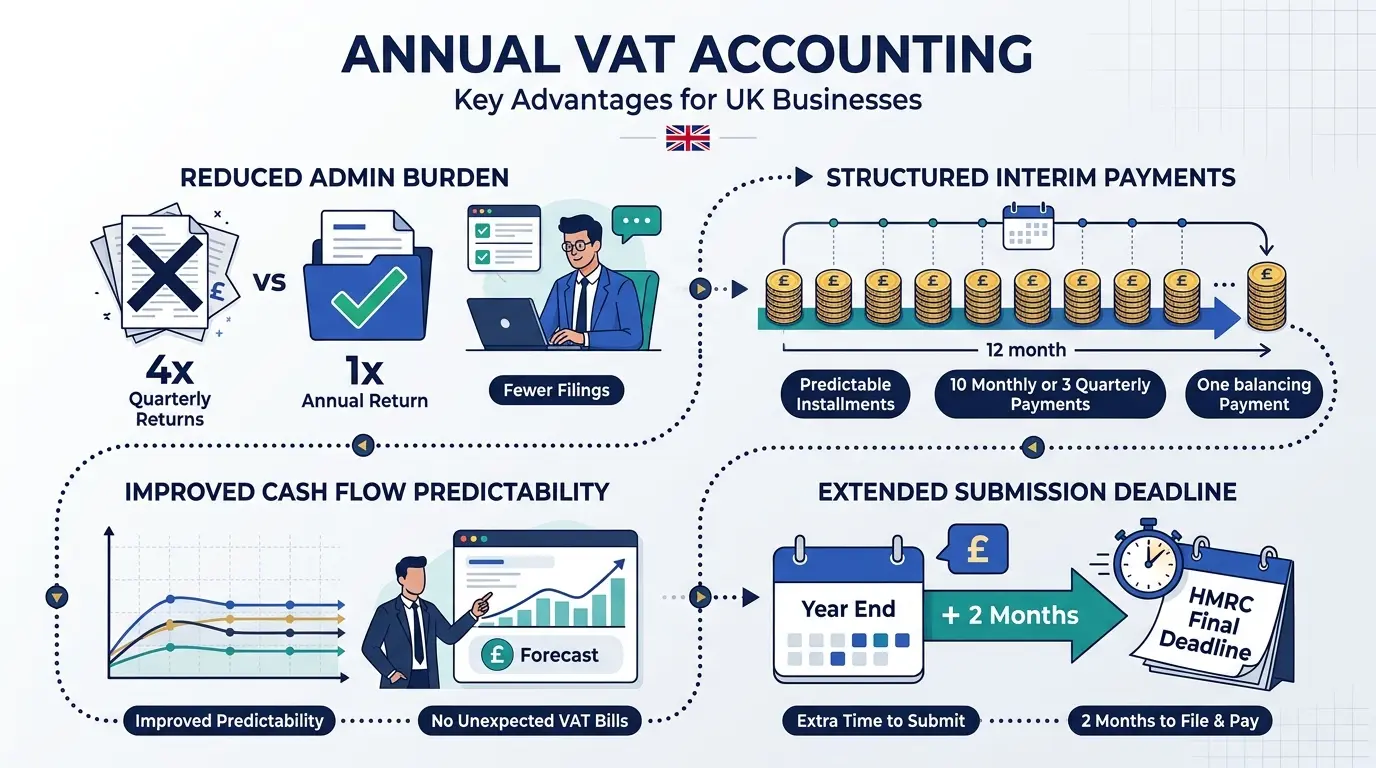
Administrative overhead drops significantly because businesses compile and verify records once a year. Accounting teams spend less time preparing multiple quarterly returns. This single reporting cycle reduces accounting fees associated with quarterly filings.
Cash flow predictability improves through set interim payment schedules. Business owners budget accurately because monthly or quarterly outgoings remain constant. Interim payments prevent sudden tax liabilities at the end of financial quarters.
Taxpayers receive double the standard time to complete their annual documentation. The two-month deadline after the accounting period provides ample time to verify input tax calculations. Extended submission periods reduce panic and minimize common submission errors.
Managing working capital becomes easier for growing enterprises. Stable payment cycles allow directors to allocate funds toward expansion activities instead of reserving large cash cushions. You can also align the VAT accounting year with your company’s fiscal year.
Who Is Eligible for the Annual Accounting Scheme?
Businesses qualify for Annual Accounting VAT if their estimated UK taxable turnover for the upcoming 12 months is £1.35 million or less, provided they are up to date on HMRC filings.
Eligibility depends primarily on annual taxable turnover thresholds established by UK tax legislation. Your projected taxable turnover must not exceed £1.35 million at the time of application. Existing businesses estimate turnover using historical sales data from previous trading periods. New businesses estimate turnover using realistic forward projections and contractual commitments.
HMRC inspects compliance history before approving applications for the scheme. Applicants must have all tax returns up to date. Outstanding VAT returns or unpaid tax debts prevent approval. Individuals or corporate entities involved in VAT default within the past 12 months face immediate rejection.
Certain business structures cannot join the scheme. Insolvent companies, businesses registered as VAT groups, and businesses not up to date with VAT payments are ineligible. Overseas traders without a UK establishment must use standard accounting mechanisms.
Monitoring ongoing eligibility is a legal requirement for company directors. If taxable turnover exceeds £1.6 million over the preceding 12 months, the business must leave the scheme immediately. You must notify HMRC within 30 days of exceeding this threshold.
How Do Interim Payments Work Under Annual Accounting?
Interim payments operate as advance installments paid over nine monthly or three quarterly cycles, calculating 10% or 25% of the total estimated annual VAT liability respectively.
HMRC calculates interim payment figures based on your previous year’s total VAT liability. If your business is new to VAT, HMRC bases payments on realistic turnover estimates provided during registration. Monthly interim payments occur in months 4 through 12 of the accounting year. Each monthly installment equals exactly 10% of the total annual estimate.
Quarterly payments occur in months 4, 7, and 10 of the accounting year. Each quarterly payment equals 25% of the overall estimated tax liability. Payments transfer electronically via direct debit, internet banking, or corporate debit card. Direct debit ensures automatic collection and avoids late payment penalties.
A balancing payment settles the difference between total interim payments and actual liability. If actual sales produce a higher liability, you pay the remaining balance with the annual return. If interim payments exceed the final calculation, HMRC issues a direct refund.
When business conditions change significantly, you can apply to adjust interim payment amounts. If sales drop sharply, submitting financial proof allows HMRC to lower monthly installments. If sales increase rapidly, requesting higher interim payments prevents a large final balancing bill.
What Are the Disadvantages of Annual Accounting VAT?
The main disadvantages include potential cash flow strain for seasonal businesses, delayed VAT refunds, and the risk of a large final balancing payment if turnover increases rapidly.
Businesses expecting regular VAT refunds suffer under annual accounting setups. Input tax reclaimers receive refunds once a year rather than quarterly. Repayment trading operations, such as exporters, experience negative cash flow impacts when waiting 12 months for refunds.
Fixed interim payments create financial strain during slow trading periods. Monthly payments remain fixed even when revenue drops temporarily. Cash reserves must cover interim payments regardless of current monthly sales figures.
Rapid business growth can lead to unexpected liabilities at year-end. If sales surge far above initial estimates, interim payments will fail to cover total VAT owed. The resulting balancing payment must be settled alongside the annual return within two months.
Overdue administration penalties apply if you miss interim payment dates. HMRC levies interest charges on late interim installments. Managing payment dates requires disciplined bank account management throughout the whole operating year.
How Do You Apply and Manage Annual Accounting VAT?
Applying involves submitting an online application via your HMRC tax account or utilizing professional VAT Registration Assistance to ensure proper registration setup and threshold checks.
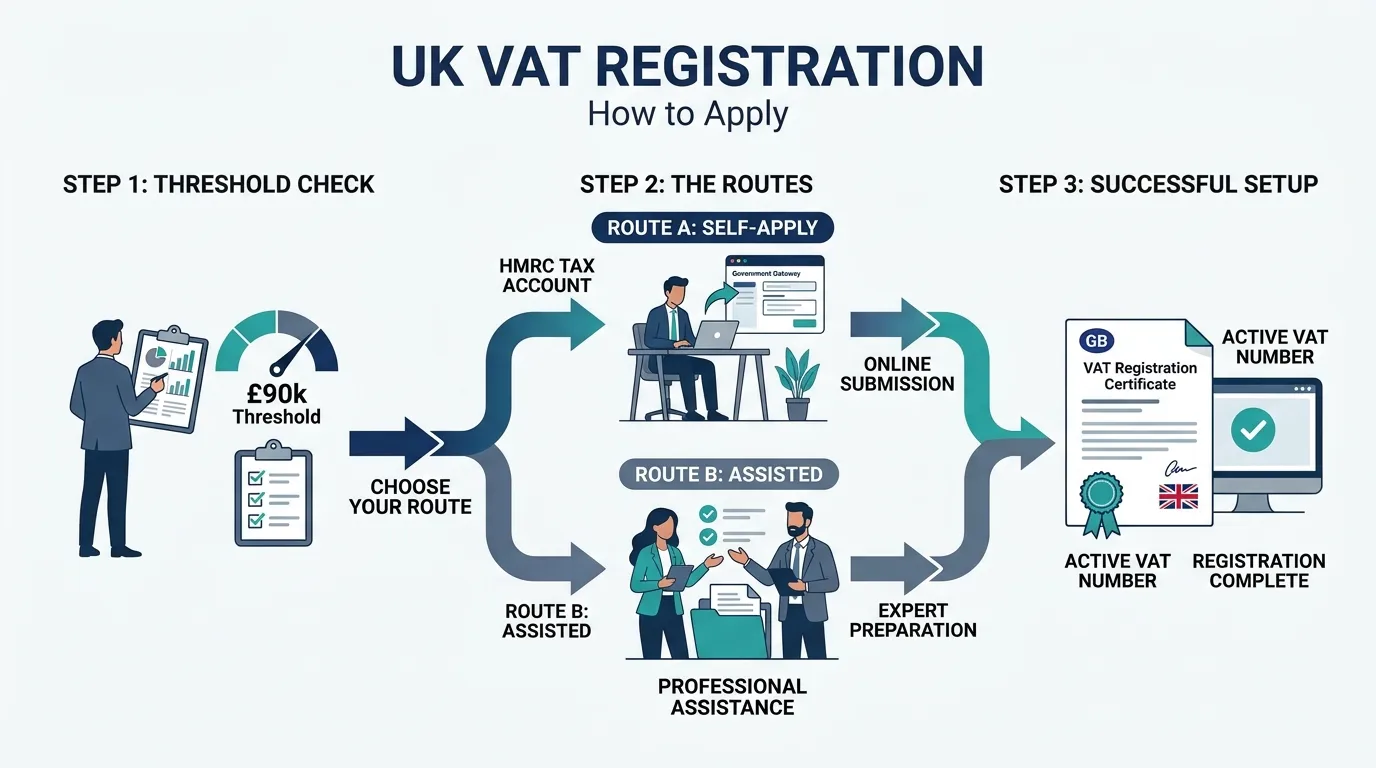
Registration begins by assessing historical turnover data against statutory threshold requirements. Applicants log into their HMRC online account to select the annual scheme. Alternatively, registered tax agents handle the submission process on behalf of the business. Approval typically takes between two and four weeks.
Once approved, HMRC confirms the specific accounting year dates and interim payment schedule. Businesses must align their internal record-keeping systems to track output and input tax continuously. You must maintain full digital accounting records under UK tax regulations.
Integrating compliant accounting software ensures smooth operation throughout the fiscal year. To avoid submission errors, business owners learn how to set up Making Tax Digital (MTD) compliant software for your business early in the setup process. Digital record-keeping tracks sales invoices, purchase receipts, and VAT rates automatically.
Reviewing turnover every quarter ensures interim payments remain accurate. If sales diverge significantly from predictions, file an application to adjust the installment figures. Proper management prevents balance surprises during the final submission month.
How Does Annual Accounting Compare to Other VAT Schemes?
Annual Accounting differs from Cash Accounting and Flat Rate schemes by focusing on filing frequency rather than calculation methods or payment timing rules.
The Standard VAT scheme requires four quarterly returns per year. Standard VAT calculates liability based on invoice dates regardless of customer payment timing. Annual Accounting reduces quarterly returns down to one annual filing, though it still utilizes invoice dates by default unless combined with Cash Accounting.
The Cash Accounting scheme calculates VAT liability based on actual payments received and paid. Businesses report VAT only when money enters or leaves their bank account. You can combine Annual Accounting with Cash Accounting if turnover remains below the eligibility thresholds for both schemes.
The Flat Rate Scheme simplifies calculations by applying a fixed percentage to total gross turnover. Flat Rate users do not reclaim VAT on individual purchases except for specific capital assets over £2,000. Flat Rate users can also apply for Annual Accounting to reduce reporting frequency.
Comparing scheme features helps determine the best fit for your business structure:
| Scheme Type | Return Frequency | Calculation Basis | Turnover Limit |
| Standard VAT | 4 per year | Invoice Date | No Limit |
| Annual Accounting | 1 per year | Invoice Date (Default) | £1.35 Million |
| Cash Accounting | 4 per year | Cash Received/Paid | £1.35 Million |
| Flat Rate Scheme | 4 per year | Flat % of Turnover | £150,000 |
Selecting the optimal combination requires evaluating payment terms, supplier credit lines, and administrative capacity. Combining Cash Accounting with Annual Accounting offers both cash-flow protection and reduced reporting frequency.
How to Stay Compliant with HMRC Under Annual Accounting?
Maintaining compliance requires keeping accurate digital records, paying all interim installments on time, and filing the annual return within two months of your period end.
Digital record-keeping laws apply to all VAT-registered UK businesses. You must store digital records of all taxable sales, purchases, and VAT invoices. Using dedicated financial software streamlines record collection and simplifies the end-of-year audit trail.
For complete setup support, implementing seamless digital compliance with Form My Company’s MTD-ready VAT system ensures your filing setup meets all statutory HMRC requirements automatically. Professional system integration eliminates compliance risks and prevents late filing penalties.
Monitoring sales turnover continuously prevents threshold breaches. If your 12-month rolling turnover exceeds £1.6 million, notify HMRC within 30 days to transition back to quarterly reporting. Failure to notify HMRC results in financial penalties and retroactive tax adjustments.
Reconcile your VAT accounts quarterly even though returns are annual. Regular internal audits catch errors early before they affect the final annual submission. Accurate bookkeeping ensures your balancing payment or refund calculation remains precise.
Explore More VAT Registration Assistance Guide,
What Is the Flat Rate VAT Scheme and Who Is Eligible to Join?
What Are the Differences Between Compulsory and Voluntary VAT Registration?
Frequently Asked Questions
How do I know if my business needs to register for UK VAT?
You must register your business for UK VAT if your total taxable turnover exceeds £90,000 within a rolling 12-month period, or if you expect to surpass that threshold in the next 30 days. Businesses earning below this limit may choose voluntary registration to reclaim input tax on business expenses. Utilizing VAT Registration Assistance from Form My Company helps business owners accurately assess their turnover and choose the optimal registration timing.
How long does the HMRC VAT registration process take?
HMRC typically processes UK VAT registration applications within 8 to 30 working days after receiving all required company information and verification documents. Processing times vary depending on the complexity of your business structure and whether HMRC requests additional identity verification. Form My Company manages the entire submission process through professional VAT Registration Assistance to prevent administrative delays and ensure first-time approval.
Can a non-UK resident register a business for VAT in the UK?
Non-UK resident business owners can register for UK VAT if they supply goods or services within the UK or store inventory in UK fulfillment centers. Non-established taxable persons (NETPs) must comply with UK tax rules, but they do not benefit from the £90,000 threshold and must register before making their first taxable sale. Form My Company assists international founders by completing non-resident VAT registration and setting up required HMRC tax agent connections.
What documents are required for UK VAT registration?
To complete UK VAT registration, you need your Certificate of Incorporation, company registration number, proof of business activity, bank details, and identity documents for company directors. HMRC may also request trade evidence, such as customer contracts, sales invoices, or supplier agreements. Form My Company reviews and organizes all supporting documentation prior to submission to maintain full compliance with HMRC guidelines.
What happens after your business receives a VAT number?
Once HMRC issues your 9-digit UK VAT number and registration certificate, your business must start charging the correct VAT rates on taxable goods and services. You must also maintain digital accounting records to comply with Making Tax Digital (MTD) rules and submit quarterly or annual VAT returns. Through dedicated VAT Registration Assistance, Form My Company ensures your company is correctly configured to fulfill ongoing HMRC reporting obligations smoothly.


