

Form My Company simplifies your Flat Rate VAT setup by evaluating your business turnover, verifying your low-cost trader status, selecting the correct sector percentage, submitting official HMRC documentation, and configuring your ongoing accounting compliance framework accurately.
What Is the Flat Rate VAT Scheme and How Does It Function?
The Flat Rate VAT Scheme allows eligible UK small businesses to pay a fixed percentage of their gross turnover to HMRC while charging customers the standard 20% VAT rate, retaining the difference as operational revenue.
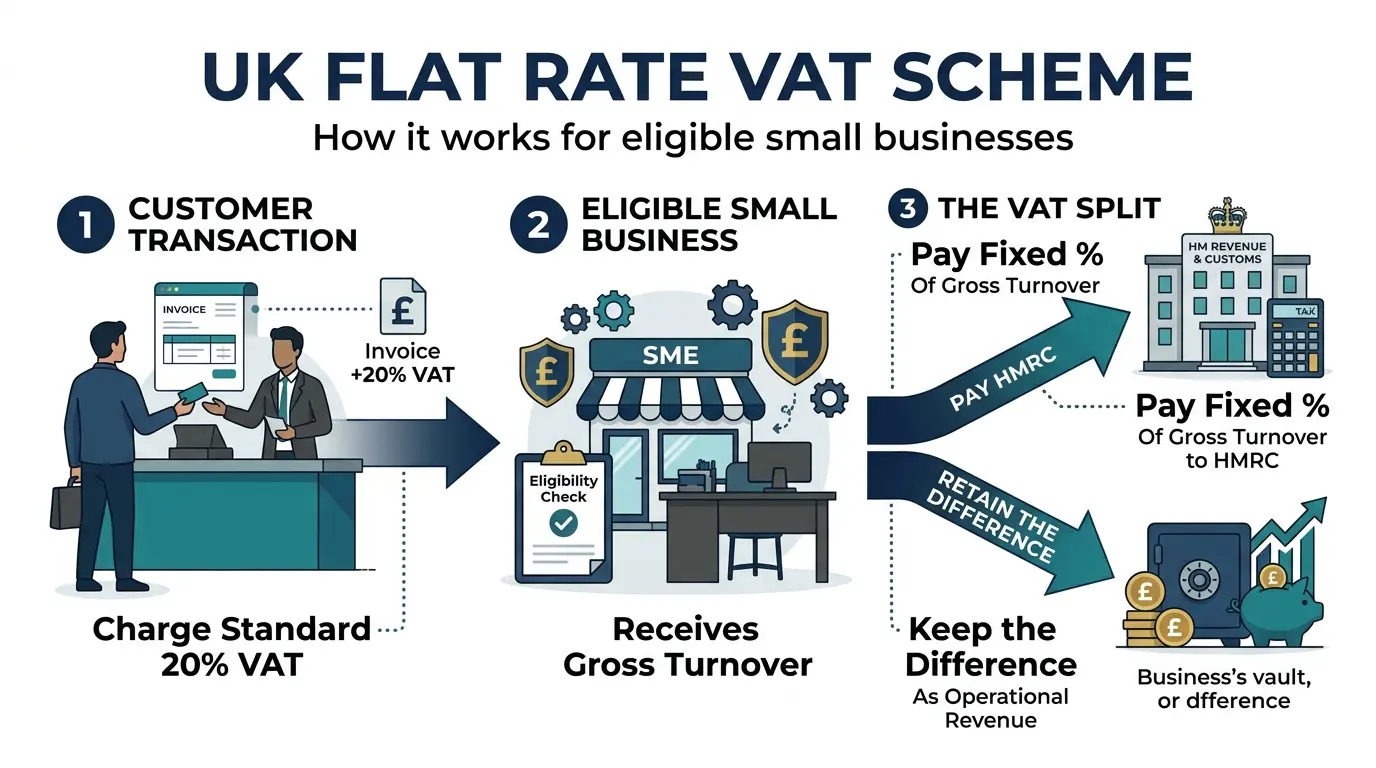
The UK government created the Flat Rate VAT Scheme to streamline tax accounting for small businesses. Standard VAT accounting requires businesses to calculate the exact difference between output VAT charged on sales and input VAT paid on purchases. The Flat Rate VAT Scheme replaces this detailed calculation with a single percentage applied to total gross turnover.
Businesses charge their clients the standard VAT rate of 20% on taxable invoices. When remitting funds to HMRC, the business applies its specific industry flat rate percentage to the gross, VAT-inclusive turnover. This accounting structure eliminates the requirement to track and record input VAT on individual operational expenses.
Small businesses with a VAT-exclusive taxable turnover of £150,000 or less qualify to join the scheme. Once registered, businesses can remain on the scheme until their total gross turnover exceeds £230,000. This threshold provides administrative relief and predictable financial planning for growing enterprises across the United Kingdom.
How Do You Determine If Your Business Is Eligible for the Scheme?
Your business qualifies for the Flat Rate VAT Scheme if your expected VAT-exclusive turnover remains under £150,000 annually and your enterprise operates as an independent UK business without recent VAT violations.
Eligibility assessments begin with calculating your projected taxable turnover for the next 12 months. Taxable turnover includes all goods and services sold that are standard-rated, reduced-rated, and zero-rated. Exempt supplies and capital asset sales do not count toward the initial £150,000 entry limit.
HMRC enforces strict exclusion rules to maintain scheme integrity. Businesses cannot join if they left the Flat Rate VAT Scheme within the previous 12 months. Associated businesses, group registrations, and entities involved in VAT offences within the last 24 months face immediate disqualification from scheme entry.
Determining your business status requires analyzing historical sales data and forward revenue projections. Professional corporate advisors evaluate your trading structure to confirm eligibility prior to submitting registration documents. Accurate entry assessment prevents formal HMRC rejections and avoids retroactive tax adjustments.
What Is the Low-Cost Trader Rule and How Does It Impact Your Rate?
The low-cost trader rule forces businesses spending less than 2% of turnover or under £1,000 annually on relevant goods to pay a higher 16.5% flat VAT rate regardless of their industry sector.
HMRC introduced the limited cost business rule to prevent service-based enterprises from acquiring unintended tax windfalls. A business classifies as a limited cost trader if its expenditure on relevant goods is less than 2% of gross turnover. Alternatively, spending under £1,000 per year on relevant goods triggers the same classification.
Relevant goods include physical items used exclusively for business operations, such as raw materials and stock. HMRC explicitly excludes capital equipment, motor vehicles, fuel, food, software, and services from the relevant goods calculation. Service-oriented firms often find that rent, sub-contractor fees, and utility bills do not count toward this threshold.
When a business meets the criteria for a low-cost trader, it must use the fixed 16.5% flat rate. This higher rate reduces the financial gain of the scheme significantly. Form My Company reviews your business expenditure profiles carefully to identify your exact trader classification before completing registration.
How Do You Select the Correct Flat Rate Sector for Your Business?
Selecting the correct flat rate sector requires matching your core business activities to HMRC’s trade categories to ensure legal compliance and optimize your applicable tax percentage.
HMRC publishes a comprehensive schedule of industry sectors, each carrying a designated flat rate percentage ranging from 4% to 14.5%. Sectors include catering, construction, management consulting, retailing, and IT services. Selecting an incorrect category leads to underpaid tax liabilities, interest charges, and financial penalties from tax authorities.
When businesses engage in multiple commercial activities, HMRC rules mandate choosing the sector that reflects the main source of turnover. Determining your primary trade involves analyzing revenue splits across product lines and service offerings over the preceding trading period.
First-year scheme users receive a 1% discount on their sector flat rate for the initial 12 months of VAT registration. Navigating these sector definitions requires precise trade analysis. If you want to evaluate alternative VAT structures across different business models, read our guide on [How to Choose the Best VAT Accounting Scheme for Your Specific Industry].
| Industry Sector Category | Standard Flat Rate (%) | First-Year Discount Rate (%) |
| Computer Repair / IT Services | 10.5% | 9.5% |
| Management Consultancy | 14.0% | 13.0% |
| Estate Agency / Property Management | 12.0% | 11.0% |
| Retailing (General Goods) | 7.5% | 6.5% |
| Pubs and Bars | 6.5% | 5.5% |
| Limited Cost Business (Any Sector) | 16.5% | 15.5% |
How Does Form My Company Streamline Your VAT Registration Process?
Form My Company manages your entire Flat Rate VAT setup by verifying documentation, completing HMRC form VAT600FRS, establishing digital accounts, and securing your official registration certificate.
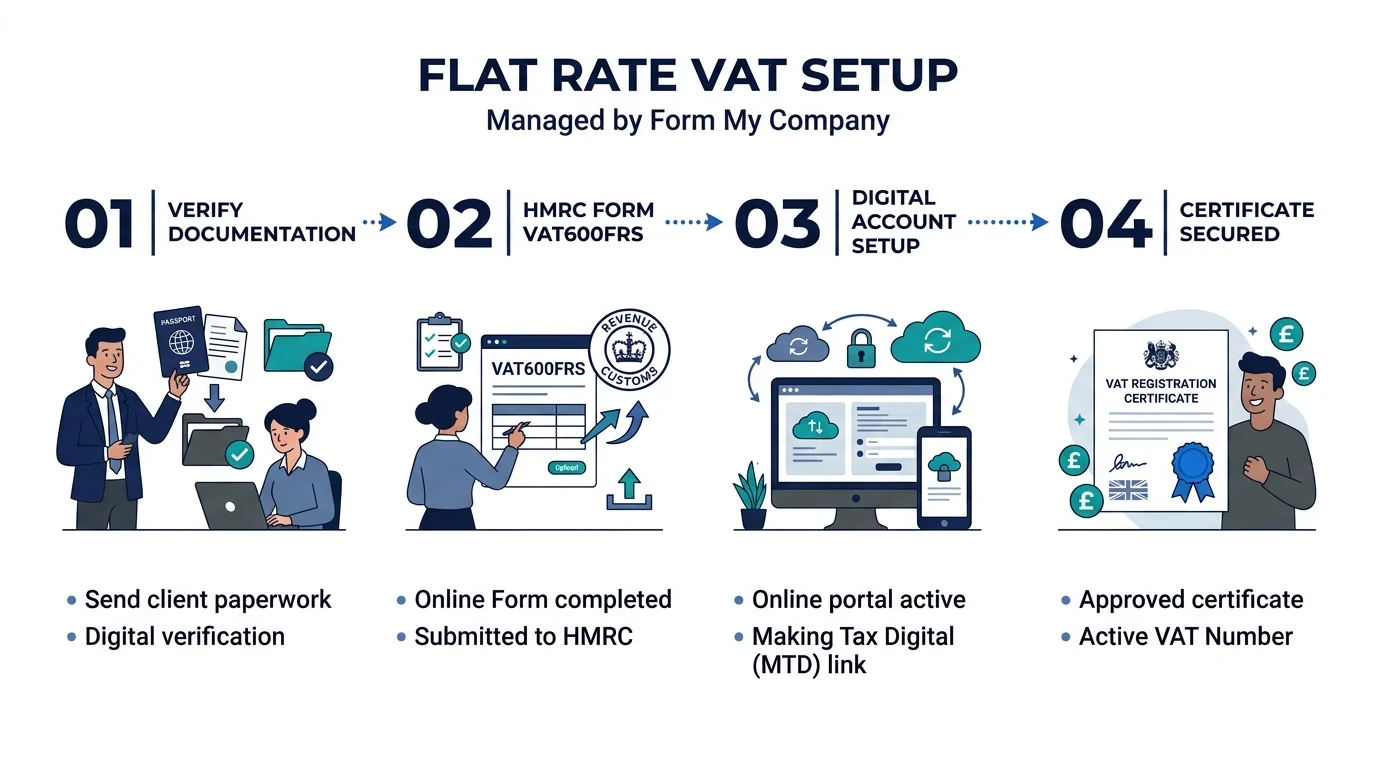
Navigating government tax portals presents technical and administrative hurdles for business owners. Form My Company executes the application process using structured compliance protocols. Our specialists audit your corporate structure, verify identity credentials, and confirm trading start dates to prepare an accurate application package.
Our team submits form VAT600FRS alongside your primary VAT registration paperwork. We interface directly with HMRC to resolve queries regarding trade classification or turnover projections. This direct intervention eliminates administrative delays and secures your VAT identification number efficiently.
Once approved, our advisors deliver your official VAT registration certificate and establish your Making Tax Digital (MTD) connections. If you require complete end-to-end administration for corporate tax setup, explore our specialized [VAT Registration Assistance] services for professional onboarding support.
What Are the Steps to Setup Flat Rate VAT with Form My Company?
Setting up Flat Rate VAT involves five structured steps: gathering financial records, conducting eligibility audits, selecting trade sectors, submitting HMRC forms, and integrating digital reporting systems.
Following a structured process prevents registration errors and secures your first-year 1% rate discount instantly. Form My Company guides business owners through each phase with transparent updates and expert oversight.
What Are the Ongoing Compliance Requirements Under the Flat Rate Scheme?
Ongoing compliance under the Flat Rate Scheme requires submitting quarterly digital VAT returns, monitoring the £230,000 turnover limit, and re-evaluating low-cost trader status every period.
Joining the Flat Rate VAT Scheme does not exempt businesses from HMRC reporting duties. Under Making Tax Digital rules, businesses must maintain digital accounting records and submit quarterly returns using compatible software. Each return calculates payable VAT by multiplying total gross sales by your assigned flat rate percentage.
Businesses must audit their gross turnover continuously throughout the financial year. If your cumulative gross turnover exceeds £230,000 over the past 12 months, you must leave the scheme immediately. Furthermore, if expected turnover for the next 30 days alone exceeds £230,000, formal notification to HMRC is mandatory.
Re-evaluating trader status occurs every accounting period. If your goods expenditure drops below the 2% threshold during a specific quarter, you must apply the 16.5% limited cost trader rate for that return. To review initial eligibility rules and basic scheme definitions, read our complete guide on [What Is the Flat Rate VAT Scheme and Who Is Eligible to Join?].
Form My Company provides continuous compliance reviews to ensure your business remains compliant with HMRC regulations. Our ongoing monitoring prevents unexpected tax reassessments and keeps your corporate standing clear.
Explore More VAT Registration Assistance Guide,
Never Miss the Threshold: How Form My Company Manages Compulsory VAT Registration for You
Fast and Accurate: How Form My Company Helps You Navigate Voluntary VAT Registration
Frequently Asked Questions
What is included in Form My Company’s VAT Registration Assistance service?
Form My Company’s VAT Registration Assistance provides end-to-end support for UK businesses registering for Value Added Tax with HMRC. The service includes evaluating your business turnover, choosing the right VAT scheme, gathering required documentation, and submitting form VAT1 or VAT600FRS. Our specialists handle all communication with tax authorities to ensure your official VAT number and registration certificate are issued without delay.
How long does VAT registration take when using Form My Company?
HMRC typically processes standard VAT applications within 5 to 20 working days depending on their current volume and verification requirements. Form My Company accelerates this timeline by conducting thorough identity checks and auditing business records prior to submission to prevent application rejections. Once approved, your business receives immediate access to its VAT registration details and Making Tax Digital (MTD) setup.
Who is required to register for VAT in the UK?
UK businesses must register for VAT if their VAT-exclusive taxable turnover exceeds the statutory threshold of £90,000 within any rolling 12-month period or if they expect to cross it in the next 30 days. Voluntary registration is also available for sole traders and limited companies looking to reclaim input tax on business purchases or improve corporate credibility. Form My Company assists both mandatory and voluntary applicants with tailored VAT registration strategies.
Can Form My Company help set up the Flat Rate VAT Scheme?
Yes, Form My Company provides specialized guidance for the Flat Rate VAT Scheme, including eligibility verification and sector rate calculations. Our team files form VAT600FRS alongside your primary application to secure your flat rate status and ensure compliance with HMRC’s low-cost trader rules. We also configure your initial accounting settings so you can utilize the first-year 1% rate discount effectively.
What documents are needed for VAT Registration Assistance with Form My Company?
To complete your VAT registration, you need to supply primary business details including incorporation certificates, business bank account statements, and director identification. Form My Company reviews your trade activities, projected annual turnover, and national insurance numbers to construct a compliant application package. Our structured document verification ensures your submission aligns fully with HMRC anti-fraud guidelines.


