A limited company isn’t a compulsory next step for a UK side hustle. There’s no legal requirement to incorporate, regardless of your trading activity or earnings. Whether it’s worth setting up a limited company for a side hustle depends on your plans for the business, how you’ll use its profits and whether the separation between company and personal liability is valuable to you.
It’s understandable to think incorporation could reduce your tax bill or make your business seem more established. But a limited company isn’t automatically more tax-efficient, and it brings different responsibilities from operating as a sole trader.
This guide explains how tax and liability compare, when a limited company may suit your plans, and when sole trader status may be enough. It also sets out practical trade-offs to help you choose a structure for your side hustle, rather than treating incorporation as a milestone you have to reach.
Key Takeaways
- There’s no legal requirement to form a limited company for a side hustle. Choose a structure based on your plans, responsibilities and how you’ll use the profits.
- Incorporation doesn’t automatically reduce tax. Whether you take profits out or leave them in the company can affect the comparison.
- Understand how the £1,000 annual trading allowance relates to Self Assessment and your side-hustle income.
- Limited liability separates the company’s finances from your personal finances, but it doesn’t remove every route to personal liability.
- If you decide to incorporate, Form My Company offers company formation packages to help you take the next step.
When should I convert from sole trader to limited company?
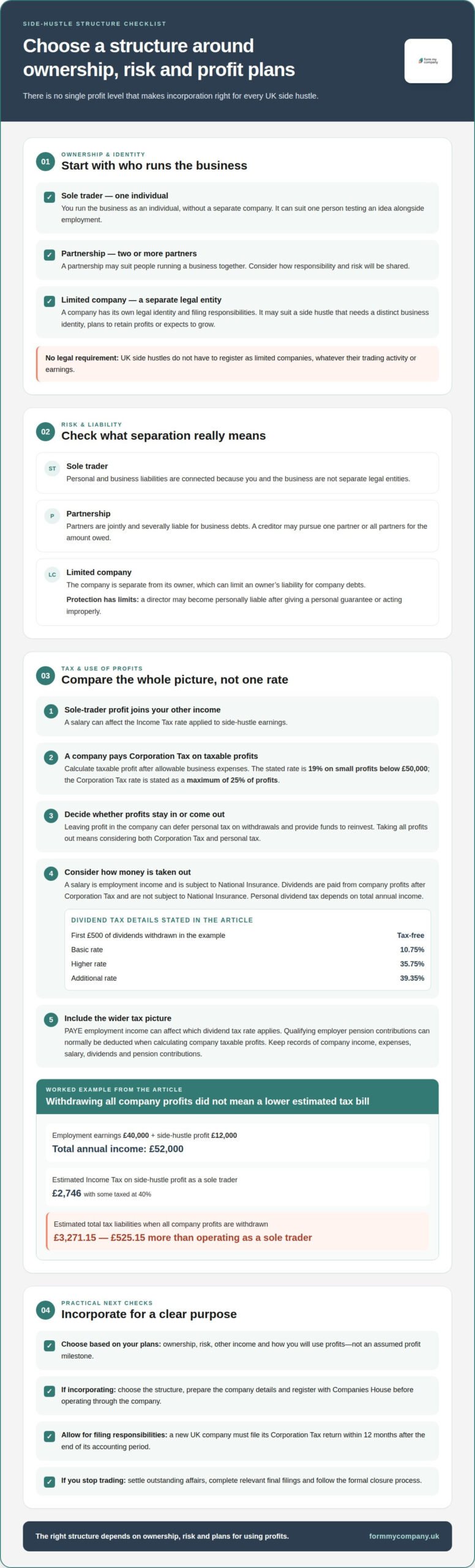
There’s no single profit level that makes incorporation right for every UK side hustle. Whether setting up a limited company is worthwhile depends on ownership, risk, tax and what you plan to do with the company’s profits.
Sole trader structure
A sole trader runs a business as an individual, without a separate company. This can suit one person testing an idea alongside employment, while a partnership may suit people running a business together. Sole-trader profit is added to other income when calculating Income Tax, so a salary can affect the rate applied to side-hustle earnings.
Limited company structure
A limited company is a separate legal entity from its owner. It may suit a side hustle that needs a distinct business identity, plans to retain profits or expects to grow. Unlike a sole trader, a company has its own filing responsibilities. Unlike a partnership, it has a separate legal identity from its owners.
The UK doesn’t require you to register a side hustle as a limited company, whatever your trading activity or earnings. If you decide to incorporate, register with Companies House before operating through the company.
Sole trader and company liability
A sole trader and their business aren’t separate legal entities, so personal and business liabilities are connected. A limited company is separate, which can limit an owner’s liability for company debts. That protection has limits: a director may become personally liable after giving a personal guarantee or acting improperly.
In a partnership, partners are jointly and severally liable for business debts. A creditor may pursue one partner or all partners for the amount owed. Before starting a side hustle with someone else, consider how responsibility and risk will be shared.
Switching and setting up a company
Consider incorporating when the company’s separate identity and responsibilities serve a clear purpose, not when you reach an assumed profit milestone. To set up, choose the structure, prepare the company details and register with Companies House. If you stop trading, settle outstanding affairs, complete relevant final filings and follow the formal closure process.
Tax can change the comparison. For example, someone earning £40,000 from employment and £12,000 in side-hustle profit has total annual income of £52,000. The example estimates Income Tax of £2,746 on the side-hustle profit, with some taxed at 40 per cent. Withdrawing all company profits gives estimated total tax liabilities of £3,271.15, or £525.15 more than operating as a sole trader.
So, is it worth setting up a limited company for a side hustle? Compare your earnings, other income and plans for taking money out. Incorporation isn’t automatically more tax-efficient.
| Structure | Who runs it? | Liability | Tax consideration |
|---|---|---|---|
| Sole trader | One individual | Personal and business liabilities are connected | Profit joins other income |
| Partnership | Two or more partners | Partners share joint and several liability | Consider how partners share the business |
| Limited company | A separate legal entity | Liability is generally limited, with exceptions | Consider profits and withdrawals |
Choose the structure that fits your ownership, risk and plans for using profits.
Corporation Tax on limited-company profits
A limited company pays Corporation Tax on its taxable profits, not on the money its owner personally withdraws. That distinction matters for a side hustle: profits retained in the company and profits paid out can have different tax consequences. Start by calculating the company’s taxable profit after allowable business expenses.
According to HM Revenue and Customs, a limited company pays 19 per cent Corporation Tax on small profits below £50,000. HM Revenue and Customs states that the Corporation Tax rate for companies is a maximum of 25% of profits. These rates apply to company profits, while personal tax may arise separately when you take money out.
Leaving profit in the company can defer personal tax on withdrawals and give the business funds to reinvest. If you take all the profit out, consider both Corporation Tax and personal tax on the money you receive. The headline Corporation Tax rate alone therefore can’t show whether incorporating would save tax overall.
Owners commonly consider taking a salary, dividends or a combination of both. Salary is employment income and is subject to National Insurance; dividends paid by a limited company aren’t subject to National Insurance. Dividends come from company profits after Corporation Tax, and the personal tax rate depends on your total annual income.
The first £500 of dividends withdrawn in the example is tax-free, according to HM Revenue and Customs. The stated dividend tax rates are 10.75 per cent at the basic rate, 35.75 per cent at the higher rate, and 39.35 per cent at the additional rate. Your other income can affect which rate applies, including earnings from PAYE employment.
A side company operates alongside existing PAYE employment; setting it up doesn’t itself change your employment terms or workplace benefits. A salary from the company is treated separately from dividends. Qualifying employer pension contributions can normally be deducted when calculating the company’s taxable profits, so pension planning may also affect the comparison.
Corporation Tax also brings a filing deadline. A new UK company must file its Corporation Tax return within 12 months after the end of its accounting period. Keep records of company income, expenses, salary, dividends and pension contributions, so the return reflects the company’s activity for that period.
Use this sequence to assess the likely tax effect:
- Work out company profit after allowable expenses.
- Estimate Corporation Tax using the applicable rate.
- Decide whether to retain profit or withdraw it as salary, dividends, or both.
- Consider personal tax, National Insurance and any qualifying pension contributions.
If you’re considering incorporation, review the company formation options alongside your plans for taking or reinvesting profits.
The £1,000 casual trading allowance and Self Assessment
The £1,000 threshold helps determine whether annual gross trading income from a side hustle needs to be reported through Self Assessment. It relates to gross trading income, meaning money received before deducting business expenses, rather than profit after costs.
According to HM Revenue and Customs, individuals with more than £1,000 in annual gross trading income from a side hustle must register for Self Assessment with HMRC. If your annual gross trading income is £1,000 or less, you don’t need to register solely because of that income, subject to exceptions.
Gross income and taxable profit are different measures. For example, someone selling handmade items receives gross trading income from those sales, while materials and other allowable expenses affect the profit calculation. Keep sales and expense records separate so you can identify both figures when completing a Self Assessment tax return.
The allowance doesn’t mean everyone below the threshold is automatically exempt from Self Assessment. Other circumstances may create a separate filing requirement, and the allowance has exceptions. Consider your side hustle as part of your overall tax position, rather than assuming HMRC looks only at its income.
Registration and filing are separate steps. If your circumstances mean you must register, use HMRC’s Self Assessment process and provide the information requested. A Self Assessment tax return must be filed by 31 January after the end of each tax year. That deadline is for filing, so don’t confuse it with the registration threshold or the decision to report income.
Use a simple record-keeping routine while trading:
- Record each customer payment and the date received.
- Keep evidence of business expenses separately from sales records.
- Add up annual gross trading income to compare it with the £1,000 threshold.
- Note other reasons you may need to submit a return, such as income beyond the side hustle.
Operating through a limited company changes how income and reporting are handled. The company reports its profits separately, while a director may receive salary or dividends as personal income. Personal allowance and Self Assessment rules relate to personal income; they don’t replace the company’s Corporation Tax and filing obligations.
Don’t treat the allowance as a reason to incorporate or as an estimate of your tax bill. First establish whether your sales count as trading income, calculate the gross amount and consider any relevant exceptions. Then work out whether you need to register for Self Assessment and organise records for your return. Paying tax through employment doesn’t, by itself, remove the need to consider separate trading income.
What does limited liability mean?
Limited liability separates a UK limited company’s legal identity from its owner’s. For a side hustle, that distinction can affect which assets are exposed when business liabilities arise.
Limited liability and personal asset protection
A limited company is responsible for its own debts as a separate legal entity. Its director and shareholder are generally liable for company debts only up to the amount invested or personally guaranteed. This differs from a sole trader, whose business and personal liabilities are connected because they aren’t separate legal entities.
For example, imagine a side hustle selling handmade goods through a limited company. If the company owes a supplier money, the debt belongs to the company. The company structure can help separate that business liability from the owner’s personal assets, but it doesn’t erase the debt or remove every route to personal liability.
Limited liability and personal guarantees
A personal guarantee is an individual’s commitment to cover a company obligation personally. If a director gives one for a company debt, the creditor may pursue that director under the guarantee, despite the company’s separate legal identity. The guarantee can therefore expose personal assets to the specific obligation it covers.
Before signing, identify which debt the guarantee covers, what circumstances trigger payment and whether it continues if the company’s position changes. A guarantee is different from ordinary company liability: it creates a personal commitment alongside the company’s responsibility. Acting improperly can also lead to personal liability, so limited company status isn’t permission to disregard company obligations.
Limited liability may also give a side hustle a clearer business identity when dealing with suppliers or customers. A company name can distinguish the business from its owner and help show who is selling goods or providing a service. But incorporation alone doesn’t establish a track record, prove financial stability or guarantee credibility with customers.
Keep the structure clear in everyday transactions. Use the company’s identity in business documents and keep company money separate from personal spending. This makes it easier to see which party is entering an agreement and where a business liability sits. It also helps distinguish company activity from personal income reported through Self Assessment.
Use these questions to assess the protection in your situation:
- Is the side hustle operating through a limited company or as a sole trader?
- Does a proposed agreement ask you to guarantee a company obligation personally?
- Are company documents and transactions clearly recorded in the company’s name?
- Could the way you act as director create personal liability?
Limited liability can reduce the connection between company debts and personal assets, but it isn’t absolute protection. Before relying on that separation, consider the company’s obligations, any personal guarantees and your conduct as a director.
When setting up a limited company is optional
A UK side hustle doesn’t have to become a limited company at any particular earnings level. There’s no legal requirement to incorporate, regardless of trading activity or income. Choose a structure that fits the work, risks and plans, rather than treating company registration as a compulsory milestone.
Sole trader status may be a straightforward fit for one person testing an idea alongside employment. The business remains directly connected to you, with personal and business responsibilities handled together. If the work stays small or irregular, this simpler arrangement may be more practical than managing a separate company with its own records and filing obligations.
A limited company can make sense when its separate identity serves a clear purpose. For example, you may plan to bring in investors, issue shares, borrow in the company’s name or build a business that operates independently of your personal finances. Those plans may justify taking on company administration. Incorporation alone, however, doesn’t guarantee better tax treatment or stronger customer confidence.
For a small or irregular side hustle, the main risk is taking on company responsibilities without enough benefit in return. A limited company must meet filing obligations even when dormant, although dormant companies have fewer obligations than actively trading companies. If the business pauses between occasional projects, those duties still matter during quieter periods.
Use a practical decision test before incorporating: identify what you need the company structure to achieve, then compare that benefit with the work of maintaining it. If you’re selling occasional handmade items and have no plans for investment or expansion, for example, staying a sole trader may be enough. If you need investors or want the business to retain and reinvest profits, a company may better fit your plans.
Ask yourself these questions:
- Will the side hustle remain a one-person activity, or will other owners join?
- Do you need to issue shares or borrow in the business’s name?
- Will the business trade regularly, or operate only occasionally?
- Does the company structure solve a specific problem beyond appearance?
Review your decision as the side hustle changes. You can continue as a sole trader while the business remains small; incorporation is an option, not a reward for reaching a particular earnings figure. If your plans develop, reconsider ownership, liability, administration and how you’ll use profits before changing structures.
If incorporation fits those plans, explore company formation options and choose the structure that matches your next step.
Form My Company
Form My Company helps you move from comparing business structures to setting up a company. If you’ve decided a limited company fits your side hustle, its formation packages support the process of establishing a UK company. Options include Digital, Digital & Print and Entrepreneurs Choice. For a business with partners, Limited Liability Partnership (LLP) Formation is also available.
Choose a structure based on your plans, then select a formation route that suits how you want to proceed. You don’t need to incorporate just because your side hustle is earning money; use a formation service when you’re ready to establish a company or LLP.
Contact Form My Company to discuss the next step.
Choose a structure that can grow with your plans
Whether it’s worth setting up a limited company for a side hustle depends on your next business decision, not an imagined milestone. Consider what you want the venture to do next: remain occasional, take on partners or develop into a business with a separate identity. Revisit the choice as your plans change, and make the structure support your work rather than add unnecessary complexity.
If you’ve decided to incorporate, Form My Company offers Digital, Digital & Print and Entrepreneurs Choice packages for company formation. Choose the route that fits how you want to establish your business, then take the next step with a clear understanding of your structure.
Contact Form My Company for help with moving forward. Your side hustle can develop at its own pace, and you can make the next decision when you’re ready.
Frequently Asked Questions
What would this look like in practice?
Imagine selling handmade items alongside a PAYE job. As a sole trader, you record sales and expenses personally and include relevant profit in your tax reporting. If you incorporate, the company becomes the seller, keeps its own financial records and reports its profits separately. You then decide how to receive money from the company. The main day-to-day change is who owns the business activity and handles its records.
Which is better for me?
The better structure depends on what you need the business to do. Sole trader status can suit a one-person activity with limited administration; a company may suit plans involving outside investors, shares or profits retained for business use. Write down your goals, how you’ll take earnings and the risks you need to manage. If your plans are modest and straightforward, incorporation may add obligations without solving a current problem.
At what income or profit level is a UK limited company tax-efficient compared with sole trader status?
There’s no single income or profit level at which a limited company automatically becomes more tax-efficient. The outcome depends on your other income, company profits, allowable expenses and whether you withdraw money or leave it in the business. For a useful comparison, assess Corporation Tax and personal tax on withdrawals together. Salary, dividends and pension contributions can each affect the overall result.
What are the current UK Corporation Tax rates and thresholds?
HM Revenue and Customs states that a limited company pays 19 per cent Corporation Tax on small profits below £50,000. HM Revenue and Customs also states that the Corporation Tax rate for companies is a maximum of 25% of profits. These figures describe tax on company profits, not the owner’s personal tax on money taken out. The company’s taxable profits determine which rate applies.
How do dividend tax rates and allowances affect limited company take-home pay?
Dividends can add personal tax after the company has paid Corporation Tax. According to HM Revenue and Customs, the first £500 of dividends withdrawn in the example is tax-free. The stated dividend rates are 10.75 per cent at the basic rate, 35.75 per cent at the higher rate and 39.35 per cent at the additional rate. Your other income affects the rate, so estimate take-home pay using all income sources.
What are the costs of forming and running a UK limited company, including Companies House and accountancy fees?
The standard digital incorporation fee charged by Companies House is £100. Accountancy costs vary with the company’s activity, transaction volume and reporting needs, so there isn’t one useful figure for every side hustle. You may also need to budget time for record-keeping and statutory filings. Formation or accountancy service fees depend on the case and are given after a quote request, with the work required shaping the cost.
What filing, bookkeeping and confirmation statement duties must a UK limited company meet?
A company needs organised records of its sales, expenses, assets and liabilities to prepare accurate accounts and tax returns. It must file annual accounts and a confirmation statement with Companies House, and submit a Corporation Tax return to HMRC. A new company’s Corporation Tax return is due within 12 months after its accounting period ends. Keep financial records current, rather than reconstructing them when a filing deadline approaches.
When must a UK side hustle register for Self Assessment or VAT?
According to HM Revenue and Customs, individuals with more than £1,000 in annual gross trading income from a side hustle must register for Self Assessment. VAT registration is required when taxable turnover is more than £90,000. These tests concern different things: the Self Assessment threshold uses gross trading income, while VAT registration depends on taxable turnover. Track sales separately and act when the relevant threshold applies.