
Form My Company provides fast and accurate voluntary VAT registration assistance, streamlining digital applications through official HM Revenue and Customs compliance pathways to secure trader credentials quickly.
Why Should Early-Stage Startups Consider Voluntary VAT Registration?
Early-stage startups choose voluntary VAT registration to recover input tax on business expenses, establish commercial credibility with corporate clients, and prepare for mandatory turnover thresholds before reaching the legal £90,000 limit.
UK business founders often debate when to enter the tax system. Operating below the statutory threshold means companies miss valuable tax recovery opportunities on initial capital expenditure. When startups buy software licenses, office equipment, and professional services, they pay standard rates without reclaim mechanisms. Registering early allows enterprises to reclaim input tax on all eligible business purchases made within the last four years for goods and six months for services.
Corporate credibility increases significantly when suppliers see a valid registration number on invoices. Large enterprises and government bodies prefer trading with established entities. Holding a registration certificate signals operational stability and fiscal maturity. This status removes the stigma of small-scale operations during vendor onboarding processes.
Strategic planning also benefits from early integration into the digital tax environment. Companies adapt their bookkeeping software to handle quarterly digital submissions long before transaction volumes become overwhelming. When scaling accelerates, internal financial controls are already mature. Founders avoid the sudden administrative shock that hits businesses when mandatory limits force abrupt structural adjustments.
Financial modeling shows distinct cash flow advantages for enterprises with high upfront costs. When revenue generation takes twelve months to materialize, reclaiming input tax provides crucial liquidity. Startups offset development expenses through quarterly repayments from HM Revenue and Customs. This mechanism functions as a government-backed subsidy for R&D and asset acquisition phases.
Enterprise owners must evaluate their customer demographic before committing to this path. Businesses selling primarily to consumers face a pricing disadvantage because adding 20% to retail prices reduces competitiveness. Conversely, B2B enterprises experience zero negative pricing impact since corporate clients recover their own output tax. Evaluating customer profiles determines whether early tax integration yields net financial gains.
What Are the Financial and Operational Benefits of Registering Early?
Early registration unlocks input tax recovery on capital assets, enhances B2B market positioning, and ensures seamless alignment with Making Tax Digital compliance frameworks.
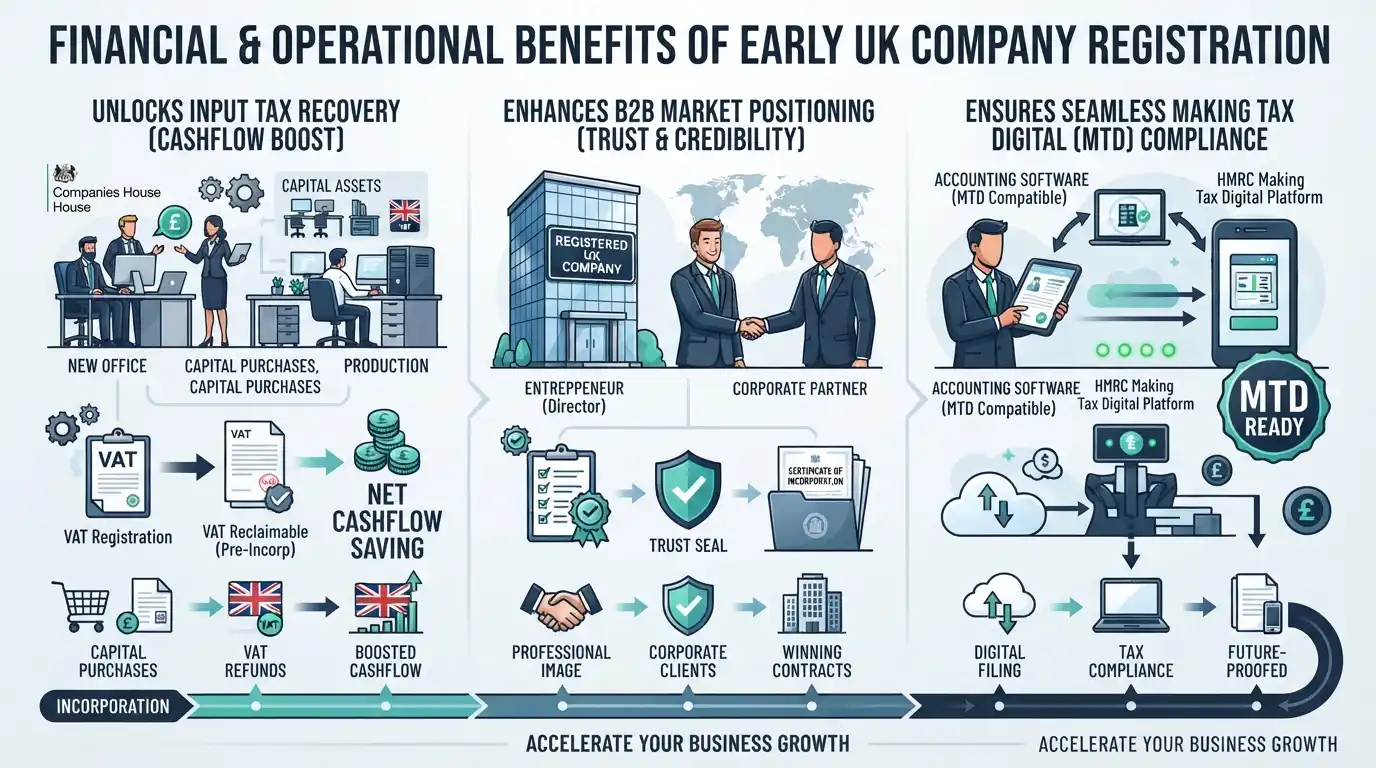
Cash flow management dictates startup survival rates during the first twenty-four months of operation. Reclaiming tax paid on expensive software subscriptions, specialized hardware, and consultancy fees injects vital capital back into business accounts. Accountants track these expenditures meticulously to maximize quarterly cash returns from HM Revenue and Customs. Every invoice containing standard-rate charges becomes a potential source of liquidity.
Market positioning shifts immediately upon receipt of a valid trader identification number. Corporate procurement departments screen vendors for tax compliance before issuing purchase orders. Startups lacking a formal tax status frequently fail initial vendor risk assessments. Securing credentials through VAT Registration Assistance eliminates this administrative barrier and accelerates enterprise sales cycles.
Software integration represents a major operational advantage for proactive founders. HM Revenue and Customs mandates digital record-keeping under current regulatory frameworks. Implementing compatible accounting software from day one prevents costly retrofitting errors later. Finance teams master digital submission protocols when transaction volumes remain manageable.
Risk mitigation plays a hidden role in operational stability. Founders avoid missing the statutory registration window because their systems already monitor rolling twelve-month turnover figures automatically. Penalties for late registration accumulate rapidly when businesses cross statutory limits unnoticed. Proactive setup establishes permanent oversight of financial thresholds.
Industry-specific factors influence the overall return on investment for early adopters. Exporters and businesses with zero-rated supplies benefit immensely because they generate tax repayments without charging output tax on sales. Understanding these structural nuances prevents costly miscalculations during the initial business planning phase.
How Does the Voluntary VAT Application Process Work?
The application process requires submitting historical financial records, validating business authenticity, and completing digital authorization protocols through government gateways.
Submitting an application demands absolute precision regarding business activities and projected turnover figures. HM Revenue and Customs scrutinizes applications to prevent fraudulent registrations and carousel schemes. Founders must provide proof of trading intent, such as signed commercial leases, client contracts, and detailed business plans. Missing documentation triggers mandatory compliance checks that delay authorization by several weeks.
Identity verification protects the integrity of the corporate tax system. Directors must submit verified identification documents and proof of residential address alongside company formation certificates. Compliance officers match these records against national databases to confirm legal existence. Once identity checks clear, the digital gateway opens for submission.
Processing times vary depending on seasonal submission volumes and sector risk profiles. Standard digital applications receive authorization within fourteen working days under normal operational conditions. Complex business models involving international trade require manual review by specialist inspectors. These specialized reviews extend approval timelines to thirty days or more.
Post-approval procedures require configuring billing systems to display registration numbers correctly. Invoices must include specific tax codes, calculation breakdowns, and sequential numbering formats. Staff training ensures sales teams apply correct rates across all product lines immediately upon receiving authorization.
Expert guidance simplifies this intricate administrative journey for busy founders. Many enterprises evaluate their readiness using insights from How to Weigh the Pros and Cons of Voluntary VAT Registration for Early-Stage Startups before submitting paperwork. Professional assistance prevents common filing errors that trigger official queries and processing freezes.
What Challenges Do Businesses Face When Registering Voluntarily?
Businesses encounter increased administrative burdens, potential cash flow strains on retail sales, and complex deregistration rules if taxable turnover subsequently declines.
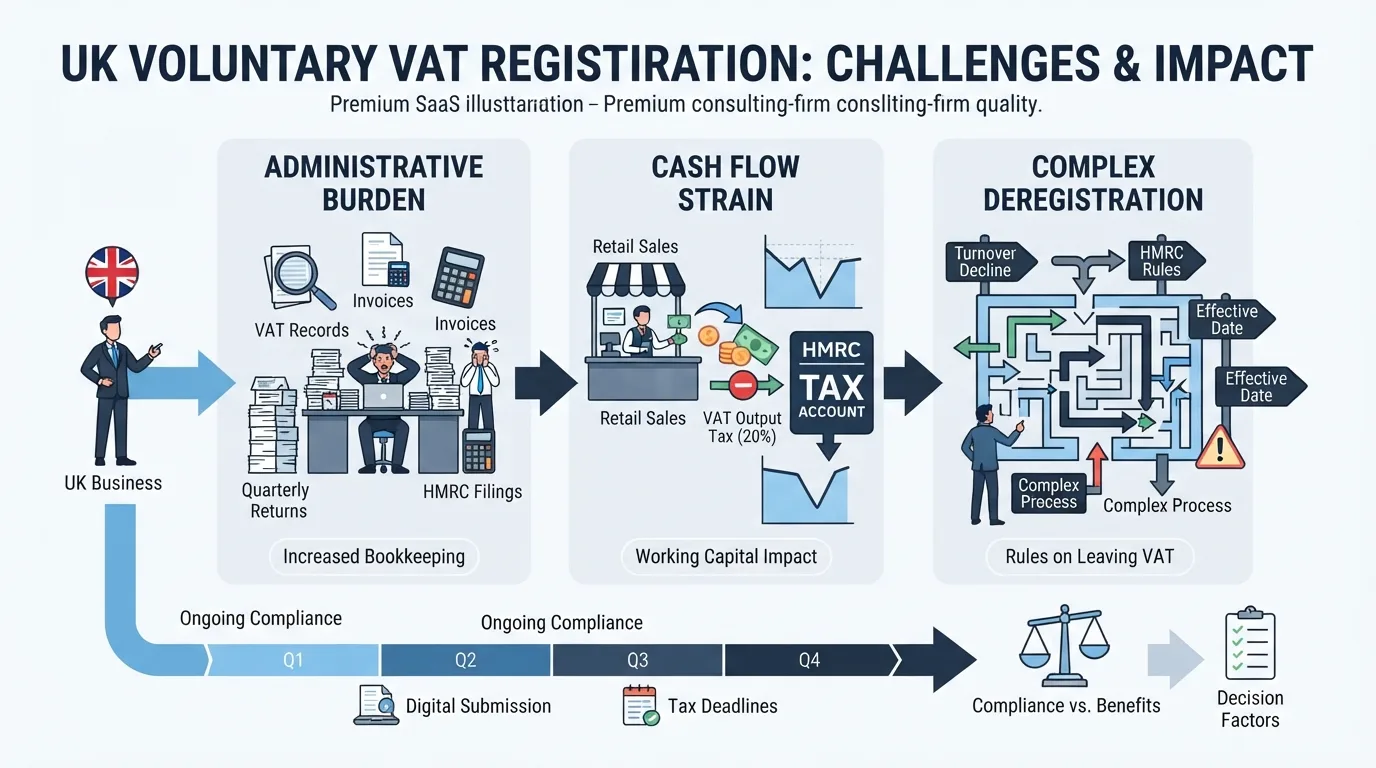
Administrative overhead increases immediately upon entering the tax regime. Finance teams dedicate dozens of hours each quarter to reconciling purchase invoices and sales ledgers. Every transaction requires accurate categorization to distinguish between standard-rated, reduced-rated, zero-rated, and exempt supplies. Errors in ledger entries invite punitive audits and financial penalties from tax authorities.
Retail businesses face severe cash flow contraction if their customer base consists entirely of non-registered consumers. Absorbing a 20% tax charge reduces profit margins significantly if prices remain static. Raising retail prices to pass the cost along drives price-sensitive consumers toward non-registered competitors. Business models relying on consumer volume require rigorous financial modeling before committing to early registration.
Deregistration rules present a rigid exit barrier for companies experiencing declining revenue. HM Revenue and Customs permits cancellation only when projected taxable turnover drops below the statutory deregistration limit of £88,000. Companies must account for capital assets held at deregistration, as deemed market value assessments can trigger unexpected tax bills upon exit.
Cross-border transactions introduce another layer of regulatory complexity. Trading physical goods or digital services internationally involves navigating destination-based tax rules and import-export declarations. Mismanaging these international rules results in double taxation liabilities or severe non-compliance penalties.
Founders must also monitor statutory thresholds closely to avoid unexpected compliance shifts. Reviewing documents such as What Is the Current UK VAT Registration Threshold for Small Businesses? helps executives understand how voluntary status interacts with mandatory limits over multi-year operational lifecycles. Maintaining continuous awareness of legislative updates protects corporate balance sheets from unforeseen liabilities.
Explore More VAT Registration Assistance Guide,
Choose the Right Supplementary Documents Package at Form My Company
Get Marketplace Verification Documents From Form My Company
How Does Form My Company Streamline Your Tax Registration Journey?
Form My Company delivers expert digital guidance, verifies compliance documentation meticulously, and accelerates tax authorization through direct government portal integration.
Navigating complex regulatory frameworks demands specialized expertise and precision. Form My Company assigns dedicated compliance specialists to audit client financial records before submission. These specialists identify missing documents, rectify structural errors, and ensure applications align with current statutory requirements. Rigorous pre-submission checks eliminate common triggers for administrative rejection.
Direct integration with digital filing portals speeds up transmission times significantly. Form My Company bypasses manual queues by utilizing authorized business channels for document delivery. This technical advantage shatters standard processing delays and secures trader credentials days ahead of industry averages.
Client support extends far beyond initial certificate delivery. Form My Company provides ongoing guidance regarding first-quarter submissions, software configuration, and record-keeping protocols. Founders gain a trusted administrative partner who safeguards their operational compliance from day one.
Operational transparency remains the cornerstone of every client engagement. Form My Company outlines exact timelines, document requirements, and fee structures upfront with zero hidden charges. Business owners retain total control over their strategic decisions while expert professionals handle complex administrative execution.
Choosing professional assistance transforms a stressful bureaucratic hurdle into a smooth operational milestone. Form My Company empowers ambitious entrepreneurs to focus on core product development and market expansion while securing essential tax credentials efficiently.
Frequently Asked Questions
Can a business register for UK VAT voluntarily before reaching the £90,000 threshold?
Yes, businesses trading below the statutory turnover limit can apply for voluntary registration through Form My Company to reclaim input tax on business expenses. Early registration establishes commercial credibility with corporate clients and ensures proactive alignment with Making Tax Digital compliance frameworks.
What documents are required when applying for VAT registration assistance?
Applicants must provide proof of trading intent, company formation documents, official director identification, and proof of residential address. Utilizing VAT Registration Assistance from Form My Company ensures these records are thoroughly audited and properly formatted before submission to HM Revenue and Customs.
How long does it take for HM Revenue and Customs to approve a voluntary VAT application?
Standard digital applications submitted through official channels typically receive authorization within 14 working days under normal operational conditions. Complex international business models or applications requiring manual compliance checks by Form My Company specialists may extend approval timelines to 30 days or more.
What are the main financial advantages of registering for VAT early?
Early registration allows startups to reclaim input tax on capital assets, software subscriptions, and professional services purchased prior to trading. Form My Company helps businesses unlock this vital cash flow advantage, turning initial operational expenditures into recoverable quarterly tax returns.
Can a company deregister from VAT if taxable turnover drops below the threshold?
Businesses can apply to cancel their registration if their expected taxable turnover falls below the statutory deregistration limit of £88,000. Form My Company provides expert guidance on navigating deregistration rules and accounting for capital assets held at the time of exit.