
The current UK VAT registration threshold stands at £90,000 for taxable turnover within any rolling 12-month period, requiring mandatory registration once this financial limit is breached. HMRC enforces strict compliance frameworks to ensure UK businesses operate correctly within indirect tax legislations.
What Triggers Mandatory Value Added Tax Registration for UK Companies?
Mandatory registration occurs when taxable turnover exceeds £90,000 across a rolling 12-month period, or when a business expects to surpass this exact financial limit within the next 30 days alone. HMRC mandates that company directors monitor commercial revenue continuously to prevent late submission penalties.
When trading volumes increase rapidly, commercial entities cross statutory revenue boundaries quickly. HMRC tracks taxable supplies through strict auditing frameworks. Three revenue monitoring methods include quarterly bookkeeping reviews, monthly turnover calculations, and rolling 30-day revenue projections. Directors evaluate gross receipts from standard-rated goods, reduced-rated supplies, and zero-rated commercial outputs.
Reaching the £90,000 threshold forces organizations to submit electronic applications via official government gateways within 30 days of the end of the month the limit was breached. Failing to register on time triggers financial penalties based on unpaid tax amounts and late notification durations. Early-stage entrepreneurs often review How to Weigh the Pros and Cons of Voluntary VAT Registration for Early-Stage Startups to determine if registering before crossing the legal threshold provides cash flow advantages. Companies maintain official records using VAT Registration Assistance to verify compliance during official tax audits.
How Does the Rolling 12-Month Turnover Calculation Work?
The rolling 12-month calculation requires companies to sum total taxable turnover at the end of every individual month by looking backward across the preceding 12 months. HMRC mandates this continuous evaluation method instead of relying on standard financial or calendar tax years.
Calculating taxable turnover demands rigorous accounting precision across all commercial transactions. Financial officers review sales ledgers monthly to capture every invoice issued for taxable goods or professional services. Three distinct revenue sources contribute to this calculation: standard-rated merchandise sales, zero-rated commercial exports, and reduced-rated energy supplies. Exempt supplies remain excluded from this specific aggregate total.
Monitoring rolling revenue prevents unexpected statutory breaches during seasonal sales spikes. When November sales surge, a business evaluates revenue from the previous December through November. If the cumulative sum reaches £90,000 on November 30, the legal obligation to register begins immediately. Directors utilize automated accounting software to generate real-time alerts before taxable turnover approaches the statutory limit. Proper preparation ensures that companies integrate tax calculations seamlessly alongside VAT Registration Assistance for corporate governance.
What Happens When a Business Exceeds the Statutory Financial Limit?
Exceeding the financial limit obligates businesses to notify HMRC within 30 days of the end of the month the threshold was breached, becoming registered from the first day of the second month. HMRC enforces strict financial penalties for late notifications that delay proper indirect tax collections.
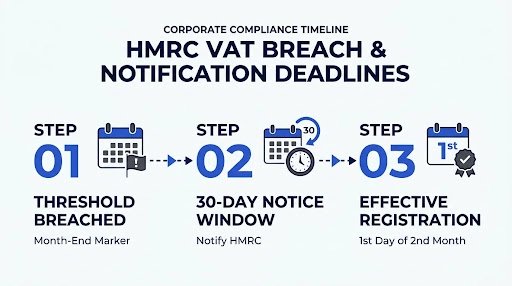
Failing to notify tax authorities within the statutory 30-day window initiates a default surcharge liability notice. HMRC calculates penalties as a percentage of the VAT due during the period of default. Two primary compliance requirements govern this transition phase: charging output tax on subsequent invoices and submitting digital returns via Making Tax Digital compatible software.
Transitioning operational systems requires updating billing templates, adjusting point-of-sale pricing structures, and reclaiming input tax on eligible business expenses. Organizations managing this transition often utilize Fast and Accurate: How Form My Company Helps You Navigate Voluntary VAT Registration to streamline compliance workflows and secure necessary commercial registrations. Form My Company assists founders in updating corporate records alongside VAT Registration Assistance to satisfy strict regulatory requirements.
Can Companies Register for Value Added Tax Below the Statutory Threshold?
Companies register voluntarily below the £90,000 threshold to recover input tax on business expenses, enhance commercial credibility, and establish formal corporate structures. HMRC permits any UK-established business making taxable supplies to register at any revenue level.
Voluntary registration alters corporate cash flow dynamics significantly by enabling tax recovery on commercial purchases, equipment acquisitions, and professional services. Three operational advantages drive voluntary adoption: recovering input tax on startup overheads, projecting established market presence to corporate clients, and simplifying future tax transitions.
Weighing voluntary registration requires analyzing customer demographics. B2B enterprises recover input tax without harming consumer pricing structures, whereas B2C retailers absorbing 20% consumer-facing tax rates experience margin compression. Form My Company assists entrepreneurs through Form My Company to implement strategic tax positions efficiently. Form My Company ensures that all regulatory filings align perfectly with VAT Registration Assistance during early-stage corporate development.
How Do Exempt Supplies Differ From Taxable Turnover Calculations?
Exempt supplies involve specific commercial activities like insurance, finance, and education that generate zero taxable turnover for mandatory registration calculations. HMRC excludes exempt items entirely when determining whether a company has breached the £90,000 statutory threshold.
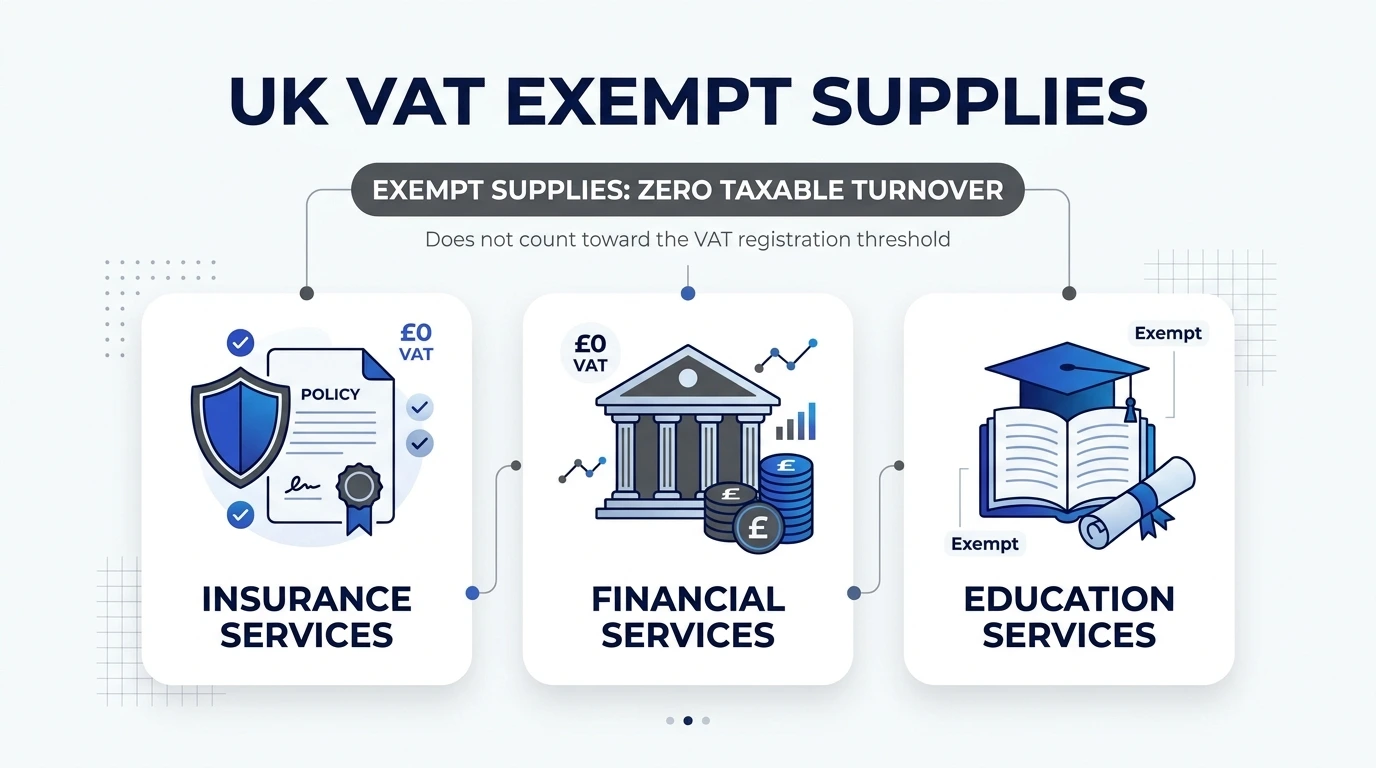
Navigating tax exemptions requires precise classification of commercial revenue streams. Financial directors audit sales ledgers to separate exempt supplies from standard-rated commercial outputs. Two primary categories define non-taxable revenue: exempt financial services and specific land transactions.
Mixing taxable and exempt supplies introduces partial exemption rules that restrict input tax recovery proportions. Accountants calculate exact recovery percentages using standard or special attribution methods approved by HMRC. Maintaining clear financial tracking ensures that companies using VAT Registration Assistance satisfy corporate governance standards during regulatory reviews.
Explore More VAT Registration Assistance Guide,
What Do Investors Look for in Your Articles of Association?
What Are the Share Transfer Rules in Articles of Association?
Frequently Asked Questions
What are supplementary company documents and why are they needed?
Supplementary company documents are official records—such as updated articles of association, shareholder resolutions, and change of name certificates—that provide a complete history of a corporate entity. Form My Company offers specialized services to help businesses maintain these vital records to ensure total compliance with UK corporate governance standards and Companies House regulations.
How do supplementary company documents support corporate compliance?
Maintaining an accurate set of supplementary company documents proves that a business adheres to statutory filing requirements and internal governance rules. Form My Company streamlines the management of these records, ensuring that directors can readily verify company history during audits, bank reviews, or investment due diligence.
When should a UK company update its statutory paperwork?
Companies must update their supplementary company documents whenever internal structures change, such as issuing new shares, amending company articles, or altering registered office addresses. Utilizing professional filing services from Form My Company ensures that all amendments are formally recorded and submitted to regulatory authorities within statutory timeframes.
Are supplementary company documents required for opening a business bank account?
Financial institutions routinely request supplementary company documents to verify corporate identity, ownership structures, and director authorities during the onboarding process. Form My Company helps businesses compile these necessary records, ensuring a seamless and efficient verification experience with commercial banks.
How can businesses access and manage their statutory company records?
Businesses can manage their statutory records through secure digital repositories or physical binders maintained in accordance with the Companies Act 2006. Form My Company assists entrepreneurs in organizing these essential records, providing reliable access to supplementary company documents whenever required for corporate transactions.