
To build a sale-ready company document pack, collate your statutory registers, certificate of incorporation, articles of association, shareholder agreements, share certificates, and confirmation statements. Organize these verified legal records into a structured digital data room to pass buyer due diligence without delays.
Why Is a Document Pack Essential When Selling a Business?
A document pack accelerates due diligence by giving buyers instant access to verified corporate records. Complete statutory documentation proves clear ownership, validates legal compliance, prevents deal renegotiations, and eliminates transactional delays during financial audits.
Corporate due diligence requires complete legal transparency before buyers commit capital. Buyers review statutory records to confirm company structure, capital allocation, and regulatory compliance. Missing files delay transactions by weeks while directors request replacement records from Companies House.
Incomplete corporate records increase perceived risk for potential acquirers. Professional buyers penalize unorganized sellers by lowering valuations or adding restrictive indemnity clauses. Providing verified legal documents builds immediate deal trust and protects your agreed sale price.
Statutory compliance issues frequently emerge during technical legal audits. Missing share certificates, unfiled confirmation statements, or inaccurate register entries trigger buyer requests for formal indemnities. Preparing documentation early allows directors to rectify corporate record discrepancies long before buyer negotiations begin.
Organized data rooms allow legal teams to complete audit tasks rapidly. Corporate solicitors require direct access to historic board resolutions, share allocation records, and updated statutory books. Systematic record preparation reduces professional legal fees by eliminating emergency administrative work.
What Corporate Records Must You Include in Your Document Pack?
Your document pack must contain the certificate of incorporation, memorandum and articles of association, statutory registers, share certificates, confirmation statements, and historical tax filings. These corporate records validate legal existence, ownership structure, and regulatory standing.
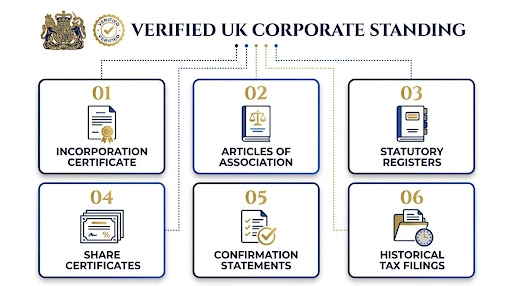
The certificate of incorporation serves as primary evidence of legal formation. This document proves corporate existence under the Companies Act 2006. Buyers verify the registration number, legal name, and incorporation date directly against official Companies House database entries.
Updated articles of association outline internal corporate governance rules. Acquirers evaluate director powers, voting rights, and share transfer restrictions within these constitutional documents. Sellers must provide both original articles and any amended versions filed through special resolutions.
Statutory books form the core legal evidence of company ownership. Your file must contain seven core registers: directors, director residential addresses, secretaries, members, persons with significant control, allocations, and transfers. Missing entries invalidate legal title to corporate equity during acquisition checks.
Shareholder agreements establish specific contractual rights between equity holders. These private contracts govern tag-along rights, drag-along clauses, and dividend distribution rules. Providing signed copies ensures buyers evaluate existing shareholder obligations without discovering unexpected legal restrictions.
Filed confirmation statements establish ongoing annual compliance history. Acquirers review historical annual returns alongside financial statements to confirm timely corporate reporting. You must include all annual filings to prove the company remains in continuous good standing.
Financial compliance records validate historical tax reporting accuracy. Sellers must include filed annual accounts, corporation tax returns, and VAT submission records for three consecutive years. Clear financial evidence supports historic earnings figures presented during initial commercial discussions.
How Do You Audit Statutory Books Before Compilation?
To audit statutory books, cross-reference internal records with official Companies House filings to confirm exact alignment. Reconcile issued shares against member registers, update director details, and correct corporate filing discrepancies before opening due diligence.
statutory book audits begin with formal register verification. Directors compare internal statutory books against public registers to identify missing filings or conflicting dates. Discrepancies between public records and private registers halt legal transactions until formal corporate rectifications occur.
Equity ownership checks require precise share register reconciliation. Match every issued share certificate against the statutory register of members and company accounting entries. Ensure share transfer forms, board approval minutes, and cancelled certificates exist for all historical equity transactions.
Director and officer records require strict detail verification. Confirm the register of directors lists exact residential addresses, service addresses, appointment dates, and corporate roles. Update Companies House immediately if previous officers resigned without formal notification filings.
Person with Significant Control records demand thorough legal review. Validate that your PSC register correctly identifies individuals or entities holding over 25 percent of voting rights or capital. Non-compliance with PSC regime requirements constitutes a criminal offense under UK corporate law.
Reconciling corporate records before going to market ensures a smooth acquisition process. When directors identify missing historical filings or unissued equity certificates, accessing professional Supplementary Company Documents resolves record deficiencies by restoring official statutory books to full regulatory compliance.
How Do You Structure a Digital Data Room for Buyers?
Structure a digital data room by creating categorized folders for corporate structure, share capital, financial history, and regulatory compliance. Apply standard naming conventions, restrict permission levels, and upload index documents for intuitive buyer navigation.
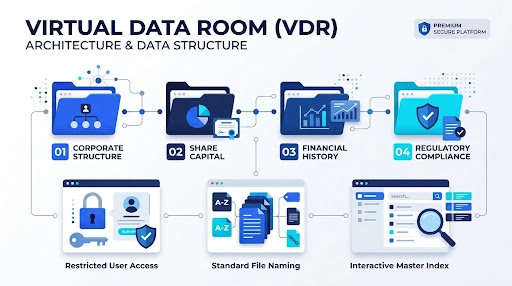
Logical folder architecture speeds up external legal review. Create primary directories organized by professional discipline: Corporate Governance, Share Capital, Financial Records, Tax Filings, and Material Contracts. Numerical prefixes keep folders ordered correctly across different operating systems.
Strict file-naming conventions maintain organizational clarity. Label each document using a standardized structure: Category_DocumentName_Date. Standardized labels eliminate confusion when legal advisors review hundreds of corporate files across multiple acquisition review rounds.
Digital access controls protect sensitive commercial data. Grant buyer legal teams read-only access while disabling bulk download or printing features for sensitive documents. Track user activity logs continuously to measure buyer engagement with specific corporate files.
Data room indexes provide clear overview maps for legal reviewers. Maintain an active master index listing every uploaded file, document version, and upload timestamp. A clear master index allows buy-side solicitors to verify complete disclosure rapidly.
When Should You Prepare Your Corporate Document Pack?
Prepare your corporate document pack six to twelve months before listing your business for sale. Early preparation provides sufficient time to locate missing records, rectify register errors, issue replacement certificates, and complete formal corporate filings.
Early preparation prevents deal failure during active price negotiations. Discovering statutory defects mid-transaction creates buyer leverage, leading to price reductions or deal abandonment. Assembling records six months early ensures directors control the narrative throughout sale discussions.
Resolving statutory record errors requires considerable administrative lead time. Reconciling historic share transfers or issuing replacement certificates takes several weeks of legal administration. Completing these tasks early prevents buyer legal teams from imposing strict deal deadlines.
Reviewing documents early highlights hidden operational risks. Examining contracts reveals change-of-control clauses that require third-party consent prior to business transfer. Identifying restrictive clauses early allows management to negotiate necessary consents quietly.
Acquirers evaluate seller readiness based on documentation speed. Delivering a complete data room immediately upon signing a non-disclosure agreement signals operational maturity. Sellers who present organized files retain momentum and maintain firm control over transaction timelines.
Understanding what company records buyers ask for when you sell a business helps owners gather exact documentation requirements before initiating formal market outreach. Early preparation transforms complex corporate legal checks into a predictable, manageable process.
How Do Statutory Register Errors Impact Business Sale Valuations?
Statutory register errors reduce business valuations by creating legal uncertainty over equity ownership and corporate compliance. Unrecorded share transfers or missing statutory books force buyers to demand purchase price discounts, holdbacks, or extensive seller indemnities.
Unrecorded share transactions create immediate legal ownership disputes. Under the Companies Act 2006, legal title to shares passes only when entered into the statutory register of members. If historical transfers exist only on signed stock transfer forms, buyers cannot verify true equity ownership.
Defective ownership records force buy-side solicitors to draft broad indemnity provisions. Acquirers insist on placing significant funds into escrow accounts to cover potential third-party ownership claims. Financial holdbacks reduce cash proceeds available to business owners at closing.
Missing corporate resolutions undermine board decision validity. Major corporate actions, such as share issuances or articles amendments, require formal board or shareholder approval minutes. Lacking written evidence of authorization leaves historical corporate actions vulnerable to legal challenge.
Acquirers apply risk discounts when corporate record-keeping shows systemic neglect. Disorganized corporate records suggest potential hidden compliance problems across wider business operations. Buyers lower their initial purchase offers to account for post-acquisition rectification costs.
Directors can protect transactional value by completing structured administrative reviews prior to negotiation. Business owners choose to order a sale-ready company document pack from Form My Company to eliminate legal record errors, streamline statutory compliance checks, and secure full value upon exit.
Explore More Supplementary Company Documents Guide,
How a Letter of Authority Supports Your Registered Office Address
How to Use Certified Formation Documents to Apply for Business Finance
Frequently Asked Questions
What documents are included in a supplementary company document pack?
A supplementary company document pack typically includes historical register updates, replacement share certificates, certified copies of incorporation documents, and missing board meeting minutes. Form My Company compiles these vital statutory records to ensure your business maintains complete legal compliance and transparency.
Why are supplementary company records necessary for a business sale?
Buyers and corporate solicitors examine statutory registers during due diligence to verify clear equity ownership and regulatory compliance. Providing an organized set of supplementary company documents prevents deal delays, eliminates valuation disputes, and proves your corporate history is fully up to date.
How long does it take to obtain replacement corporate documents?
Obtaining replacement corporate documents through professional filing services usually takes between 3 and 10 working days depending on the complexity of your statutory history. Form My Company streamlines this process by retrieving official records directly from Companies House archives and updating your internal books.
Can missing share certificates invalidate a company acquisition?
Missing share certificates create severe legal ambiguity regarding true equity ownership and shareholder rights during corporate acquisitions. Reissuing these missing documents before entering negotiations protects your valuation and reassures buyers that the target company has clean equity titles.
How do I update unfiled historical changes in my statutory registers?
Updating unfiled historical changes requires drafting retrospective board resolutions, executing proper stock transfer forms, and reconciling member registers with public filings. Form My Company provides specialized supplementary document solutions to rectify historical compliance gaps and restore statutory book accuracy.