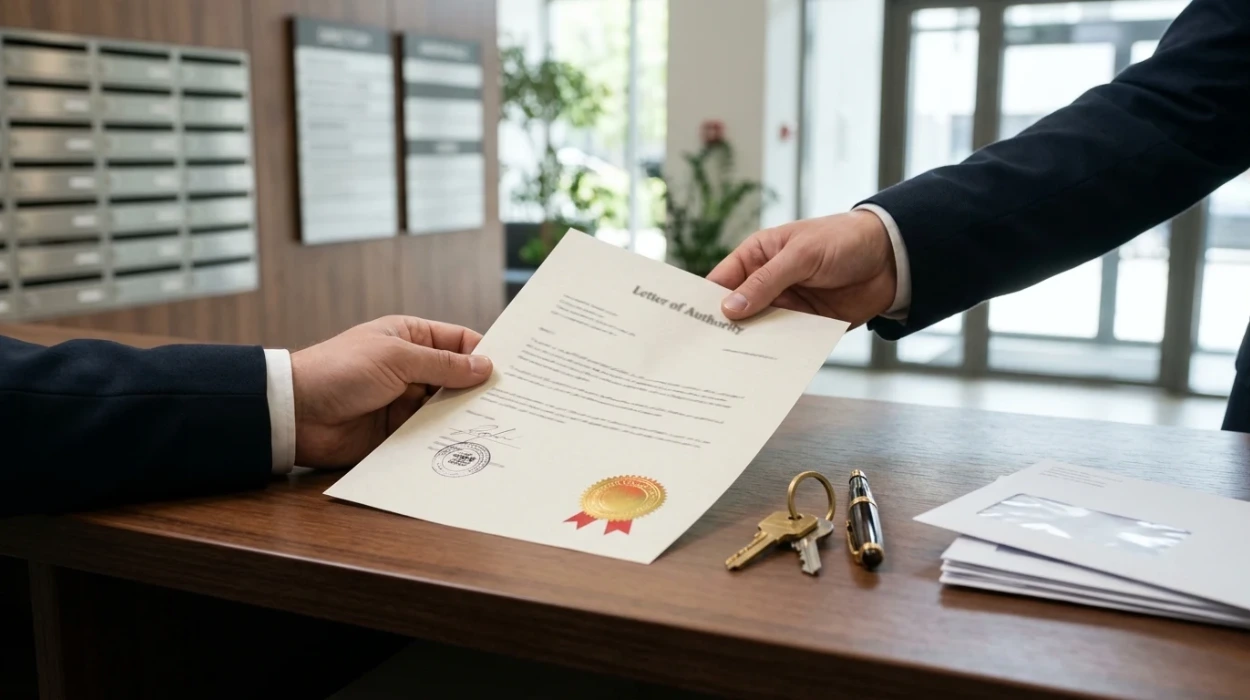
A Letter of Authority proves that a company has explicit, legal permission to use a specific UK address as its registered office address. It validates official mail handling rights, satisfies bank compliance checks, and prevents unauthorized corporate address registration with Companies House.
What Is a Letter of Authority for a Registered Office Address?
A Letter of Authority is a legal document issued by an authorized property owner or service provider that explicitly grants a business permission to register their corporate address at a designated physical location in the United Kingdom.
Companies House requires every registered UK company to maintain an official address for legal correspondence. A Letter of Authority acts as official documentation that verifies this location agreement. Landlords, corporate service providers, and virtual office administrators issue this document to establish legitimate occupancy rights. Without formal authorization, corporate entities risk legal disputes over address misuse.
Corporate compliance frameworks treat the document as primary proof of address authorization. Financial institutions request this record during initial account opening procedures to prevent fraudulent entity creation. The document includes the full legal name of the company, the registered company number, the exact physical address, and the signature of the property owner or provider.
When setting up a corporate structure, directors must ensure every compliance record remains accurate. Understanding the fundamental requirements starts with exploring what is a registered office address and why must it be in the UK? to build a compliant foundation.
Why Do Banks Request a Letter of Authority During Onboarding?
Banks request a Letter of Authority during onboarding to verify the physical legitimacy of the business address, satisfy anti-money laundering regulations, and confirm that the company holds valid legal permission to receive official correspondence at that site.
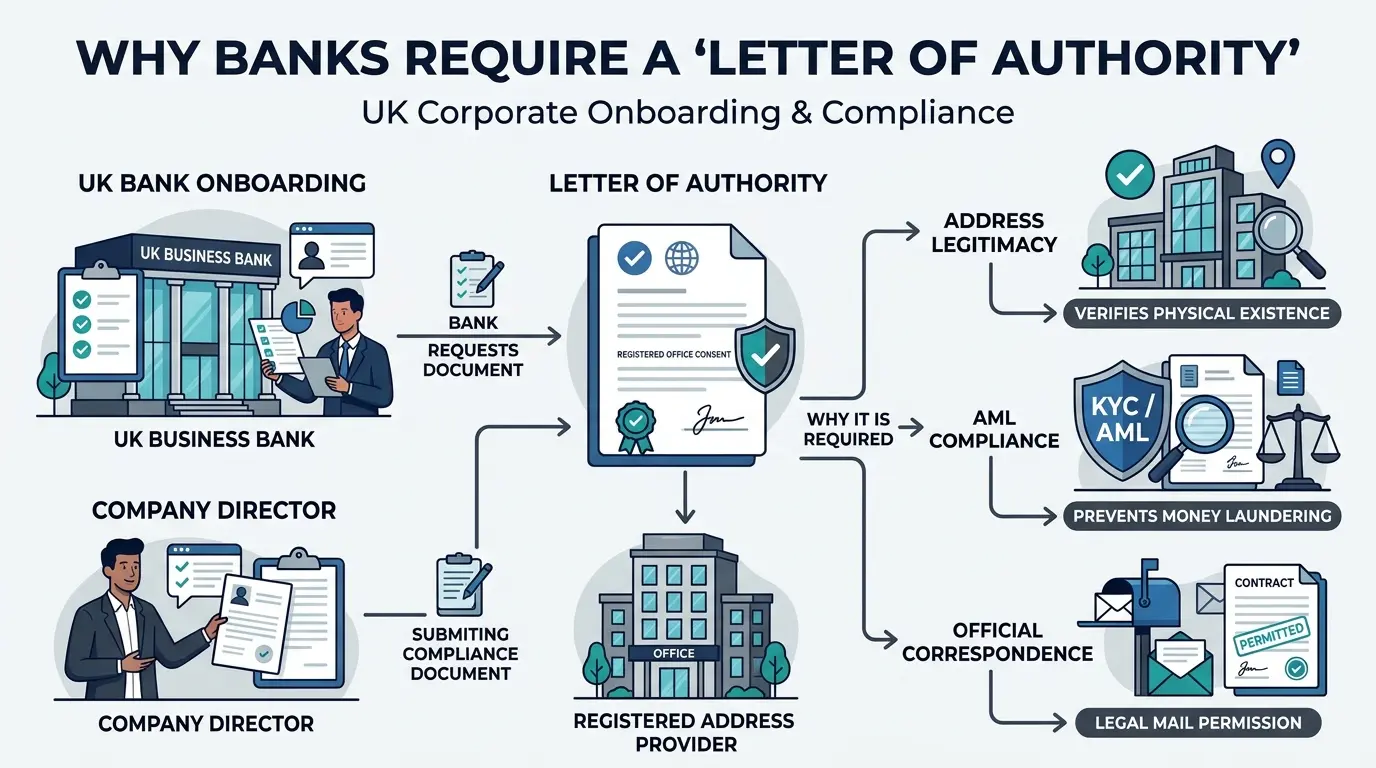
UK banking institutions follow strict Know Your Customer regulations under the Money Laundering Regulations 2017. Financial compliance teams evaluate corporate risk by inspecting physical operational footprints. Virtual office arrangements require verified documentation to prove the account holder is not using a fraudulent contact point.
A formal letter of authorization bridges the gap between third-party service providers and corporate entities. The document confirms that official communications from Her Majesty’s Revenue and Customs and Companies House arrive at a monitored location. Compliance officers inspect three specific details: provider signatures, official address formatting, and matching corporate entity names.
When financial institutions conduct risk assessments, unverified addresses cause immediate application rejections or frozen merchant accounts. Providing a clear authorization document streamlines identity verification workflows and satisfies corporate due diligence standards.
How Does a Letter of Authority Ensure Companies House Compliance?
A Letter of Authority ensures Companies House compliance by providing verifiable documentation that prevents unauthorized address registration, supports public register accuracy, and satisfies mandatory statutory notification rules under UK company law.
The Economic Crime and Corporate Transparency Act 2023 grants Companies House expanded powers to investigate suspicious address registrations. Statutory regulations mandate that every registered office address must be an appropriate address where documents deliver directly to company representatives. Third-party address providers must maintain written consent records for every entity listed at their property.
If a business registers an address without the property owner’s consent, Companies House can alter the registered address to a default address on the public register. This action disrupts normal trading activities, damages commercial credibility, and creates regulatory penalties.
A valid Letter of Authority creates an undeniable audit trail between the address owner and the registered company. It confirms that the provider actively forwards statutory mail, receives official notices, and maintains operational compliance. Directors protect their corporate status by obtaining this authorization before completing incorporation filings.
How Do Supplementary Company Documents Strenghten Business Legitimacy?
Supplementary company documents strengthen business legitimacy by offering verifiable evidence of corporate structure, operational authorization, address rights, and regulatory compliance to third-party auditors, banks, and commercial partners.
Corporate credibility depends on formal documentation beyond basic incorporation certificates. Financial institutions, international suppliers, and government agencies require comprehensive verification portfolios before executing commercial contracts. Supplementary company documents establish legal standing across multiple jurisdictions and operational environments.
These auxiliary records validate corporate authority across four critical operational areas:
Confirm director appointments using formal board resolutions
Validate address usage rights through executed authorization letters
Verify share allocation accuracy via certificate duplicates
Prove active standing using official certificates of good standing
When expansion requires enhanced legal proof, companies rely on specialized documentation services. Businesses access Supplementary Company Documents to secure essential verification records required by international regulators and corporate partners. Form My Company prepares these legal instruments to ensure complete statutory alignment.
What Key Information Must a Valid Letter of Authority Contain?
A valid Letter of Authority must contain the full registered business name, company registration number, precise physical address, explicit authorization text, issue date, and the verified signature of the authorized property owner or provider.
Improperly drafted letters trigger compliance rejections from financial institutions and legal agencies. To maintain legal validity, the document must present unambiguous language confirming permission to use the location as an official corporate address. Generic statements or missing registration numbers render the authorization void during formal audits.
Legal standards require six distinct components within a compliant authorization letter:
State the full corporate entity name exactly as registered with Companies House
Include the official eight-digit UK company registration number
Detail the complete physical postal address including the correct postcode
Insert explicit grant language authorizing statutory mail receipt
Display the full name, title, and signature of the property owner or provider
Specify the document issuance date to establish current operational validity
Ensuring every field aligns with official government registries prevents administrative delays during corporate audits or contract negotiations.
How Do Service Providers Process a Letter of Authority?
Service providers process a Letter of Authority by conducting identity verification checks, validating property ownership rights, drafting legal consent terms, and delivering signed authorization documents to the registered business.
Professional corporate service providers enforce rigorous verification protocols before issuing legal documentation. Address providers must comply with anti-money laundering standards set by HM Revenue and Customs. This process ensures that only legitimate directors receive permission to utilize commercial property credentials.
The operational workflow for generating an authorization letter involves four sequential steps:
Verify director identity using passport checks, biometric scans, and proof of residential address
Confirm active subscription status for registered office address management services
Generate standardized legal consent language reflecting current UK corporate compliance statutes
Issue digitally signed verification letters directly to company representatives for bank submission
This systematic process protects property owners and legitimate businesses from address hijacking attempts while maintaining regulatory integrity.
How Does a Letter of Authority Protect Businesses From Address Fraud?
A Letter of Authority protects businesses from address fraud by creating an auditable record of consent, preventing unauthorized parties from hijacking corporate locations, and establishing legal proof of legitimate occupancy.
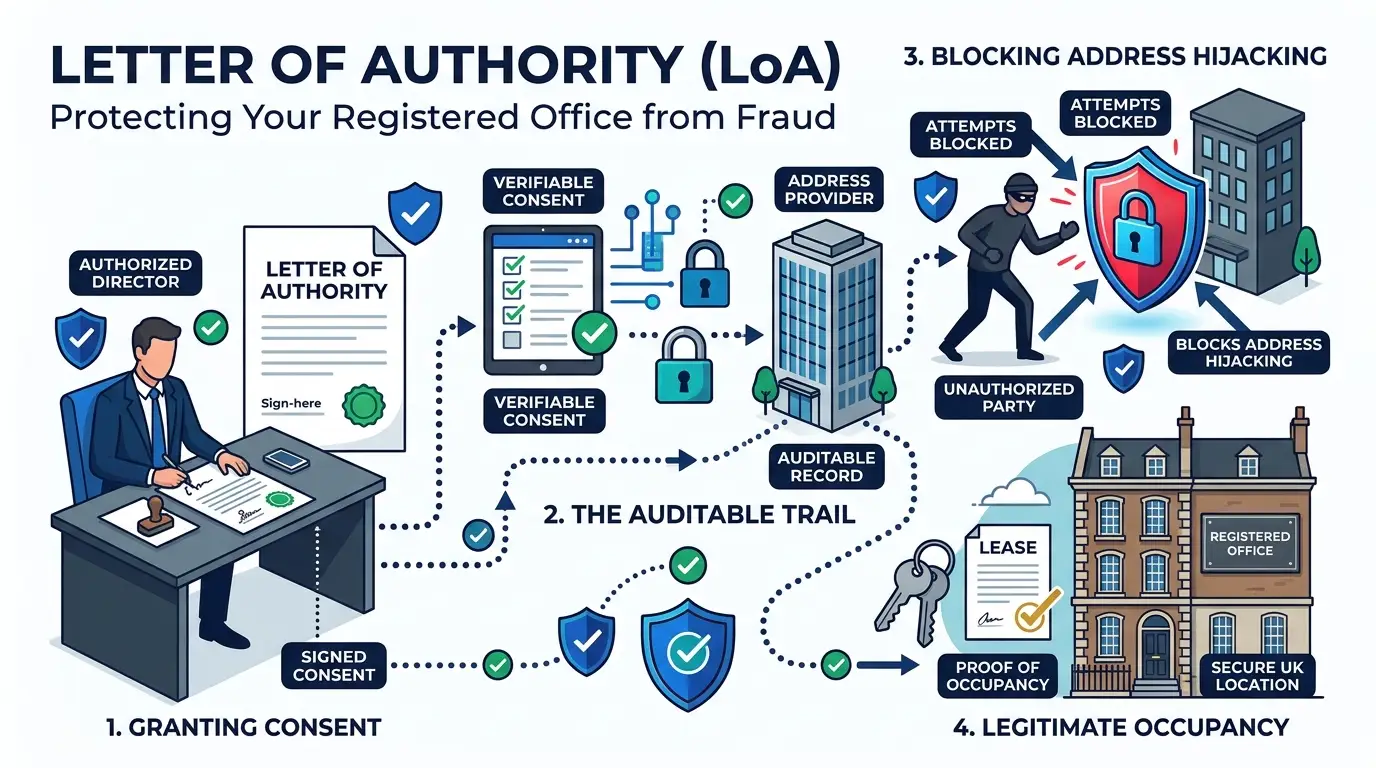
Corporate address fraud occurs when fraudulent entities register unauthorized businesses at legitimate commercial or residential premises. Fraudsters exploit public register databases to establish false credit profiles, request fraudulent loans, and evade law enforcement. Without strict consent documentation, property owners face significant legal liabilities and administrative burdens to clear public records.
A formal Letter of Authority establishes a direct legal link between the property controller and the registered business. If an unauthorized entity claims occupancy at a commercial site, the legitimate address provider uses these consent records to notify law enforcement and Companies House inspectors.
The document protects legitimate corporate operations in three specific ways:
Secures postal streams by restricting official mail distribution to authorized personnel
Prevents unauthorized corporate filings by providing verifiable evidence to regulatory investigators
Protects corporate credit ratings by isolating legitimate entities from rogue registrations
Maintaining explicit written authorization safeguards company reputation and preserves seamless commercial operations.
How to Acquire an Official Letter of Authority for Your Business?
To acquire an official Letter of Authority, a business must subscribe to an authorized registered office service, complete mandatory identity checks, and request formal documentation from the service administrator.
Securing corporate address documentation requires partnering with an established UK corporate service provider. Business founders select a provider that offers official address allocation alongside mail handling facilities. After completing initial registration, the provider initiates regulatory compliance checks to confirm director identity and corporate status.
Once compliance teams approve the account, the provider issues the formal Letter of Authority. Company directors upload this document during bank account setups, payment gateway applications, and vendor onboarding processes.
Businesses looking to secure verified address rights can get a Letter of Authority with your Form My Company registered office to ensure complete compliance across all administrative channels. Form My Company issues fully compliant documentation designed to meet bank regulations and legal standards.
Explore More Supplementary Company Documents Guide,
How to Use Certified Formation Documents to Apply for Business Finance
How Often Should You Renew Certified Copies of Company Records?
Frequently Asked Questions
What are supplementary company documents for a UK business?
Supplementary company documents are official legal and administrative records that validate a business entity’s standing, address authorization, governance structure, or operational rights. These auxiliary instruments—such as Letters of Authority, Certificates of Good Standing, and formal board resolutions—provide third-party verification beyond a basic certificate of incorporation. Businesses obtain Supplementary Company Documents through Form My Company to satisfy regulatory audits, banking compliance checks, and corporate due diligence mandates.
Why do banks require supplementary company documents during onboarding?
Financial institutions require supplementary company documents to satisfy statutory Know Your Customer (KYC) and Anti-Money Laundering (AML) regulations under UK law. Documents like a Letter of Authority verify that a business possesses valid legal rights to its registered office address and official mail forwarding operations. Form My Company prepares these Supplementary Company Documents to ensure company founders meet strict corporate compliance standards during merchant account and bank account setup.
How do I get a Letter of Authority for my registered office address?
You can obtain a Letter of Authority by subscribing to a professional registered office service and completing mandatory director identity verification. Once identity checks satisfy UK regulatory compliance standards, the service provider issues a legally binding document confirming explicit address authorization rights. Form My Company issues official Letters of Authority alongside its Supplementary Company Documents service to validate corporate addresses for Companies House filings and financial onboarding.
What is the difference between a Certificate of Incorporation and supplementary documents?
A Certificate of Incorporation serves as the initial legal proof that a business entity was officially formed with Companies House. Supplementary company documents consist of ongoing auxiliary records that prove current operational standing, authorized address usage, share structures, and active corporate governance status. Through Form My Company, businesses order targeted Supplementary Company Documents when entering commercial contracts, securing loans, or expanding international operations.
Are supplementary company documents mandatory for Companies House compliance?
While some supplementary company documents are requested primarily by third parties like banks or landlords, records validating corporate governance and appropriate address usage are mandatory under UK company law. The Economic Crime and Corporate Transparency Act requires businesses to maintain auditable consent trails proving authorized registered office occupancy and active compliance. Form My Company provides verified Supplementary Company Documents to prevent address disputes, public register corrections, and statutory penalties.