
A registered office address is the official legal location of a UK company registered with Companies House. It serves as the official contact address for government bodies, legal notices, and statutory correspondence. UK law mandates that this address must remain located within the physical jurisdiction of the UK.
What Is a UK Registered Office Address?
A UK registered office address is the official public headquarters for a limited company or limited liability partnership. It receives statutory communications from Companies House, HM Revenue and Customs, and court systems. This address appears on the public Companies House register.
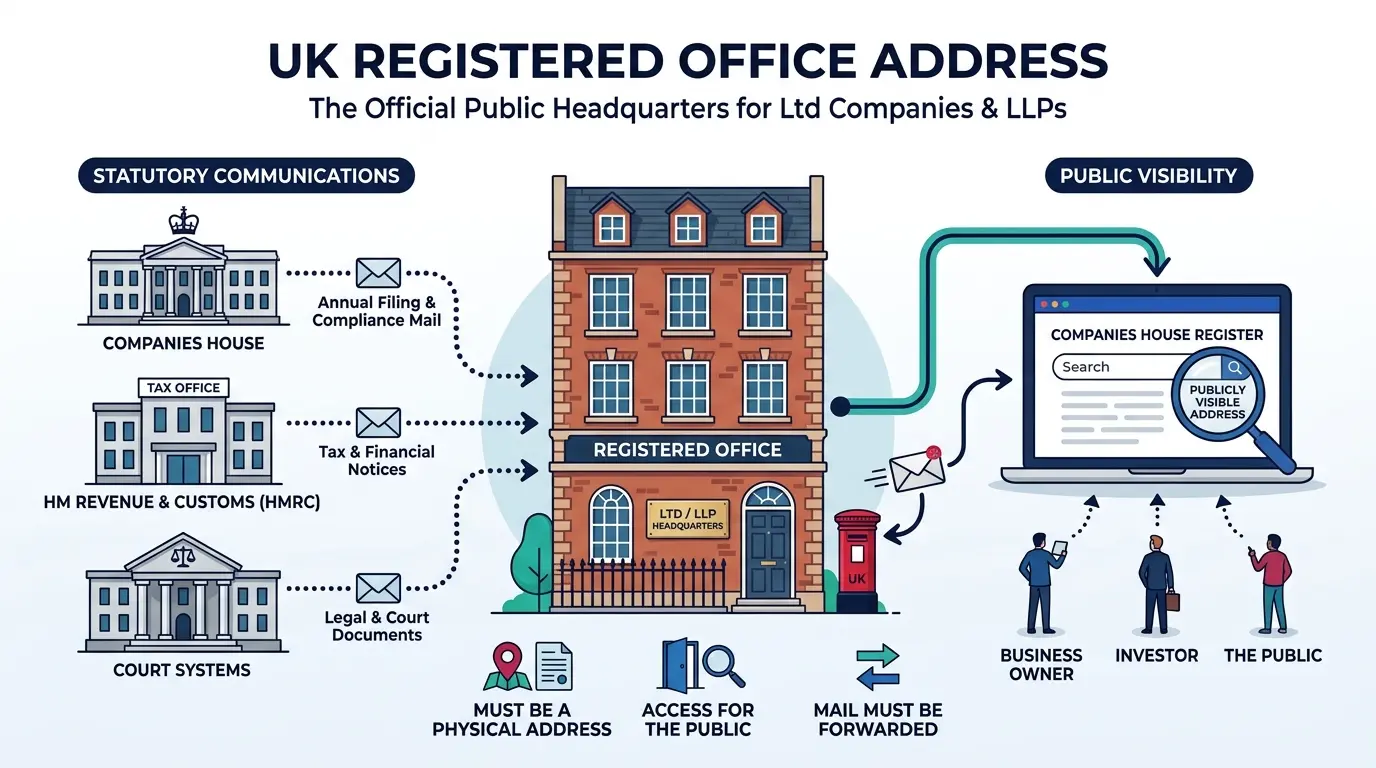
Every UK limited company must maintain an official registered address from the date of incorporation. Government agencies post legal notices, tax demands, and compliance notifications to this location. Statutory letters sent to a registered office are legally considered delivered to company directors.
Company directors can select a physical commercial office, a residential property, or a professional address service. The chosen location must provide a physical street address within the UK jurisdiction. P.O. Box numbers are invalid unless accompanied by a full physical address and building number.
The public register displays this address to maintain transparency across the UK business sector. Anyone can access the Companies House database to inspect corporate records and official contact details. Using a professional address service protects personal privacy by keeping private residential details off public registers.
Companies must process all official mail delivered to the registered office without delay. Directors incur legal liabilities if corporate correspondence remains unhandled or unanswered. Maintaining a reliable point of contact ensures uninterrupted compliance with statutory reporting schedules.
Why Must a UK Company Registered Office Be Located in the UK?
UK law mandates a domestic registered office address to establish legal jurisdiction for corporate operations. A physical location within England, Wales, Scotland, or Northern Ireland ensures UK courts and regulatory bodies maintain statutory authority over the corporate entity.
The Companies Act 2006 dictates legal boundaries for corporate registration within the UK framework. A company incorporated in England and Wales must maintain a registered office in England or Wales. Entities registered in Scotland or Northern Ireland must keep their registered office within their respective jurisdictions.
Legal jurisdiction determines which court system manages corporate litigation and insolvency proceedings. Servicing legal papers requires a valid physical destination within national boundaries. Operating an overseas address prevents UK courts from serving documents under standard domestic procedures.
HM Revenue and Customs relies on domestic corporate records to administer tax obligations. A physical address within UK borders ensures precise corporate tax assessments and compliance monitoring. Regulatory authorities verify address authenticity using official databases and cross-referenced land registry records.
International founders must secure a UK physical presence before submitting incorporation filings. Using legal UK addresses grants global entrepreneurs access to the UK banking and commercial ecosystem. Legal compliance maintains standard operational standing across international corporate jurisdictions.
What Are the Legal Requirements for a Registered Office Address?
A compliant registered office address must exist as a physical location capable of receiving official mail. The address must remain in the same UK jurisdiction as the company registration and display corporate name details clearly.
Companies House mandates that every registered office must remain reachable by post and courier services. Electronic addresses or virtual boxes lacking physical ground presence fail compliance standards. Mail distribution systems must handle statutory documents, tax notices, and court summonses effectively.
Regulations require companies to display their full corporate name at the registered office. The display must remain visible to the public during standard business operating hours. Shared office locations and corporate service providers use digital directories to fulfill this legal display rule.
Corporate registers must remain available for public inspection at the official registered address. These statutory records include director registers, shareholder records, and debenture logs. Alternatively, companies notify Companies House if records reside at a Single Alternative Inspection Location.
Changing a registered office requires immediate submission of official filings to Companies House. The updated address becomes legally effective once Companies House processes the formal notification. Historical address records remain permanently visible on public corporate registries for transparency.
To maintain compliance across all corporate records, business owners often purchase Supplementary Company Documents to verify legal status and support administrative updates.
How Does a Registered Office Protect Director Privacy?
Using a dedicated registered office address prevents personal residential addresses from appearing on public registers. This separation protects company directors from unsolicited marketing mail, identity theft, and unwanted visitors at their personal homes.
Companies House publishes corporate records online for public inspection without access fees. When directors use home addresses as registered offices, their private locations become permanently searchable. Marketers, commercial databases, and private individuals aggregate this public data for commercial outreach.
Dedicated address services intercept public records exposure by substituting commercial addresses for personal ones. statutory correspondence forwards automatically to private destinations without exposing home details. Directors preserve personal boundaries while satisfying statutory transparency obligations.
Residential lease agreements often prohibit running commercial entities from home premises. Using a commercial registered office avoids breaching private tenancy contracts or mortgage conditions. Directors avoid local authority zoning issues connected to business operations on residential property.
Maintaining a commercial public profile enhances business credibility among clients and suppliers. Corporate partners evaluate public address listings during initial due diligence procedures. A central business address presents a stable operational image compared to a residential listing.
Understanding corporate governance rules helps directors manage public filings efficiently. Reading about how a Letter of Authority supports your Registered Office Address clarifies how third-party service providers handle corporate communications legally.
What Are the Risks of Non-Compliant Registered Office Addresses?
Operating a non-compliant registered office risks financial penalties, legal prosecution, and company strike-off by Companies House. Failure to maintain an active, valid address invalidates legal standing and disrupts business operations.
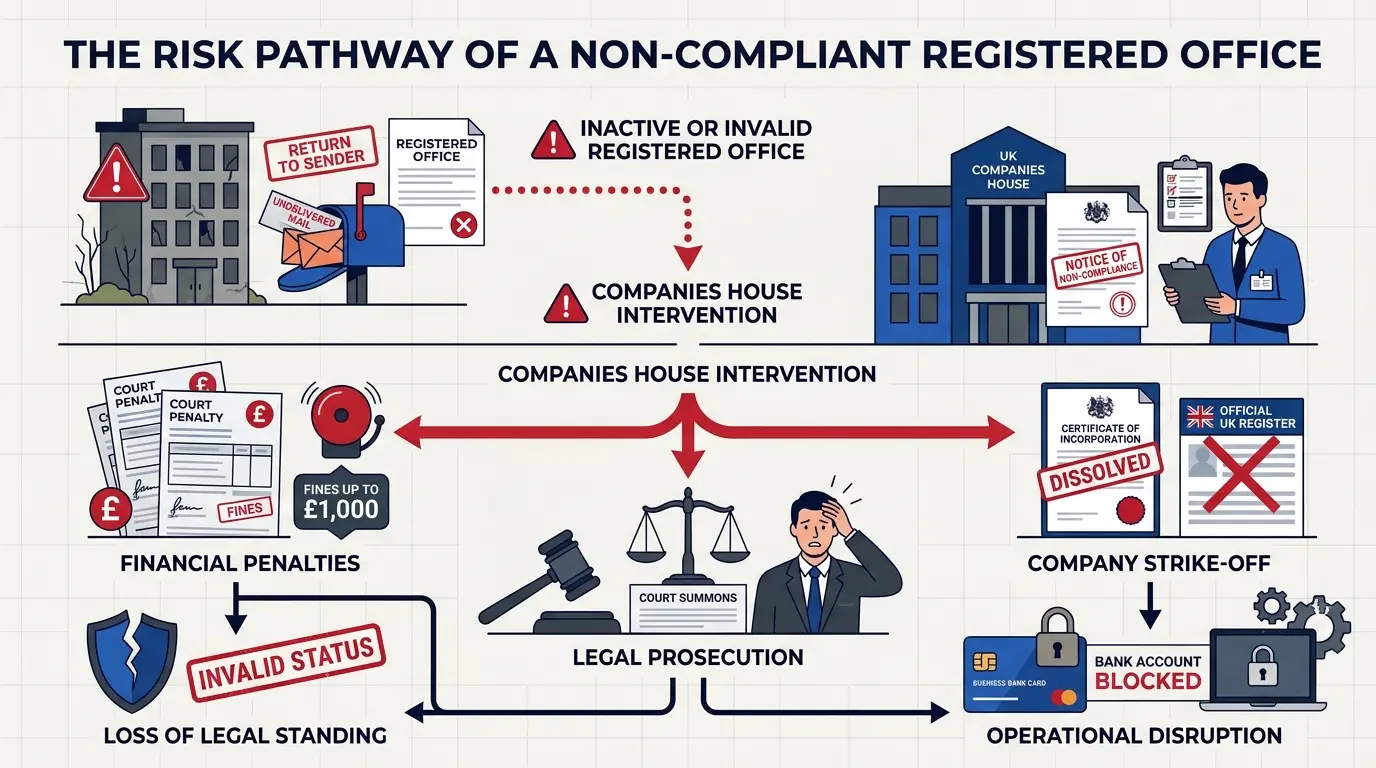
Companies House issues official warnings when correspondence returns as undelivered from a registered address. If directors fail to provide a valid replacement address, regulatory action commences quickly. Authorities possess statutory powers to remove non-compliant entities from the official corporate register.
Striking a company off the register dissolves the legal personality of the corporate entity. Company assets, bank accounts, and property transfer automatically to the Crown as bona vacantia. Reinstating a dissolved company requires costly legal applications and court proceedings.
Directors face personal fines for failing to maintain accurate corporate records on file. Failure to handle official court documents leads to default judgments against the business entity. Legal notices sent to a registered address count as legally served, regardless of physical receipt.
Financial institutions perform continuous compliance monitoring on corporate account holders. Finding an invalid registered office triggers account suspensions and commercial lending reviews. Unresolved compliance issues freeze corporate banking facilities and payment processing operations.
Securing professional corporate services prevents administrative oversights and maintains regulatory compliance. Entrepreneurs can get a Letter of Authority with your Form My Company Registered Office to delegate correspondence management and safeguard operational continuity.
How Do Professional Address Services Handle Official Mail?
Professional registered office services receive official government mail, log physical items, and process correspondence securely. They forward documents electronically or via post according to statutory privacy and compliance procedures.
Authorized mail processing units inspect arriving mail for official government markers. Systems filter statutory correspondence from commercial junk mail and promotional circulars. Staff log items from Companies House, HM Revenue and Customs, and legal officers immediately.
Scanning systems convert physical statutory documents into high-resolution electronic records. Secure digital portals dispatch scanned files to designated company officers within 24 hours. Electronic distribution ensures directors review time-sensitive tax demands and compliance warnings instantly.
Physical mail forwarding dispatches original hard-copy letters to international or domestic private locations. Service providers maintain strict verification protocols to prevent unauthorized access to corporate communications. Document retention schedules archive physical papers in compliance with UK privacy legislation.
Professional providers maintain verification systems to satisfy anti-money laundering regulations. Address services validate director identity using passport checks, utility bills, and electronic verification. Form My Company manages corporate address requirements to maintain compliance with UK corporate law.
Form My Company delivers corporate administration solutions designed to maintain compliance across all business stages. Professional governance structures safeguard operational stability while supporting long-term corporate growth.
Explore More Supplementary Company Documents Guide,
What Do Investors Look for in Your Articles of Association?
What Are the Share Transfer Rules in Articles of Association?
Frequently Asked Questions
What Are Supplementary Company Documents in the UK?
Supplementary company documents are official legal records and secondary filings submitted to Companies House beyond basic incorporation forms, including Certificates of Good Standing, updated Articles of Association, board resolutions, and filing copies. These records verify a business’s ongoing legal compliance, corporate structure, and current operational status. Businesses can secure verified digital or certified hard copies directly through the Form My Company Supplementary Company Documents service.
Why Do UK Businesses Need Supplementary Company Documents?
Banks, investors, utility providers, and foreign government authorities require certified supplementary documents to verify corporate identity, legal standing, and ownership structure during due diligence processes. Having updated corporate filings ensures seamless compliance when opening business bank accounts, securing loans, or expanding international operations. The Supplementary Company Documents service from Form My Company provides certified records that meet strict regulatory and financial requirements.
How Can You Obtain Certified Copies of Supplementary Company Documents?
Certified copies can be requested directly from Companies House or sourced efficiently through a professional corporate service provider. Using Form My Company to order Supplementary Company Documents guarantees accurate retrieval, proper formatting, and official certification stamps for immediate legal or commercial use. This managed approach saves administrative time and avoids costly document processing errors.
What Is the Difference Between Standard and Certified Supplementary Documents?
Standard supplementary documents are simple public records or uncertified digital PDFs used primarily for internal recordkeeping. Certified supplementary documents feature an official Companies House authentication seal or statement, making them legally admissible for court proceedings, overseas filings, and institutional KYC checks. Form My Company facilitates both digital downloads and certified physical copies via their Supplementary Company Documents feature.
Which Specific Records Are Included Under Supplementary Company Documents?
Key filings include Certificates of Incorporation on Change of Name, Statements of Capital, Person with Significant Control (PSC) updates, statutory mortgage charges, and Confirmation Statements. They also encompass board minutes, written resolutions, and special governance filings that modify internal company rules. Form My Company helps limited entities organize and maintain complete Supplementary Company Documents to ensure ongoing legal compliance under the Companies Act.